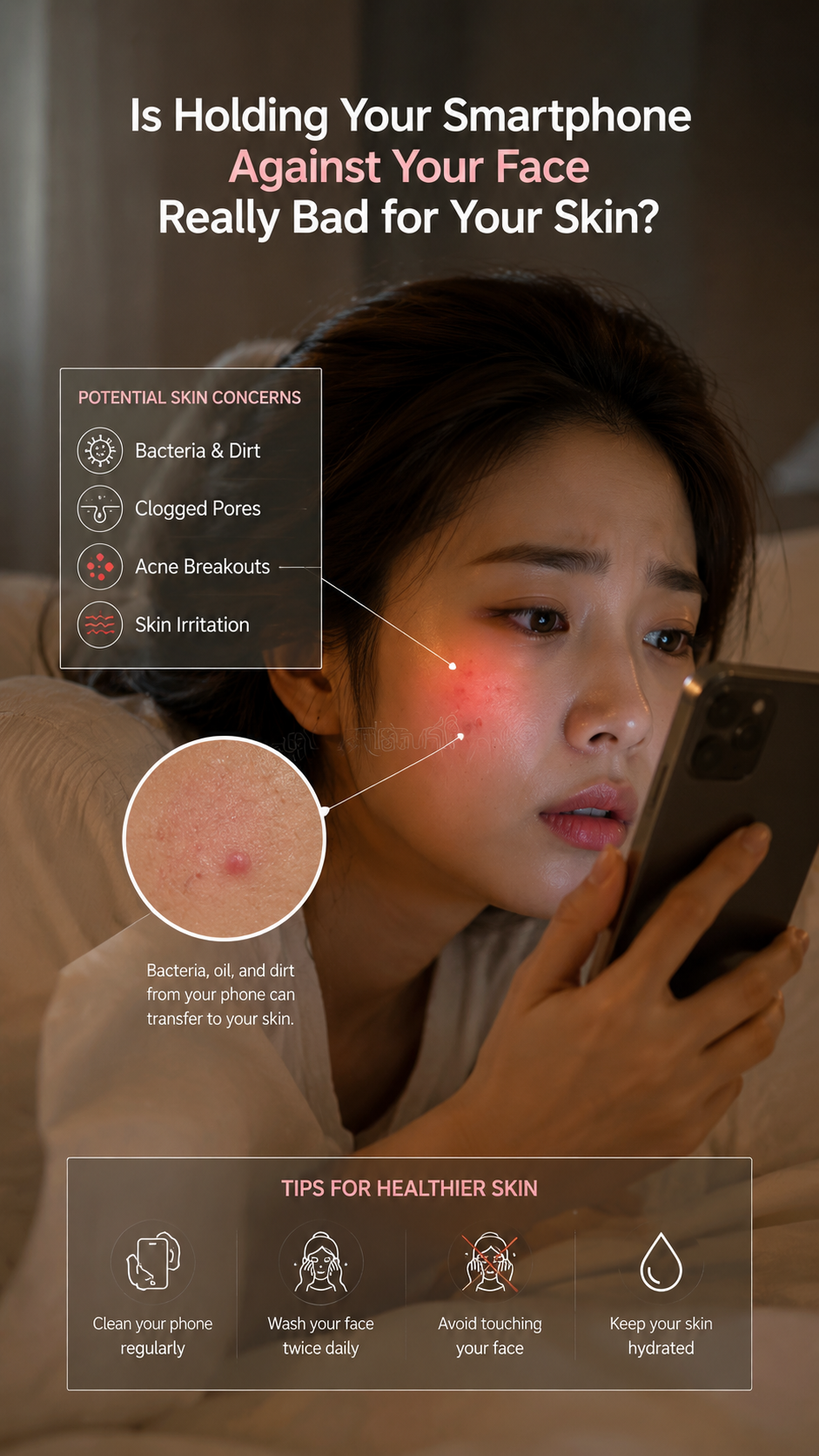
Is Holding Your Smartphone Against Your Face Really Bad for Your Skin?
Minjin Park
·
There are a few everyday things we do so often that we stop seeing them as “habits.”
Holding a phone against your cheek is one of them.
You answer a call, press the screen to your face, talk for ten minutes, then go on with your day. No big deal. It feels harmless. Compared to things like sleeping in makeup, skipping sunscreen, or picking at pimples, a phone call seems pretty innocent.
But if you keep getting breakouts on one cheek, or your jawline feels irritated after long calls, your phone might be quietly involved.
Not always. Not dramatically. Your smartphone is not some evil acne machine sitting in your pocket. But it can become a problem for your skin, especially if you press it against your face often, talk for long periods, sweat easily, or already have acne-prone or sensitive skin.
The annoying part is that it makes sense once you think about it.
Your phone goes everywhere with you. Your face probably should not be touching it that much.
Let’s be honest. Most of us clean our faces more carefully than we clean our phones.
We wash our face, apply skincare, maybe use sunscreen, maybe avoid touching our skin too much. Then we pick up a phone that has been on a desk, in a bag, near food, in our hands after touching door handles, or sitting in a pocket collecting lint and oil.
Then we press it directly onto our cheek.
Beautiful.
A phone screen can collect oil from your fingers, sweat, makeup, skincare residue, dust, and bacteria from surfaces. That does not mean every phone is dangerously dirty, and it does not mean one quick call will ruin your skin. Skin is not that helpless.
But repeated contact can transfer all that residue to your face. If your pores are already easily clogged, this can make breakouts more likely.
The biggest issue is not just “germs.” It is the mix of oil, pressure, friction, heat, and repeated contact.
That combination can irritate skin and create the perfect little environment for clogged pores.
Why One Cheek Might Break Out More Than the Other
Have you ever noticed breakouts showing up more on one side of your face?
It is one of those things people suddenly realize and then cannot stop thinking about. One cheek is mostly calm, and the other one seems to be having a personal crisis.
There are many possible reasons. You may sleep on one side more. Your pillowcase may be involved. Hair products may touch that area. You may rest your face in one hand. Or, yes, you may hold your phone against that cheek.
If you always use the same side for calls, that side gets more pressure and more contact. If you wear makeup or sunscreen, the phone can also press that product into the skin or move it around. Add a little sweat, and your skin may start complaining.
This does not mean your phone is the only cause. Skin rarely works that simply. Acne especially is usually a combination of hormones, oil production, bacteria, inflammation, skincare, stress, sleep, diet, and habits.
But your phone can be one piece of the puzzle.
And sometimes removing one small trigger makes a bigger difference than expected.
Pressure and Friction Matter Too
When people talk about phone-related breakouts, they usually focus on bacteria. But friction and pressure deserve just as much attention.
Pressing your phone against your cheek creates repeated rubbing. If you are walking while talking, moving your jaw, or adjusting the phone a lot, that rubbing increases. For some people, friction can lead to irritation, redness, or small bumps.
This is similar to what can happen with masks, tight collars, helmets, or anything else that repeatedly touches the same area of skin.
Your skin barrier likes consistency. It does not love being rubbed, heated, pressed, and exposed to oils over and over again.
If you already have sensitive skin, rosacea-prone skin, eczema, or a damaged skin barrier, phone contact may make your cheek feel warm, itchy, or irritated. It might not even look like classic acne. It may just look like redness, tiny bumps, or rough texture.
That is why the question is not only, “Is my phone dirty?”
It is also, “Is my phone physically irritating my skin?”
Heat and Sweat Can Make It Worse
Long phone calls can create warmth between the phone and your face. This is especially noticeable if your phone heats up, the weather is humid, or you are wearing sunscreen and makeup.
Warmth plus pressure plus sweat is not exactly skin’s dream environment.
Sweat itself is not “dirty,” but when it mixes with oil, skincare products, makeup, and friction, it can contribute to clogged pores or irritation. If you tend to break out after workouts, hot weather, or wearing masks, you may also be more likely to notice issues from phone contact.
This is why a quick two-minute call probably does not matter much.
But long calls where the phone is pressed against your cheek for half an hour? That is where some people start seeing a pattern.
What About Makeup and Sunscreen?
Makeup and sunscreen can make this habit more noticeable.
If you hold your phone to your face after applying foundation, cushion, powder, or sunscreen, some of that product transfers onto your phone screen. Then the screen touches your face again later. Then your fingers touch the screen. Then your fingers touch your face.
It becomes a little cycle of oil and product transfer.
This does not mean makeup or sunscreen is bad. Sunscreen is still important. Makeup is fine if your skin tolerates it. The problem is when product buildup sits on your phone and repeatedly gets pressed back onto your skin.
You might notice your phone screen looking cloudy or smudged after calls. That is not just visually annoying. It is also a reminder that something from your face is now on your phone, waiting for the next round.
A quick screen wipe can help more than people think.
Can Your Phone Cause Acne?
Your phone probably does not “cause acne” all by itself.
Acne is more complicated than that. Hormones, oil glands, dead skin cells, inflammation, bacteria, and genetics all play a role. So if someone says, “You have acne because your phone is dirty,” that is too simple and honestly a bit unfair.
But your phone can contribute to breakouts.
It may worsen existing acne, especially on the cheek or jawline. It can add oil and residue to the skin. It can create friction. It can trap heat. It can irritate already inflamed areas. And if you are touching your phone all day, then touching your face, it may indirectly affect your skin too.
So the better way to think about it is this:
Your phone may not be the root cause of your skin problems, but it can be a trigger that keeps making them harder to calm down.
That distinction matters.
Because you do not need to panic. You just need to adjust the habit.
The Jawline Area Is Especially Vulnerable
A lot of phone contact happens around the lower cheek and jawline. This area can already be prone to breakouts for many people, especially hormonal acne.
That makes it tricky.
If you are getting jawline acne, it may be hormonal. It may be related to stress, cycle changes, shaving, hair products, skincare, or other factors. But if you also hold your phone against that area every day, the phone may be making an already sensitive area more irritated.
This is why it helps to look for patterns rather than blame one thing immediately.
Ask yourself:
Do breakouts happen more on the side where I hold my phone?
Do they get worse after long calls?
Does my cheek feel warm or irritated after talking on the phone?
These small clues can tell you whether your phone is worth paying attention to.
How Often Should You Clean Your Phone?
You do not need to disinfect your phone every five minutes. That would be exhausting, and honestly, most people would quit after one day.
But wiping your phone screen once a day is a reasonable habit, especially if you use it constantly or hold it against your face.
Use a screen-safe wipe or a soft cloth slightly dampened with an appropriate cleaner. Avoid soaking your phone or using anything too harsh that could damage the screen coating. The goal is simple: remove oil, fingerprints, and residue.
Also, clean your phone case sometimes. People forget the case, but it touches hands, tables, bags, and random surfaces all day.
A dirty case with a clean screen still feels a little suspicious.
Use Earbuds or Speaker Mode When You Can
One of the easiest fixes is to avoid pressing the phone to your face in the first place.
Use earbuds, headphones, or speaker mode when possible. This is especially helpful for long calls. Even if you only do it at home, it reduces the amount of time your phone spends pressed against your skin.
Of course, speaker mode is not always practical. Nobody wants to hear your entire conversation in public, and earbuds are not always available.
But when you have the option, it is a good skin-friendly habit.
It also saves your makeup, if that matters to you. Nothing like finishing a call and seeing half your foundation stamped onto your phone screen.
Be Careful After Applying Skincare
Another small thing: try not to press your phone against your face right after applying skincare.
Fresh moisturizer, sunscreen, facial oil, or makeup can transfer easily. If your skincare has not fully settled, the phone can pick it up and move it around. This may make your skin feel greasy, clog-prone, or irritated depending on the products.
Give your skincare a little time to absorb before taking a long call with the phone against your face.
If you have no choice, use earbuds or keep the phone slightly away from direct skin contact.
Tiny habit, surprisingly useful.
Don’t Over-Wash Your Face Because of It
Here is where people sometimes go too far.
They realize their phone might be affecting their skin, then start washing their face aggressively or cleansing every time they take a call. Please do not do that.
Over-cleansing can strip the skin barrier, which can lead to dryness, irritation, more oiliness, or more breakouts. Skin that feels attacked will often act attacked.
Instead of washing your face constantly, focus on reducing the source of the issue.
Clean the phone. Use earbuds. Avoid long pressure against the same cheek. Wash your hands before touching your face or applying skincare. Keep your routine gentle.
Your face does not need punishment. It needs less irritation.
What If You Already Have Active Breakouts?
If you have active pimples on your cheek or jawline, try not to press your phone directly onto them. Pressure can make inflamed spots feel worse, and friction can increase redness.
A pimple patch can help if the breakout is in a place where your phone touches. It creates a small barrier and also stops you from touching or picking at the spot. I love a skincare product that works partly by preventing me from making bad decisions.
If the breakout is painful, cystic, or keeps returning in the same area, it may be worth seeing a dermatologist. Phone habits can worsen skin, but recurring deep acne usually needs more than just a cleaner screen.
Your Hands Are Part of the Phone Problem
Even if you never press your phone to your face, your phone still affects your skin through your hands.
You touch your phone constantly. Then you touch your face without thinking. Maybe you rub your eyes, scratch your chin, pick at a bump, or rest your cheek in your palm.
The phone becomes one more surface in the chain.
This is why “clean your phone” and “stop touching your face so much” often go together. Not in an obsessive way. Just in a practical, everyday way.
If your skin is acting up, try to notice how often your hands go from phone to face. Most people are surprised.
A little awareness can be humbling.
So, Is It Really Bad for Your Skin?
Holding your smartphone against your face is not the worst thing you can do to your skin.
But it is not completely harmless either.
If you do it often, especially during long calls, your phone can transfer oil, sweat, makeup, sunscreen, and bacteria to your skin. It can also create friction, pressure, and heat, which may worsen breakouts or irritation. For acne-prone or sensitive skin, that can be enough to make a noticeable difference.
The good news is that this is an easy habit to improve.
Wipe your phone screen regularly. Use earbuds or speaker mode for longer calls. Avoid pressing your phone into active breakouts. Let skincare settle before taking calls. Clean your phone case. And try to notice if one side of your face is getting more phone contact than the other.
You do not need to fear your phone.
Just maybe stop letting it cuddle your cheek all day.
Hi, I’m the creator and editor behind ZestyHabit. I research everyday safety, first aid, and practical wellness topics using official guidance and reliable public sources, then turn that information into clear, realistic steps for daily life.
My goal is to help readers make safer, better-informed choices at home and beyond.