What to Do If a Tire Blows Out at Highway Speed: A Step-by-Step Driving Guide
Minjin Park
·
Learn how to stay in control when a tire blows out at highway speed, why sudden braking is dangerous, and how to pull over safely after a blowout.
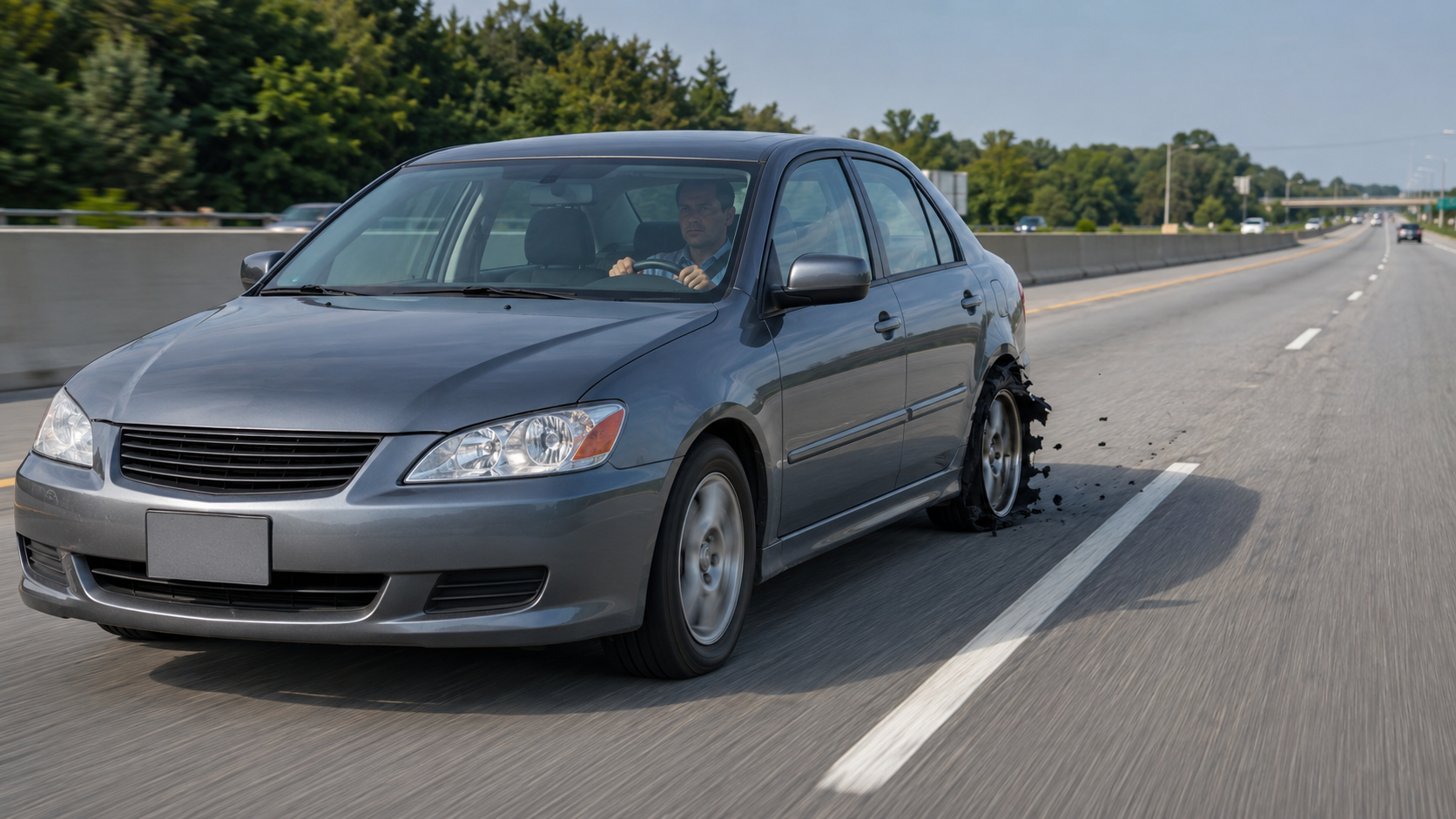
A tire blowout at highway speed is loud, sudden, and frightening. You may hear an explosive bang, feel the steering wheel pull sharply, or notice the rear of the vehicle beginning to wobble. Your first instinct may be to hit the brakes and steer immediately toward the shoulder.
Unfortunately, those instinctive reactions can make the situation more dangerous.
The safest response is to keep the vehicle balanced, maintain control, and reduce speed gradually. That means holding the steering wheel firmly, avoiding sudden braking, keeping the vehicle pointed in a safe direction, and moving off the road only after it has stabilized.
Knowing these steps before a blowout occurs can help you react more calmly when there is no time to search for instructions.
A tire blowout is a rapid loss of air pressure rather than an ordinary slow leak. It can happen after striking road debris or a pothole, but it may also result from underinflation, overloading, physical tire damage, excessive heat, or tire deterioration.
Wobbling or fishtailing from the rear of the vehicle.
Difficulty maintaining your lane.
A tire-pressure warning light, although it may appear too late to prevent the event.
The experience may differ depending on which tire fails. According to the National Highway Traffic Safety Administration, a front-tire blowout is usually felt more strongly through the steering wheel, while a rear-tire blowout is often felt through the seat or body of the vehicle.
The recommended response, however, remains essentially the same for either situation.
Step 1: Stay Calm and Keep Your Eyes on the Road
A loud blowout can make you jump, but avoid looking down at the dashboard or trying to see the damaged tire. Keep your eyes focused on the road and look toward the path you want the vehicle to follow.
Drivers naturally tend to steer toward whatever they are staring at. If you become fixated on a guardrail, median, or nearby vehicle, you may unintentionally move in that direction. Look ahead toward open pavement and a safe escape path.
Take a quick breath and remind yourself of the immediate priorities:
Hold the steering wheel.
Keep the vehicle stable.
Avoid sudden braking.
Slow down gradually.
Pull over only when it is safe.
You do not need to identify which tire failed while the vehicle is still moving. Stabilizing the car comes first.
Step 2: Hold the Steering Wheel Firmly With Both Hands
Place both hands securely on the steering wheel and resist the vehicle’s pull. Modern driving guidance generally recommends keeping the hands on opposite sides of the wheel, around the 9 and 3 o’clock positions.
Your grip should be firm, but avoid locking your arms or making exaggerated steering movements. A blown front tire may cause a strong pull toward the damaged side. A rear blowout may make the back of the vehicle feel loose or unstable.
Do not try to “fight” the car with a sudden countersteer. Make small, controlled corrections to keep the vehicle traveling as straight as conditions allow.
If the car moves partly out of its lane, do not jerk the wheel to bring it back instantly. A rapid correction can transfer weight abruptly and cause a spin, particularly if a rear tire has failed.
The goal during the first few seconds is not perfect lane position. The goal is to prevent a complete loss of control.
Step 3: Do Not Slam on the Brakes
Hard braking is one of the most dangerous reactions to a high-speed tire blowout.
With one tire damaged, the vehicle is already unbalanced. Slamming on the brakes shifts weight forward and may increase the pull toward the failed tire. It can also make a rear blowout more unstable, potentially causing the vehicle to rotate or fishtail.
Even a vehicle equipped with anti-lock brakes and electronic stability control can become difficult to manage when a tire has lost pressure or separated from the wheel. These safety systems are helpful, but they cannot restore the grip of a destroyed tire.
The NHTSA warns that overreacting—including suddenly braking or abruptly removing your foot from the accelerator—may lead to loss of control. Instead, maintain the vehicle’s balance until it becomes stable enough to slow safely.
Do not use the parking brake or shift into Park while moving. Do not turn off the engine because that may reduce power-steering assistance and make the vehicle harder to control.
Step 4: Avoid Abruptly Lifting Off the Accelerator
It may sound surprising, but you should not instantly lift your foot completely off the accelerator when the tire bursts.
Suddenly removing power can produce a rapid weight shift similar to sudden braking. Instead, keep the accelerator steady momentarily if necessary to maintain control. This does not mean speeding up aggressively. It means avoiding a dramatic change in speed during the most unstable moment.
Once the vehicle is traveling in a controlled direction, gradually reduce accelerator pressure. Allow aerodynamic drag, rolling resistance, and the damaged tire to slow the vehicle naturally.
Official NHTSA guidance recommends maintaining speed if possible and safe, followed by gradually releasing the accelerator. This brief period of steady speed can give you time to regain directional control before beginning to slow.
The exact timing depends on traffic, road conditions, and how the vehicle responds. If there is an immediate obstacle ahead, avoiding a collision takes priority. In most open-highway situations, however, a smooth release is safer than a sudden reaction.
Step 5: Make Small Steering Corrections
Keep looking in the direction you want to travel and correct the steering only as much as necessary.
Avoid sharp lane changes, even if the shoulder is nearby. Crossing lanes too quickly with a failed tire can upset the vehicle’s balance and place you in the path of other traffic.
If you are on a curve, follow the curve as smoothly as possible rather than trying to straighten the vehicle abruptly. In rain, snow, or ice, steering inputs should be even more gradual because the remaining tires have less available grip.
Drivers of SUVs, vans, pickup trucks, and vehicles carrying roof cargo should be especially careful. Higher centers of gravity and heavy loads can make sudden steering corrections more dangerous.
Do not assume you must reach the shoulder immediately. Remaining in your lane for several additional seconds while you regain control may be safer than swerving across traffic.
Step 6: Let the Vehicle Slow Gradually
After the vehicle has stabilized, continue easing off the accelerator. Maintain a straight, predictable path and monitor traffic using your mirrors.
You can activate the hazard warning lights when you are sufficiently stable to reach the control without compromising your grip on the wheel. If operating the switch would require you to look away or release the steering wheel during the initial instability, wait.
As your speed decreases, the vehicle should become easier to manage. However, the damaged tire may continue producing vibration, pulling, or loud flapping noises. Do not allow those sounds to pressure you into making a sudden move.
Avoid coasting all the way to a stop in an active travel lane unless the vehicle cannot be controlled or moved farther. Other drivers approaching at highway speed may not immediately realize how slowly you are traveling.
Signal your intention to pull over when appropriate and check carefully for vehicles beside you.
Step 7: Move Toward a Safe Stopping Area
Once you have reduced your speed and regained control, begin moving gradually toward the shoulder or another safe area.
Space that keeps the vehicle away from moving traffic.
If the nearest shoulder is extremely narrow, next to a concrete barrier, or located on a blind curve, it may be safer to continue slowly for a short distance to a wider area. Protecting the wheel from further damage is less important than avoiding a secondary collision.
Do not attempt to cross several lanes at once. Move one lane at a time only when traffic conditions allow. Continue using smooth steering inputs and avoid cutting in front of other vehicles.
When your speed is low and the vehicle is nearly stopped, apply the brakes gently. The California DMV’s blowout guidance similarly recommends stabilizing the vehicle, slowing gradually, and pulling off the road where and when it is safe.
Bring the vehicle completely out of the travel lane whenever possible.
Step 8: Secure the Vehicle After Stopping
Once stopped, shift into Park, apply the parking brake, and leave the hazard lights on. Take a moment to assess where you are before opening a door.
Highway shoulders are dangerous. Vehicles may pass only a few feet away, and distracted drivers sometimes drift out of their lanes.
If the vehicle is safely positioned on a wide shoulder, remaining inside with your seat belt fastened may be the safest choice while waiting for roadside assistance. Call the local emergency or highway-assistance number if the car is blocking traffic or stopped in an especially dangerous location.
If you must leave the vehicle and can do so safely, exit from the side farthest from traffic. Move behind a guardrail or well away from the roadway. Do not stand directly in front of or behind the disabled vehicle.
Situations involving smoke, flames, leaking fuel, or an immediate risk of being struck require a different response. Exit carefully, move a substantial distance from the vehicle and traffic, and call emergency services.
Should You Change the Tire Yourself?
Changing a tire beside a high-speed highway can be more dangerous than the blowout itself. Do not attempt it if the shoulder is narrow, the ground is unstable, visibility is poor, or any part of your body would be close to a traffic lane.
Call roadside assistance or highway patrol instead. Professional responders may use warning lights, traffic-control equipment, or towing procedures to reduce the danger.
If you are in a genuinely safe location and decide to install a spare tire, follow the vehicle manufacturer’s instructions. Confirm that the parking brake is applied and that the vehicle is on firm, level ground.
Temporary spare tires often have strict speed and distance limits. Read the warning printed on the spare or consult the owner’s manual. A temporary spare is meant to help you reach a repair facility, not to continue a long highway journey at normal speed.
The damaged tire should be inspected by a qualified professional. A blowout can also damage the wheel, suspension, brake components, wheel well, or nearby body panels.
Common Mistakes During a Highway Blowout
The following reactions can increase the chance of losing control:
Slamming on the brake pedal immediately.
Abruptly lifting completely off the accelerator.
Jerking the wheel toward the shoulder.
Staring at the obstacle you want to avoid.
Trying to cross several lanes at once.
Turning off the engine while still moving.
Using the parking brake at highway speed.
Stopping in an active traffic lane when the car can still move safely.
Getting out on the traffic side of the vehicle.
Attempting a tire change too close to moving vehicles.
Driving a long distance on the damaged tire.
Passengers can help by staying calm, fastening their seat belts, and avoiding sudden movements or shouted instructions. If necessary, a passenger can activate the hazard lights and call for help after the driver has stabilized the vehicle.
Can You Prevent a Tire Blowout?
Not every tire failure is preventable, but regular maintenance can reduce the risk significantly.
Check the pressure of all tires—including the spare—at least once a month and before long trips. Measure pressure when the tires are cold, meaning the vehicle has not been driven for at least three hours.
Use the recommended pressure listed on the driver’s doorjamb label or in the owner’s manual. The number molded onto the tire sidewall is generally the tire’s maximum pressure or load information, not necessarily the correct inflation pressure for your vehicle.
Inspect tires regularly for:
Cuts or cracks.
Bulges or bubbles.
Embedded objects.
Exposed cords.
Uneven tread wear.
Repeated loss of pressure.
Unusual vibration or noise.
Damage after hitting a pothole or curb.
Do not rely entirely on the tire-pressure monitoring system. NHTSA notes that TPMS warnings normally activate only after a tire has become significantly underinflated, so the system is not a substitute for manual pressure checks.
Follow the vehicle manufacturer’s tire-rotation schedule, observe load limits, and have alignment or balance problems corrected. Tires that are old may also require replacement even when they still have visible tread. Consult the tire and vehicle manufacturers’ recommendations or a qualified tire professional when evaluating tire age.
Remember the Safe Sequence
When a tire blows out at highway speed, the correct response is controlled rather than dramatic:
Grip the wheel, look ahead, maintain stability, release the accelerator gradually, steer smoothly, slow down, and pull over only when it is safe.
The noise and vibration may feel catastrophic, but many vehicles remain controllable when the driver avoids abrupt braking and steering. Preparing mentally for the correct sequence can make it easier to resist panic and follow the safest course of action.
Have you ever experienced a tire blowout or sudden flat while driving, and did the vehicle react the way you expected? Share your experience and the lesson you learned in the comments—your story may help another driver stay calm during a highway emergency.
Hi, I’m the creator and editor behind ZestyHabit. I research everyday safety, first aid, and practical wellness topics using official guidance and reliable public sources, then turn that information into clear, realistic steps for daily life.
My goal is to help readers make safer, better-informed choices at home and beyond.