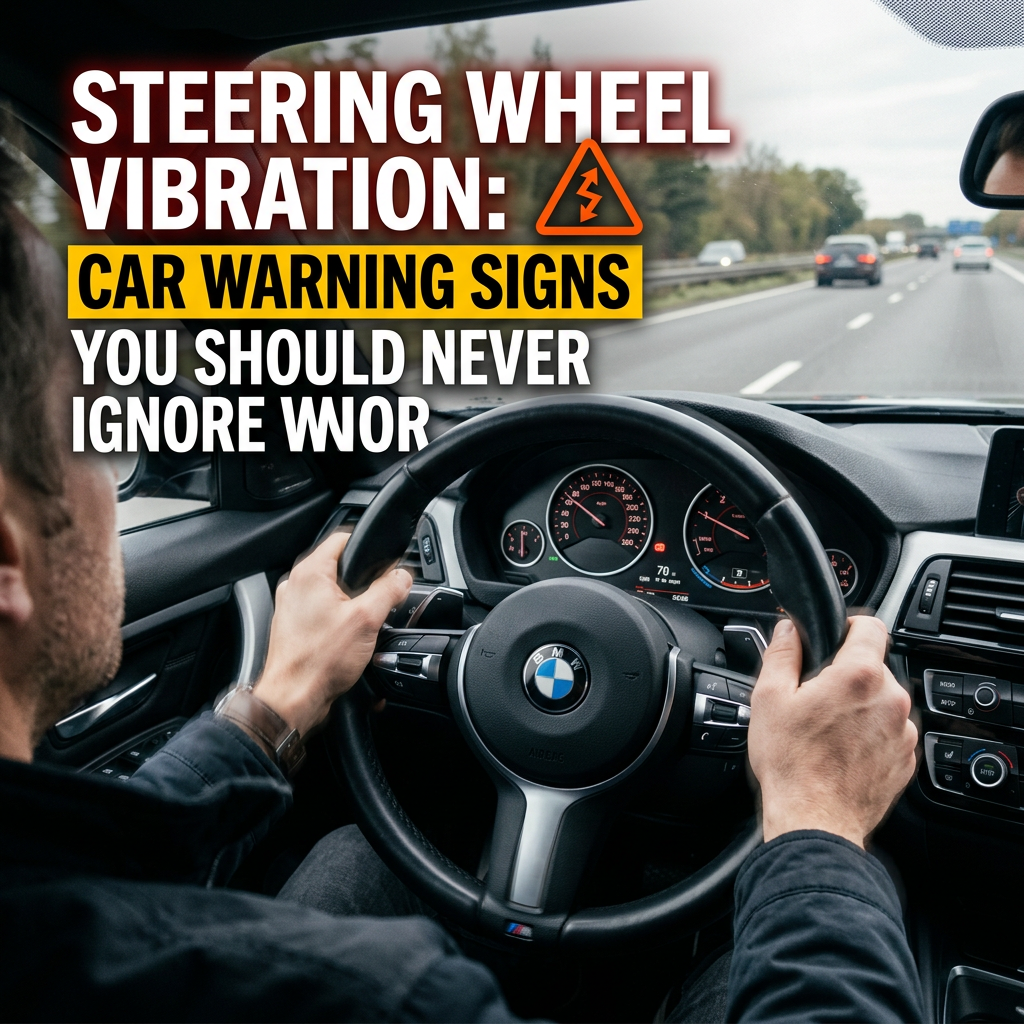
Steering Wheel Vibration: Car Warning Signs You Should Never Ignore
Minjin Park
·
Is your steering wheel shaking while driving or braking? Learn what steering wheel vibration may mean, when to stop driving, and how to prevent costly repairs.
A steering wheel should give you a clear sense of what the front tires are doing, but it should not constantly shake, pulse, wobble, or buzz in your hands. When a new vibration appears, it is easy to dismiss it as a rough road, an aging car, or a minor comfort issue. In reality, steering wheel vibration is often the first noticeable sign that something in the tires, wheels, brakes, suspension, steering, or drivetrain needs attention.
Some causes are relatively simple, such as a wheel that needs balancing. Others can become dangerous, including tire damage, loose wheel hardware, severely worn suspension components, or a developing brake problem. The timing of the vibration provides useful clues, but it cannot confirm the cause on its own.
The safest response is to pay attention to when the shaking occurs, reduce speed if the vehicle feels unstable, and arrange a professional inspection before a small problem becomes a loss-of-control risk or an expensive repair.
The steering wheel is connected to a system that includes the steering column, steering gear, linkages, suspension components, wheel hubs, wheels, and front tires. A vibration created at one of these points can travel through the structure of the vehicle until you feel it in your hands.
The most important diagnostic question is not simply, “Does the steering wheel shake?” It is, “Exactly when does it shake?”
Notice whether the vibration:
Appears only within a certain speed range
Gets stronger as the car accelerates
Happens mainly while braking
Occurs while turning
Is strongest at idle or low speed
Began after a pothole, curb strike, tire change, or repair
Is accompanied by pulling, noise, or unstable handling
Speed-specific vibration is frequently associated with the tire-and-wheel assemblies. A vibration felt mainly through the steering wheel often points technicians toward the front of the vehicle, while shaking felt through the seat or floor may originate farther back. However, these are clues rather than guaranteed diagnoses. Professional testing is still necessary.
Vibration at Highway Speed
If the steering wheel begins shaking around highway speed but feels relatively normal at lower speeds, wheel imbalance is one of the first possibilities to investigate.
A tire and wheel assembly must distribute its weight evenly as it rotates. When one section is heavier, the rotating assembly can create a repeating force that becomes more noticeable at particular speeds. Manufacturers describe wheel imbalance as uneven mass distribution that can generate vibration as rotational speed increases. Tire stiffness variation, improper inflation, wheel runout, and temporary tire flat-spotting can produce similar symptoms.
A balancing weight may have fallen off, a tire may have worn unevenly, or the wheel may not have been mounted correctly after service. The vehicle may feel smooth at city speed, begin shaking within a certain range, and then feel somewhat different again above that range.
Do not assume that the vibration is harmless because the car still travels in a straight line. Continued driving with an unbalanced or irregular tire-and-wheel assembly can contribute to uneven tread wear and place additional stress on steering and suspension parts. NHTSA recommends consulting a tire professional when tire-related noise, vibration, or pressure problems appear.
Vibration While Braking
A steering wheel that shakes mainly when the brake pedal is pressed deserves prompt attention. The problem may involve brake components, although tires, wheel mounting, or suspension wear can sometimes amplify the sensation.
Drivers often describe this symptom as a rhythmic pulsing or side-to-side movement that becomes stronger during braking from higher speeds. Brake rotor thickness variation, uneven rotor surfaces, heat-related damage, a sticking caliper, or irregular pad contact may be involved. Ford lists steering wheel vibration or shudder during braking among the signs that the brakes should be inspected.
Improper wheel installation can also affect how a wheel or brake rotor sits against the hub. Manufacturer service information notes that incorrect wheel-torquing procedures may create mounting variation, brake rotor distortion, and vibration that resembles a tire-balance problem.
Do not keep driving normally when braking vibration is accompanied by:
When stopping performance changes, treat the problem as more than a comfort issue. Slow down carefully, increase your following distance, and move to a safe location. If the brakes feel unreliable, have the car towed rather than driving it to a repair shop.
Vibration After Hitting a Pothole or Curb
A hard pothole impact can bend a wheel, damage a tire internally, disturb alignment, or strain steering and suspension components. The tire may still hold air and look acceptable from a distance, yet the steering wheel may begin shaking shortly afterward.
Park safely and inspect the affected wheel area without crawling under the vehicle. Look for:
A bulge or bubble in the tire sidewall
Cuts, exposed cords, or missing rubber
A visibly bent wheel rim
Rapid pressure loss
A tire that appears tilted
Fresh scraping or impact marks
Fluid leaking near the wheel
A wheel that seems out of position
A sidewall bulge can indicate internal structural damage. A tire may also develop tread separation, and unusual noise or vibration can be a warning sign of that condition. Certain tire recalls have specifically identified vibration as a possible sign of developing tread separation.
Do not attempt to “test” a visibly damaged tire at higher speed. Install the spare only when conditions are safe and you know how to do so correctly. Otherwise, call roadside assistance.
Could Incorrect Tire Pressure Cause Steering Wheel Vibration?
Incorrect inflation can contribute to poor handling, irregular wear, heat buildup, and tire-related vibration. However, checking pressure alone does not rule out tire damage or wheel imbalance.
Measure tire pressure when the tires are cold and use the pressure listed on the vehicle’s door placard or in the owner’s manual. Do not use the maximum pressure molded into the tire sidewall as the routine inflation target.
If one tire repeatedly loses pressure, the problem may involve a puncture, valve, wheel, bead seal, or structural damage. Adding air every few days without finding the leak is not a safe long-term solution.
NHTSA emphasizes routine pressure, tread, balance, and alignment checks and advises professional evaluation when a tire will not maintain pressure or produces unusual vibration or noise.
Wheel Alignment Versus Wheel Balance
Drivers often use “alignment” and “balance” interchangeably, but they describe different services.
Wheel balancing corrects uneven weight distribution within a rotating tire-and-wheel assembly. Alignment adjusts the angles at which the wheels point and contact the road.
An imbalance commonly produces speed-related vibration. Alignment problems more often cause the vehicle to pull, the steering wheel to sit off-center, or the tires to wear unevenly. However, a pothole impact or worn suspension component may create several symptoms at once, so a car can require both balancing and alignment work.
An alignment should be performed only after the steering and suspension components are checked. Aligning a vehicle with loose or damaged parts may fail to correct the underlying problem.
Worn Steering or Suspension Components
The front suspension must keep each tire controlled while allowing it to move over bumps and turn with the steering system. As ball joints, tie-rod ends, control-arm bushings, struts, shocks, or other components wear, the wheel may no longer remain as stable as intended.
Possible symptoms include:
Steering wheel vibration on rough roads
Clunking over bumps
Loose or wandering steering
Uneven or scalloped tire wear
A knocking sensation while turning
Delayed steering response
The vehicle drifting after minor road disturbances
Tire manufacturers note that cupped or scalloped tread can be associated with balance or suspension problems and that worn steering or suspension parts can contribute to handling changes and vibration.
These components cannot be accurately assessed simply by looking at the vehicle while it is parked. A technician may need to lift the car safely, check for movement at the wheels, inspect bushings and joints, and road-test the vehicle.
Loose Wheel Nuts Are an Urgent Possibility
A new vibration that begins soon after a tire rotation, brake repair, wheel replacement, or other wheel-related service should be investigated immediately.
Improperly tightened or loosening wheel nuts can produce creaking, rattling, grinding, or steering vibration. In a documented manufacturer service campaign, ignoring the condition could allow lug nuts to detach or wheel studs to fracture.
Do not continue driving to see whether the vibration disappears. Pull over safely and contact the service facility or roadside assistance. Wheel fasteners must be tightened to the vehicle manufacturer’s specification using the correct procedure and equipment. Guessing the torque or repeatedly tightening the nuts with excessive force can also cause damage.
Vibration During Acceleration
When shaking becomes stronger under acceleration and fades when the accelerator is released, the cause may extend beyond the tires.
Depending on the vehicle, technicians may investigate:
An inner CV joint or drive axle
A driveshaft or universal joint
Engine or transmission mounts
Engine misfire
A bent wheel or damaged tire that reacts differently under load
Loose or worn drivetrain components
A misfire may feel like a vibration through the steering wheel even though the steering system itself is not causing it. The check-engine light may illuminate or flash, and the engine may hesitate or lose power.
A flashing check-engine light generally calls for immediate attention because continued operation may cause additional damage. Reduce load on the engine, avoid hard acceleration, and arrange diagnosis as soon as it is safe.
Vibration at Idle or While Parked
If the steering wheel vibrates while the vehicle is stationary, wheel balance is unlikely to be the direct cause because the wheels are not rotating.
Possible sources include rough engine operation, worn engine mounts, an accessory problem, or normal vibration from certain engines. The air-conditioning compressor or electrical load can sometimes make a mild existing vibration more noticeable.
The key question is whether the sensation is normal for that vehicle or represents a clear change. New, severe, or worsening vibration—especially with warning lights, unusual noises, smoke, fuel odors, or loss of power—should be inspected.
Make Sure It Is Not a Driver-Assistance Alert
Some modern vehicles intentionally vibrate the steering wheel to warn the driver about an unintended lane departure. The sensation may resemble driving over a rumble strip and usually occurs briefly when the vehicle approaches a lane marking without the turn signal activated.
Check the dashboard and owner’s manual before assuming every brief vibration is mechanical. However, a continuous shake, speed-related wobble, braking vibration, or sensation accompanied by noise and poor handling should not be blamed on lane-keeping technology.
A malfunctioning or misunderstood driver-assistance feature also deserves attention if it activates unexpectedly or repeatedly under inappropriate conditions.
When Should You Stop Driving Immediately?
Not every mild vibration requires an emergency stop, but some combinations of symptoms indicate that continuing could be dangerous.
Reduce speed smoothly, turn on the hazard lights when appropriate, and pull over in a safe location when the vibration is:
Sudden and severe
Accompanied by tire thumping or flapping
Combined with strong pulling or steering difficulty
Present after a major pothole or curb impact
Accompanied by grinding, clunking, or metal-on-metal noise
Associated with a visibly damaged or deflated tire
Appearing shortly after wheel service
Combined with reduced braking ability
Causing the vehicle to wobble or feel unstable
Avoid sudden steering inputs or harsh braking unless necessary to prevent a collision. Hold the steering wheel with both hands, gradually release the accelerator, and move away from traffic.
After stopping, do not stand beside the vehicle in an active traffic lane. Move yourself and your passengers to a safer location when possible. Call roadside assistance or emergency services if the vehicle cannot be safely controlled.
How a Repair Shop Diagnoses Steering Wheel Vibration
A useful diagnosis begins with a detailed description. Tell the technician:
The speed at which the vibration begins
Whether it changes during braking or acceleration
Whether it is felt in the wheel, seat, floor, or entire vehicle
Whether the car pulls to one side
Whether the tires or brakes were recently serviced
Whether the car recently hit a pothole or curb
Whether the vibration is worse when the vehicle is cold
The technician may inspect tire pressure and condition, verify wheel-fastener torque, measure wheel runout, balance the tire-and-wheel assemblies, check radial force variation, inspect brakes, and test steering and suspension components. Service information from several manufacturers emphasizes a structured diagnostic process rather than repeatedly replacing parts or performing basic balancing without confirming the vibration source.
Avoid approving multiple repairs based only on guesses. Ask what was inspected, what measurements were taken, and what evidence identifies the recommended repair.
How to Prevent Steering Wheel Vibration
Check tire pressure at least monthly and before long trips. Inspect the tread and sidewalls for cuts, bulges, embedded objects, uneven wear, and exposed material.
Have the wheels balanced when new tires are installed and whenever speed-related vibration develops. Arrange an alignment inspection after a significant pothole impact, curb strike, or suspension repair, or when the vehicle pulls and the tires wear unevenly.
After wheel service, follow the vehicle or service provider’s guidance about rechecking wheel-fastener torque. Use the correct tire size and wheel specifications, and do not assume that inexpensive aftermarket parts will fit or perform like the original components.
Finally, do not normalize a vibration just because the car is old. Mechanical wear may develop gradually, but a familiar shake can still indicate a problem that is damaging the tires or reducing vehicle control.
Final Takeaway
Steering wheel vibration is a symptom, not a diagnosis. Shaking at highway speed often directs attention toward the tires and wheels, while vibration during braking may involve the braking system or wheel mounting. A sudden wobble after an impact, severe pulling, tire damage, grinding noises, or vibration after wheel service requires more urgent action. Pay attention to when the symptom appears, avoid driving aggressively, and have the vehicle inspected before the vibration becomes worse. A timely balance, tire replacement, brake repair, or suspension service is far less costly than losing control or allowing damaged components to affect other parts of the car.
Has your steering wheel ever started shaking unexpectedly? Tell us when the vibration occurred, what the repair shop found, and which repair finally solved it in the comments. Your experience could help another driver recognize an important warning sign before it becomes a roadside emergency.
Hi, I’m the creator and editor behind ZestyHabit. I research everyday safety, first aid, and practical wellness topics using official guidance and reliable public sources, then turn that information into clear, realistic steps for daily life.
My goal is to help readers make safer, better-informed choices at home and beyond.