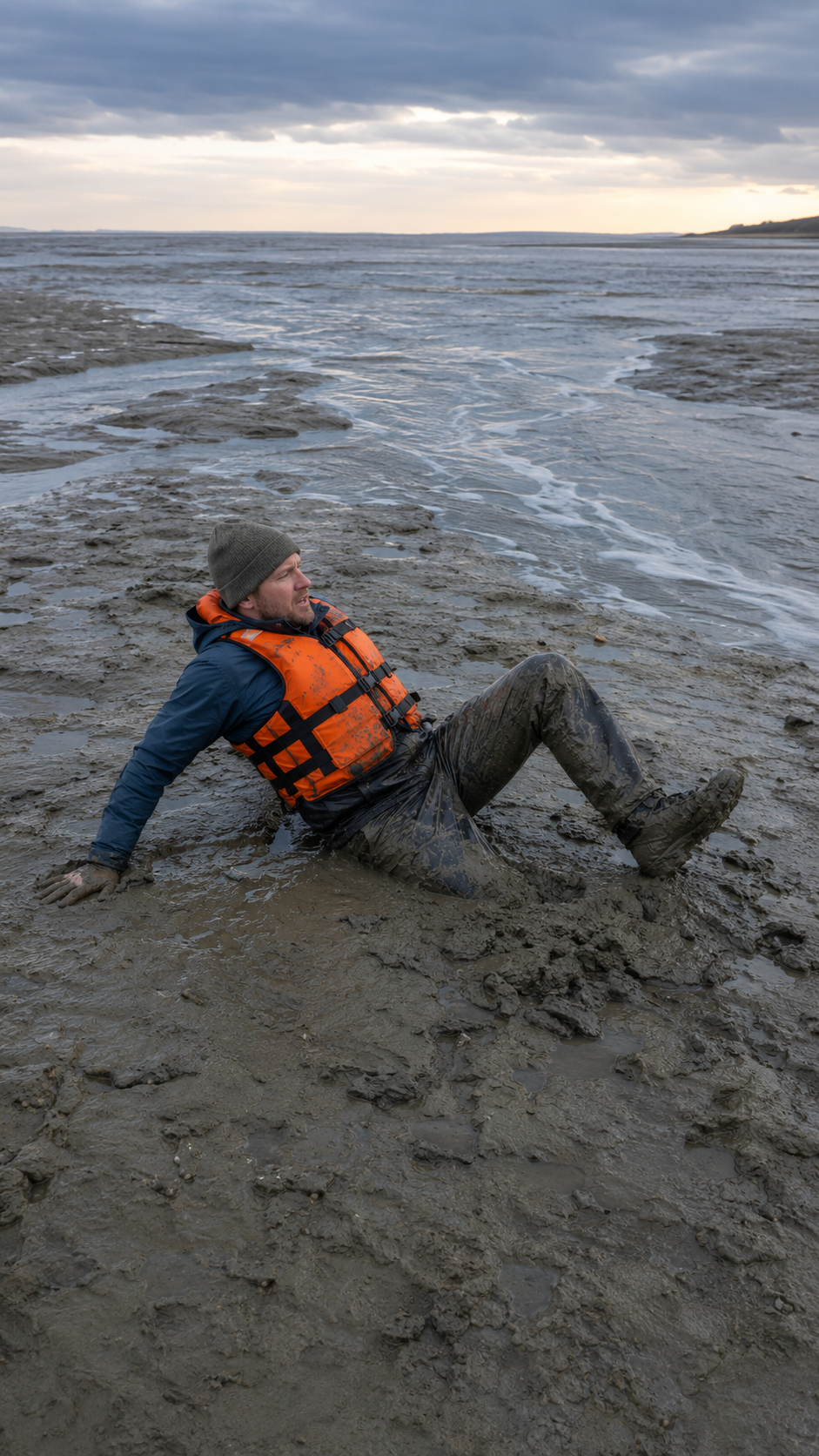
Stuck in a Mudflat? How to Escape Safely and Survive a Rising Tide
Minjin Park
·
A walk across a coastal mudflat can feel harmless at first. The surface may appear firm, the water may be far away, and the shoreline may remain clearly visible. Then one foot suddenly sinks. When you try to pull it free, the other foot goes deeper. Within seconds, ordinary mud can become a serious trap.
The greatest danger is not that the mud will “swallow” you like quicksand in a movie. The more realistic threats are exhaustion, falling face-first, cold exposure, injury from hidden objects, and an incoming tide that can cover a vast area surprisingly quickly.
If you become stuck in a mudflat, the safest response is to stop struggling, spread your weight, call emergency services early, and prevent other people from entering the mud to rescue you. Attempting a forceful escape can make you sink deeper and turn a manageable situation into a life-threatening emergency.
This guide explains what to do if your feet become trapped in a tidal mudflat, which self-rescue movements may help, when to stop moving, and how to prevent the situation in the first place.
Coastal mud is often made of fine sediment mixed with water. When a foot or boot sinks, the mud closes around it. Pulling straight upward requires you to overcome resistance from the surrounding mud while balancing on the other trapped leg.
The harder you struggle, the more the sediment may be disturbed. Your supporting foot can sink deeper, and frantic movement may create additional space for your legs to descend.
Footwear can also complicate the situation. Boots have a larger surface area than bare feet and may become tightly surrounded by mud. A loose boot might come off, while a tall or tightly fastened boot can make lifting the leg more difficult.
Mudflat conditions are not consistent. One step may land on firm sand, while the next enters soft sediment. A route that seemed safe earlier can also change after waves, rainfall, river flow, human activity, or a previous tide.
The Most Important Rule: Stop Struggling
The natural reaction is to pull harder, twist rapidly, or take a large step toward solid ground. These movements can transfer all your weight onto one leg and push it deeper.
As soon as you realize that your foot is not coming out normally:
Stop taking additional steps.
Keep your movements slow and controlled.
Breathe steadily and assess your position.
Determine whether the tide is coming in.
Call for help before the situation becomes worse.
Staying calm is not simply motivational advice. It reduces unnecessary movement, conserves energy, and helps you communicate clearly with rescuers.
The Royal National Lifeboat Institution advises people trapped in coastal mud to remain calm, avoid unnecessary movement, and spread their weight as evenly as possible. It also warns against allowing other people to attempt an untrained rescue because they may become trapped as well. This guidance is explained by the RNLI.
Step 1: Call Emergency Services Immediately
Do not wait until the water reaches you.
In the United States, call 911 and explain that you are trapped in a coastal mudflat or tidal area. The U.S. Coast Guard directs people needing emergency Coast Guard assistance to call 911 or use VHF-FM Channel 16 if they are on the water with a marine radio.
In the United Kingdom, call 999 or 112 and ask for the Coastguard. In other countries, call the local emergency or maritime rescue number.
Tell the dispatcher:
That you are stuck in mud
Your exact or approximate location
The name of the beach, bay, estuary, or nearby landmark
How deeply you are trapped
Whether the tide is rising
Whether you are injured
How many people are involved
What clothing or colors rescuers should look for
Your phone’s remaining battery level, if low
Use your phone’s map to provide coordinates or share your location when possible. Stay on the line and follow the dispatcher’s instructions. Put the phone on speaker if you need both hands for balance, but secure it so it does not fall into the mud.
Calling early gives rescuers more time to reach you before darkness, cold, or rising water creates a more dangerous situation.
Step 2: Spread Your Weight Across the Surface
If you remain upright with all your weight concentrated through your feet, you may continue to sink. Carefully spreading your weight over a larger area can reduce pressure on the mud.
If you can do so without falling forward, slowly sit back or lean backward. Extend your arms to improve balance and distribute your weight. Your goal is to create more contact with the surface rather than pushing downward through two narrow points.
Do not suddenly throw yourself backward. Check for rocks, shells, water, or other hazards behind you, and keep your face away from the mud. If you are already deeply trapped or feel unstable, remain as still as possible and wait for instructions from emergency responders.
The appropriate position depends on the depth and consistency of the mud. Advice from a dispatcher who understands your location should take priority over general online instructions.
Step 3: Retrace Your Steps—But Only If You Can Move Safely
The route behind you is usually more predictable than untested ground ahead. If you are only slightly stuck, no immediate tide threat exists, and you can move without sinking farther, try to return along your exact footprints.
Move slowly. Use small backward movements rather than turning around and stepping into a new area. Test whether the trapped foot can move gently before transferring your weight.
If the mud releases easily, continue retracing your route with short, deliberate steps. If resistance increases, your supporting leg begins to sink, or you lose balance, stop.
The RNLI recommends trying to retrace your steps when possible. However, its guidance also emphasizes spreading your weight, avoiding excessive movement, and waiting for trained rescuers when self-extraction is not working.
Do not keep experimenting with different directions. Mud that looks drier or darker is not necessarily firmer, and a nearby patch may be deeper than the area already holding you.
Step 4: Use Gentle Movement, Not a Powerful Upward Pull
If one foot is lightly trapped, a small, slow movement may allow water or loosened sediment to enter around the foot. This can sometimes reduce resistance.
Avoid pulling the leg vertically with maximum force. Instead, gently move the foot or heel within the limited range available while keeping your weight distributed. Stop if the movement causes pain, damages the ankle or knee, or pushes the other leg deeper.
Do not continue a self-rescue attempt if you are trapped near or above the knees. Deep mud can be extremely difficult to escape without specialized equipment.
Professional mud-rescue teams may use boards to spread their weight and tools that introduce water or air around a trapped limb. These techniques require training and should not be improvised by bystanders.
Step 5: Protect Yourself From the Incoming Tide
A mudflat is part of an intertidal area. Ground that is exposed at low tide may later be completely underwater.
The tide may also return through channels, behind sandbars, or from more than one direction. This can cut off your route to shore before water reaches your feet. Walking against moving water is far harder than crossing dry mud, especially when the current becomes stronger.
If the tide appears to be rising:
Tell the emergency dispatcher immediately.
Keep your upper body as high and stable as possible.
Follow instructions about positioning and flotation.
Do not waste energy on repeated forceful escape attempts.
Keep communicating with rescuers.
Make yourself visible with bright clothing, a flashlight, or controlled arm movements.
If safe, conserve your phone battery by reducing screen brightness while maintaining contact.
If you have a personal flotation device, keep it properly secured. Do not rely on an inflatable toy, empty bottle, or loose bag as dependable lifesaving equipment.
Never assume you have several hours because the tide has only just started coming in. Local geography, tidal range, wind, river flow, and narrow channels can dramatically affect how quickly an area becomes dangerous.
What Should a Companion or Bystander Do?
Watching someone struggle in mud creates a strong urge to run toward them. That reaction can produce a second casualty.
Unless you are a trained mud-rescue professional with appropriate equipment, stay on firm ground. Call emergency services and provide the trapped person’s location. Encourage them to remain calm and stop struggling.
A bystander can also:
Keep the trapped person in sight
Warn other visitors away from the area
Guide emergency crews toward the correct access point
Report changes in the tide or the person’s condition
Prepare dry clothing or blankets for after the rescue
Throw an approved flotation device if water is approaching and it can be done safely
Follow instructions given by the emergency dispatcher
Do not form a human chain across soft mud. Do not drive a regular vehicle onto the mudflat. Do not tie a rope around the person and pull forcefully without professional direction. These actions can injure the casualty or trap additional people.
A Real Mudflat Rescue in Alaska
In May 2023, a fisherman became trapped up to his waist near the mouth of Alaska’s Twentymile River. People at the scene reportedly tried to free him for about an hour before calling 911.
Girdwood Fire and Rescue responded with specialized mud-rescue equipment and freed the fisherman within approximately 14 minutes. The department’s deputy chief emphasized that getting out becomes extremely difficult once a person is trapped deeper than the knee and urged people to call firefighters immediately.
The fisherman was not injured, but the incident demonstrates why early emergency contact matters. Waiting while untrained helpers attempt an extraction can use up valuable time, especially on a tidal flat. The details of the rescue were reported by Alaska Public Media.
A separate RNLI rescue in March 2026 involved two people who had reportedly been stuck for up to 90 minutes. Both were suffering from mild hypothermia when rescued. The RNLI again stressed checking tide times and calling for help as soon as trouble begins. The RNLI published an account of that rescue.
What Not to Do When Trapped in a Mudflat
Several common reactions can make the situation worse:
Do not continue walking forward
Untested ground may be softer or deeper. If movement is possible, retrace the route you already used.
Do not repeatedly yank your legs upward
Forceful pulling can exhaust you, injure a joint, or push the supporting leg deeper.
Do not crawl face-down
Spreading your weight may help, but your face and airway must remain clear of mud and water.
Do not wait to call for help
Your phone may lose signal or battery power, and the tide may reduce the available rescue time.
Do not let friends enter the same mud
Untrained companions can quickly become trapped, leaving nobody on firm ground to summon help.
Do not risk your life to save a shoe or bag
Equipment can be replaced. If an item interferes with safety, follow the emergency dispatcher’s instructions about releasing or abandoning it.
Do not assume low tide means the entire area is safe
Mud depth, channels, and sediment consistency can vary within a few feet.
How to Prevent Becoming Trapped
Mudflat emergencies are much easier to prevent than to escape.
If warning signs say not to enter, stay off the mudflat entirely. No footwear, walking pole, or phone app can make a prohibited or highly unstable area safe.
After the Rescue
Once you reach firm ground, do not assume the danger has passed. Check for cuts, puncture wounds, ankle or knee pain, numbness, dizziness, and signs of cold stress.
Remove wet clothing and replace it with dry layers. Warm the center of the body gradually and seek medical help for persistent shivering, confusion, slurred speech, extreme tiredness, poor coordination, or loss of consciousness. The CDC considers hypothermia a medical emergency and recommends moving the person into shelter, removing wet clothing, warming the chest, neck, head, and groin, and obtaining medical attention.
Wash cuts with clean running water when available and have significant wounds assessed, particularly if they were exposed to seawater, contaminated sediment, or sharp shells. Anyone who was deeply trapped, immersed in cold water, injured during extraction, or unable to walk normally should be evaluated by a healthcare professional.
The Safest Escape Begins With an Early Call
If your feet become stuck in a mudflat, stop struggling, remain calm, call emergency services, and spread your weight. Retrace your steps only when the mud is shallow, movement remains easy, and doing so does not cause you to sink farther. If you are trapped deeply or the tide is returning, conserve energy and wait for trained rescuers rather than allowing friends to create a second emergency.
Have you ever felt your boots sinking during a mudflat walk, shellfish trip, or coastal hike? What safety preparation do you think visitors are most likely to forget? Share your experience or questions in the comments so other readers can explore tidal areas more safely.
Hi, I’m the creator and editor behind ZestyHabit. I research everyday safety, first aid, and practical wellness topics using official guidance and reliable public sources, then turn that information into clear, realistic steps for daily life.
My goal is to help readers make safer, better-informed choices at home and beyond.