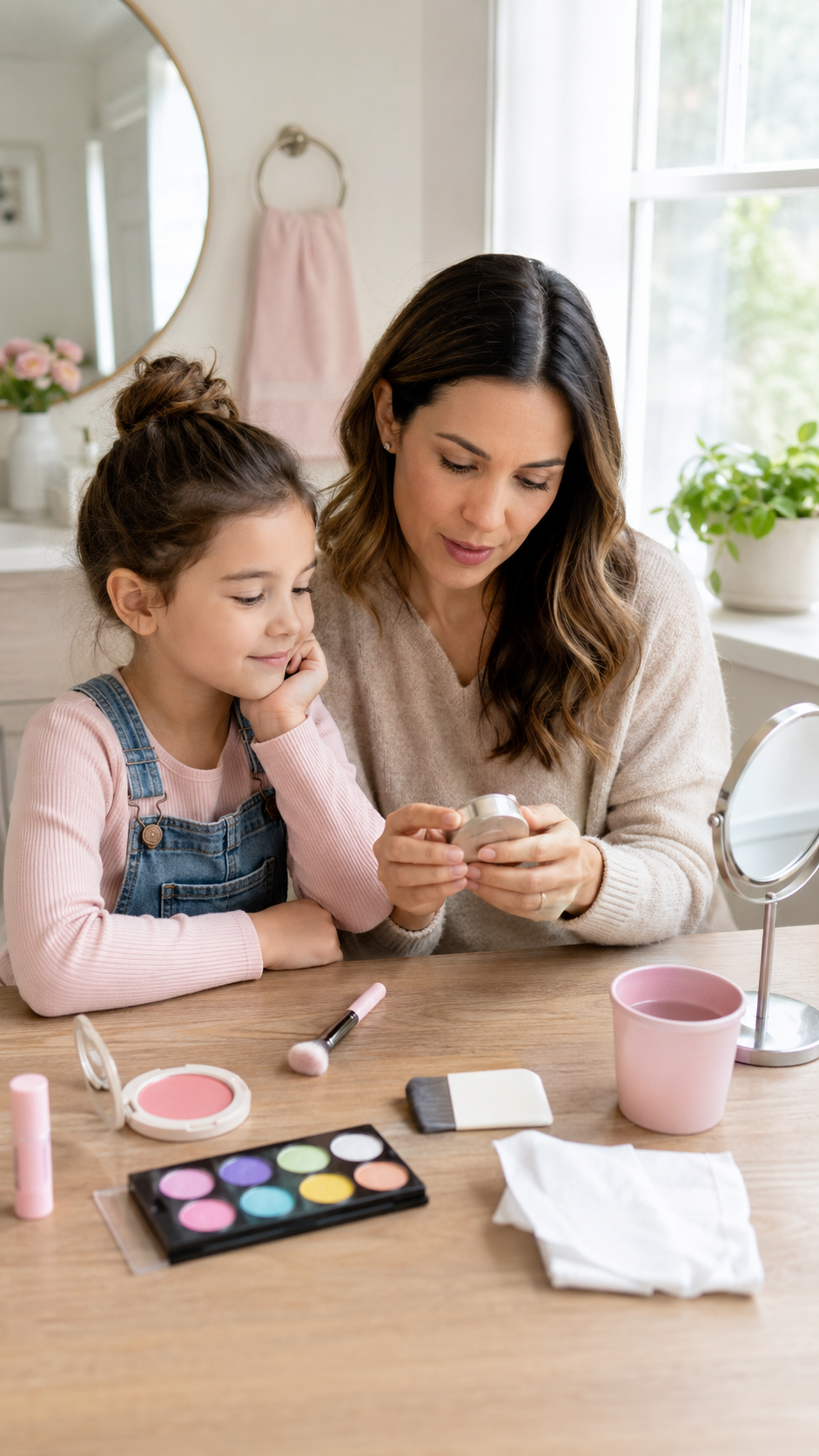
Children’s Makeup Safety: Hidden Risks and Essential Rules Every Parent Should Know
Minjin Park
·
A sparkly eyeshadow palette or brightly colored lipstick can look like harmless fun to a child. Makeup often becomes part of imaginative play, birthday parties, dance performances, Halloween costumes, or a young person’s growing interest in personal style.
Most children will use makeup without experiencing a serious problem, especially when an adult selects an appropriate product and supervises its use. However, “made for kids,” “natural,” and “hypoallergenic” do not automatically mean that a cosmetic is risk-free. Children’s makeup can cause skin reactions, eye irritation, infections, accidental ingestion, and injuries from applicators. Poorly labeled or contaminated products may present additional concerns.
The goal does not have to be banning makeup altogether. Parents can treat it like any other personal-care product: choose carefully, use it hygienically, and know what to do if something goes wrong.
There is no simple yes-or-no answer. Safety depends on the product, its ingredients, the area where it is applied, how long it remains on the skin, and whether it is used according to its directions.
In the United States, cosmetic products and most cosmetic ingredients do not need FDA approval before reaching store shelves. Color additives are an important exception. Manufacturers are legally responsible for ensuring that their products are safe and properly labeled, while the FDA monitors complaints, inspections, imports, and recalls. This means parents should not interpret a product’s presence in a store or online marketplace as proof that the FDA personally tested and approved it. The FDA’s cosmetic safety guidance also notes that terms such as “hypoallergenic” are not formally defined by the agency.
A well-made cosmetic used occasionally and correctly may carry relatively little risk. Trouble is more likely when children share products, use adult cosmetics near their eyes, sleep in makeup, apply craft supplies to their faces, or play with cosmetics without supervision.
1. Allergic Reactions and Skin Irritation
Fragrances, preservatives, dyes, adhesives, and other cosmetic ingredients can trigger irritation or allergic contact dermatitis. Symptoms may include:
Redness
Itching
Burning or stinging
Dry, flaky skin
Small bumps or blisters
Swelling, particularly around the eyelids
A reaction does not necessarily mean that a product contains a “toxic chemical.” Even an ingredient considered safe for most people can cause a reaction in someone who is sensitive to it. Likewise, a plant-derived or “natural” ingredient can still be irritating or allergenic.
Children with eczema, very sensitive skin, known allergies, or a previous reaction to cosmetics may be more vulnerable. Makeup should never be applied over an active rash, sunburn, broken skin, or an infected area.
Before applying a new face paint or cosmetic to a large area, place a small amount on the child’s inner arm and observe the area over the next couple of days. The FDA specifically recommends this precaution for unfamiliar face paints, especially for people who tend to have allergies. A patch test cannot guarantee that a reaction will not occur, but it may reveal an obvious sensitivity before the product covers the child’s face.
2. Eye Irritation, Infection, and Applicator Injuries
The eye area deserves extra caution. Mascara, eyeliner, glitter, face paint, and eyeshadow may enter the eye and cause redness, tearing, burning, or pain. An applicator can also scratch the cornea if a child moves unexpectedly while makeup is being applied.
Contaminated eye cosmetics create another risk. Bacteria and fungi can enter a product through hands, brushes, saliva, water, or repeated use. According to the FDA’s eye cosmetic safety advice, eye infections linked to contaminated cosmetics have, in rare cases, caused temporary or permanent loss of vision.
Children should never apply mascara or eyeliner while walking, riding in a moving car, or playing. Parents should also avoid placing products close to the eye unless the label specifically says they are intended for that area. A color approved for the lips, hair, or nails is not necessarily permitted around the eyes.
Makeup should not be applied to a child who already has an eye infection, swollen eyelids, or inflamed skin around the eyes. Products used shortly before or during an eye infection should be discarded rather than saved for later.
3. The Risks of Sharing Makeup
Sharing may be encouraged in many childhood activities, but makeup should be an exception. Lip products, mascara, eyeliner, brushes, and sponges can transfer saliva, skin oils, bacteria, fungi, and viruses from one person to another.
The same concern applies to testers at beauty stores and shared makeup at parties or school performances. If a product must be used on several children, each child should have a clean, single-use applicator. Double-dipping a disposable wand into a mascara tube defeats its purpose.
Each child should ideally have a small personal set with their own labeled brushes or applicators. Brushes should be cleaned regularly and allowed to dry completely before being stored.
4. Contamination and Expired Products
Cosmetics do not remain fresh forever. Moisture, heat, dirty fingers, and repeated opening can weaken the product’s preservative system or introduce microorganisms.
The FDA explains that cosmetics can become harmful if contaminated with pathogenic bacteria or fungi. Warning signs may include:
An unusual or unpleasant smell
Separation that does not disappear when mixed
A noticeable color or texture change
Visible mold or foreign material
A dried-out formula
Damaged or leaking packaging
U.S. law does not require every cosmetic to display an expiration date. Parents can write the opening date on the container and follow any period-after-opening symbol or manufacturer instructions. Mascara deserves especially frequent replacement; the FDA notes that manufacturers commonly recommend discarding it two to four months after purchase.
Never add water or saliva to dried makeup. Water can introduce microorganisms and dilute preservatives, while saliva carries bacteria from the mouth. If a product has dried out, it is time to throw it away.
5. Accidental Swallowing and Inhalation
Young children explore with their mouths. A colorful lip gloss, scented spray, or glittery bottle can easily be mistaken for candy or a drink.
A small taste of ordinary lipstick or powder is often minimally toxic, but symptoms and risks vary by product. Swallowing larger quantities may cause nausea, vomiting, diarrhea, or abdominal discomfort. Loose powders can also irritate the airways if a child inhales them. Poison Control warns that inhaling talc-based cosmetic powder may result in more serious lung problems, even though swallowing a small amount is usually minimally toxic.
Some related beauty products pose greater risks than ordinary makeup. Perfume frequently contains alcohol, which can produce dangerous effects in children when swallowed. Nail products, removers, essential oils, eyelash adhesives, and concentrated makeup removers also require careful storage.
Keep cosmetics in their original containers and store them out of young children’s sight and reach. Do not transfer remover, perfume, or another liquid cosmetic into a food or beverage container.
6. Craft Paint and Glitter Are Not Makeup
One of the simplest safety rules is also one of the most important: only put products on the skin that are intended for cosmetic use.
Washable craft paint, markers, metallic powder, school glue, and craft glitter may seem suitable for a costume, but “washable” does not mean “safe for the face.” These products may contain pigments, particles, solvents, or adhesives that were not designed for prolonged skin contact or use near the eyes and mouth.
Cosmetic glitter is generally made and cut differently from craft glitter, but it still should not be placed near a child’s eyes unless the product is specifically labeled for that use. Never assume that a picture on the front of a package overrides the warnings or instructions on the back.
The FDA’s novelty makeup guidance advises consumers to check both the ingredient list and the approved uses of color additives. Some colors permitted on the skin are not permitted around the eyes.
7. Unlabeled and Counterfeit Cosmetics
Very inexpensive cosmetics from unknown online sellers may be tempting, especially when the packaging features favorite characters or resembles a toy. However, products without a full ingredient list, manufacturer information, lot number, or clear directions are difficult to evaluate or trace.
Avoid cosmetics that:
Arrive without a seal when one would normally be expected
Have misspelled or incomplete labels
Make vague claims such as “100% chemical-free”
Lack a manufacturer or distributor contact
Have no warnings or usage instructions
Smell unusually strong or unpleasant
Appear to imitate a well-known brand at an unrealistic price
Check current FDA recall notices before using an unfamiliar product, particularly one purchased long ago or through a third-party marketplace.
A Real Recall Involving Makeup Marketed to Young Consumers
In March 2019, Claire’s voluntarily recalled three makeup products—an eyeshadow, compact powder, and contour palette—after FDA testing indicated the possible presence of asbestos fibers in samples from one lot of each product. The affected products had been sold nationwide between October 2016 and March 2019.
The company stated at the time that it was not aware of any injuries or illnesses associated with the recalled products. The recall was later completed and terminated, but the incident remains a useful reminder: colorful packaging and a child-focused retail setting cannot replace ingredient oversight, lot tracking, or attention to recalls. Details remain available in the official FDA recall notice.
The FDA also reports that certain face paints were recalled in 2005 and 2009 after users developed problems such as rashes, itching, irritation, and minor swelling. These documented events do not mean that all face paint is unsafe. They show why parents should watch for reactions even when a product appears suitable for children.
12 Practical Safety Rules for Children’s Makeup
Parents can make occasional makeup play significantly safer by following a few consistent rules:
Choose cosmetics, not toys or craft supplies. Use products specifically intended for application to human skin.
Read the entire label. Check the ingredient list, age recommendations, warnings, directions, and approved application areas.
Buy from a traceable seller. Choose products with clear manufacturer details, intact packaging, and identifiable lot information.
Start with a patch test. Test unfamiliar products on a small area of the arm before applying them to the face.
Supervise young children. Do not leave toddlers or preschoolers alone with an open makeup kit.
Keep makeup away from broken or irritated skin. Wait until rashes, cuts, infections, and sunburn have healed.
Use extra caution around the eyes. Avoid eye makeup for children who cannot remain still, and never use a lip or craft product as eyeliner.
Do not share products or applicators. Give each child clean brushes, sponges, and lip products.
Wash hands and tools. Clean hands before application and wash reusable tools according to their care instructions.
Keep the session short. Occasional dress-up is different from leaving a heavy layer of face paint on all day.
Remove everything before bed. Follow the product’s removal directions and clean the skin gently without aggressive scrubbing.
Store products securely. Keep cosmetics, removers, perfume, nail products, adhesives, and sprays out of young children’s reach.
What to Do If a Child Has a Reaction
If makeup causes redness, itching, burning, or swelling, remove it promptly and gently wash the area. Stop using the product and keep its package, ingredient list, and lot number in case a healthcare professional needs that information.
Seek emergency help if the child develops trouble breathing, facial or tongue swelling, faintness, or another sign of a severe allergic reaction.
If makeup gets into the eye, remove contact lenses if present and rinse the eye with plenty of room-temperature water for 15 to 20 minutes. Do not let the child rub the eye. Persistent pain, light sensitivity, blurred vision, significant swelling, or an injury from an applicator requires prompt medical evaluation.
If a cosmetic is swallowed, do not induce vomiting. In the United States, use the online tool at Poison Control or call 1-800-222-1222 for product-specific guidance. Call emergency services immediately if the child collapses, has a seizure, cannot breathe normally, or cannot be awakened.
Makeup Can Be Fun Without Becoming a Free-for-All
For many children, makeup is simply another form of creative play. A little face paint can complete a costume, while a small amount of lip color may make a dance performance feel special. Parents do not need to create fear around cosmetics, but they should set boundaries that match the child’s age and ability to follow directions.
A preschooler may only need an occasional, supervised face-painting session. An older child can begin learning to read labels, keep personal products clean, and recognize when something should be discarded. These habits teach more than makeup safety—they help children become thoughtful consumers who understand that attractive packaging does not tell the whole story.
Has your child ever experienced irritation from makeup or face paint, and which safety rule do you think other parents are most likely to overlook? Share your experience or practical tips in the comments so other families can enjoy creative makeup play more safely.
Hi, I’m the creator and editor behind ZestyHabit. I research everyday safety, first aid, and practical wellness topics using official guidance and reliable public sources, then turn that information into clear, realistic steps for daily life.
My goal is to help readers make safer, better-informed choices at home and beyond.