Dangerous Birthday Party Supplies: Hidden Hazards and Essential Safety Tips for Parents
Minjin Park
·
Birthday parties are supposed to be filled with laughter, cake, colorful decorations, and happy memories. Unfortunately, some of the most common birthday party supplies can also create unexpected safety hazards—especially when babies, toddlers, and young children are present.
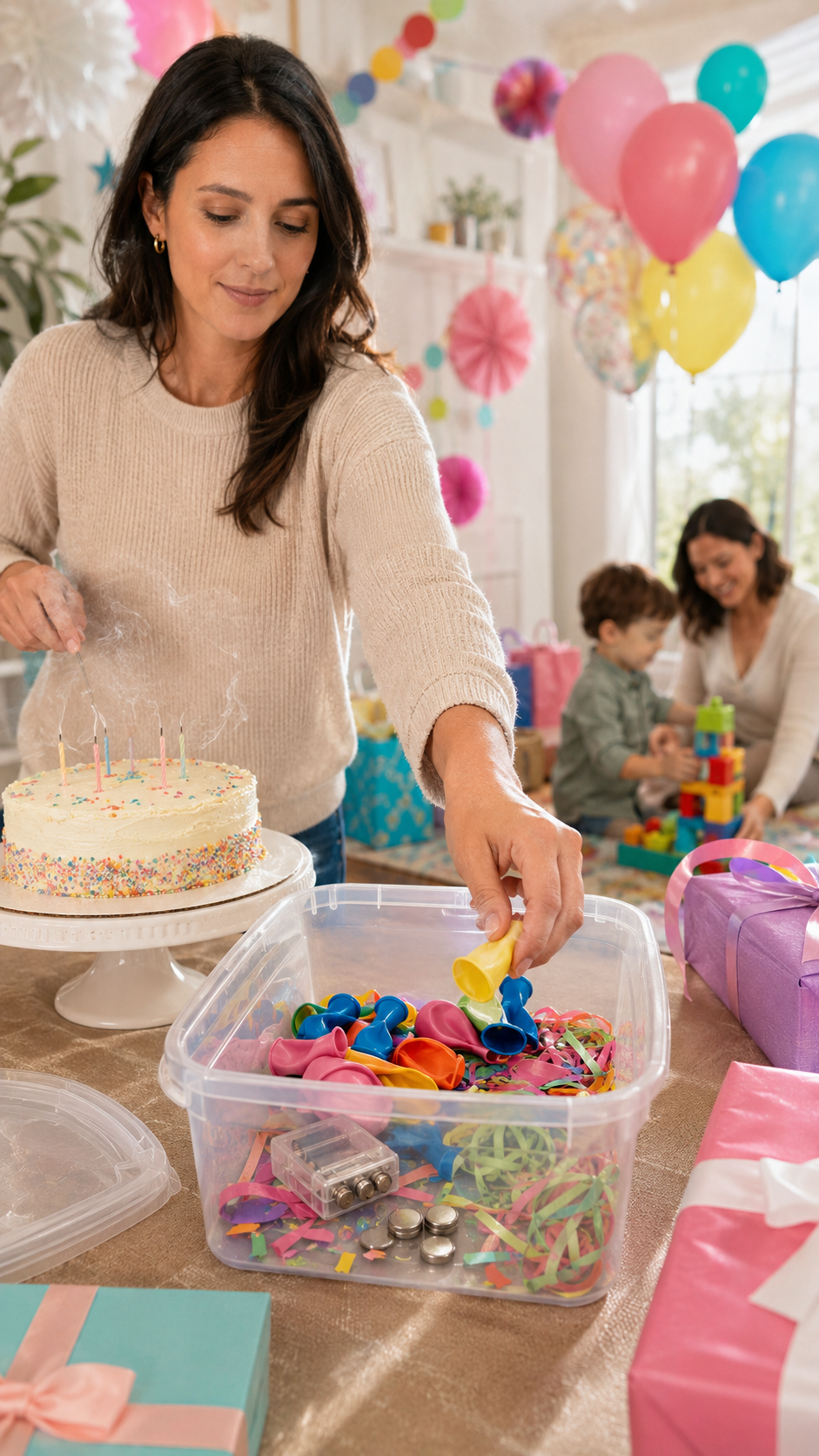
Balloons can become choking hazards, light-up party favors may contain button batteries, and candles can ignite nearby decorations. Even products that appear harmless, such as water beads, confetti poppers, and glow sticks, require careful supervision.
The good news is that parents do not need to remove every decoration or activity from a child’s birthday party. Most accidents can be prevented by selecting age-appropriate products, checking them before use, supervising children closely, and cleaning up damaged supplies immediately.
Balloons are among the most recognizable birthday decorations, but they are also one of the most serious party-related choking hazards.
An uninflated latex balloon can conform to a child’s airway if swallowed or inhaled. Unlike many solid objects, soft latex may be difficult to remove because it can completely block airflow. Pieces left behind after a balloon pops can create the same danger.
During the party, ask one adult to monitor the floor for popped balloons. Do not allow children to chew balloons, suck helium from them, or place balloon pieces in their mouths. Young children should never be left alone in a room filled with loose balloons.
Foil balloons are not free from risk, either. Large pieces can cover a young child’s nose and mouth, while ribbons may become wrapped around the neck. Keep all balloons away from sleeping infants and never place them inside a crib, playpen, or child’s bed.
For parties with many toddlers, consider paper decorations, fabric banners, or cardboard cutouts instead of clusters of loose latex balloons.
2. Light-Up Party Favors With Button Batteries
Flashing rings, glowing glasses, LED finger lights, light-up headbands, and electronic wands are popular birthday party favors. Many of these inexpensive products are powered by button cell or coin batteries.
If the battery compartment opens easily, a child may remove and swallow the battery. A swallowed button battery can cause devastating internal injuries, including chemical burns, in a very short time.
Before handing out any electronic party favor, inspect it carefully. Pull gently on the battery cover and check for missing screws, cracks, or loose components. Do not use a product if the compartment can be opened by hand.
Recent CPSC recalls have included LED party favors and finger lights with batteries that children could easily access. This is a useful reminder that a product being sold online does not automatically mean it meets every safety requirement.
If you believe a child has swallowed or inserted a battery into the nose or ear, seek emergency medical help immediately. Do not wait for symptoms to appear, and do not make the child vomit unless a medical professional specifically directs you to do so.
3. Small Toys, Favors, Magnets, and Decorative Pieces
Party favor bags often contain whistles, spinning tops, miniature erasers, marbles, bouncy balls, plastic jewelry, toy gems, and other small objects. These items may be suitable for older children but dangerous for babies and toddlers.
This is especially important at mixed-age birthday parties. A toy intended for a seven-year-old may end up on the floor where a younger sibling can reach it. Create separate favor bags for different age groups and avoid giving small toys to children under three.
Small, powerful magnets deserve additional caution. If multiple magnets are swallowed, they may attract each other through internal tissue and cause serious injury. Avoid magnetic party favors when young children are present, and discard any toy that begins releasing its magnets.
Cake decorations can create similar problems. Remove small plastic toppers, picks, toothpicks, candles, and skewers before serving cake to children. Do not assume guests will notice a clear plastic decoration hidden in frosting.
4. Birthday Candles and Flammable Decorations
Lighting candles for the birthday song is a familiar tradition, but it brings an open flame into a crowded space where children may be leaning across a table.
Hair, loose sleeves, paper crowns, plastic tablecloths, tissue-paper pom-poms, banners, and artificial flowers can all get too close to the flame. Children may also reach for candles before they have cooled.
Place the cake on a stable, uncluttered surface before lighting the candles. Keep the cake away from hanging decorations and ask children to remain on the opposite side of the table until an adult says it is safe to approach.
Light the candles shortly before the song and extinguish them immediately afterward. Check every wick instead of assuming that one strong breath put them all out. Allow the candles and melted wax to cool before removing them.
For very young children, consider a flameless candle or a candle placed on a separate cupcake controlled by an adult. You can preserve the tradition and the photo opportunity without placing an open flame directly in front of an excited toddler.
5. Sparklers, Fireworks, and Flame-Producing Cake Decorations
Sparklers are sometimes treated as a harmless alternative to fireworks, but they burn hot enough to cause serious injuries. They may ignite clothing, burn skin, or injure someone’s eyes when waved in a crowded area.
According to the CPSC’s fireworks safety guidance, sparklers burn at approximately 2,000 degrees Fahrenheit. The agency advises never allowing young children to play with or ignite fireworks, including sparklers.
Avoid putting sparklers into an indoor birthday cake. In addition to the burn risk, people may crowd close to the flame for photos or attempt to remove the device before it has cooled.
Some cake fountains and novelty candles produce large flames, sparks, or rotating parts. Always read the manufacturer’s instructions and confirm that the item is intended for the setting where you plan to use it. Keep water nearby, maintain a safe distance, and never hold a lit device unless its instructions explicitly permit it.
Local fireworks laws vary, and a product being available for purchase does not necessarily make it legal to use at home. A professionally organized public display is generally a safer choice than setting off fireworks during a backyard birthday party.
6. Water Beads and Sensory Decorations
Water beads begin as tiny pellets and expand after absorbing water. They are sometimes used in sensory bins, floral arrangements, table centerpieces, or party games.
Their small size and bright appearance can make them attractive to young children. If swallowed, a bead may expand inside the body and cause a dangerous blockage. Children may also insert them into their ears or noses.
The safest option for a party involving babies or toddlers is to avoid water beads entirely. Use larger decorative objects that cannot be swallowed, or choose edible sensory materials appropriate for the children’s ages.
If a child may have swallowed a water bead, contact a medical professional or Poison Control promptly. Do not rely on the absence of immediate symptoms as proof that nothing was swallowed.
7. Confetti Cannons and Party Poppers
Confetti poppers can surprise guests with a colorful burst, but they may also fire small components with enough force to injure the face or eyes. The sudden noise can frighten babies, guests with sensory sensitivities, and pets.
Only an adult should operate a spring-loaded or compressed-air party popper. Read the instructions, hold it away from the face, and never point it toward another person—even as a joke. Check the ceiling height and make sure there are no candles, hanging lights, fans, or breakable decorations nearby.
Avoid homemade confetti cannons that use uncontrolled pressure or improvised explosive materials. A simple handful of paper confetti provides the same visual effect without creating a projectile.
After using confetti, clean it up before allowing babies or pets onto the floor. Metallic confetti, plastic shapes, and small sequins may become choking hazards. They can also create a slippery surface on smooth flooring.
8. Glow Sticks and Chemical-Filled Favors
Glow bracelets, necklaces, and sticks are popular at evening parties. They generally present a relatively low poisoning risk, but they can still cause problems if children bite or break them.
A damaged glow stick may leak liquid into the mouth or eyes. According to Poison Control, glow-stick liquid can irritate the skin and eyes and may cause mouth irritation or an upset stomach if swallowed.
Choose sturdy glow products and check them for cracks before distribution. Tell children not to chew them, cut them open, or use them as throwing toys. Discard leaking products immediately.
If the liquid contacts the skin, mouth, or eyes, rinse the affected area with water. Contact Poison Control or a medical professional for instructions based on the child’s age, symptoms, and type of exposure.
Remember that some electronic “glow” products contain button batteries rather than chemical glow liquid. Inspect the product packaging so you know which type you are giving to children.
9. Face Paint, Temporary Tattoos, and Cosmetic Glitter
Face painting can be a fun party activity, but craft paint, markers, and ordinary glitter should not be used as substitutes for products made specifically for cosmetic use.
Avoid applying paint to irritated, injured, or infected skin. Use clean applicators, avoid sharing sponges without sanitizing them, and remove the makeup according to the product’s instructions. Stop using it if a child develops burning, swelling, itching, or a rash.
Be especially cautious with products labeled “black henna.” Temporary body art containing unapproved ingredients may cause serious skin reactions. When in doubt, choose a simple sticker or skip the body decoration.
10. Bounce Houses and Inflatable Party Equipment
Bounce houses may be the main attraction at a birthday party, but poor anchoring, overcrowding, rough play, and strong wind can lead to falls and collisions.
Use a reputable rental provider and follow the manufacturer’s instructions for setup, anchoring, capacity, and weather. Place the inflatable on a suitable surface away from branches, fences, power lines, pools, and traffic.
An adult should supervise the entrance throughout the activity. Separate children by size and age, limit the number of participants, and prohibit flips, climbing on walls, food, sharp objects, and shoes inside the inflatable.
Do not wait for an inflatable to begin shifting before stopping play. Weather conditions can change quickly, and gusts may be stronger than the steady wind speed shown in a general forecast.
11. Electrical Decorations, Extension Cords, and Trip Hazards
String lights, speakers, projectors, balloon pumps, warming trays, and inflatable blowers can result in a web of electrical cords across a party area.
Inspect cords and plugs before use. Do not use equipment with exposed wires, cracked insulation, loose connections, or damaged sockets. Make sure indoor and outdoor products are used only in the environments for which they are rated.
Avoid overloading outlets or connecting more light sets than the manufacturer permits. The CPSC recommends using extension cords that are rated for their intended purpose and discarding cords that show cuts or fraying.
Route cords away from walkways, stairs, doorways, and areas where children are running. When a cord must cross a floor, use a proper cord cover rather than hiding it under a loose rug. Keep drinks, water-play activities, and wet hands away from electrical equipment.
Create a Simple Birthday Party Safety Plan
Before guests arrive, walk through the party space from a child’s perspective. Look under tables, beside chairs, and around decorations for small objects, loose ribbons, plastic packaging, exposed batteries, electrical cords, and sharp edges.
Assign specific adults to important tasks. One person can supervise the bounce house, another can manage candles and food, and another can watch toddlers. “Everyone is watching” often means no one person realizes that a child has wandered away.
Keep a first-aid kit available and know the address of the party location in case emergency services must be called. Ask parents in advance about serious allergies, medical conditions, and dietary restrictions. Make sure exits remain clear and that every child leaves with an approved caregiver.
Finally, clean up during the event rather than waiting until the party ends. Discard popped balloons, broken favors, candle pieces, used matches, plastic packaging, and spilled confetti as soon as you notice them.
A safe birthday party does not have to feel strict or boring. Thoughtful preparation simply allows children to enjoy the celebration without preventable hazards getting in the way. Which birthday party supply do you think parents most often underestimate, and what safety rule would you add to this list? Share your ideas and experiences in the comments below to help other families plan safer celebrations.
Hi, I’m the creator and editor behind ZestyHabit. I research everyday safety, first aid, and practical wellness topics using official guidance and reliable public sources, then turn that information into clear, realistic steps for daily life.
My goal is to help readers make safer, better-informed choices at home and beyond.