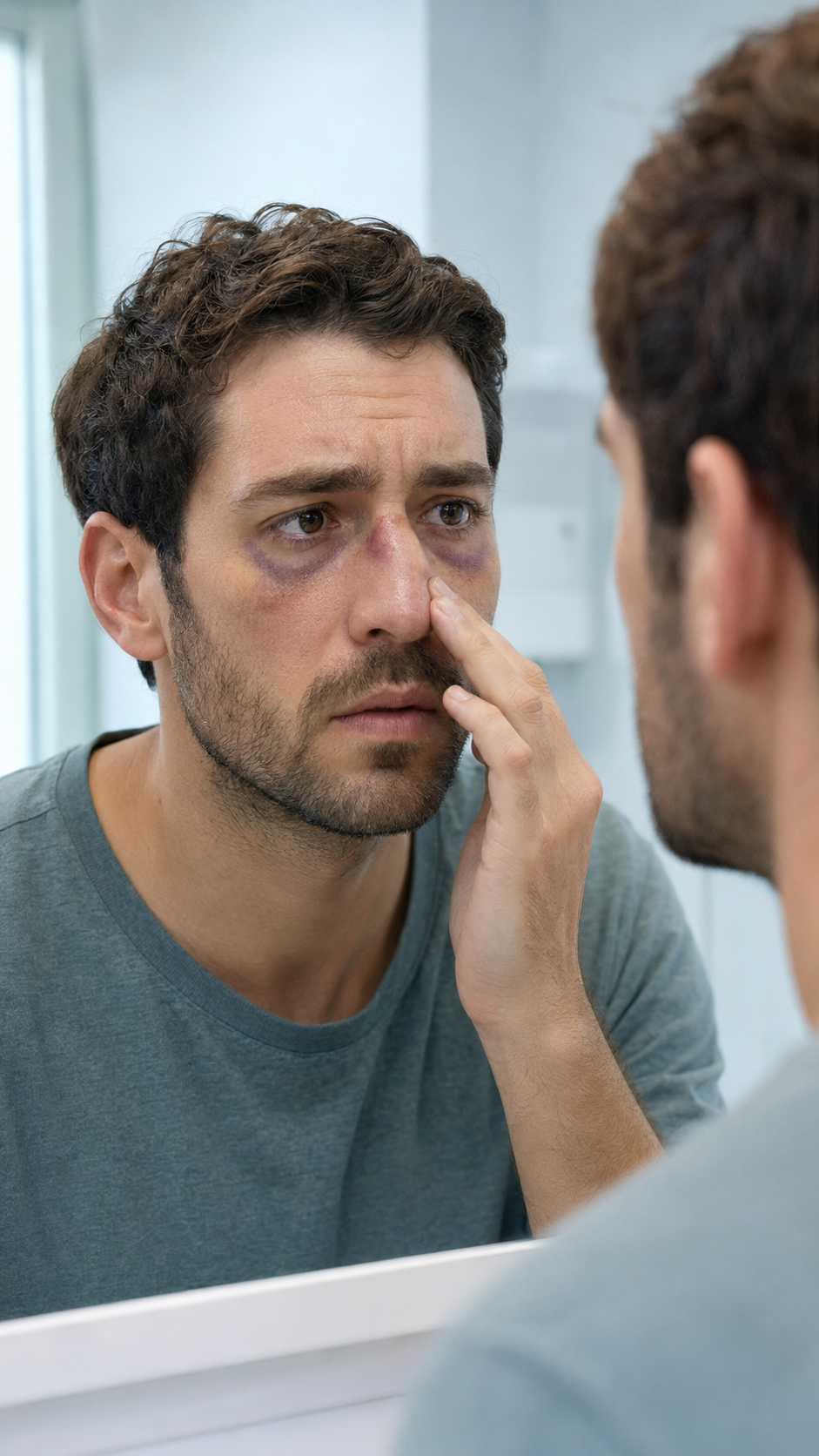
Crooked Nose After Injury: Why You Shouldn’t Ignore It
A crooked nose after a fall, sports collision, car accident, or blow to the face may seem like a cosmetic problem that can be dealt with later. Once the bleeding stops and the swelling begins to improve, many people assume the injury will simply heal on its own.
Sometimes it does. A minor nasal fracture that has not displaced the bones, changed the nose’s shape, or affected breathing may need only conservative care. However, a nose that looks newly crooked—or feels persistently blocked—deserves a medical examination.
The injury may involve displaced nasal bones, damaged cartilage, a deviated septum, or a collection of blood inside the nasal septum. Some of these problems are easier to treat during a relatively short period after the injury. One complication, a nasal septal hematoma, requires urgent treatment because delaying care can permanently damage the cartilage supporting the nose.
Here is why a crooked nose should not be ignored, which symptoms require immediate attention, and what treatment may involve.
People often use the phrase “crooked nasal bone” to describe any visible change in the nose. In reality, several structures may be involved.
The upper portion of the nose contains the nasal bones. The lower portion receives much of its shape and support from cartilage. Inside the nose, the nasal septum—a wall made of cartilage and bone—separates the two nasal passages.
After an injury, the nose may appear crooked because:
One or both nasal bones have moved out of alignment
The cartilage has bent or collapsed
The nasal septum has shifted to one side
Swelling is temporarily making the nose look uneven
The person had a preexisting deviation that has become more noticeable
A septal hematoma is causing internal swelling
It can be difficult to judge the final shape immediately because swelling may hide or exaggerate a deformity. That is why healthcare professionals often perform an early examination to rule out urgent complications and then reassess the shape after some swelling has subsided.
1. A Septal Hematoma Can Damage the Nose Quickly
The most urgent reason not to ignore nasal trauma is the possibility of a septal hematoma.
This occurs when blood collects between the cartilage of the septum and the tissue covering it. Septal cartilage does not have an independent blood supply; it receives nutrients from the tissue around it. A trapped collection of blood can separate those layers and deprive the cartilage of oxygen and nutrients.
Without prompt drainage, the cartilage may become damaged or die. The hematoma may also become infected and form an abscess. Possible consequences include a hole in the septum, persistent nasal obstruction, or collapse of the bridge into a deformity known as a saddle nose.
A septal hematoma may occur even when the outside of the nose does not appear badly broken. Warning signs include:
Increasing blockage in one or both nostrils
A soft or swollen area along the nasal septum
Pain that is becoming worse instead of better
Difficulty breathing through both sides of the nose
Fever or feeling unwell after the injury
This is not something to drain at home. It requires urgent assessment and, when confirmed, drainage by a healthcare professional.
A small 2021 retrospective study illustrates the consequences of delayed recognition. Researchers reviewed 13 children with nasal septal hematomas. Five had the condition missed in more than one healthcare setting, and seven developed complications, including three cases of saddle nose deformity. Because this was a small group of referred patients, the percentages should not be treated as the risk for every child with a nose injury. Still, the findings demonstrate how serious a missed hematoma can be. The study is available through PubMed.
2. The Nasal Bones Begin Healing in Their New Position
A displaced nasal fracture does not remain freely movable for long. As healing begins, new tissue forms around the broken areas and the bones start setting in their current position.
If the nose is allowed to heal while visibly crooked, later correction may be more difficult. A healthcare professional can sometimes perform a closed reduction, gently moving the bones and cartilage back into alignment without making surgical incisions.
Timing varies according to the patient’s age, swelling, fracture pattern, and specialist preference. Mayo Clinic advises that manual realignment should generally be performed within 14 days and preferably sooner. After that, the bones may be too firmly set for a straightforward reduction. More extensive surgery may then be required to reshape healed bone and cartilage. See the Mayo Clinic broken-nose treatment guide.
This does not mean that every crooked nose must be manipulated immediately. Severe swelling can make accurate alignment difficult, so a specialist may wait several days for swelling to decrease. The important step is arranging an examination early enough that the treatment window is not missed.
Children may require even faster assessment because their nasal bones can heal more quickly and injury to developing cartilage may affect future nasal growth.
3. A Crooked Septum Can Restrict Airflow
The outside of the nose and the inside do not always match. A nose may look nearly straight while the internal septum is significantly displaced. Conversely, an externally crooked nose may not cause major obstruction.
When trauma narrows one or both nasal passages, symptoms may include:
Difficulty breathing through the nose
Persistent congestion on one side
Mouth breathing, especially during sleep
Noisy nighttime breathing
Reduced exercise comfort
A sensation that one nostril never fully opens
Swelling and dried blood commonly cause temporary blockage during the first few days. Concern increases when breathing remains restricted after swelling has improved.
A badly deviated septum may force nighttime mouth breathing and worsen existing sleep problems. It can also make colds and allergies feel more severe because already narrow nasal passages become further swollen.
Medication may reduce inflammation from allergies or rhinitis, but it cannot physically straighten displaced bone or cartilage. Mayo Clinic notes that surgery is the only way to correct a symptomatic deviated septum, although a deviation that causes no symptoms generally requires no treatment. Its deviated septum guidance explains this distinction.
4. Dryness and Recurrent Nosebleeds May Develop
Normal airflow is distributed through both sides of the nose. A significant deviation can change how air moves across the nasal lining, causing one area to become unusually dry or irritated.
That irritation may contribute to crusting and repeated nosebleeds. Mayo Clinic lists nosebleeds and noisy breathing during sleep among the potential symptoms of a deviated septum.
Repeated bleeding should not automatically be blamed on the old injury, however. Dry air, allergies, medications, frequent use of decongestant sprays, bleeding disorders, and other nasal conditions can cause similar symptoms. A clinician can examine the internal nasal passages and determine whether a structural problem is contributing.
5. Persistent Obstruction Can Affect Daily Life
A crooked nose is not dangerous merely because it looks asymmetrical. The clinical concern depends on function, symptoms, and associated injuries.
Chronic nasal obstruction can become surprisingly disruptive. People may notice that they sleep with their mouth open, wake with a dry throat, struggle to breathe comfortably during exercise, or repeatedly use nasal sprays without understanding why one side remains blocked.
Some people gradually adapt and stop noticing the obstruction. They may assume that breathing through only one side is normal because the problem has existed for years. A cold, seasonal allergy, or later injury can then make the narrowing much more obvious.
Correcting a structural problem does not guarantee that every breathing or sleep symptom will disappear. Allergies, enlarged turbinates, nasal polyps, and sleep apnea may coexist with a deviated septum. Proper evaluation helps separate these conditions rather than assuming the crooked structure explains everything.
6. A Nasal Injury May Be Part of a Larger Facial Injury
The nose occupies a central and exposed position on the face. A force strong enough to displace it may also injure the eyes, cheekbones, jaw, teeth, or structures around the brain.
Seek emergency care after nasal trauma if the person has:
Loss of consciousness, confusion, or repeated vomiting
Severe or worsening headache
Vision changes, double vision, or eye pain
Difficulty moving an eye
Clear, watery fluid draining continuously from the nose
A deep cut or open wound over the fracture
Heavy bleeding that does not stop
Neck pain, weakness, or numbness
A changed bite or difficulty opening the mouth
Severe facial swelling or deformity
Trouble breathing
Clear nasal drainage after significant head trauma is particularly concerning because, although uncommon, it can represent cerebrospinal fluid leaking from an injury at the base of the skull. Do not assume that every clear runny nose after an accident is simply mucus.
How Doctors Evaluate a Crooked Nose
Diagnosis usually begins with the injury history and a careful examination.
The clinician may check the external nose for tenderness, abnormal movement, flattening, or deviation. They will also look inside the nostrils for bleeding, lacerations, obstruction, septal displacement, and signs of a hematoma.
Photographs taken before the accident can be surprisingly useful, especially if swelling makes it difficult to determine whether the deviation is new. A clear front-facing photograph may help the clinician compare the nose’s previous shape.
Routine X-rays are often unnecessary for an uncomplicated nasal fracture because the diagnosis and treatment decision are usually based on the examination. A CT scan may be ordered when the injury is severe or when fractures involving other facial structures are suspected.
Does Every Crooked Nose Need Surgery?
No. Treatment depends on the cause, severity, timing, appearance, and effect on breathing.
A small fracture that has not displaced the nose and does not obstruct airflow may heal without a procedure. A visibly displaced fracture may be treated with closed reduction during the early treatment window.
If the injury has significantly damaged the septum, a specialist may recommend septoplasty to improve the internal airway. More complex or older deformities may require septorhinoplasty, which addresses both nasal function and external shape.
The American Academy of Otolaryngology–Head and Neck Surgery states that surgery may be indicated when a nasal fracture causes deformity or airway obstruction, while fractures without either problem may not need surgical treatment. Its clinical indicators for nasal fracture provide an overview.
Surgery also has risks, including bleeding, infection, persistent obstruction, septal perforation, scarring, and the possibility that the final appearance will not be perfectly symmetrical. Treatment should therefore be based on meaningful symptoms or deformity—not the assumption that every slight deviation needs correction.
What to Do Immediately After a Nose Injury
If the injury appears isolated and there are no emergency warning signs, basic first aid may help while you arrange an evaluation:
Sit upright and lean slightly forward if the nose is bleeding. This helps keep blood from running down the throat.
Apply a wrapped cold pack gently for 10 to 15 minutes at a time. Do not press hard enough to move the nose.
Keep the head elevated, including during sleep, to limit swelling.
Avoid blowing or picking the nose while it heals.
Do not try to straighten the nose yourself. Uncontrolled pressure can worsen bleeding, damage the septum, or move the fracture incorrectly.
Avoid contact sports and activities that could cause another impact until a healthcare professional says it is safe.
Ask a clinician or pharmacist which pain medicine is appropriate, especially if the person takes blood thinners, has a bleeding disorder, has kidney or stomach problems, or is a child.
When Should You Arrange an Examination?
Seek urgent medical attention immediately if you suspect a septal hematoma, cannot breathe through the nose, have uncontrolled bleeding, or have signs of a serious head or facial injury.
For a less severe injury, arrange an examination if the nose remains crooked after swelling begins to decrease, breathing remains difficult, pain is not improving, nosebleeds keep returning, or fever develops.
Do not wait several weeks to decide whether the new shape bothers you. By then, the opportunity for a relatively simple realignment may have passed.
The NHS also advises people not to straighten a changed nose themselves and to seek help when it remains crooked or breathing stays difficult. Its broken nose guidance provides additional warning signs and self-care instructions.
What If the Nose Has Been Crooked for Years?
A long-standing crooked nose without pain, breathing difficulty, recurrent bleeding, or other symptoms is not automatically a medical problem. Many people naturally have some septal deviation or facial asymmetry and never require treatment.
An ENT evaluation becomes more useful when the deviation causes persistent obstruction, repeated nosebleeds, troublesome nighttime mouth breathing, or significant concern about a past injury. Old fractures can still be treated, but the procedure may be more involved than an early closed reduction.
The goal is not necessarily to create a perfectly straight nose. It is to restore a functional airway, address a meaningful deformity, and set realistic expectations about appearance.
The Bottom Line
A newly crooked nose should not be dismissed as a cosmetic inconvenience. It may represent displaced nasal bones, septal damage, or an internal hematoma that cannot be judged from appearance alone. Early assessment can identify urgent complications and preserve the option of simpler realignment before the bones heal in the wrong position.
At the same time, not every mild or asymptomatic deviation requires surgery. The right decision depends on breathing, bleeding, pain, appearance, associated injuries, and what an internal nasal examination reveals.
Have you or someone in your family ever ignored a nose injury because it seemed minor, only to notice breathing problems or a change in shape later? Share your experience or questions in the comments below—your story may remind another reader to have a seemingly simple injury checked in time.