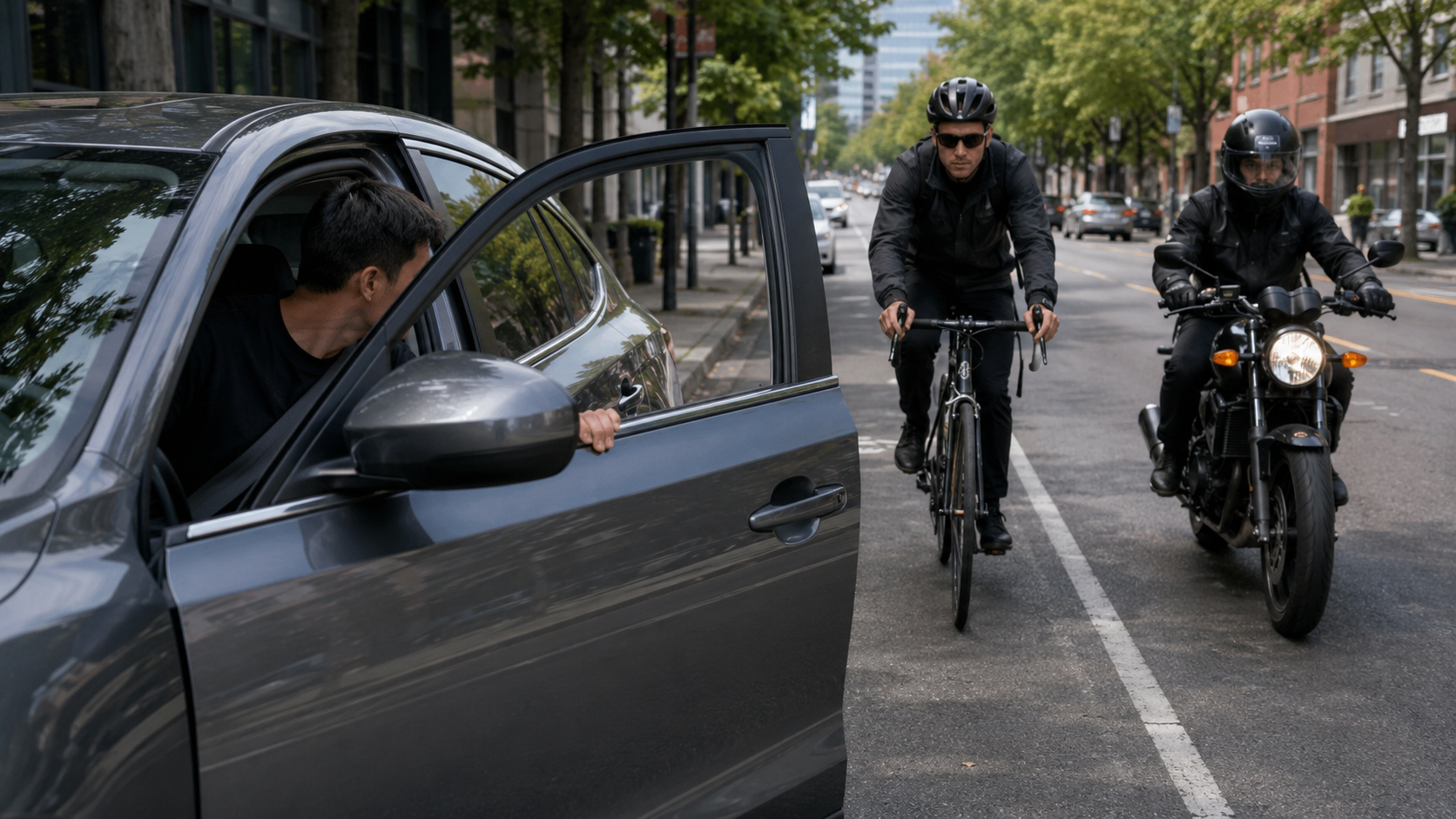
Why You Should Always Check for Bikes and Motorcycles Before Opening Your Car Door
Minjin Park
·
Opening a car door without checking can put bicyclists and motorcyclists at risk. Learn simple habits like mirror checks, shoulder checks, and the Dutch Reach to make everyday parking safer.
A Small Car Door Habit That Can Prevent a Big Problem
Most drivers think carefully about safety while the car is moving. We check mirrors, signal before changing lanes, watch for pedestrians, and try to keep space around us in traffic.
But one risky moment often happens after the car is already parked.
You turn off the engine. You grab your phone, bag, coffee, or grocery list. Then you open the door and step out.
It feels like the drive is over. But for people moving beside your parked car—especially bicyclists, e-bike riders, scooter riders, and motorcyclists—the danger may still be very real.
When a car door suddenly opens into the path of a rider, it can cause a crash known as “dooring.” The rider may hit the door directly, swerve into traffic, fall, or collide with another vehicle. Even when the driver did not mean any harm, the result can be serious.
Dooring happens when someone opens a parked vehicle’s door into the path of another road user.
Most people think of bicycles first, and that is common. A cyclist may be riding in a bike lane or along the edge of the road when a driver or passenger opens a door without looking. The cyclist has only a second to react.
But dooring can also affect motorcyclists, moped riders, scooter riders, delivery riders, and even people using mobility devices near parked cars.
It can happen on busy city streets, quiet neighborhoods, school pickup zones, downtown parking areas, apartment complexes, and curbside rideshare stops.
The moment is usually quick. The person inside the car may not even realize anyone is approaching until the door is already open.
That is why checking before opening the door matters so much.
Why Bikes and Motorcycles Are Easy to Miss
They Are Narrower Than Cars
Bicycles and motorcycles take up less visual space than cars and trucks. In a quick glance, they may not stand out in the mirror, especially if there is other traffic behind them.
A cyclist can be close to your car but still hidden in a mirror’s blind spot. A motorcycle may be moving between shadows, parked cars, or lane markings.
If you only glance once, you may miss them.
They Can Approach Quietly
A car or truck usually announces itself with engine noise, tire noise, or headlights. A bicycle may be much quieter. Many modern e-bikes and scooters are also quieter than people expect.
A motorcycle can be loud, but not always. Traffic noise, music inside the car, rain, wind, or a conversation with passengers can cover up the sound.
Relying on hearing alone is not enough. You need to look.
They May Be Riding Close to Parked Cars
In some areas, bike lanes are placed next to parked cars. In other places, riders use the right side of the road because that is where traffic flow pushes them.
This creates a “door zone,” the area next to parked vehicles where an opening door can reach into a rider’s path.
A rider may be doing everything normally and still be close enough to be affected by a sudden door.
Speed Is Hard to Judge
A bicycle may look far away but arrive quickly. An e-bike, scooter, or motorcycle may approach faster than expected.
Drivers sometimes think, “I have time,” then open the door too wide or too quickly. But if the rider is close, even a small door opening can force a fast reaction.
The safest habit is not to guess. Wait until the path is clearly open.
Common Situations Where Dooring Happens
Street Parking in Busy Areas
Dooring is especially common where cars park along active streets. Think downtown blocks, restaurant areas, school zones, university neighborhoods, and streets near parks.
People are often distracted when they park. They may be checking a map, looking for a wallet, reaching for a backpack, or watching traffic from the driver’s side.
That distraction makes it easier to forget about riders passing beside the car.
Rideshare and Drop-Off Stops
Passengers getting out of rideshare vehicles, taxis, or family cars may open doors quickly because they feel rushed.
This is especially risky when the vehicle stops near a bike lane or curbside traffic. A passenger in the back seat may not have been paying attention to the road and may not know a cyclist is coming.
Before anyone exits, the driver can help by saying, “Check for bikes before opening.”
It sounds simple, but that reminder can prevent a rushed mistake.
School Pickup and Drop-Off Lines
School areas are full of movement. Kids are opening doors. Parents are pulling in and out. Buses may be nearby. Some students ride bikes or scooters.
Because everyone is focused on timing, backpacks, and children, it is easy to forget to check the road side before opening a door.
Children also may not understand that a cyclist or motorcyclist can be passing close to the car. Adults should help manage doors in school zones and remind kids to look first.
Parallel Parking on Narrow Streets
After parallel parking, the driver-side door often opens toward traffic. If the street is narrow, a cyclist or motorcycle may pass close by.
This is a moment to slow down. Check the mirror, turn your head, and open the door only a little at first.
A door does not need to swing wide open immediately.
The Biggest Mistake: Opening the Door Automatically
The most dangerous part of this habit is how automatic it feels.
When people park, they often follow the same routine without thinking. Engine off. Seat belt off. Phone in hand. Door open.
That routine may work in a driveway or empty parking lot, but it is not safe near traffic.
Opening a car door should be treated like merging into a lane. You are putting part of your vehicle into a space where someone else may be moving.
Before you open, you need to check.
Use the Dutch Reach: A Simple Habit That Helps You Look
One of the easiest ways to reduce dooring risk is a technique often called the Dutch Reach.
Instead of opening the driver’s door with your left hand, use your right hand—the hand farther from the door. If you are a front passenger, use your left hand to open the passenger-side door.
This motion naturally turns your shoulders and head toward the window and mirror. It encourages you to look back before the door opens.
The Dutch Reach is not magic. You still need to check carefully. But it helps break the automatic habit of throwing the door open without looking.
Here is the basic idea:
Use the hand farther from the door.
Turn your body slightly.
Check the mirror.
Look over your shoulder.
Open the door slowly.
Pause if anyone is approaching.
It takes only a second or two, but that small pause can make the difference.
Teach Passengers, Not Just Drivers
Drivers are not the only ones who open car doors.
Passengers can cause dooring too, especially in the back seat. Children, teens, friends, rideshare passengers, and older relatives may not think about bikes or motorcycles before stepping out.
Make it a family habit to say, “Check before you open.” This is especially helpful in cities, near schools, near bike lanes, and during drop-offs.
For children, give a simple rule: wait for an adult before opening the door near traffic.
Another useful habit is “curb side first.” When possible, have passengers exit on the side closest to the sidewalk rather than the side facing traffic. This is not always possible, but it is often safer.
How to Open Your Door More Safely
Check Your Side Mirror First
Before opening the door, check the side mirror. Look for cyclists, motorcycles, scooters, cars, or pedestrians approaching from behind.
Do not rely on a tiny glance. Actually look.
If you are parked next to a bike lane, take extra care. A rider may be exactly where your door would swing open.
Look Over Your Shoulder
Mirrors do not show everything. A bicycle or motorcycle may be in a blind spot.
After checking the mirror, turn your head and look over your shoulder. This gives you a better view of what is coming alongside the vehicle.
This is where the Dutch Reach helps because it naturally turns your body in the right direction.
Open the Door Slowly
Do not swing the door wide open all at once.
Crack it open slightly first. This gives you another chance to look and gives approaching riders a little more warning. Then open wider only when the space is clear.
A slow door is easier for others to see and easier for you to control.
Keep the Door Open Only as Long as Needed
Leaving a door open into traffic can create a hazard even after you step out. It may block a bike lane, narrow the road, or force riders to move around it.
Get out carefully, then close the door as soon as practical.
Warning Signs That You Need Extra Caution
Some parking situations should immediately make you more alert.
Be extra careful if you are parked next to a bike lane, on a narrow street, near a school, beside a delivery zone, near a bus stop, in heavy traffic, or on a street with lots of scooters and e-bikes.
Also be careful at night, in rain, or during sunrise and sunset. Riders may be harder to see, and headlights can blend into other traffic.
If you hear a bicycle bell, motorcycle engine, scooter noise, or someone calling out, stop opening the door and wait.
If you are not sure whether the path is clear, keep the door closed.
What Cyclists and Motorcyclists May Be Dealing With
It helps to think about the situation from the rider’s side.
A cyclist may be watching traffic, potholes, parked cars, pedestrians, road debris, and traffic signals all at once. A motorcyclist may be managing speed, lane position, visibility, and nearby vehicles.
If a door opens suddenly, the rider may have only a moment to choose between hitting the door or swerving into traffic. Neither option is good.
Drivers and passengers can make the road safer by not creating that sudden obstacle in the first place.
This is not about blaming one group of road users. It is about sharing space with more awareness.
Special Tips for Parents
Children often open doors quickly because they are excited to get out. They may see school, home, a store, or a friend and forget everything else.
If your child sits on the traffic side, use child locks when appropriate and help them exit. Teach them to wait until you say it is safe.
You can also make a small routine:
Seat belt off only after the car is parked.
Hands stay off the door handle.
Adult checks traffic.
Child exits on the sidewalk side when possible.
This routine is especially useful during school drop-off, sports practice, and street parking.
Special Tips for Rideshare Drivers and Passengers
Rideshare stops can be tricky because passengers may not know the area, and drivers may feel pressure to keep moving.
Drivers can help by stopping in a legal, safe place where passengers can exit away from traffic when possible. Before unlocking doors, a quick reminder helps: “Please watch for bikes before opening.”
Passengers should take responsibility too. Before opening a door, look behind you. Do not assume the driver checked for you.
If there is a bike lane beside the vehicle, pause and look carefully before stepping out.
What Not to Do
Do not open the door while looking down at your phone.
Do not assume a bike lane is empty just because you did not hear anything.
Do not let children open traffic-side doors without checking.
Do not leave the door open while organizing bags or putting on a jacket.
Do not swing the door wide because you are in a hurry.
Do not assume riders will always have enough room to avoid you.
The easiest safety habit is one you do every time.
When you park, train yourself to think: mirror, shoulder, slow door.
That is it.
Mirror.
Shoulder.
Slow door.
You can teach the same phrase to kids, teens, and passengers. Over time, it becomes automatic in a good way.
Just like checking before changing lanes, checking before opening a door becomes part of being a thoughtful road user.
Final Thoughts: One Second Can Make the Street Safer
Opening a car door feels like a small action, but it can affect people moving beside you. Bicyclists, motorcyclists, scooter riders, and pedestrians all share the space around parked vehicles.
The safest approach is simple. Check your mirror. Look over your shoulder. Use the Dutch Reach when you can. Open the door slowly. Teach passengers and children to wait, look, and exit carefully.
You do not need to be nervous every time you park. Just build a calmer habit.
Before the door opens, take one second to check. That small pause can protect someone else, prevent damage to your car, and make everyday streets safer for everyone.
Hi, I’m the creator and editor behind ZestyHabit. I research everyday safety, first aid, and practical wellness topics using official guidance and reliable public sources, then turn that information into clear, realistic steps for daily life.
My goal is to help readers make safer, better-informed choices at home and beyond.