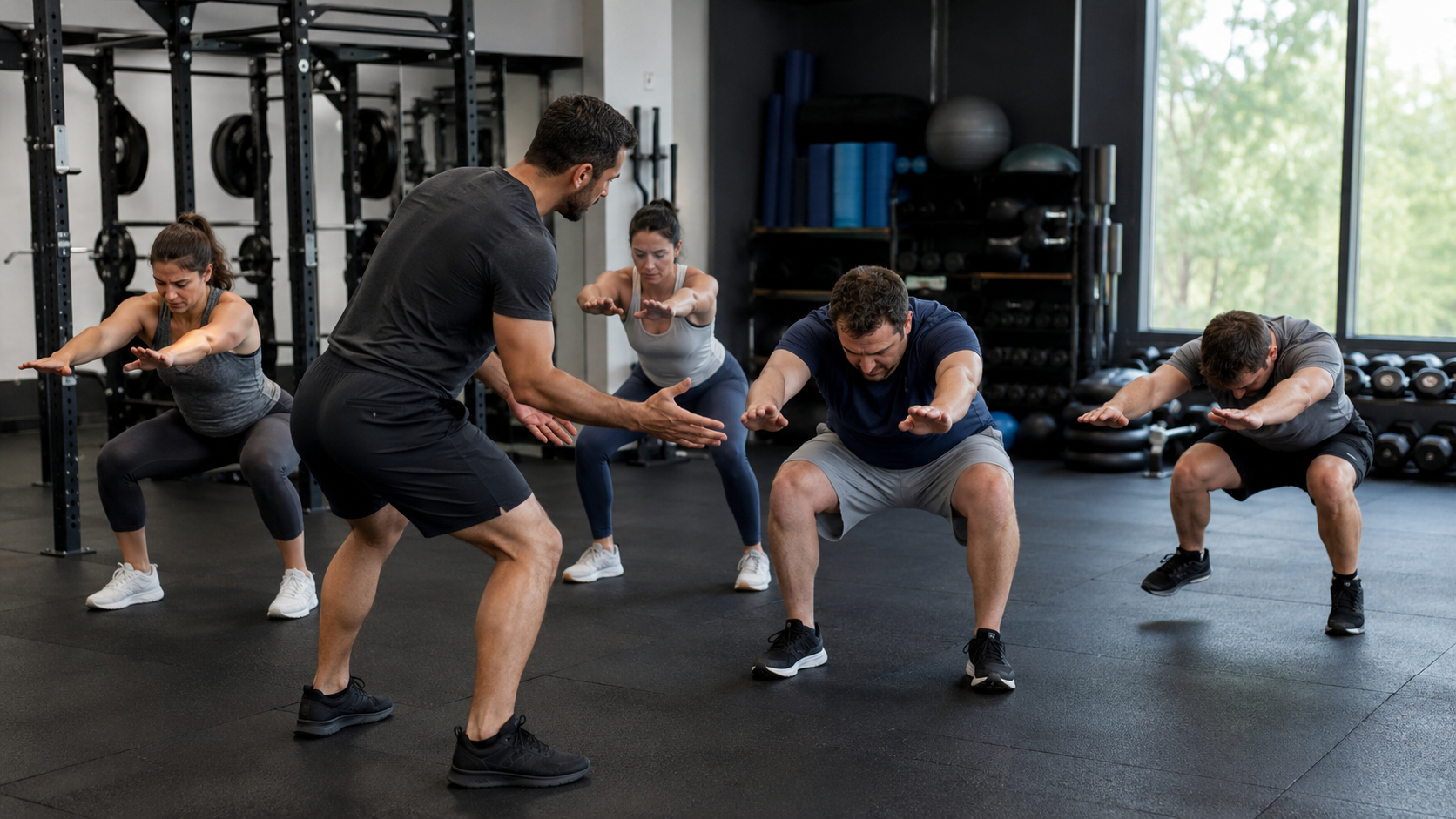
The Squat Habit That Quietly Teaches Your Body the Wrong Pattern
Minjin Park
·
Repeating squats with poor form can slowly strain your knees, hips, back, and ankles. Here’s how this everyday workout habit causes problems and how to make squats safer and more useful.
You bend your knees, lower your hips, stand back up, and somehow that counts as exercise. No machine. No complicated setup. No membership required. It is probably why squats show up everywhere: home workout videos, gym warm-ups, physical therapy routines, fitness challenges, and those “do 100 squats a day” plans that sound inspiring until your knees start arguing with you.
The tricky part is that squats are simple, but they are not mindless.
When done well, a squat can strengthen your thighs, glutes, hips, core, and even help you move better in everyday life. Sitting down, standing up, picking up groceries, getting out of the car—your body uses squat-like patterns all the time.
But when you repeat squats with poor posture, your body also gets better at that pattern.
That is the part people often miss. Exercise is not only about burning calories or feeling sore. It is also practice. Every repetition teaches your nervous system, joints, and muscles how to move. If the pattern is messy, rushed, or forced, you may be practicing the wrong thing over and over.
And because squats are so common, the habit can sneak in quietly.
You may not feel anything dramatic at first. Maybe your knees feel a little irritated. Maybe your lower back feels tight afterward. Maybe your hips feel pinchy at the bottom. It is easy to blame “weak legs” or age or a bad workout day. Sometimes that is partly true. But often, the way you are squatting deserves a closer look.
Poor Squat Form Usually Starts Small
Bad squat posture does not always look extreme.
It is not always someone collapsing under a heavy barbell or doing something obviously dangerous. A lot of poor squat habits are small enough to ignore, especially during bodyweight squats.
Maybe your chest drops forward so much that the squat turns into a strange bowing motion.
Maybe one side does more work than the other, and you never notice because you are focused on finishing the set.
The problem is repetition. A single awkward squat is not usually a big deal. Bodies are flexible and forgiving. But doing that same pattern every day, especially when tired, can build stress in the same places again and again.
It is a bit like walking in shoes that do not fit. One short walk may be fine. Months of walking that way can leave your feet, knees, or hips complaining.
What Poor Squat Form Can Do to Your Knees
The knees often get blamed first when squats feel uncomfortable.
That makes sense. They are right there in the middle of the movement, bending and straightening each time. But knee discomfort during squats is not always because “squats are bad for knees.” Often, the issue is how the forces are being shared.
Knees caving inward
One common habit is letting the knees fall inward as you lower or stand up. You might notice it more when you get tired, or when you try to squat deeper than your body can control.
This inward collapse can place extra stress around the knee joint. It may also suggest that your hips and glutes are not controlling the movement well enough, or that your feet are not staying stable.
A helpful cue is to imagine your knees tracking in the same general direction as your toes. They do not have to point perfectly straight ahead. People’s hip shapes, ankle mobility, and stance widths differ. But the knees should not be diving inward while the feet stay planted outward.
Pushing the knees forward without control
There is a common myth that your knees should never go past your toes. That is too rigid. For many people, especially in a deeper squat, the knees naturally move forward.
The real issue is whether the movement is controlled and balanced.
If your heels pop up, your weight shifts too far forward, and your knees take most of the load, the squat may start feeling rough. You may feel pressure in the front of the knees or struggle to stand up smoothly.
A better target is balance through the whole foot: heel, big toe base, and little toe base. Not gripping the floor like your life depends on it, but staying grounded enough that your body is not tipping forward.
Your Lower Back May Be Doing Work It Did Not Sign Up For
A squat is mostly a lower-body movement, but your torso matters a lot.
When your upper body collapses forward, your lower back may start working overtime to keep you from folding. Some forward lean is normal, especially depending on your body proportions. People with longer femurs, for example, often lean more than people with shorter legs. That does not automatically mean their form is bad.
But there is a difference between a natural lean and losing control.
If your chest drops suddenly, your spine rounds hard at the bottom, or you feel the movement mostly in your lower back instead of your legs and hips, that is worth adjusting.
The “butt wink” question
People online love arguing about “butt wink,” which is when the pelvis tucks under near the bottom of a squat and the lower back rounds.
A tiny amount may happen for some people, especially at deeper ranges. It is not always a disaster. But if you are forcing depth and your lower back rounds strongly every time, you may be going lower than your current mobility and control allow.
That is where ego gets sneaky.
You see someone else squatting deep, so you try to match them. But your ankles, hips, core control, and limb proportions may not allow the same depth right now. Squatting slightly higher with better control is usually more useful than chasing depth with a folded spine.
Hip Pinching Is Not Something to Push Through
Some people feel squats in the front of the hips, like a pinch or blocked sensation near the crease of the hip.
This can happen for a few reasons. Your stance may be too narrow. Your toes may need to turn out slightly. Your hips may not like the exact path you are using. Or you may be dropping into a depth your joints are not comfortable controlling.
The mistake is treating every discomfort as weakness.
A burning thigh muscle is one thing. A sharp or pinching feeling inside the joint is different. That is usually your body saying, “Can we not do it this way?”
Try adjusting your stance before assuming you are bad at squats. Some people feel better with feet shoulder-width apart. Others need a slightly wider stance. Some need toes turned out a bit more. The squat does not need to look identical for every body.
A good squat should feel challenging, not jammed.
Ankles Matter More Than People Think
If your ankles are stiff, your squat will usually show it somewhere else.
Limited ankle mobility can make your heels lift, your knees cave in, or your torso lean forward more than you want. Then you might blame your knees or back, when the original limitation is lower down.
This is common for people who sit a lot, wear stiff shoes often, or have old ankle sprains that never fully recovered. Even people who are strong can have poor ankle movement.
A quick sign: if you cannot lower into a squat without your heels wanting to leave the ground, your ankles may be part of the issue.
That does not mean you should force your ankles into a painful stretch. Start simple. Slow calf stretches, controlled ankle rocks, and squatting to a box or chair can help you practice without collapsing into a position you cannot own yet.
Shoes also matter. Squatting in soft, unstable running shoes can make balance harder. Some people do better barefoot, in flat shoes, or in proper lifting shoes. For home workouts, even just noticing the shoe issue can explain a lot.
Speed Can Make Bad Form Worse
A lot of squat problems show up when people rush.
Fast squats feel productive. They raise your heart rate. They make the set feel intense. They also make it easier to bounce, collapse, or ignore where your knees and hips are going.
This is especially true in challenge-style workouts: 50 squats, 100 squats, squats between meetings, squats while watching TV. Nothing wrong with convenience, but fatigue changes form quickly.
The first ten reps may look decent. By rep sixty, the knees wobble, the back rounds, and the depth changes every time.
A slower squat gives you feedback. You can feel your weight shifting. You can notice if one knee caves. You can tell whether you are controlling the bottom or just dropping into it.
You do not have to move like a robot. Just stop treating every squat like a race.
Why Repeating Bad Squats Can Affect Daily Movement
The body loves familiar patterns.
If you repeatedly squat with knees collapsing inward, you may start using that same pattern when you stand up from a chair. If you always hinge forward and load your back, you may do the same when picking something up. If you shift more weight into one leg, stairs and daily lifting may follow that habit too.
This is why form matters even for people who are not “serious gym people.”
Squats are not only a workout move. They are a rehearsal for daily life.
A parent picking up toys from the floor, a person carrying laundry, someone gardening, someone helping a child into a car seat—all of these movements ask the body to bend, brace, shift weight, and stand again.
When your squat pattern improves, everyday movement often feels smoother too. Not perfect. Not magical. Just less clunky.
The Mirror Can Help, But It Can Also Fool You
Many people check squat form in a mirror. It is useful, especially from the front. You can see if your knees are caving inward or if your shoulders are uneven.
But a mirror has limits.
From the front, you may not notice your lower back rounding. From the side, you may not notice one knee drifting. And sometimes staring at yourself mid-squat changes your neck position in weird ways.
A simple phone video can be more helpful. Record a few reps from the front and side. You do not need to post it anywhere. Please do not let the internet judge your living room squat unless you really want that experience.
Watch for basics:
Are your feet staying planted?
Do your knees track roughly with your toes?
Does your torso stay controlled?
Are you shifting to one side?
Does the movement look the same from rep to rep?
You may spot something immediately. Most people do.
A Safer Way to Relearn the Squat
If your squat feels off, do not start by trying to fix everything at once. That usually makes the movement feel stiff and confusing.
Start with an easier version.
Use a chair or box
Squat down to a chair, bench, or sturdy box. Lightly tap it, then stand back up. This gives you a target and keeps you from dropping too low before you are ready.
Choose a height where you can stay controlled. Over time, you can lower the target if your body handles it well.
Hold onto support
A doorframe, countertop, or sturdy rail can help you practice the movement without worrying so much about balance. This is not cheating. It is a way to learn.
Holding support lets you sit your hips back, keep your feet grounded, and explore a comfortable depth.
Try a counterbalance
Holding a light weight, backpack, or even a water bottle in front of your chest can help some people squat more upright. It shifts your balance slightly and may make the movement feel more natural.
You do not need to go heavy. This is about finding the pattern, not proving anything.
Small Cues That Actually Help
Some fitness cues sound nice but do not mean much once you are moving. “Use your core” is technically true, but not very helpful if you do not know what that feels like.
Try cues that are more concrete.
Think about keeping your whole foot on the floor.
Let your knees follow your toes.
Lower with control instead of falling into the bottom.
Keep your ribs and pelvis from flaring far apart.
Stand up by pressing the floor away.
Pick one or two cues at a time. Too many instructions can turn a squat into a mental puzzle, and suddenly you forget how legs work.
When to Stop and Get Help
Mild muscle fatigue is normal. Some soreness after a new workout can happen. But pain is not something to romanticize.
Stop or scale back if you feel sharp pain, joint pinching, numbness, sudden weakness, or pain that gets worse as you continue. If knee, hip, or back pain keeps returning during squats, it may be worth seeing a physical therapist, qualified trainer, or medical professional.
That does not mean something is terribly wrong. Sometimes a small adjustment makes a huge difference. But getting eyes on your movement can save you a lot of guessing.
You Do Not Need a Perfect Squat
There is no single perfect squat that fits everyone.
Your ankle mobility, hip structure, leg length, training history, injury history, and even comfort level all affect how your squat looks. Someone else’s “ideal form” may not be yours.
The goal is not to make your squat look like a diagram in a textbook. The goal is to move with control, distribute effort well, and avoid repeatedly forcing your joints into positions that complain.
A good squat should feel steady. Your muscles should work. Your breathing may get heavier. You may feel challenged. But you should not feel like your knees, hips, or back are being bullied into the movement.
A Better Habit Than “More Squats”
Doing more squats is not always the answer.
Sometimes the better habit is doing fewer squats with more attention. Five controlled reps can teach your body more than thirty rushed ones. A chair squat done well may be more useful than a deep squat done with collapsing knees and a rounded back.
That can feel less exciting, especially if you like checking off big numbers. But the body tends to reward consistency and quality more than dramatic workout promises.
Squats can be a great movement. They can build strength, confidence, and better daily function. They just deserve a little respect.
So the next time you squat, slow down for a few reps. Notice your feet. Watch your knees. Feel whether your hips and legs are doing the work, not just your lower back. You do not have to become obsessed with form.
You just have to stop practicing the version that keeps making your body feel worse.
Hi, I’m the creator and editor behind ZestyHabit. I research everyday safety, first aid, and practical wellness topics using official guidance and reliable public sources, then turn that information into clear, realistic steps for daily life.
My goal is to help readers make safer, better-informed choices at home and beyond.