Martial Arts Precautions: What Beginners Should Know Before Training
Minjin Park
·
Martial arts can be exciting, challenging, and deeply rewarding. Whether you are interested in karate, taekwondo, jiu-jitsu, boxing, Muay Thai, judo, kickboxing, kung fu, or another style, training can improve fitness, coordination, confidence, discipline, and body awareness.
But martial arts are not the same as a regular gym workout.
Many classes involve contact, fast movement, flexibility, partner drills, falls, kicks, punches, joint positions, and repeated practice under fatigue. That does not mean beginners should be afraid. It simply means you should walk in with the right mindset: learn gradually, respect your body, and focus on control before intensity.
A good martial arts class should help you build skill safely. Still, beginners can run into problems when they try to move too fast, kick too high, spar too early, ignore joint discomfort, or copy advanced students before learning the basics.
Here is what beginners should know before training, especially if you want to enjoy martial arts without unnecessary strain, injury, or frustration.
Many beginners arrive with a picture in their head. They imagine sharp kicks, powerful punches, fast throws, smooth submissions, or dramatic sparring. Then they feel disappointed when the first few classes are full of basics.
But the basics are where safe training begins.
Footwork, stance, posture, balance, breathing, guard position, breakfalls, controlled striking, and simple defensive movement may not look flashy, but they protect your body. They also give you the foundation to train harder later.
If you skip the fundamentals, everything becomes riskier. A kick can strain the hip. A punch can irritate the wrist. A fall can shock the back. A grappling movement can twist the knee or shoulder.
Your first goal should not be to look impressive. It should be to move safely, listen well, and understand how the class works.
Choose a Beginner-Friendly Instructor
Instructor guidance matters a lot in martial arts.
A good instructor should explain movements clearly, offer modifications, watch for unsafe form, and create a training environment where beginners are not pressured into doing things they are not ready for.
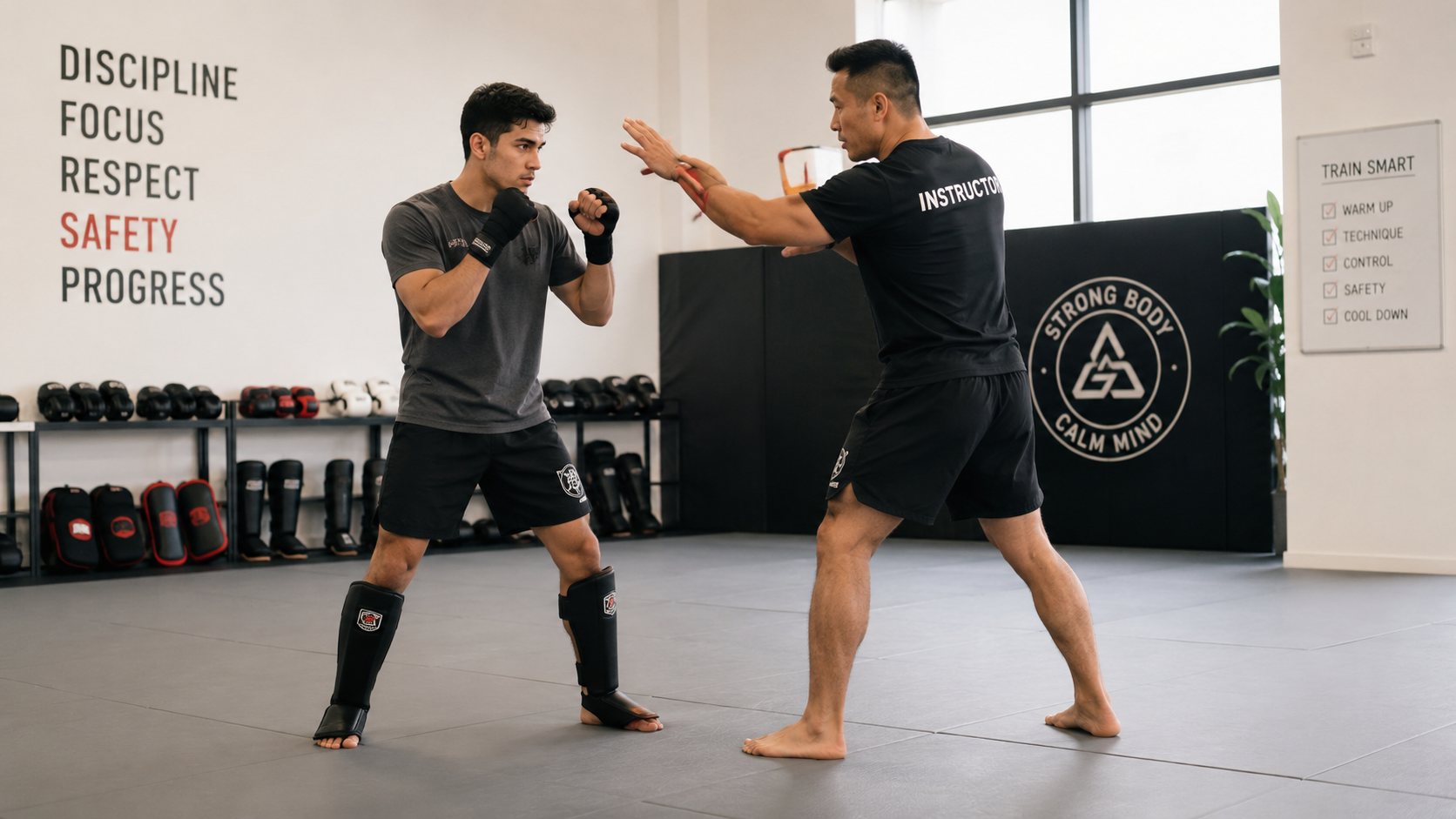
Before joining a class, observe the atmosphere if you can. Are beginners treated with patience? Are advanced students controlled and respectful? Does the instructor explain safety rules? Do students warm up properly? Is sparring supervised? Are people encouraged to tap, stop, or ask questions?
A tough class is not automatically a bad class. But a careless class is a problem.
Be cautious if the instructor pushes beginners into hard sparring too soon, dismisses pain, mocks people for modifying, or allows aggressive partners to dominate new students. Martial arts should build confidence, not make you feel unsafe.
Understand the Contact Level
Not all martial arts classes involve the same amount of contact.
Some classes focus on forms, technique, movement, and light drills. Others include pad work, controlled contact, grappling, throws, sparring, or competition preparation. Even within the same martial art, one school may be gentle and technical while another may be intense and fight-focused.
Before training, ask what kind of contact to expect. Will there be sparring? Is it optional for beginners? Do you need protective gear? Will you be doing throws or ground work? Are there partner drills that involve joint locks or chokes?
Knowing this ahead of time helps you prepare mentally and physically.
If you are nervous about contact, say so. A good instructor can guide you toward appropriate drills and partners. You do not have to pretend to be fearless on day one.
Warm Up Properly
Martial arts often involve quick direction changes, kicks, punches, rotations, and explosive movement. Going into that cold can increase the chance of strain.
A good warm-up should gradually raise your body temperature and prepare your joints. It may include light jogging, jump rope, mobility drills, dynamic stretches, shadowboxing, footwork, bodyweight squats, hip circles, shoulder circles, or light technical movement.
Avoid forcing deep static stretches before your body is warm. Trying to push into splits, high kicks, or deep hip openers too early can irritate the hips, hamstrings, knees, or lower back.
Your warm-up should make you feel more prepared, not already exhausted.
If you train at home, do not skip this part just because nobody is watching. A few minutes of preparation can make the rest of your practice much safer.
Do Not Force Flexibility
Flexibility can be useful in martial arts, especially for kicks, stances, guard positions, and ground movement. But forcing flexibility is one of the quickest ways to hurt yourself.
Beginners often try to kick higher than their hips can control. They may swing the leg upward, lean backward, twist the standing knee, or strain the groin and hamstrings. The kick may look higher, but it is not safer or stronger.
Flexibility should develop gradually. High kicks require more than loose muscles. They also need hip strength, core control, balance, and good technique.
If your instructor asks for a kick and you can only do it at waist height, that is fine. A controlled low kick is better than a sloppy high kick that pulls your hip or lower back.
Stretch gently after training, and work on mobility consistently. Do not yank, bounce, or force your body into shapes it is not ready for.
Protect Your Knees During Kicks and Stances
Knees are especially important in martial arts because many movements involve pivoting, stepping, lunging, kicking, and changing direction.
When kicking, your standing foot often needs to pivot so your hip can rotate. If your foot stays stuck while your hip turns, the knee may take the twist. This is common in roundhouse kicks, side kicks, and spinning movements.
Pay attention to your base leg. The knee should generally track in the same direction as the toes. Avoid letting it collapse inward or twist under pressure.
In deep stances, do not force the knee into an extreme position. Keep the knee aligned, avoid locking it hard, and use a stance width you can control.
If your knees hurt during a movement, stop and ask for correction. Knee discomfort is not something to ignore in martial arts.
Take Care of Your Wrists and Hands
Punching looks simple, but poor hand and wrist alignment can cause problems.
When striking a bag, pad, or target, your wrist should stay straight and supported. A bent wrist can absorb force poorly and become sore quickly. Make sure your fist is formed correctly, and do not hit hard until your alignment is clean.
If your class uses gloves or wraps, learn how to use them properly. Hand wraps can support the wrist and knuckles during striking. Gloves can protect both you and your training partner.
Beginners should focus on technique before power. Hitting hard with poor form is not impressive. It is a good way to irritate your wrist, elbow, shoulder, or knuckles.
If your wrist hurts during push-ups, striking, or grappling, tell your instructor. You may need a modification, lighter contact, or better support.
Learn How to Fall Safely
In martial arts that involve throws, takedowns, sweeps, or trips, learning how to fall is essential.
Breakfalls may feel awkward at first, but they are not optional. They teach you how to protect your head, neck, wrists, shoulders, and back when going to the ground.
A common beginner mistake is reaching out with the hand to stop a fall. This can put a lot of force through the wrist, elbow, or shoulder. Another mistake is holding the breath, stiffening the body, or twisting while falling.
If your martial art includes falling, take breakfall practice seriously. Start low, move slowly, and build confidence gradually.
Do not rush into throws or takedowns before you understand how to land. Falling safely is a skill, not a natural reaction for most people.
Tap Early in Grappling
If you train jiu-jitsu, judo, wrestling, aikido, or any grappling-based art, you need to understand tapping.
Tapping means you are telling your partner to stop. It is not failure. It is a basic safety tool.
Tap when you feel joint pressure, choking pressure, panic, pain, or a position you do not understand. Do not wait until something hurts badly. Joint locks can become unsafe quickly, especially for beginners who may not recognize danger until late.
A good training partner should release immediately when you tap. You should do the same for others.
Never treat tapping as embarrassment. People who train for years still tap. It is part of learning and staying healthy enough to come back.
Choose Partners Carefully
Your training partner can make a big difference in your safety.
As a beginner, you want partners who are controlled, patient, and willing to communicate. You do not need someone who tries to “win” every drill. You need someone who helps you learn.
Before a drill, clarify the intensity. Are you going light? Are you practicing slowly? Is resistance allowed? What is the goal?
If someone is too rough, tell them directly: “Can we go lighter?” or “I’m new, so I need to slow this down.” If they do not respect that, ask the instructor for a different partner.
Martial arts require trust. You should never feel forced to train with someone who ignores your safety.
Do Not Spar Too Hard Too Soon
Sparring can be valuable, but beginners should approach it carefully.
Hard sparring before you have defense, control, footwork, and composure can lead to bad habits and unnecessary injuries. You may flinch, panic, swing wildly, turn away, or tense up. That does not help you learn well.
Light, technical sparring is usually better for beginners. The goal should be timing, distance, movement, defense, and control—not trying to hurt each other.
Protective gear matters too. Depending on the style, this may include mouthguard, gloves, shin guards, headgear, groin protection, or chest protection.
If sparring feels chaotic or unsafe, step back. Skill develops through controlled practice, not through getting overwhelmed.
Respect Fatigue
Martial arts can be tiring in a different way than regular workouts. You are not only using muscles. You are also thinking, reacting, balancing, coordinating, and managing contact.
When fatigue sets in, form often breaks down. Your hands drop. Your stance collapses. Your kicks get sloppy. Your knees twist. Your falls become uncontrolled. Your reactions slow down.
That is when injuries are more likely.
Pay attention to signs that you are losing control. If you are dizzy, confused, unusually clumsy, or unable to follow instructions, take a break.
There is no shame in stepping out for water or reducing intensity. Training while exhausted may feel tough, but it is not always productive.
Wear the Right Gear
The right gear depends on the martial art, but beginners should not ignore it.
For striking arts, gloves, wraps, shin guards, and mouthguards may be needed. For grappling arts, a properly fitted gi or rash guard can help prevent discomfort and skin irritation. For taekwondo or karate, you may need a uniform that allows movement without tripping you. For boxing or kickboxing, supportive shoes may be required depending on the training surface.
Remove jewelry before class. Rings, necklaces, earrings, watches, and bracelets can scratch you or your partner.
Keep nails short, especially for grappling. Long fingernails and toenails can cut skin during partner work.
Clean gear regularly. Sweat-soaked gloves, wraps, uniforms, and pads can smell bad and may irritate the skin.
Pay Attention to Hygiene
Martial arts often involve close contact, shared mats, and sweaty equipment. Good hygiene is part of training safely and respectfully.
Wear clean clothes to class. Wash your uniform, rash guard, or workout clothes after training. Shower after class when possible. Cover cuts or scrapes properly. Do not train with open wounds.
If you have a skin infection, unusual rash, fever, or contagious illness, skip class until it is safe to return. This protects your training partners too.
Bring your own towel and water bottle. Avoid walking barefoot in dirty areas outside the mat if your school trains barefoot.
Clean habits help keep the training environment comfortable for everyone.
Build Strength Around Your Joints
Martial arts require more than flexibility and cardio. You also need strength around the joints.
Strong hips help protect the knees during kicks and stances. Strong shoulders and upper back help with punching, grappling, and posture. Strong core muscles help with balance, rotation, and protecting the lower back. Strong ankles and feet help with footwork.
Beginners do not need a complicated strength program. Basic squats, lunges, planks, rows, push-ups, hip bridges, and balance work can support training.
The goal is not to become a bodybuilder. It is to build enough strength to control your own movement.
A flexible body without strength can be unstable. A strong body without mobility can feel restricted. Martial arts work best when both improve together.
Listen to Small Pain Signals
Martial arts culture sometimes praises toughness. That can be motivating, but it can also make beginners ignore pain.
There is a difference between effort and injury. Muscle fatigue, mild soreness, and normal training discomfort can happen. Sharp pain, joint pain, numbness, swelling, or pain that changes your movement should be taken seriously.
If something hurts, tell your instructor. Modify the drill. Reduce intensity. Stop if needed.
Do not hide pain because you want to seem committed. Long-term progress comes from training consistently, not from pushing through problems until they become bigger.
If pain does not improve or keeps returning, talk with a qualified healthcare professional.
Learn the Rules and Etiquette
Every martial art has its own culture and rules. Some bow before stepping on the mat. Some use specific titles for instructors. Some have rules about sparring, belt rank, hygiene, tapping, or how to ask questions.
Learning etiquette is not just about tradition. It helps keep the class organized and respectful.
Pay attention to how students line up, how drills begin, how partners are chosen, and how intensity is managed. When unsure, ask.
Good etiquette also means being honest about your level. Do not pretend to know a movement you do not know. Do not increase intensity without agreement. Do not coach other beginners unless the instructor asks you to.
Respect makes training safer.
Progress Slowly
Martial arts can be addictive in a good way. After a few classes, you may want to train every day, learn every technique, and improve as fast as possible.
But your body needs time.
If you go from no training to intense classes several times a week, your joints, muscles, skin, and nervous system may struggle to keep up. Soreness, fatigue, bruising, tight hips, sore wrists, or irritated knees can appear quickly.
Start with a manageable schedule. Two classes per week may be enough at first. Add more only when your body is adapting well.
Progress is not just about doing more. It is about recovering well enough to return with focus and good form.
Practical Beginner Martial Arts Checklist
Before and during training, check these points:
Choose a beginner-friendly instructor. Understand the contact level before class. Warm up before intense movement. Do not force flexibility or high kicks. Keep knees aligned during stances and kicks. Protect wrists during striking and floor work. Learn breakfalls before throws. Tap early during grappling. Use respectful, controlled partners. Stop or modify when pain appears.
These basics help make martial arts safer, more enjoyable, and easier to stick with.
Final Thoughts
Martial arts can be one of the most rewarding ways to train your body and mind. You can build strength, confidence, coordination, discipline, and resilience. But beginners should not rush into intensity before learning control.
Contact, flexibility, joint safety, and instructor guidance all matter. Do not force high kicks. Do not spar hard too soon. Do not ignore knee, wrist, shoulder, or back discomfort. Learn how to fall, how to tap, how to communicate, and how to choose the right intensity.
The best beginner is not the person who tries to prove toughness on day one. It is the person who listens, learns, respects their body, and keeps showing up.
Train with patience, protect your joints, and let skill grow one safe repetition at a time.
Hi, I’m the creator and editor behind ZestyHabit. I research everyday safety, first aid, and practical wellness topics using official guidance and reliable public sources, then turn that information into clear, realistic steps for daily life.
My goal is to help readers make safer, better-informed choices at home and beyond.



[…] Martial arts […]