Skateboarding Precautions: What Beginners Should Know About Balance and Safety
Minjin Park
·
Skateboarding has a way of looking effortless when someone knows what they are doing. A smooth push, a relaxed turn, a clean stop, maybe a small trick over a curb—it all seems natural from the outside. But when you are a beginner standing on a board for the first time, the experience can feel completely different.
The board moves under your feet. Your balance feels uncertain. Small cracks in the pavement suddenly matter. Even pushing off can feel awkward. That is normal. Skateboarding is not just about being brave or stylish. It is a balance sport, a movement skill, and a safety awareness exercise all at once.
For beginners, the goal should not be to learn tricks as quickly as possible. The first goal is learning how to stand, push, stop, turn, fall more safely, and choose the right place to practice. These basics may not look flashy, but they are what make skateboarding safer and more enjoyable.
Skateboarding will always involve some risk. Falls are part of learning. But many beginner injuries happen because people skip simple precautions: no helmet, wrong shoes, poor practice surface, stiff posture, too much speed, or trying tricks before they can control the board.
Here is what beginners should know about balance and safety before rolling too far.
Skateboarding rewards patience. It may look like a sport where you just “go for it,” but beginners usually do better when they slow down and build control step by step.
The first few sessions should be about getting comfortable on the board. That means learning how the board feels under your feet, how your weight affects movement, and how to step off safely when you lose balance.
Do not rush into ramps, hills, tricks, or busy skateparks before you can ride on flat ground. Even a small slope can feel fast when you do not yet know how to stop.
A good beginner mindset is simple: control first, speed later.
That does not make skateboarding boring. In fact, once you feel more stable, the sport becomes much more fun. You can move with less fear, react more naturally, and enjoy the ride instead of constantly worrying about falling.
Wear a Helmet Every Time
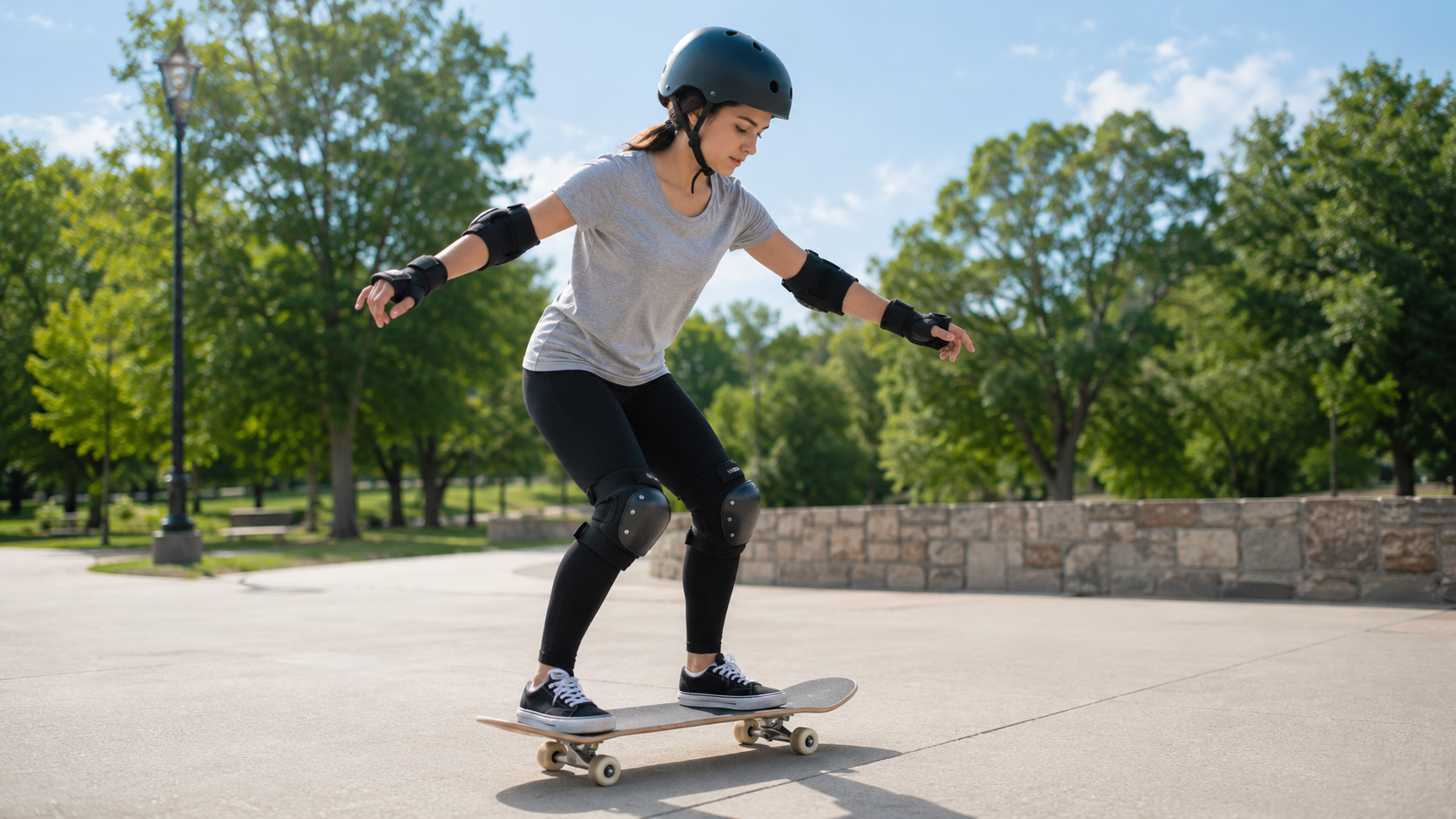
A helmet is one of the most important pieces of beginner skateboarding gear. Beginners fall often, and head injuries can happen even at low speeds.
Some people avoid helmets because they think they look awkward or unnecessary. But safety gear is normal in skateboarding, especially when you are learning. A helmet does not mean you are scared. It means you are taking the sport seriously.
Choose a skateboarding helmet that fits properly. It should sit level on your head, not tilted far back. It should feel snug but not painfully tight. When you shake your head gently, it should not slide around. The chin strap should be secure enough that the helmet stays in place if you fall.
A bike helmet is better than no helmet, but a certified skate-style helmet is usually a better choice for skateboarding because it is designed for the types of falls skaters commonly have.
Replace a helmet after a significant impact, even if it looks fine on the outside. Damage is not always visible.
Use Pads While You Learn
Wrist guards, knee pads, and elbow pads are especially helpful for beginners. When you are new, your reactions are not trained yet. You may instinctively throw your hands out, land on your knees, or fall sideways onto your elbows.
Wrist injuries are common because many people try to catch themselves with stiff arms. Wrist guards can help reduce the impact and give you a little more confidence while learning.
Knee pads are useful because beginners often drop to their knees during falls or awkward stops. Elbow pads can protect against scrapes and impact when falling backward or sideways.
You may not want to wear full pads forever, but during the learning stage, they can make practice less intimidating. If fear of falling keeps you stiff, pads can help you relax enough to actually learn balance.
Just remember that protective gear does not make you invincible. It reduces risk, but you still need to practice on safe surfaces and avoid movements beyond your level.
Choose a Safe Practice Surface
The road surface matters a lot in skateboarding. A skateboard wheel can catch on cracks, rocks, sticks, rough pavement, or uneven seams. For beginners, these small obstacles can cause sudden falls.
Start on a smooth, flat, open surface. An empty parking lot, quiet basketball court, smooth driveway, or beginner-friendly skate area can work well. Avoid busy roads, steep hills, crowded sidewalks, wet pavement, gravel, and rough asphalt.
Before you start, scan the ground. Look for pebbles, cracks, sand, water, leaves, oil, or uneven patches. Even a tiny rock can stop the board while your body keeps moving forward.
Flat ground is best at first. Hills may seem fun, but they introduce speed before you have control. If you cannot stop confidently on flat ground, you are not ready for downhill riding.
Also give yourself space. Beginners need room to wobble, turn, step off, and make mistakes. Practicing too close to cars, walls, curbs, people, or traffic adds unnecessary risk.
Wear the Right Shoes
Shoes affect your grip, balance, and control. Skateboarding is much harder in sandals, slippery sneakers, platform shoes, loose shoes, or shoes with thick unstable soles.
Choose flat-soled shoes with decent grip. Skate shoes are designed for board feel and traction, but any comfortable flat shoe with a stable sole is better than footwear that slides around.
Your shoes should fit securely. If your foot moves inside the shoe, your balance becomes less reliable. Avoid open-toe shoes completely. They do not protect your feet and can easily slip off.
Good shoes help you feel the board. Beginners often underestimate this. When you can feel the board under your feet, it becomes easier to adjust your weight and stay balanced.
Learn Your Stance First
Before pushing, turning, or trying anything else, figure out your stance. Most skaters ride either regular or goofy. Regular means the left foot is forward. Goofy means the right foot is forward.
Neither is better. It is simply about what feels natural.
A quick way to test this is to stand on the board on grass or carpet so it does not roll. Try both stances. Which one feels more stable? Which foot naturally wants to be in front?
Your front foot usually stays on the board while your back foot pushes. Beginners sometimes switch around too much and feel confused. Once you find the stance that feels more natural, practice it consistently.
Stand with your knees slightly bent and your feet over the bolts, not too close together. Keep your shoulders relaxed. Avoid standing stiff and tall like you are balancing on a narrow ledge. A soft athletic stance gives you better control.
Bend Your Knees and Stay Relaxed
Balance on a skateboard does not come from locking your body in place. It comes from staying loose enough to adjust.
Beginners often get scared and stiffen their legs. Unfortunately, stiff legs make the board feel even more unstable. When your knees are locked, every tiny movement of the board travels straight through your body.
Bend your knees slightly. Keep your weight centered over the board. Let your ankles and knees make small adjustments. Your upper body should stay calm, not swinging wildly from side to side.
A helpful cue is: “soft knees, quiet shoulders.”
If you feel like you are about to fall, do not panic and throw your body backward. Step off if you can. Learning to step off calmly is part of beginner safety.
Practice Getting On and Off the Board
This sounds basic, but it is one of the most useful beginner skills.
Before rolling, practice stepping onto the board and stepping off. Do this first on grass or carpet so the board stays mostly still. Then try it on smooth pavement.
Step on with your front foot first, then place your back foot. Keep your knees bent. To step off, remove your back foot first and place it on the ground beside the board.
Beginners often fall because they try to stay on the board too long after losing control. It is better to step off early than to fight a fall badly.
Practice small movements: standing, stepping off, repositioning your feet, and getting back on. These little habits build confidence.
Learn to Push Slowly
Pushing is where many beginners feel awkward. The board rolls, one foot is moving, and balance suddenly becomes harder.
Keep your front foot on the board near the front bolts, angled slightly forward. Use your back foot to push gently against the ground. Start with small pushes, not powerful ones.
After pushing, place your back foot on the board and turn your front foot slightly more sideways into your riding stance. This foot adjustment takes practice. Do not rush it.
Look where you want to go, not straight down at your feet the whole time. It is okay to glance down, but staring at the board can throw off your balance and reduce awareness of your surroundings.
At first, one gentle push is enough. Roll a short distance, step off, and reset. Gradually increase the number of pushes as you feel more stable.
Learn How to Stop Before You Go Faster
Stopping is not optional. It is one of the first skills every beginner should learn.
The simplest beginner stop is stepping off at very low speed. This only works when you are moving slowly. As you go faster, jumping off can become risky.
Another basic method is foot braking. Keep your front foot on the board, lower your back foot gently to the ground, and drag it lightly to slow down. This takes balance, so practice at slow speed first.
Do not rely on crashing into grass, curbs, walls, or people to stop. That may seem harmless at low speed, but it is a bad habit and can lead to injuries.
Avoid hills until you can stop confidently. Speed feels exciting, but if you do not know how to slow down, it becomes dangerous quickly.
A beginner should be able to start, roll, slow down, stop, and step off on flat ground before moving to more challenging areas.
Understand How Falls Usually Happen
Falls are part of skateboarding, but understanding why they happen can help you reduce them.
Many beginner falls happen because the board suddenly stops while the rider keeps moving. This can happen when a wheel hits a rock, crack, stick, or rough patch.
Other falls happen because the rider leans too far back. When your weight shifts behind the board, the board can shoot forward and you fall backward.
Leaning too far forward can also cause problems, especially if the board slows suddenly. You may pitch forward and try to catch yourself with your hands.
Turning too sharply, pushing too hard, or standing with stiff legs can also lead to falls.
The lesson is not to fear every movement. The lesson is to ride on smooth surfaces, keep your knees soft, stay centered, and avoid sudden speed before you have control.
Learn to Fall More Safely
You cannot prevent every fall, so learning safer falling habits matters.
Try not to catch yourself with stiff, locked arms. This can put a lot of force into the wrists, elbows, and shoulders. Wrist guards can help, but your falling habits still matter.
If you feel yourself going down, try to stay loose. Bend your arms and knees. Let your body roll or slide rather than landing rigidly. On flat ground, a controlled roll can spread the impact better than a hard stop.
If you are wearing knee pads and falling forward, learning to slide on the pads can be useful, especially later in skateparks. But beginners should practice this carefully and ideally with guidance.
Falling backward can be more dangerous because of head impact. This is another reason a helmet matters. Try to avoid leaning back when scared. Keep your weight centered or slightly forward, with control.
After a fall, pause. Check yourself. Do not immediately jump back on the board if you feel dizzy, sharp pain, or disoriented.
Avoid Tricks Too Early
It is tempting to learn tricks right away. Skateboarding videos make ollies, kickturns, manuals, and flips look exciting. But tricks require balance, board control, timing, and falling skills.
Trying tricks before you can ride comfortably can lead to unnecessary injuries. You may land awkwardly, slip backward, twist an ankle, or fall onto your wrists.
Before learning tricks, build the basics:
Comfortable stance
Smooth pushing
Controlled stopping
Gentle turning
Safe stepping off
Awareness of road surface
Basic balance while rolling
Once those feel natural, small beginner tricks or skills can be introduced gradually. Even then, practice in a safe area with protective gear.
There is nothing wrong with wanting to progress. Just do not skip the foundation.
Watch Your Wrists, Ankles, and Knees
Skateboarding can stress several body parts, especially while learning.
The wrists often take impact during falls. Wrist guards and better falling habits can help.
The ankles work constantly to balance and steer the board. They can also twist during awkward landings or sudden step-offs. Warm up your ankles with circles, calf raises, and gentle mobility before practice.
The knees help absorb movement and maintain balance. Keeping them slightly bent is protective, but deep awkward bends or repeated hard falls can irritate them.
Do not ignore pain that feels sharp, swollen, unstable, or worsening. Soreness from learning can happen, but joint pain should be taken seriously.
If you fall and cannot put weight on a foot, have significant swelling, hit your head, or feel dizzy, stop skating and get appropriate help.
Warm Up Before Riding
Skateboarding may not look like a workout at first, but your body still needs preparation. A short warm-up can make your balance and reactions better.
Start with a few minutes of light movement. Walk briskly, jog lightly, or do gentle side steps. Then move your ankles, knees, hips, wrists, and shoulders.
Try ankle circles, bodyweight squats, hip circles, wrist circles, arm swings, and calf raises. You do not need to stretch aggressively. The goal is to feel awake and mobile.
Warm up especially well if the weather is cold. Cold muscles and stiff joints may react more slowly.
Stay Away From Traffic
Beginners should not practice near cars. Roads add too many risks: traffic, parked cars, uneven pavement, drains, curbs, pedestrians, and distractions.
Even if a road seems quiet, a beginner may not be able to stop or turn quickly enough when a car appears. Skateboarding near traffic requires control and awareness that beginners are still developing.
Choose controlled spaces. Empty lots, smooth courts, and beginner-friendly skate areas are much safer.
Also respect pedestrians. Sidewalks can be crowded, unpredictable, and full of obstacles. If you are still learning, avoid places where you might roll into someone.
Check Your Board
A poorly maintained board can make learning harder and less safe.
Before riding, check that the wheels spin properly, the trucks are not dangerously loose, and the deck is not cracked. Make sure the grip tape still gives traction. If the board feels unstable, wobbly, or damaged, inspect it before continuing.
Beginners sometimes use old boards that have been sitting in a garage for years. That may be okay, but check the condition first. Dry, cracked wheels or loose hardware can affect control.
Truck tightness also matters. Very loose trucks turn easily but may feel unstable for beginners. Very tight trucks feel stable but harder to turn. A moderate setup is usually easier while learning.
If you are unsure, ask someone at a skate shop or an experienced skater to help adjust the board.
Practice in Short Sessions
Skateboarding uses focus. When you get tired, your balance and reaction time get worse.
Beginners may not notice fatigue right away because they are excited. But tired legs, sore feet, and reduced concentration can lead to falls.
Practice in shorter sessions with breaks. Drink water, especially in warm weather. Stop before you are completely exhausted.
A good beginner session might include standing practice, pushing, stopping, turning, and a few minutes of relaxed rolling. You do not need to practice until you are frustrated or sore.
Progress comes from consistency, not from one overly long session.
Be Patient With Fear
Feeling nervous is normal. The board moves. The ground is hard. Falling is possible. Fear is not a sign that you are bad at skateboarding.
But panic can make your body stiff, and stiffness makes balance harder. That is why beginners should create a low-pressure practice environment.
Start on flat ground. Wear protective gear. Keep speeds low. Practice stepping off. Celebrate small improvements, like rolling a few feet more smoothly or stopping with better control.
Confidence grows from repeated safe practice. You do not have to force yourself into scary situations to improve.
A Beginner Skateboarding Safety Checklist
Before you ride, run through a simple checklist:
Helmet fits snugly and securely
Wrist guards, knee pads, and elbow pads are on
Shoes are flat, secure, and grippy
Board is in good condition
Practice area is smooth, flat, and open
Ground is clear of rocks, cracks, water, and debris
You can step on and off the board safely
You are practicing at a speed you can control
You know how to slow down or stop
You are away from traffic and crowds
This checklist may seem simple, but it covers many of the most common beginner problems.
Final Thoughts
Skateboarding is fun, creative, and rewarding, but it asks for patience. Beginners should not feel pressured to learn tricks, ride fast, or copy advanced skaters right away. The basics matter more than they look.
Wear a helmet. Use pads while learning. Choose smooth, flat surfaces. Learn your stance. Keep your knees soft. Practice pushing, stopping, and stepping off before attempting anything more advanced. Pay attention to cracks, rocks, and road conditions. Learn safer falling habits and stop when you feel tired or hurt.
The more control you build early, the more freedom you will have later. Balance is not something you either have or do not have. It is a skill you develop little by little.
Skateboarding becomes much more enjoyable when you stop fighting the board and start understanding it. Begin slowly, protect your body, and let each practice session make you a little more comfortable on the wheels.
Hi, I’m the creator and editor behind ZestyHabit. I research everyday safety, first aid, and practical wellness topics using official guidance and reliable public sources, then turn that information into clear, realistic steps for daily life.
My goal is to help readers make safer, better-informed choices at home and beyond.