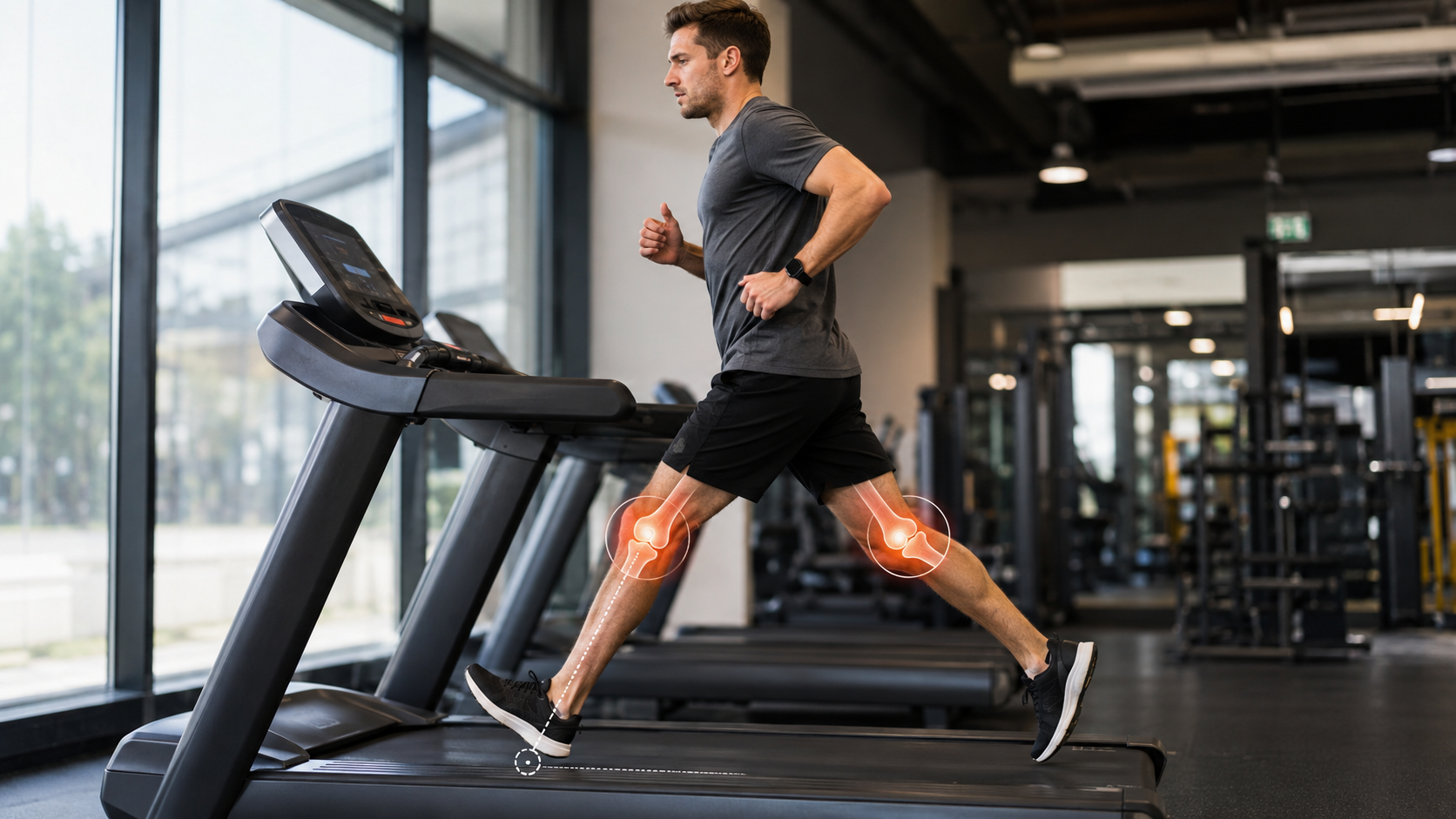
Treadmill Precautions: Common Mistakes That Can Affect Your Knees
Minjin Park
·
The treadmill is one of the most convenient pieces of exercise equipment. You can walk or run indoors, control your speed, adjust the incline, and exercise without worrying about weather, traffic, or uneven sidewalks. For many people, it is the easiest way to stay consistent with cardio.
But convenience can also make the treadmill feel too simple.
You step on, press start, choose a speed, and keep moving. Because the machine controls the pace, it is easy to ignore small form problems until your knees start feeling sore. Maybe you set the incline too high. Maybe you hold the handrails without realizing it changes your posture. Maybe your stride gets too long when the belt speeds up. Over time, these small habits can create unnecessary stress on your knees, hips, feet, and lower back.
The treadmill is not bad for your knees by itself. In fact, it can be a useful tool when used thoughtfully. But like any exercise, how you use it matters.
This guide breaks down common treadmill mistakes that may affect your knees and how to make your walking or running sessions safer, smoother, and more comfortable.
Knee discomfort on the treadmill usually does not come from one single step. It often builds from repeated movement patterns.
Each stride sends force through your feet, ankles, knees, hips, and core. If your speed is too fast, your stride is too long, your shoes are worn out, or your posture is awkward, the knee may absorb more stress than it should.
The treadmill also has a moving belt, which changes the way some people walk or run. Instead of naturally pushing forward across the ground, you are keeping pace with a surface moving underneath you. This can make people overstride, lean back, grip the handrails, or stiffen their legs without noticing.
Common treadmill-related knee stress can come from:
Increasing speed too quickly
Using a steep incline before your legs are ready
Holding the handrails for long periods
Taking overly long strides
Landing heavily on the heels
Wearing unsupportive shoes
Skipping warm-ups and cool-downs
Doing too much treadmill work without recovery
Most of these issues are fixable with small adjustments.
Mistake 1: Starting Too Fast
A common treadmill mistake is starting at a speed your body is not ready for.
Maybe you feel motivated and immediately set the machine to a brisk pace. Maybe you copy the speed someone else uses. Maybe you think slower walking does not “count.” But your joints and muscles need time to warm up before handling faster movement.
When you start too fast, your stride may become stiff and uncontrolled. Your knees may absorb more impact because your hips, calves, and feet have not fully warmed up yet. You may also start gripping the handrails or leaning back to keep up.
Begin with an easy pace for five to ten minutes. Let your breathing, posture, and steps settle before increasing speed.
A good warm-up pace should feel comfortable enough that you can breathe easily and walk naturally. Once your body feels ready, increase the speed gradually.
Mistake 2: Increasing Speed Too Quickly
Speed can be useful, but sudden jumps are not always friendly to the knees.
If you move from an easy walk to a near-jog too quickly, your body may not adjust smoothly. Your stride may become longer, your feet may hit harder, and your knees may feel more pressure.
Instead of jumping the speed up dramatically, increase in small steps. Give your body a minute or two to adjust before deciding whether to go faster.
For walking, even a small increase can change your form. A pace that feels slightly challenging but controlled is usually better than a speed that makes you slap the belt, hold the rails, or lean forward awkwardly.
For running, the same idea applies. Speed should not come at the cost of control. If your knees start feeling uncomfortable as the pace rises, slow down and check your stride.
Mistake 3: Setting the Incline Too High
Incline walking is popular because it can raise your heart rate without running. It can also help train the glutes, hamstrings, and calves. But a steep incline can become a problem if your body is not prepared for it.
When the incline is too high, you may start leaning forward, gripping the handrails, shortening your ankle movement, or overworking your calves. Some people also feel more pressure around the knees, especially if they push hard uphill for too long.
The issue is not incline itself. The issue is using too much incline too soon.
Start with a gentle incline, especially if you are new to treadmill workouts. Even 1% to 3% can feel different from flat walking. If that feels good, you can slowly increase over time.
A very steep incline may be useful for some people, but it should not destroy your form. If you cannot walk without holding the rails, the incline is probably too high for your current level.
Mistake 4: Holding the Handrails the Whole Time
Handrails are there for safety. They are helpful when stepping on or off the treadmill, recovering balance, or adjusting settings. But holding them for the entire workout can change your posture and stride.
When you grip the rails, your body weight is partly supported by your arms. This may make the workout feel easier, but it can also distort your natural walking pattern. You may lean back, hunch your shoulders, or take unnatural steps. On a steep incline, holding the rails can turn the workout into something very different from true uphill walking.
This matters for your knees because your lower body is no longer moving naturally. The machine speed and your body position may not match.
Try to walk or run without holding the rails once you are balanced. Let your arms swing naturally at your sides. If you feel like you need the handrails to survive the speed or incline, reduce the setting.
It is better to use a lower speed with good form than a high speed while hanging onto the treadmill.
Mistake 5: Overstriding
Overstriding means your foot lands too far in front of your body. On a treadmill, this often happens when the speed is too high or when someone tries to “reach” forward with each step.
Overstriding can increase braking force. Instead of landing smoothly under your body, your foot hits out in front, and your knee has to deal with more impact.
For walkers, overstriding may feel like a long, exaggerated step. For runners, it may look like the heel striking far ahead of the hips.
A better approach is to take slightly shorter, quicker steps. Your foot should land closer under your body, not far in front of you. This can help reduce knee stress and make your movement feel smoother.
If you hear loud slapping on the belt, check your stride. The treadmill should not sound like you are fighting it.
Mistake 6: Landing Too Hard
A treadmill can reveal heavy foot strikes quickly. If each step sounds loud and forceful, your knees may be absorbing more impact than necessary.
Heavy landing can come from fatigue, poor shoes, overstriding, stiff legs, or too much speed. Some people also lock their knees slightly as they step, which makes the impact feel sharper.
Try to land quietly. This does not mean tiptoeing or changing your gait dramatically. It means moving with a little more control.
A helpful cue is: “quiet feet.”
Keep your knees soft, not locked. Let your ankles, calves, hips, and core help absorb movement. If quieting your steps feels impossible, slow the treadmill down.
Mistake 7: Leaning Too Far Forward or Backward
Good posture matters on the treadmill.
Leaning too far forward can happen when the incline is high or when you are trying to push through fatigue. Leaning backward often happens when the speed is too fast and you feel like the belt is pulling you.
Both positions can affect your stride and increase stress on the knees or lower back.
Aim for a tall, relaxed posture. Keep your head lifted, shoulders down, chest open, and eyes looking forward. Your arms should swing naturally, not cross tightly in front of your body.
A slight forward lean from the ankles can happen during running, but bending from the waist is different. You should not feel folded over the console.
If your posture falls apart, lower the speed or incline.
Mistake 8: Skipping the Cool-Down
Many people finish a treadmill workout by pressing stop and stepping off immediately. After a hard session, that sudden stop can feel jarring. Your heart rate is elevated, your legs are warm, and your body needs a short transition.
A cool-down helps your breathing and movement return to normal. It also gives your knees and legs a gentler finish instead of ending abruptly after intense effort.
Spend five minutes walking at an easy pace after your main workout. If you used incline, bring it back down gradually. Let your stride become relaxed before you step off.
This simple habit can make the entire workout feel better.
Mistake 9: Wearing the Wrong Shoes
Shoes matter on the treadmill, especially if you walk or run often.
Old, flat, or unsupportive shoes may not absorb impact well. Shoes that are too tight can affect your foot movement. Shoes that are too loose can cause sliding, friction, or instability.
Your shoes should feel comfortable, secure, and appropriate for the type of treadmill workout you do. Running shoes may be better if you jog or run. Walking shoes can work well for steady walking. The best shoe is one that supports your foot without forcing it into an uncomfortable position.
If your knees started hurting around the same time your shoes got older, the shoes may be part of the problem.
Mistake 10: Doing Too Much Incline Walking Every Day
Incline walking can feel addictive because it raises the intensity quickly. It may seem easier on the body than running, but it still places repeated demand on the calves, Achilles tendons, knees, hips, and lower back.
Doing steep incline workouts every day may create overuse discomfort, especially if you are also strength training or walking a lot outside.
Mix your treadmill sessions. Some days can be flat and moderate. Some can include short incline intervals. Some can be easier recovery walks.
Your body usually handles variety better than repeating the same intense pattern every session.
Mistake 11: Ignoring Knee Pain Early
Knee pain is not something to push through blindly.
Mild muscle fatigue is normal. A warm feeling in the thighs or glutes during incline walking can be expected. But sharp pain, swelling, pinching, or pain that changes the way you walk deserves attention.
If your knee starts hurting during a treadmill session, reduce the speed and incline. If it continues, stop. Do not try to finish the workout just because the timer says you have ten minutes left.
Early adjustment can prevent a small irritation from becoming a longer setback.
Notice when the pain happens. Does it appear only at high speed? Only with incline? Only after 20 minutes? Only in certain shoes? These clues can help you adjust your routine.
Mistake 12: Looking Down at the Belt
It is natural to glance down occasionally, especially when adjusting your position. But constantly looking down can change your posture.
When your head drops, your shoulders may round, your upper back may hunch, and your stride may become less natural. This can affect the whole chain of movement, including the knees.
Try to look forward. Keep your gaze relaxed and your neck neutral. If you watch a screen, place it at a comfortable height when possible. Avoid staring down at your phone while walking fast.
A treadmill workout should not turn into a hunched-over scroll session.
Mistake 13: Standing Too Close to the Console
Some people walk very close to the front of the treadmill, almost crowding the console. This often happens when they are nervous, holding the rails, or using a high incline.
Standing too close can shorten your stride unnaturally and make your posture stiff. It may also cause you to hit the front cover with your feet.
Try to stay around the middle of the belt. Give yourself enough room to move naturally. You should not feel like you are being squeezed into a tiny space.
If you keep drifting forward, check whether the speed is too slow, the incline is too steep, or you are relying on the handrails.
Mistake 14: Forgetting Strength Training
Knee comfort is not only about what happens on the treadmill. Strong muscles around the hips, thighs, calves, and core help support better movement.
If your glutes are weak or your hips lack control, your knees may move inward or absorb more stress. If your calves are tight or weak, your stride may feel less smooth. If your core is tired, your posture may collapse.
Helpful strength exercises include:
Glute bridges
Step-ups
Bodyweight squats
Calf raises
Side leg raises
Wall sits
Dead bugs
Clamshells
You do not need a complicated routine. A few basic strength exercises two or three times per week can support your treadmill workouts.
How to Use Speed More Safely
Speed should match your current fitness level and form.
For walking, choose a pace where you can move without gripping the rails or taking awkwardly long steps. Your arms should swing naturally, and your feet should land quietly.
For jogging or running, avoid jumping into a fast pace before warming up. Let your body gradually adjust. If your stride gets loud, stiff, or uneven, slow down.
Intervals can be useful, but keep them realistic. A beginner might alternate one minute of faster walking with two minutes of easy walking. A more experienced person might use short running intervals. The key is to maintain control.
Fast does not automatically mean better. Controlled movement is more valuable than a number on the screen.
How to Use Incline More Safely
Incline can be helpful when used with good form.
Start low. Increase gradually. Keep your posture tall. Avoid hanging onto the rails. Use shorter, controlled steps rather than huge strides.
If your calves burn intensely, your knees ache, or your lower back tightens, the incline may be too high or the session may be too long.
You can use incline in short segments instead of keeping it steep for the entire workout. For example, alternate a few minutes at a gentle incline with a few minutes flat. This gives your body variety and reduces constant stress on the same tissues.
A Knee-Friendly Treadmill Routine for Beginners
Here is a simple structure:
Start with 5 minutes of easy walking on a flat setting. Gradually increase to a comfortable moderate pace for 10 to 20 minutes. Keep your hands off the rails, your posture tall, and your steps quiet. If you want incline, add a gentle incline for 1 to 3 minutes at a time, then return to flat walking. Finish with 5 minutes of slower walking.
This may sound basic, but it builds the foundation. Once your body adapts, you can increase time, speed, or incline slowly.
Do not increase everything at once. If you add incline, keep speed moderate. If you add speed, keep incline low. If you increase duration, avoid making the whole session harder at the same time.
When to Stop or Modify Your Workout
Stop or reduce intensity if you notice:
Sharp knee pain
Swelling
Pain that changes your stride
Knee buckling or instability
Numbness or tingling
Pain that worsens as you continue
Lingering pain after workouts
These signs do not mean you can never use a treadmill. They mean your current setup, intensity, or form may need adjustment. If symptoms persist, it is best to speak with a healthcare professional or physical therapist.
Final Thoughts
The treadmill can be a great tool for walking, running, and building consistency. But small mistakes can affect your knees over time, especially when speed, incline, handrail use, and stride are not managed well.
Start slowly. Increase speed gradually. Use incline with respect. Avoid holding the handrails unless you need them for safety. Keep your steps shorter, quieter, and more controlled. Wear supportive shoes and give your body recovery when it needs it.
A good treadmill workout should challenge you without making your knees feel punished. When you move with better form and smarter settings, the treadmill becomes not just convenient, but sustainable.
Hi, I’m the creator and editor behind ZestyHabit. I research everyday safety, first aid, and practical wellness topics using official guidance and reliable public sources, then turn that information into clear, realistic steps for daily life.
My goal is to help readers make safer, better-informed choices at home and beyond.