Foam Rolling Precautions: What Not to Do When Releasing Muscle Tension
Minjin Park
·
Foam rolling has become one of those fitness habits that seems simple enough to do without much instruction. You grab a roller, place it under a tight muscle, move back and forth, and hope the stiffness melts away. It is common in gyms, Pilates studios, physical therapy spaces, home workout routines, and even office recovery corners.
And yes, foam rolling can feel helpful. It may reduce that heavy, tight feeling after exercise, help you slow down after a long day, and make your muscles feel a little more relaxed before stretching or movement.
But foam rolling is not just “the harder, the better.”
Many beginners press too aggressively, roll directly over sensitive areas, stay on one painful spot for too long, or use foam rolling as a way to punish sore muscles. Instead of feeling better, they end up bruised, irritated, or even more tender the next day.
Foam rolling should feel like controlled pressure, not a battle with your body. The goal is to release tension, improve comfort, and support recovery, not create extra pain.
Here is what not to do when foam rolling, especially if you are new to it or using it for sore, tight muscles.
One of the biggest myths about foam rolling is that it must be extremely painful to work.
Some people believe that if they are not wincing, sweating, or holding their breath, they are not rolling hard enough. This is not a helpful mindset. Strong pressure can sometimes feel intense, especially on tight areas, but it should still feel manageable.
A good foam rolling sensation may feel like firm pressure, mild discomfort, or a “good hurt.” It should not feel sharp, burning, stabbing, or unbearable.
If you are clenching your jaw, holding your breath, or tensing your whole body, the pressure is probably too much. When your body reacts by guarding, the muscle may not relax well anyway.
Use a pressure level you can breathe through. That simple rule can prevent a lot of unnecessary soreness.
Do Not Roll Directly on Joints
Foam rollers are designed for soft tissue areas, not joints.
Avoid rolling directly over your knees, elbows, ankles, wrists, neck bones, or spine. These areas do not have the same amount of muscle padding and may become irritated by direct pressure.
For example, if your thighs feel tight, roll the muscles above the knee, not the kneecap itself. If your calves feel tight, roll the calf muscle, not the back of the knee. If your upper back feels stiff, roll around the upper back muscles, not aggressively over the neck or lower spine.
The roller should move over muscle tissue, not bony points.
If you feel the roller pressing into bone, shift your position slightly or choose a softer tool.
Do Not Roll Your Lower Back Aggressively
Many people want to foam roll the lower back because it often feels tight. But direct, aggressive rolling on the lower back can be uncomfortable and may not be the safest choice for many people.
The lower back does not have the same ribcage support that the upper back does. When you place a roller under it and move back and forth, the area can arch, compress, or become irritated.
If your lower back feels tight, it may be better to focus on surrounding areas: glutes, hips, hamstrings, hip flexors, and upper back. These areas often influence lower-back tension.
For direct lower-back relief, gentle stretching, breathing, walking, or guided mobility work may be more appropriate than hard rolling.
If you do use a roller near the lower back, keep it very gentle and avoid forcing your spine over the roller.
Do Not Roll Over Sharp Pain
Foam rolling can feel uncomfortable, but sharp pain is a stop sign.
Sharp pain may mean you are pressing on a nerve, an irritated tendon, a bruise, an injury, or an area that simply should not be compressed. Do not try to “break up” pain by grinding harder.
Stop rolling if you feel:
Sharp or stabbing pain
Numbness
Tingling
Burning nerve-like sensations
Pain that shoots down the leg or arm
Sudden weakness
Pain that gets worse as you continue
A tight muscle may respond to gentle pressure. An irritated tissue may become more irritated if you keep pressing on it.
If pain feels unusual, intense, or persistent, skip foam rolling that area and consider getting professional guidance.
Do Not Stay on One Spot Too Long
When people find a tender spot, they often stay there for several minutes, pressing harder and waiting for it to “release.” This can backfire.
Too much pressure for too long can irritate the tissue and leave the area feeling bruised or sore later. You do not need to attack a knot until it disappears completely.
Instead, pause briefly on a tender area for a few slow breaths, then move on. You can return to it later if needed.
A good guideline is to spend about 20 to 30 seconds on a specific tender spot, not several painful minutes. For a larger muscle group, one to two minutes total is usually enough for beginners.
More is not always better. Often, gentle and consistent works better than intense and excessive.
Do Not Roll Too Fast
Fast rolling may look active, but it usually does not give your body time to respond.
If you zip back and forth quickly, you may miss the areas that need attention. You may also create friction without much useful pressure. Foam rolling works best when you move slowly enough to notice what you are feeling.
Think of scanning the muscle. Move a few inches at a time. When you find a tender area, slow down, breathe, and let the pressure settle.
You do not need to move in slow motion forever, but avoid treating foam rolling like a race. The slower pace helps you stay in control and avoid accidentally rolling onto sensitive areas.
Do Not Use Maximum Pressure Right Away
Beginners often make the mistake of putting their full body weight onto the roller immediately. This can be too intense, especially on the calves, IT band area, quads, glutes, and upper back.
Start lighter. Support some of your weight with your hands or opposite leg. You can always increase pressure gradually if it feels comfortable.
For example, when rolling your calf, place one leg on the roller and keep the other foot on the floor to control pressure. If that feels fine, you can stack the other leg on top later. When rolling the quads, use your arms to support your body instead of collapsing all your weight into the roller.
Your first few passes should be gentle. Let your body decide whether it wants more pressure.
Do Not Hold Your Breath
Breathing is one of the easiest ways to tell whether you are rolling too hard.
If you hold your breath, your body may tense up. Your shoulders may rise, your jaw may clench, and your muscles may resist the pressure. That is the opposite of what you want.
Try to breathe slowly and steadily as you roll. When you find a tender spot, take a long exhale. Let your body soften around the pressure.
A simple rule: if you cannot breathe normally, reduce the pressure.
Foam rolling should help your nervous system calm down. Breath-holding turns it into a stress response.
Do Not Foam Roll Fresh Injuries
Foam rolling is not a cure-all for every ache.
If you recently strained a muscle, twisted an ankle, fell, bruised an area, or developed sudden pain, do not immediately press a roller into it. Fresh injuries often need protection, rest, and proper evaluation, not deep pressure.
Rolling over swelling, bruising, or acute pain may make the area more irritated.
Be especially careful if you notice redness, heat, swelling, severe tenderness, or pain that appeared suddenly during activity. In those cases, foam rolling is not the first tool to reach for.
Use common sense. Tension from a hard workout is one thing. A possible injury is another.
Do Not Roll Bruised or Inflamed Areas
If an area is already bruised, swollen, or visibly irritated, skip it.
Foam rolling adds pressure. Pressure on a bruise can make discomfort worse and may delay the area from calming down. Rolling over inflamed tissue can also increase sensitivity.
This is especially important after a hard workout, fall, sports contact, or any activity that left a specific spot tender to touch.
Wait until the area feels normal again before applying pressure. Even then, start gently.
Do Not Roll Directly on the IT Band Too Aggressively
The outer thigh, often called the IT band area, is one of the most painful places people foam roll. Many believe they need to crush this area to fix tightness.
But the IT band itself is a thick band of connective tissue, not a muscle that relaxes the same way a muscle does. Aggressive rolling on the side of the thigh can be very uncomfortable and may irritate the area.
If the outside of your thigh feels tight, consider rolling nearby muscles more gently, such as the quads, glutes, and tensor fasciae latae area near the side of the hip. You can also work on hip strength and mobility instead of relying only on pressure.
If you do roll the outer thigh, use lighter pressure and avoid grinding.
Do Not Foam Roll as a Replacement for Strength Training
Foam rolling may help you feel looser temporarily, but it does not fix every movement problem.
Sometimes muscle tension comes from weakness, poor posture, repetitive movement, or lack of control. If your hips, glutes, core, or upper back are weak, foam rolling may provide short-term relief, but the same tightness may keep returning.
For example, tight calves may need gradual strengthening and better footwear. Tight hip flexors may need glute strengthening and less sitting. Tight shoulders may need upper-back strength and posture work.
Foam rolling can be part of your routine, but it should not be the whole routine.
Combine it with mobility, stretching, strength training, walking, hydration, and recovery.
Do Not Foam Roll Only Where It Hurts
The place that feels tight is not always the only place that needs attention.
For example, knee discomfort may be influenced by quads, glutes, calves, or hip control. Lower-back tightness may be related to hips, hamstrings, glutes, or upper-back stiffness. Shoulder tension may involve the chest, lats, upper back, and neck habits.
Instead of attacking one painful spot, think about the surrounding muscles.
If your calves feel tight, roll the calves gently, but also consider your feet and hamstrings. If your hips feel tight, work around the glutes, quads, and hip flexors. If your upper back feels stiff, open the chest and move the shoulders too.
The body is connected. A broader, gentler approach often works better than obsessing over one sore point.
Do Not Roll Before Exercise Until You Feel Weak or Loose
Foam rolling before exercise can be useful, especially if it helps you feel more mobile. But spending too long on intense rolling before a workout can make some people feel relaxed in a way that is not ideal for performance.
Before exercise, keep foam rolling brief and moderate. The goal is to prepare your body, not make it feel sleepy or overly tender.
After a short rolling session, add dynamic movement. For example, if you roll your quads and calves before a walk or leg workout, follow with leg swings, bodyweight squats, or easy walking. This helps your body turn that improved range into active control.
Think of pre-workout foam rolling as preparation, not a full recovery session.
Do Not Foam Roll Hard Right Before Bed If It Wakes You Up
Some people love foam rolling at night because it helps them relax. Others find that intense pressure wakes up their body and makes them feel alert.
If foam rolling before bed helps you unwind, keep it gentle and slow. Focus on breathing and comfort. Avoid painful pressure or long sessions.
If it makes you feel more energized or sore, move it earlier in the day.
Timing matters because recovery habits should support your routine, not disrupt it.
Do Not Expect Instant Permanent Results
Foam rolling can create a temporary feeling of relief, but it may not permanently solve tightness after one session.
This does not mean it is useless. It simply means you should use realistic expectations. Foam rolling may help you feel better before movement, after a workout, or during a recovery routine. But if the same area tightens repeatedly, look at the bigger picture.
Foam rollers come in different densities and textures. Some are soft and smooth. Others are very firm, ridged, or spiky.
Beginners often assume a harder roller is better. But a very firm or textured roller can be too intense, especially if your muscles are sensitive.
Start with a medium or softer roller. Learn how your body responds. Once you have more experience, you can decide whether a firmer roller is useful.
A tool that makes you dread recovery is probably not the right tool for you.
Do Not Ignore Positioning
Foam rolling is not just lying on the roller and hoping for the best. Your body position affects pressure, comfort, and safety.
Keep your movements controlled. Use your hands and feet for support. Avoid twisting awkwardly just to reach a spot. Keep your neck relaxed. Do not let your shoulders collapse.
If a position feels unstable, change it. You can roll the same muscle with less pressure or use a massage ball against a wall instead of the floor.
For example, rolling the upper back on the floor may be too intense for some people. Using a ball against the wall can offer more control. Rolling calves with both legs stacked may be too much, so keep one foot on the floor.
Control is more important than intensity.
Areas That Need Extra Caution
Some areas are more sensitive and should be approached carefully.
Be cautious around:
Neck
Lower back
Front of the throat
Armpit area
Inner thigh
Back of the knee
Bony points around hips
Kneecaps
Ankles
Elbows
Fresh scars or bruises
These areas may contain nerves, blood vessels, joints, or delicate tissues that do not respond well to heavy pressure.
A beginner routine should be short, gentle, and easy to repeat.
Start with the calves. Roll slowly from below the knee to above the ankle, avoiding the back of the knee and the ankle joint. Spend about 30 to 60 seconds per side.
Move to the quads. Lie face down with the roller under the front of one thigh. Use your arms and opposite leg to control pressure. Roll from the upper thigh to above the knee, not over the kneecap.
Then try the glutes. Sit on the roller and shift slightly to one side. Roll gently over the glute muscle, avoiding sharp pain.
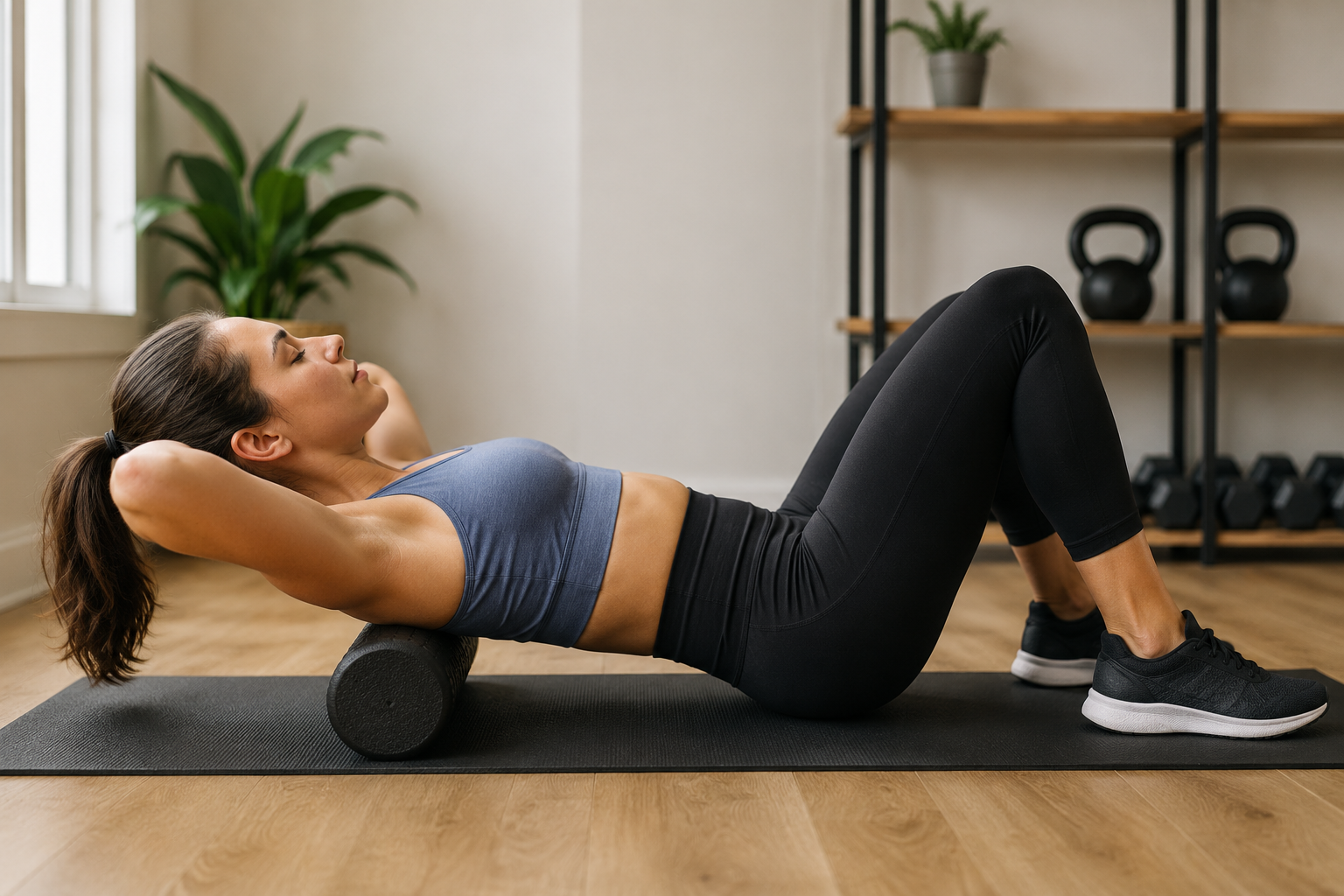
Finish with the upper back. Place the roller under the upper back, support your head lightly if needed, and roll from the mid-back to the upper back. Avoid the neck and lower back.
Keep the whole session around 5 to 10 minutes. Breathe slowly. Stop if anything feels sharp or strange.
What Foam Rolling Should Feel Like Afterward
After foam rolling, you may feel lighter, warmer, or more mobile. The area may feel mildly tender, but it should not feel bruised, painful, or irritated.
If you feel worse afterward, you may have used too much pressure, rolled too long, or targeted the wrong area.
Next time, reduce the intensity. Use a softer roller. Spend less time. Avoid sensitive spots. Foam rolling should leave you feeling better prepared to move, not beaten up.
When to Get Professional Guidance
If you have ongoing pain, recurring tightness, nerve symptoms, or an injury history, it may help to work with a physical therapist, athletic trainer, or qualified movement professional.
This is especially important if you experience numbness, tingling, swelling, sharp pain, or pain that does not improve with rest and gentle movement.
Foam rolling can support recovery, but it should not replace proper care when something more serious is going on.
Final Thoughts
Foam rolling can be a helpful part of a fitness, recovery, or wellness routine, but it works best when used with care. The goal is not to crush your muscles into submission. The goal is to apply controlled pressure, breathe, and help your body feel more comfortable.
Avoid rolling directly on joints, bones, bruises, fresh injuries, or sharp pain. Do not stay on one tender spot too long. Do not use maximum pressure just because you think pain means progress. Start gently, move slowly, and let your body guide the intensity.
Foam rolling should support your movement, not punish it. When you use it wisely, it can be a simple and effective way to release tension without creating new soreness.
Hi, I’m the creator and editor behind ZestyHabit. I research everyday safety, first aid, and practical wellness topics using official guidance and reliable public sources, then turn that information into clear, realistic steps for daily life.
My goal is to help readers make safer, better-informed choices at home and beyond.