Pilates Precautions: What Beginners Should Know Before Their First Class
Minjin Park
·
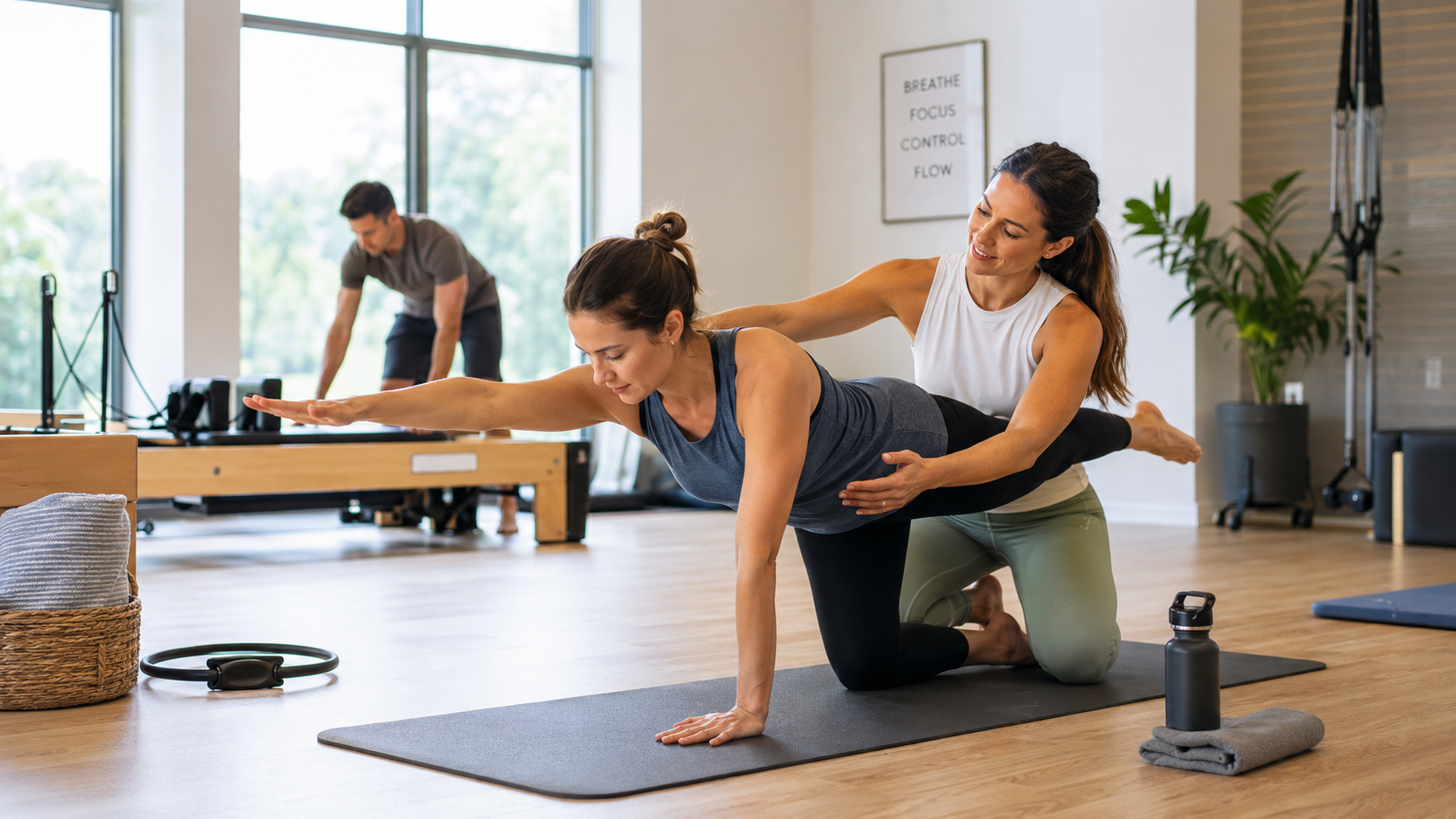
Pilates has a calm reputation. When people picture it, they often imagine controlled movements, clean studios, soft mats, and slow breathing. Compared with intense gym workouts or fast cardio classes, Pilates can look gentle and almost effortless.
Then the first class begins.
Suddenly, your legs are shaking during a tiny movement. Your instructor asks you to breathe while holding your core. You realize that “small and controlled” can be much harder than it looks. You may also hear unfamiliar cues like neutral spine, pelvic tilt, imprint, tabletop, ribs down, or engage your deep core.
Pilates can be a wonderful way to build strength, improve posture, increase body awareness, and support better movement. But beginners should not treat it as something they can rush through without paying attention. Pilates is low-impact, but it is still exercise. Done carelessly, it can strain the neck, lower back, hips, or shoulders.
The good news is that Pilates is also highly adaptable. You do not have to be flexible, strong, thin, young, or already “good at fitness” to start. You simply need to understand a few basic precautions before your first class.
Here is what beginners should know before stepping onto the mat or reformer.
One of the biggest surprises for beginners is how slow Pilates can feel. Many exercises are performed with small, precise movements. You may not be jumping, sprinting, or lifting heavy weights, but your muscles still work hard because they are being asked to move with control.
In Pilates, faster is not usually better. Rushing often means you are using momentum instead of muscle. That can reduce the benefit of the exercise and make it harder to keep your spine, hips, and shoulders aligned.
If your instructor asks you to move slowly, there is a reason. A slow leg lower, controlled bridge, or careful roll-up can reveal exactly where your body wants to compensate. Maybe your back arches. Maybe your shoulders tense. Maybe your breath disappears.
The point is not to perform perfectly. The point is to notice, adjust, and move with awareness.
Do Not Worry If You Feel Uncoordinated
Your first Pilates class may feel confusing. You may be asked to breathe in one direction, move your legs another way, keep your ribs still, and engage your core all at the same time.
That is normal.
Pilates requires coordination between breath, core control, spinal position, and limb movement. Beginners often feel like they are one step behind the instructor. It does not mean you are bad at Pilates. It means your body is learning a new movement language.
Give yourself permission to move slowly. Watch the instructor. Listen for the main cue. If you miss one detail, continue with the next rep. You do not have to master every instruction in your first class.
A good beginner mindset is simple: control what you can, breathe, and avoid pain.
Learn What “Core Control” Really Means
Many people think core control means squeezing the abs as hard as possible. In Pilates, it is more subtle than that.
Your core includes more than the visible abdominal muscles. It also involves deeper muscles around your trunk, pelvis, spine, and hips. These muscles help stabilize your body while your arms and legs move.
Engaging your core should not feel like holding your breath or bracing your body like a rock. It should feel like gentle support. Imagine lightly drawing your lower belly inward and upward while still being able to breathe.
You may hear cues like “pull your navel toward your spine” or “zip up through the lower belly.” These can be useful, but do not overdo them. If you clench too hard, your neck, shoulders, and hips may tense up.
A better cue for beginners is: support, not squeeze.
Breathing Is Part of the Exercise
Pilates breathing can feel strange at first because it is often coordinated with movement. You may be told to inhale as you prepare and exhale as you move. Or you may use breath to help stabilize your ribs and core.
Do not ignore the breathing cues. Breath is not just decoration in Pilates. It helps you control movement, reduce tension, and connect to your deep core.
A common beginner mistake is holding the breath during difficult exercises. This can make your neck and shoulders tense and can make the movement feel harder than it needs to be.
Try to keep breathing even if you lose the exact pattern. If you forget whether to inhale or exhale, simply breathe naturally until you catch the rhythm again.
During effort, exhaling often helps. For example, you may exhale as you lift your head and shoulders, press into a bridge, or extend a leg. The exhale can help your core engage without forcing it.
Protect Your Neck During Ab Exercises
Many Pilates exercises involve lifting the head and shoulders while lying on your back. This can be challenging for beginners, especially if the deep core is not strong yet.
If your neck starts working harder than your abs, you may feel strain quickly.
To protect your neck, avoid yanking the head forward. Keep the back of your neck long and imagine a small space between your chin and chest. Your gaze can be toward your thighs or knees, not straight up at the ceiling.
If the instructor offers the option to keep your head down, take it when needed. There is no shame in modifying. Keeping your head on the mat can help you focus on the core and legs without neck strain.
You can also place one hand lightly behind your head for support, but do not pull. The support should feel gentle, not forceful.
If neck discomfort continues, tell the instructor. They can offer a variation.
Understand Neutral Spine and Imprinted Spine
Two terms you may hear in Pilates are neutral spine and imprinted spine.
Neutral spine usually means maintaining the natural curves of your spine. When lying on your back, this may leave a small space under your lower back. Your pelvis is not tucked too much or arched too much.
Imprinted spine usually means gently flattening the lower back toward the mat by slightly tilting the pelvis. This can give more support during certain beginner exercises, especially when the legs are lifted.
Neither position is “better” all the time. They are tools.
Beginners sometimes force the lower back into the mat with too much tension or arch the back without realizing it. Both can create discomfort. The key is to follow the instructor’s cue and choose the position that lets you move with control and no pain.
If your lower back lifts or strains during leg exercises, reduce the difficulty. Bend your knees, keep one foot down, or make the range smaller.
Modify Before Your Form Falls Apart
Pilates instructors often offer modifications. Beginners sometimes avoid them because they think modifications mean they are failing.
They do not.
A modification is a smarter version for your current body. It allows you to build strength and coordination without losing alignment.
Common Pilates modifications include:
Keeping the head down during ab work
Bending the knees instead of keeping legs straight
Reducing range of motion
Keeping one foot on the floor
Using a cushion or prop for support
Moving slower
Taking a break between reps
The best time to modify is before your form falls apart. If your lower back arches, your neck strains, your shoulders creep up, or your breath disappears, choose an easier option.
Good Pilates is not about doing the hardest version. It is about doing the version you can control.
Do Not Force Flexibility
Pilates can improve mobility over time, but it is not about forcing your body into deep stretches. Many beginners see flexible people in class and try to match their range of motion immediately.
That can lead to strain.
Your hamstrings, hips, back, and shoulders may have different limits than someone else’s. That is normal. Pilates should help you learn your range, not punish you for it.
If a leg stretch, spine stretch, or hip movement feels too intense, reduce the range. Bend your knees. Use a strap if available. Stop before the movement becomes painful.
A mild stretch or muscle effort is fine. Sharp pulling, pinching, or joint pain is not.
Flexibility improves best when your body feels safe, supported, and consistent.
Keep Your Shoulders Relaxed
Shoulder tension is common in beginner Pilates. When the core gets tired, the shoulders often try to help.
You might notice your shoulders creeping toward your ears during planks, ab curls, bridges, or arm exercises. This can create neck tightness and make the movement feel more stressful than it needs to be.
Try to keep your shoulders broad and relaxed. Your upper back should feel supported, not collapsed. When your hands are on the mat, press through them evenly without locking your elbows or sinking into your shoulders.
A helpful cue is: collarbones wide, neck long.
If your shoulders feel overloaded during an exercise, ask for a modification. Sometimes raising the hands, changing the angle, or reducing the range can make a big difference.
Move From the Right Place
Pilates is full of small details about where movement begins. A leg movement may be meant to come from the hip joint. A spinal movement may be meant to curl one vertebra at a time. An arm movement may require the ribs to stay still.
Beginners often move from the easiest place instead of the intended place.
For example, during leg circles, the lower back may rock instead of the hip moving smoothly. During bridges, the ribs may flare instead of the glutes and hamstrings working. During arm exercises, the shoulders may shrug instead of staying stable.
This is why Pilates can feel humbling. It teaches you how your body compensates.
Do not worry if you cannot feel everything right away. Start by making the movement smaller. A smaller, cleaner movement is usually better than a bigger, messy one.
Be Careful With Reformer Classes
Reformer Pilates uses a machine with springs, straps, a moving carriage, and a footbar. It can be excellent, but beginners should pay close attention to setup and safety.
The reformer may look smooth and graceful, but the moving carriage and spring resistance require control. If you move too quickly or release tension carelessly, the carriage can move suddenly.
Before class, tell the instructor it is your first time. Ask how to get on and off safely. Make sure you understand where your feet, hands, and head should go before each movement.
Do not change springs or adjust equipment unless the instructor tells you to. Spring settings affect difficulty and control. A lighter spring is not always easier, especially for exercises that require stability.
Move slowly until you understand how the machine responds.
Tell the Instructor About Injuries or Concerns
Before class starts, tell the instructor if you have any injuries, pain, pregnancy-related needs, recent surgeries, or medical concerns. You do not need to share a long story, but basic information helps them guide you safely.
For example, if you have lower back pain, neck sensitivity, wrist pain, knee problems, or shoulder issues, the instructor may suggest modifications before discomfort starts.
This is especially important in group classes, where the instructor may not know your history unless you mention it.
A good instructor will not judge you for needing adjustments. Pilates is built around body awareness and modification.
Wear Comfortable, Fitted Clothing
You do not need fancy clothing for Pilates, but what you wear can affect comfort.
Choose clothes that let you move freely but are not so loose that they get in the way. Very baggy shirts may ride up during lying or inverted positions. Tight waistbands may feel uncomfortable during breathing and core work.
Grip socks are often recommended or required in studio classes, especially reformer classes. They help prevent slipping and keep the equipment cleaner.
Avoid heavy jewelry, belts, or anything that digs into your body while lying down.
The goal is to wear something that lets you focus on movement, not constant adjusting.
Do Not Eat a Heavy Meal Right Before Class
Pilates includes core work, twisting, bending, and lying down. A heavy meal right before class can feel uncomfortable.
You do not need to exercise on an empty stomach if that makes you feel weak, but give your body time to digest. A light snack may be fine if you need energy, such as a banana, yogurt, or small piece of toast.
Hydrate normally, but avoid drinking so much right before class that you feel uncomfortable during abdominal exercises.
A comfortable stomach makes it easier to breathe and engage your core.
Expect Muscle Shaking
Beginners are often surprised when their legs, abs, or arms start shaking during Pilates. This can happen even with tiny movements.
Shaking does not automatically mean something is wrong. It often means your muscles are working hard to stabilize and control the movement.
However, shaking plus pain, loss of form, or breath-holding is a sign to modify or rest. There is a difference between a challenging tremble and your body struggling to stay safe.
If you feel shaky, slow down. Reduce the range. Take a breath. Use a modification. Over time, your endurance and control will improve.
Avoid Comparing Yourself to Others
Pilates classes can include people with very different experience levels. Someone near you may have been practicing for years. They may lift their legs lower, move with more control, or understand cues instantly.
Do not use their body as your standard.
Your first class is about learning your own movement. Comparing yourself can make you push too hard or feel discouraged for no reason.
Pilates progress is often subtle. You may notice that your breathing improves, your posture feels better, your lower back feels more supported, or your balance improves. These changes matter.
Focus on how the exercise feels in your body, not how impressive it looks from the outside.
Know the Difference Between Effort and Pain
Pilates can be challenging. You may feel burning in your abs, shaking in your legs, or fatigue in your glutes. That kind of effort can be normal.
Pain is different.
Stop or modify if you feel:
Sharp pain
Pinching in the hip, shoulder, or back
Neck strain
Numbness or tingling
Dizziness
Lower back pain during core work
Knee pain during leg exercises
Wrist pain during plank positions
Do not push through pain to keep up with the class. A good Pilates practice should challenge your control, not punish your joints.
Start With Beginner-Friendly Classes
If you are new, choose a beginner class, fundamentals class, or private introductory session if available. Jumping into an advanced class can be frustrating and unsafe because the pace may be faster and the cues may assume prior knowledge.
Mat Pilates and reformer Pilates can both be beginner-friendly, depending on the instructor and class level. Mat classes use your body weight and sometimes small props. Reformer classes use equipment and springs. Neither is automatically easier.
Read the class description and ask the studio if you are unsure. It is better to start with the basics and build confidence than to feel lost in a class that moves too quickly.
Give Yourself Time to Learn
Pilates may not click immediately. The first few classes can feel like learning a new language.
That is okay.
You may not fully understand your core engagement at first. You may forget to breathe. You may need the instructor to explain neutral spine several times. You may modify many exercises.
This is part of the process.
The beauty of Pilates is that it often gets better with practice. As your awareness improves, the same exercise can feel completely different. You begin to notice smaller muscles, better alignment, and smoother breathing.
Progress in Pilates is not only about doing harder exercises. It is about doing familiar exercises with more control.
Final Thoughts
Pilates is beginner-friendly, but it is not something to rush through without attention. The movements may look small, but they require focus, breath, core control, and good alignment.
Before your first class, remember this: move slowly, breathe, protect your neck and lower back, and modify whenever your form starts to slip. Do not force flexibility. Do not compare yourself to others. Tell the instructor if you have injuries or concerns.
A good Pilates class should help you feel more connected to your body, not frustrated by it. Start with the basics, respect your limits, and let control come before intensity.
When you approach Pilates with patience, it can become one of the most useful and sustainable ways to build strength, posture, and body awareness.
Hi, I’m the creator and editor behind ZestyHabit. I research everyday safety, first aid, and practical wellness topics using official guidance and reliable public sources, then turn that information into clear, realistic steps for daily life.
My goal is to help readers make safer, better-informed choices at home and beyond.