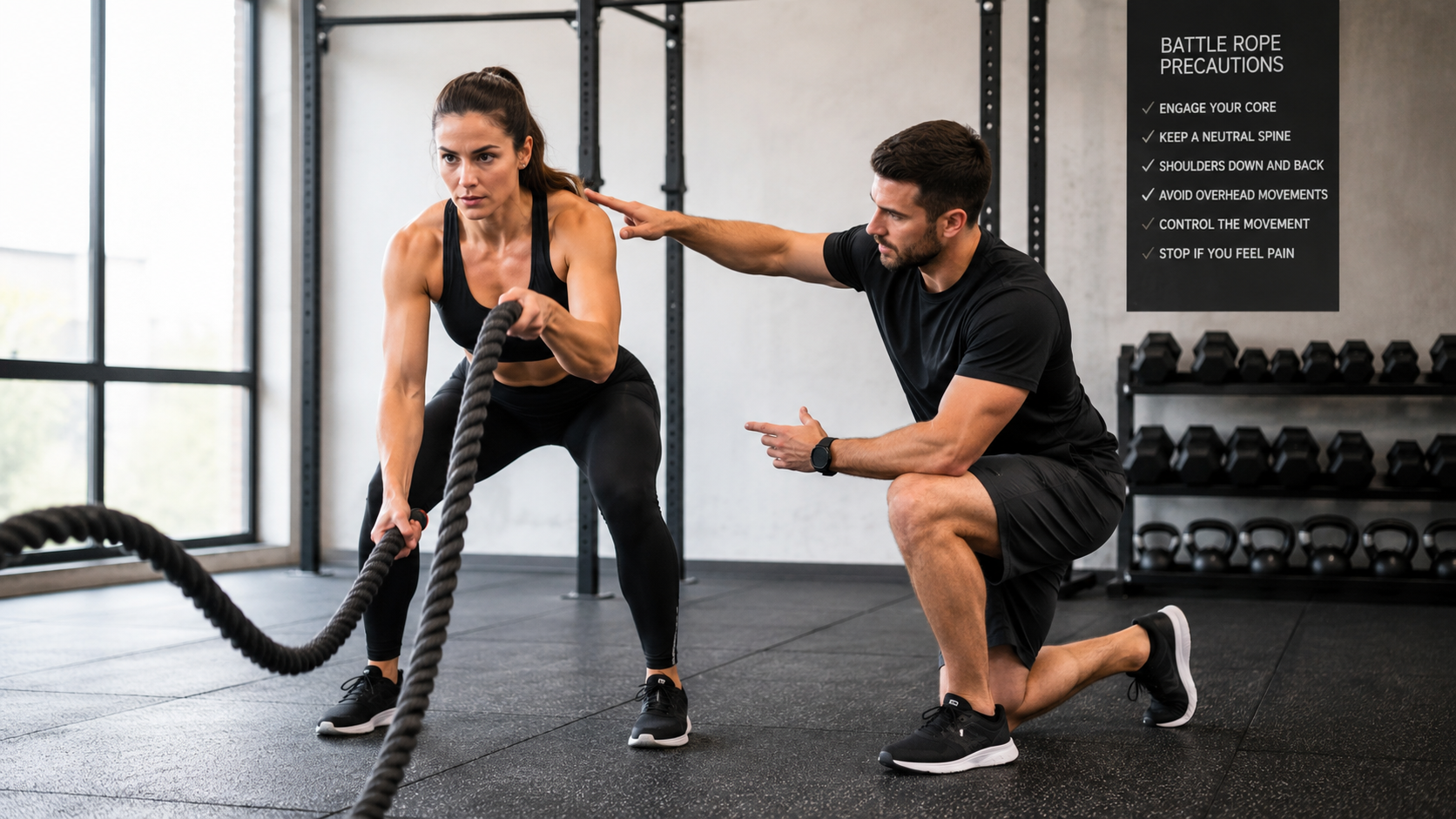
Battle Rope Precautions: How to Protect Your Shoulders and Back
Minjin Park
·
Battle ropes look intense, and honestly, that is part of their appeal. They make a workout feel powerful almost immediately. You grab the ropes, start making waves, and within seconds your heart rate climbs, your arms burn, and your whole body feels involved.
Because battle ropes are often used in HIIT circuits, bootcamp classes, and athletic conditioning workouts, people sometimes treat them as a “just go hard” exercise. The faster and louder the waves, the better the workout seems.
But battle ropes are not only about effort. They also require good shoulder mechanics, a stable stance, core control, and smart pacing. If you use only your arms, shrug your shoulders, round your back, or push past fatigue, the exercise can quickly become rough on your shoulders, neck, and lower back.
The good news is that battle ropes can be adjusted for almost any fitness level. You do not need to slam the ropes violently or train until your form completely falls apart. With the right setup and technique, battle ropes can be an excellent conditioning tool that challenges your body without leaving your joints feeling irritated.
Here are the main battle rope precautions to keep in mind, especially if you want to protect your shoulders and back while still getting a strong workout.
Why Battle Ropes Can Strain the Shoulders and Back
Battle ropes create repeated force through the arms and upper body. Every wave, slam, circle, or alternating motion sends demand through your hands, wrists, elbows, shoulders, upper back, core, hips, and legs.
That is what makes the exercise so effective. It is also why poor form can become a problem.
If your shoulders creep up toward your ears, your neck and upper traps may take over. If your core relaxes, your lower back may start arching or twisting with every wave. If your stance is too narrow, your body may rock around instead of staying grounded. If you keep going after your form breaks down, your shoulders and back may absorb more stress than they should.
Battle ropes should feel challenging, but not chaotic. You should feel strong effort through your arms, shoulders, core, and legs. You should not feel sharp shoulder pain, pinching, lower back strain, or uncontrolled pulling through your spine.
Start With the Right Stance
Your stance is the foundation of the whole exercise. If your feet are unstable, everything above them has to compensate.
Stand with your feet about hip-width to shoulder-width apart. Bend your knees slightly. Keep your weight balanced through the middle of your feet, not only in your toes or heels. Your body should feel athletic and ready, similar to the position you might use before jumping or catching a ball.
Avoid standing too tall and stiff. Also avoid squatting so low that your legs tire before you even begin. You want a position that lets you absorb movement and create force without losing control.
A good cue is: soft knees, strong feet, steady body.
If you feel yourself rocking backward or being pulled forward by the ropes, adjust your distance from the anchor or widen your stance slightly.
Keep Your Core Engaged
Battle ropes may look like an arm exercise, but your core plays a major role. Your midsection helps stabilize the spine while your arms create waves.
Before starting, gently brace your core as if preparing for someone to tap your stomach. You do not need to squeeze as hard as possible. You should still be able to breathe. The goal is to create enough support so your ribs, pelvis, and spine stay controlled.
If your core is not active, you may start arching your lower back, leaning too far forward, or twisting from the spine instead of moving with control.
Think of your torso as the anchor between your arms and legs. Your arms move the ropes, but your core keeps the rest of you organized.
Avoid Shrugging Your Shoulders
One of the most common battle rope mistakes is shrugging the shoulders up toward the ears. This often happens when the ropes are too heavy, the pace is too fast, or fatigue sets in.
Shrugging may seem harmless at first, but it can create neck tension and make the shoulders feel tight or irritated. It also makes the movement less efficient because your upper traps begin doing more work than necessary.
Keep your shoulders down and away from your ears. Your shoulder blades should feel controlled, not jammed or collapsed.
This does not mean forcing your shoulders down rigidly. It means staying relaxed enough that your neck does not become part of the exercise.
A helpful cue is: long neck, relaxed shoulders, strong arms.
If you cannot maintain that position, slow down or shorten the interval.
Use Your Whole Body, Not Just Your Arms
Beginners often try to create rope waves using only the arms. They stand stiffly and pump their hands as fast as possible. This usually makes the shoulders burn quickly and can lead to sloppy movement.
Instead, let your whole body help.
Your legs, hips, core, and upper body should work together. With alternating waves, your knees can stay soft and your torso stable while your arms move rhythmically. With rope slams, you can use a small hip and knee bend to help generate power, rather than yanking only from the shoulders.
The more controlled your base is, the safer your upper body usually feels.
Watch Your Back Position
Lower back strain during battle ropes often comes from poor posture. Some people round their back as they lean forward. Others arch their lower back as they try to create bigger waves. Both can become uncomfortable, especially during long intervals.
Your spine should stay relatively neutral. Keep your chest open, ribs controlled, and hips slightly back. A small forward lean is okay, but it should come from the hips, not from collapsing through the lower back.
Imagine doing a mini athletic hinge: knees soft, hips slightly back, spine long.
If you feel pressure in your lower back, check your posture. You may be leaning too far forward, standing too upright with your back arched, or letting your core relax as you get tired.
Reset before continuing.
Choose the Right Rope Weight and Length
Not all battle ropes feel the same. Thicker, heavier, and longer ropes are harder to move. That can be great for advanced training, but beginners may struggle to control them.
If the rope is too heavy for your current strength level, you may compensate by shrugging, jerking, rounding your back, or using momentum. That can increase strain through the shoulders and spine.
Start with a rope that allows you to create smooth waves without losing your posture. You should feel challenged, but you should not need to fight the rope with your whole body.
If you are training at a gym, ask whether lighter or shorter rope options are available. If not, simply reduce the intensity. Stand a bit closer to the anchor to create more slack, use shorter intervals, or choose slower movements.
The best rope is not the hardest rope. It is the one you can control well.
Do Not Grip Too Hard
A firm grip is important, but death-gripping the ropes can create unnecessary tension through your forearms, elbows, shoulders, and neck.
Hold the rope handles securely enough that they do not slip, but avoid squeezing as if you are trying to crush them. Your wrists should stay fairly neutral, not bent sharply up or down.
When your grip becomes too tense, the rest of your upper body often tightens too. You may notice your shoulders rising, your jaw clenching, or your breathing getting shallow.
Keep your grip strong but relaxed. Let the movement flow.
Start With Short Intervals
Battle ropes can become exhausting very quickly. That is why they are popular for conditioning. But long sets are not always better, especially for beginners.
When fatigue builds, form often breaks down. The shoulders shrug, the waves get messy, the back rounds, and the movement becomes less controlled.
Instead of starting with one long set, use short intervals. For example, try 10 to 20 seconds of work, then rest. Repeat for a few rounds while keeping your form clean.
As you improve, you can gradually increase the duration or intensity. But do not rush. Battle ropes are demanding even in short bursts.
A clean 15-second set is more useful than a sloppy 60-second struggle.
Warm Up Before Using Battle Ropes
Battle ropes place sudden demand on the shoulders, wrists, core, and back. Going straight into hard slams or fast waves without warming up can feel jarring.
Spend a few minutes preparing your body first. You can do light cardio, arm circles, band pull-aparts, shoulder rolls, bodyweight squats, hip hinges, and gentle plank work.
A simple warm-up might include:
Warm-Up Move
Why It Helps
Arm circles
Prepares shoulders
Shoulder rolls
Reduces upper-body stiffness
Hip hinges
Prepares back and hips
Bodyweight squats
Warms legs and stance
Plank hold
Activates core stability
Light rope waves
Practices the pattern
Your first rope set should not be your hardest one. Start easy and build gradually.
Control the Movement Instead of Chasing Noise
There is something satisfying about making loud rope slams. But noise is not the same thing as good technique.
Some people slam the ropes as hard as possible while losing their posture completely. Their shoulders jerk, their back rounds, and their breathing disappears. It may look intense, but it is not necessarily productive.
Focus on controlled power. The ropes should move because your body is coordinated, not because you are throwing yourself around.
With waves, aim for steady rhythm. With slams, aim for strong but clean movement. With circles, keep the shoulders stable and the core engaged.
The goal is not to punish the floor. The goal is to train your body.
Be Careful With Overhead Slams
Overhead rope slams can be effective, but they require more shoulder control than simple waves. Raising the arms overhead repeatedly can bother people with limited shoulder mobility, previous shoulder issues, or poor core control.
If your ribs flare, your lower back arches, or your shoulders pinch when you lift the ropes overhead, modify the movement. Use smaller slams, alternating waves, or low waves instead.
You do not need overhead slams to get a good battle rope workout. Many safer variations still challenge your conditioning and upper body.
If overhead movement causes pain, do not force it.
Keep Your Breathing Steady
Battle ropes can make people hold their breath without realizing it. They tense the body, brace hard, and attack the ropes until they run out of air.
Holding your breath increases tension and can make fatigue arrive faster. It may also cause your neck and shoulders to tighten.
Try to breathe rhythmically. Exhale during strong efforts, such as slams, and keep breathing during waves. Your breathing does not need to be perfect, but it should not disappear.
If you cannot breathe at all during the set, you may be going too hard.
Avoid Twisting Through the Lower Back
Some battle rope variations involve side-to-side movement, circles, or rotational patterns. These can be useful, but they need control.
If you twist mainly through the lower back, you may irritate the spine. Rotation should come from the hips, upper back, and controlled core movement, not uncontrolled wrenching through the lumbar area.
For beginners, start with basic alternating waves or double waves before adding complicated rotational moves. Once you do try side-to-side waves, move slowly and keep your core engaged.
Your body should rotate as a unit, not whip from the lower back.
Stop Before Your Form Falls Apart
Battle ropes are often used as a finisher, which means you may be doing them when you are already tired. This is where shoulder and back risk can increase.
Fatigue changes everything. Your stance gets weaker, your core turns off, your shoulders rise, and your waves lose rhythm.
Pay attention to the first sign of form breakdown. If your back starts to ache, your shoulders feel pinched, or you cannot keep the ropes moving without jerking, stop the set.
Stopping early with good form is better than finishing with poor form. Your body does not care whether the timer had five seconds left. It cares how you moved.
Choose Beginner-Friendly Variations
You do not need to start with the hardest rope movements. Basic variations can be very effective.
Variation
Why It Helps
Alternating waves
Builds rhythm and shoulder endurance
Double waves
Teaches symmetrical control
Low waves
Reduces overhead shoulder stress
Seated waves
Limits lower-body momentum and trains control
Kneeling waves
Challenges core stability
Short rope slams
Builds power without excessive range
Start with the version that lets you keep your shoulders relaxed, core engaged, and back stable.
Do Not Ignore Pain
Battle ropes should feel hard. Your arms may burn. Your heart rate may climb quickly. Your shoulders and core may fatigue. That is normal.
Pain is different.
Sharp shoulder pain, pinching, numbness, tingling, lower back pain, or pain that worsens as you continue should not be ignored. Stop the exercise and adjust your technique, rope choice, stance, or intensity.
If pain keeps returning, choose another conditioning exercise for now and consider getting guidance from a coach, physical therapist, or healthcare professional.
Pushing through pain does not make a workout better. It usually makes recovery harder.
Common Battle Rope Mistakes to Avoid
Here are some of the most common mistakes that can increase shoulder and back strain:
Mistake
Why It Can Be a Problem
Shrugging shoulders
Creates neck and shoulder tension
Rounding the back
Can strain the lower back
Arching excessively
Places pressure on the spine
Using only the arms
Overloads the shoulders
Standing too narrow
Reduces stability
Going too long
Fatigue causes form breakdown
Gripping too hard
Increases upper-body tension
Forcing overhead slams
May irritate shoulders
Holding the breath
Adds unnecessary tension
Most of these mistakes improve when you slow down, shorten the interval, and reset your stance.
A Shoulder- and Back-Friendly Battle Rope Checklist
Before your next set, use this quick checklist:
Form Check
What to Do
Feet
Hip- to shoulder-width apart
Knees
Slightly bent and soft
Hips
Slightly back, stable
Core
Engaged but still breathing
Back
Long and neutral
Shoulders
Down, not shrugged
Grip
Secure but not tense
Movement
Controlled, not chaotic
Interval
Stop before form breaks
This small checklist can make battle ropes feel much safer and more effective.
What to Remember
Battle ropes can be an excellent tool for conditioning, power, and full-body training, but they should not be treated as a mindless exercise. The faster and harder version is not always the better version.
To protect your shoulders and back, start with a stable stance. Keep your core engaged, shoulders relaxed, and spine neutral. Use your whole body instead of only your arms. Choose a rope and pace you can control, and keep your intervals short enough that your form stays strong.
A good battle rope workout should feel intense, but not reckless. When you move with control, the ropes can challenge your body without beating it up.
Hi, I’m the creator and editor behind ZestyHabit. I research everyday safety, first aid, and practical wellness topics using official guidance and reliable public sources, then turn that information into clear, realistic steps for daily life.
My goal is to help readers make safer, better-informed choices at home and beyond.