
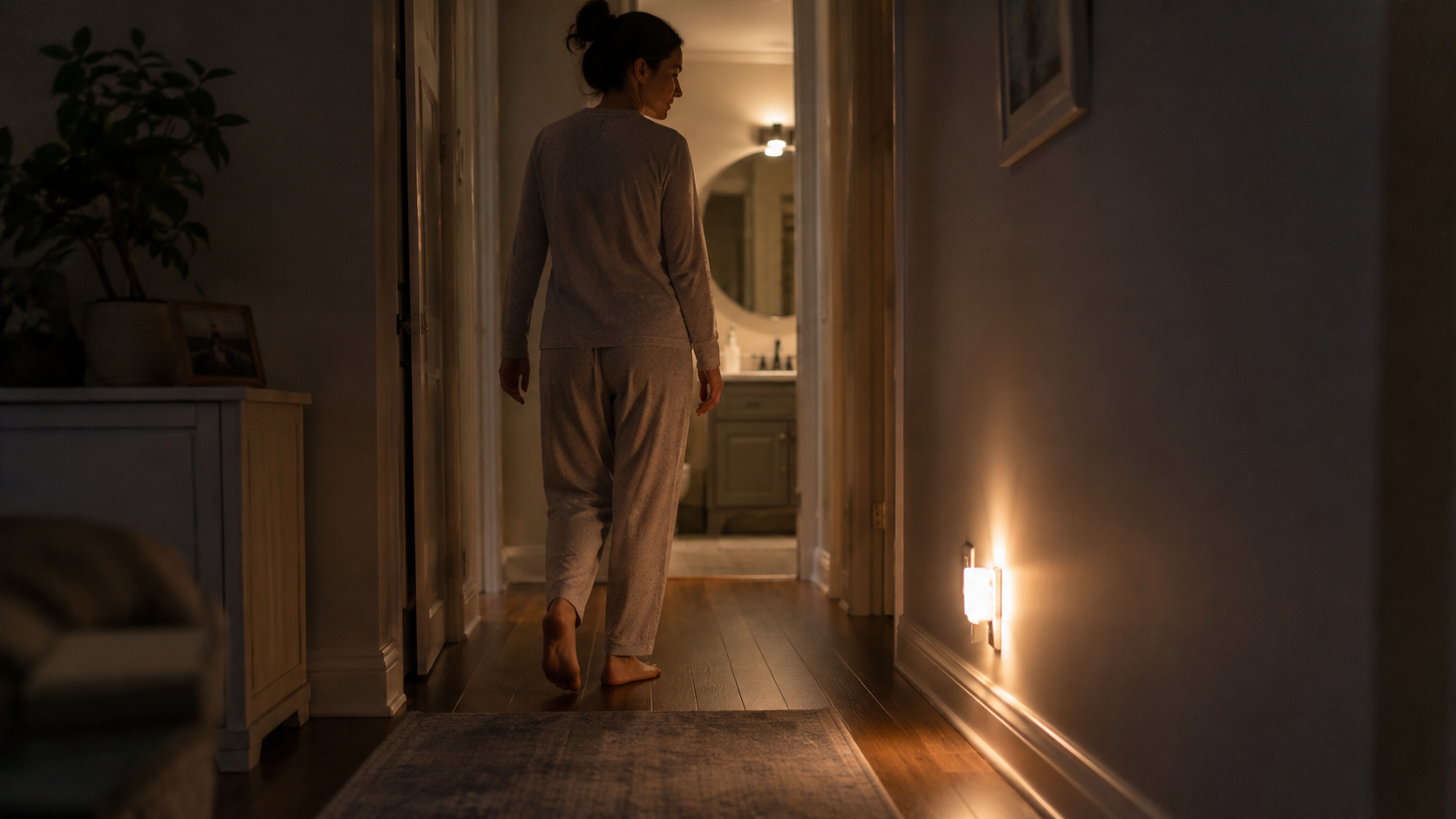

Dark hallways can make nighttime trips to the bathroom, kitchen, or a child’s room more risky. Learn how night lights can help prevent trips, bumps, falls, and confusion without disturbing sleep.
The Hallway You Know Well Can Feel Different at Night
During the day, your hallway probably feels harmless.
You walk through it without thinking. You know where the bathroom is, where the bedroom doors are, where the laundry basket sits, and which floorboard creaks. It is one of the most familiar spaces in the house.
But at night, the same hallway can feel completely different.
The lights are off. Your eyes are still adjusting. You may be half-asleep, carrying a child, rushing to the bathroom, checking on a pet, or walking to the kitchen for water. A pair of shoes by the door, a toy on the floor, a laundry basket against the wall, or a slightly open cabinet can become harder to notice.
That is where a night light can help.
A night light is not a dramatic safety device. It is small, quiet, and easy to overlook. But in a dark hallway, it can give just enough visibility to help people move more safely without turning on bright overhead lights.
The goal is not to light the hallway like daytime. It is to reduce the guesswork.
Why Dark Hallways Create Everyday Risks
Most household falls do not happen because someone is doing something extreme. They happen during ordinary movement.
Walking to the bathroom. Getting up for water. Answering a child’s call. Letting the dog out. Checking a noise. Carrying laundry. Looking for medicine. Moving through the house while tired.
A dark hallway can make these simple moments less predictable.
When you cannot see clearly, your brain fills in the blanks. You assume the floor is clear. You assume the door is fully open. You assume the rug is flat. You assume the pet is not lying in the walkway.
Most of the time, those assumptions are right.
But when one of them is wrong, you may trip, bump your shoulder, stub a toe, lose balance, or step awkwardly.
A night light helps you confirm what is actually there.
The Nighttime Problem: You Are Not Fully Alert
Nighttime movement is different from daytime movement because you are often not fully awake.
You may be groggy, disoriented, or moving automatically. Your reaction time is slower. Your balance may not be as steady. You may not lift your feet as high as usual. You may forget that something was left in the hallway earlier.
This is especially common during the first few seconds after getting out of bed. You know where you are, but your body has not fully caught up yet.
Bright lights can help you see, but they can also feel harsh and may wake you up more than you want. That is why many people avoid turning on the hallway light at night. They choose darkness instead.
A soft night light gives a middle option: enough light to move safely, not so much that it shocks your eyes awake.
Common Accidents in Dark Hallways
Tripping Over Small Objects
Small objects are easy to miss in a dark hallway.
A shoe, toy car, backpack, charging cable, pet bowl, book, or dropped towel can blend into the floor. Even something low and soft can catch your foot if you are walking half-asleep.
Children’s toys are a common example. During the day, a small block or stuffed animal is obvious. At night, it can disappear into the shadows.
A night light will not remove clutter, but it can help you notice it before your foot does.
Bumping Into Walls, Doors, or Furniture
In narrow hallways, a small misjudgment can lead to a bumped shoulder, hip, elbow, or knee.
This is more likely if a door is partly open, a hamper has been placed outside a bedroom, or a small table sits along the wall. You may know the hallway layout, but dark spaces make edges harder to judge.
A gentle light helps define the outline of the walls, door frames, and objects.
Missing a Step or Threshold
Some homes have a step between rooms, a small landing, a raised threshold, or a transition between flooring types. These details are easy to forget when you are tired.
Even a slight change in floor level can cause a stumble if you do not see it coming.
Night lights are especially helpful near stairways, hallway steps, and places where flooring changes from carpet to tile or hardwood.
Slipping on Rugs or Mats
Hallway runners and small rugs can shift, curl, or bunch over time. In the dark, a curled corner can be hard to see.
A night light can help you spot an edge before your toes catch it. Still, lighting should be paired with rug safety: use non-slip backing, keep rugs flat, and remove rugs that slide easily.
Stepping on a Pet
Pets love hallways.
Dogs may sleep across a walkway. Cats may wander silently at night. A pet may follow you closely, stop suddenly, or lie in a dark corner where you cannot see them.
Stepping on a pet can startle both of you. You may jump, twist, or lose your balance. A soft hallway light makes it easier to see pets before you step.
Who Benefits Most From Hallway Night Lights?
Older Adults
Night lights can be especially helpful for older adults because vision, balance, and reaction time can change with age. Getting up at night to use the bathroom is common, and dark hallways can make that trip less steady.
A well-placed night light gives visual cues without requiring someone to search for a switch.
Children
Children may wake up scared, thirsty, or needing the bathroom. A dark hallway can make them nervous or cause them to run quickly toward a parent’s room.
Night lights can help children walk more calmly and confidently. They also reduce the chance of a child stepping on toys or bumping into furniture.
Parents With Babies or Toddlers
Parents often walk through the house at night while carrying a baby, bottle, blanket, diaper supplies, or laundry. Their hands may be full, and turning on bright lights may wake the child.
A soft hallway light can help parents move safely without fully lighting the home.
Guests
Guests do not know your hallway as well as you do.
They may not know where the bathroom is, where the hallway turns, or whether there is a step near the guest room. A night light can make overnight visits more comfortable and safer.
Anyone Who Gets Up Often at Night
Some people regularly get up for water, medication, pets, bathroom trips, or temperature adjustments. If nighttime walking is part of your routine, hallway lighting matters.
A Night Light Is Not Just for Kids
Many people think of night lights as something for children who are afraid of the dark. That is one use, but it is not the only one.
A night light is also a practical visibility tool.
Hotels use low lighting in hallways. Stairways often have small lights. Emergency paths are marked with lighting. The idea is the same: people move better when they can see enough of the space.
At home, a small plug-in night light can make the difference between walking confidently and feeling your way along the wall.
Where to Place Night Lights in a Hallway
Placement matters. A night light should help guide movement without shining directly into someone’s eyes.
Near Bedroom Doors
A light near bedroom exits helps people orient themselves as soon as they step into the hallway.
This is useful for children, older adults, guests, and anyone who wakes up groggy.
Along the Path to the Bathroom
The bathroom route is one of the most common nighttime paths. A night light along this route can reduce the need to turn on harsh overhead lights.
If the hallway is long, one light may not be enough. Use soft lighting at intervals.
Near Stairs or Steps
Any step, stairway, landing, or change in floor level should be visible. A small light near these areas can help prevent missteps.
Do not place a night light where it creates glare or hides shadows on the step edge. The point is to make the change in level easier to see.
Near Hallway Turns
If your hallway has a corner, a soft light near the turn can help define the path.
This is helpful in homes where walls, doors, and floors are similar colors.
Near Guest Rooms
Guests may wake up in an unfamiliar space and need to find the bathroom. A small light can make the hallway feel less confusing.
It is a thoughtful touch as well as a safety habit.
Choosing the Right Night Light
Soft, Warm Light Is Usually Best
A night light should be bright enough to show the floor and path, but not so bright that it feels like a spotlight.
Warm white or amber light is often easier on sleepy eyes than harsh blue-white light. Very bright or cool-toned lights can feel disruptive at night.
You want a gentle glow, not a mini floodlight.
Motion-Sensor Lights Can Be Helpful
Motion-sensor night lights turn on when someone walks nearby and turn off after a short time. These are useful if you do not want lights glowing all night.
They can work well in hallways, stair areas, closets, and bathroom paths.
The main thing is to test them. Make sure they turn on quickly enough and do not startle people with sudden brightness.
Dusk-to-Dawn Lights Are Simple
Some night lights turn on automatically when the room gets dark and turn off when it gets light. These are easy for hallways because you do not have to remember anything.
They are especially good for children’s routes or guest areas.
Battery-Powered Lights Work Where Outlets Are Missing
If your hallway does not have a convenient outlet, battery-powered stick-on lights can help. These may be useful near stair edges, turns, or dark corners.
Check batteries regularly so they do not fail quietly.
Avoid Lights With Exposed Cords
A night light should not create a new trip hazard. Avoid running cords across hallways or walkways.
Plug-in lights should sit securely in the outlet. Battery lights should be attached firmly so they do not fall.
Common Night Light Mistakes
Using a Light That Is Too Bright
If the light is too bright, people may avoid using it or cover it up. It may also disturb sleep, especially if it shines into a bedroom.
Choose a softer light or place it lower and away from direct sightlines.
Placing It Too High
A night light placed too high may shine into eyes instead of illuminating the floor. Lower placement often works better for showing the path.
Blocking the Light With Furniture
A night light behind a dresser, laundry basket, or open door does not help much. Make sure the glow reaches the walking path.
Relying on One Light for a Long Hallway
A single dim light may not be enough for a long or L-shaped hallway. It may create one bright spot and several dark sections.
Use more than one low-level light if needed.
Forgetting About Power Outages
A plug-in night light will not help during a power outage unless it has battery backup. If your home loses power often, consider rechargeable or battery-powered options for key areas.
Ignoring Clutter Because There Is a Light
Lighting helps you see hazards. It does not remove them.
Night lights work best when the hallway is also kept clear.
Pair Night Lights With a Clear Walkway
A night light is helpful, but it should be part of a simple hallway safety routine.
Keep the floor clear of:
- Shoes
- Toys
- Bags
- Laundry baskets
- Charging cables
- Pet bowls
- Loose rugs
- Books
- Packages
- Cleaning tools
Hallways are easy places to “temporarily” drop things. The problem is that temporary clutter often stays until someone trips over it.
Before bedtime, do a quick floor check. It takes less than a minute.
What About Leaving the Main Hallway Light On?
Some people leave the full hallway light on overnight. That may work, but it is not always ideal.
A bright overhead light can shine into bedrooms, affect sleep, waste energy, or make the house feel less restful. It may also cause people to avoid turning it on because it feels too harsh.
A night light gives enough guidance without fully lighting the home.
That said, if someone needs brighter light for safety, especially because of vision or mobility concerns, brighter lighting may be appropriate. The best choice is the one that helps people move safely and comfortably.
Night Lights and Bathroom Trips
The route from bed to bathroom is one of the most important places to think about lighting.
At night, people may hurry. They may be half-awake. They may not put on glasses. They may walk barefoot. They may avoid turning on bright lights because they want to fall back asleep.
A soft hallway night light, paired with a small bathroom night light, can make that route easier.
Make sure the bathroom floor is not wet, the bath mat is flat, and the path from hallway to toilet or sink is clear. Lighting helps most when the surfaces are also safe.
Night Lights for Emergency Preparedness
Night lights can also help during unexpected situations.
If a smoke alarm sounds, a child wakes up sick, a storm knocks something over, or someone needs to move quickly through the house, a completely dark hallway adds confusion.
A few small lights can make it easier to orient yourself.
For outages, keep flashlights in known locations and consider battery-powered night lights or rechargeable emergency lights. This is especially useful in homes with stairs.
You do not need an elaborate emergency system to make the hallway safer. Even a simple light source in the right place can help.
Signs Your Hallway Needs Better Night Lighting
You may benefit from night lights if:
- People use phones as flashlights at night.
- Someone has tripped or nearly tripped.
- Children call for help because the hallway is too dark.
- Guests have trouble finding the bathroom.
- Pets sleep or move through the hallway.
- There are steps, rugs, or floor transitions.
- The hallway has no windows.
- The light switch is hard to reach from the bedroom.
- Someone avoids turning on the main light because it is too bright.
- You often walk while sleepy or carrying things.
A near miss is a useful clue. If someone says, “I almost fell,” treat that as a reason to improve the setup.
A Simple Hallway Night Light Setup
For many homes, a good setup might look like this:
- One soft night light near bedroom doors
- One along the path to the bathroom
- One near any stairs or steps
- One in or near a guest area
- Battery backup or flashlights for outages
Keep the lights low, warm, and gentle. Test the hallway at night by walking the normal route. Can you see the floor? Can you see door frames? Can you see pets, shoes, or rugs? Does the light bother anyone sleeping?
Adjust from there.
Final Thoughts: A Little Light Can Prevent a Lot of Guessing
A dark hallway may seem harmless because it is familiar. But at night, when people are sleepy, barefoot, distracted, or moving quickly, the same hallway can become harder to navigate.
A night light gives just enough visibility to reduce trips, bumps, missed steps, and confusion. It helps children, older adults, guests, parents, pet owners, and anyone who gets up during the night.
The best night light setup is simple: soft, low, warm, and placed along the paths people actually use. Pair it with clear floors, flat rugs, and easy access to bathroom and bedroom routes.
You do not need to brighten the whole house. You just need enough light to see where your next step is going.
That small glow in the hallway can make nighttime movement calmer, safer, and a lot less clumsy.

Hi, I’m the creator and editor behind ZestyHabit. I research everyday safety, first aid, and practical wellness topics using official guidance and reliable public sources, then turn that information into clear, realistic steps for daily life.
My goal is to help readers make safer, better-informed choices at home and beyond.


