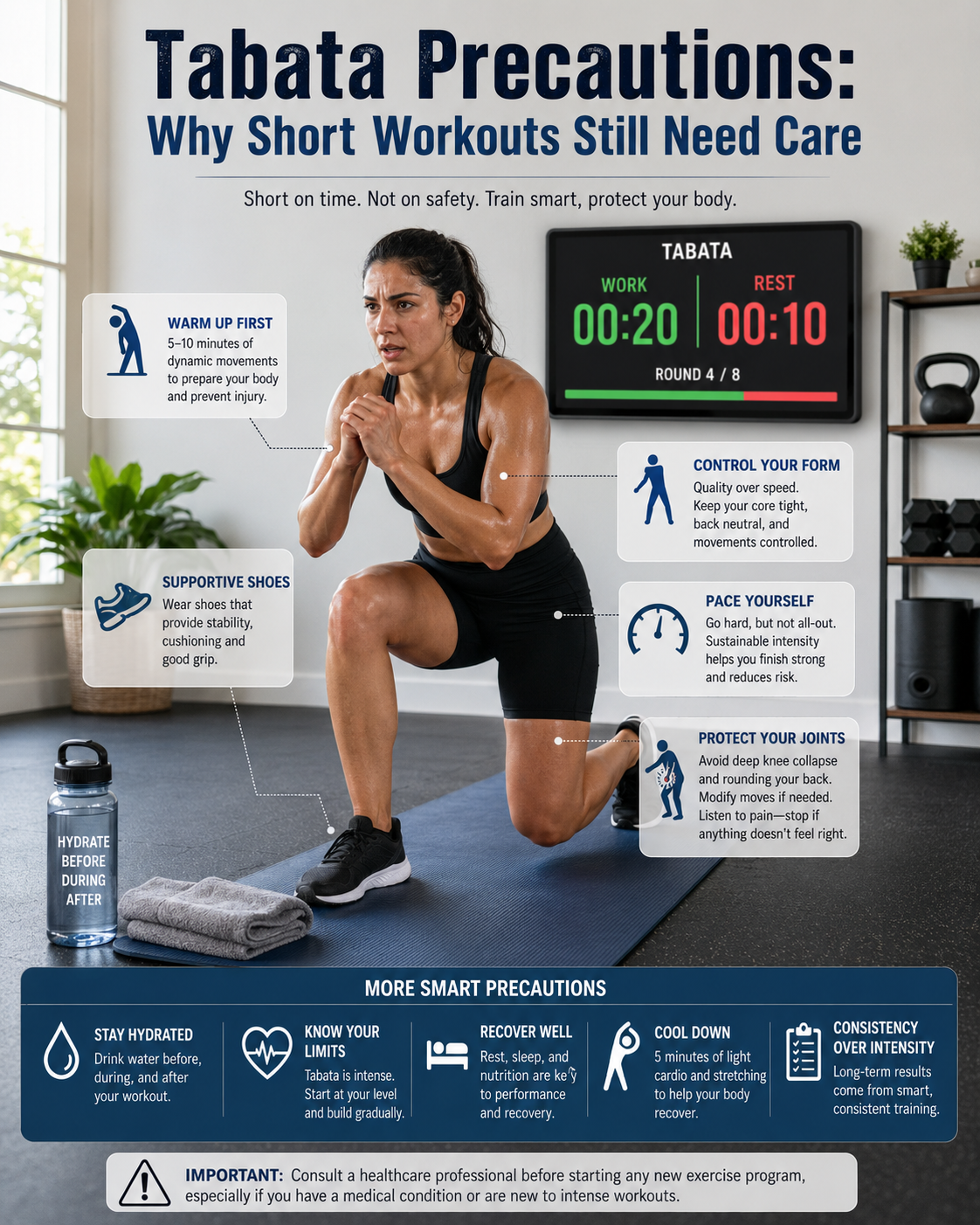
Tabata Precautions: Why Short Workouts Still Need Care
Minjin Park
·
Tabata has a way of sounding almost too good to be true. A workout that takes only a few minutes, gets your heart rate up quickly, and can be done at home with little or no equipment? It is easy to see why so many people are drawn to it.
The classic Tabata structure is short and intense: 20 seconds of hard effort followed by 10 seconds of rest, repeated for several rounds. On paper, that looks simple. In practice, it can feel surprisingly demanding. Those 20 seconds can become very long when you are doing squats, mountain climbers, burpees, push-ups, or high knees at a fast pace.
Because Tabata is short, many people assume it is automatically beginner-friendly or low-risk. But short does not always mean easy. In fact, the intensity is exactly why Tabata needs care. A workout does not have to last an hour to challenge your heart, lungs, muscles, joints, and recovery system.
Done wisely, Tabata can be an efficient way to improve conditioning and build consistency. Done carelessly, it can leave you dizzy, overly sore, irritated in the knees or shoulders, or discouraged because the pace feels impossible to keep up with.
The goal is not to avoid Tabata. The goal is to treat it with the respect any high-intensity workout deserves.
What Makes Tabata Different From Regular Intervals?
Tabata is a form of high-intensity interval training, often called HIIT. The main idea is simple: you work hard for a short period, rest briefly, then repeat.
The part people often underestimate is the work-to-rest ratio. Twenty seconds of work followed by only 10 seconds of rest does not give your body much time to recover. That means fatigue builds quickly. Your breathing gets heavier, your muscles burn, and your form can start to break down before you realize it.
A short Tabata session may only last four minutes, but those four minutes can be intense if you are truly pushing hard. And many online “Tabata-style” workouts stack several rounds together, turning a quick session into a much longer high-intensity routine.
This is why Tabata should not be treated like a casual warm-up or a random add-on at the end of every workout. It is a real training method, and it should be matched to your current fitness level.
Short Workouts Can Still Be High Stress
One of the biggest mistakes with Tabata is thinking, “It is only a few minutes, so I can go all out.”
Your body does not only respond to workout length. It also responds to intensity, impact, exercise choice, rest time, and your current recovery level. A short workout made of jumping lunges, burpees, squat jumps, and mountain climbers can be much harder on the body than a longer walk or gentle strength session.
High-intensity work places stress on your cardiovascular system and your muscles. High-impact movements also add stress to your knees, ankles, hips, wrists, and shoulders. If you are tired, under-fueled, dehydrated, or returning after a long break, that stress can feel even stronger.
This does not mean Tabata is bad. It means you should not judge a workout only by the clock. Four minutes can be enough to challenge you. Ten minutes can be plenty. More is not always better.
Warm Up Before You Start
Skipping the warm-up is one of the easiest ways to make Tabata feel rough. Since the workout is short, it is tempting to jump right in. But your body still needs a transition from rest to effort.
A proper warm-up helps increase your heart rate gradually, loosen your joints, and prepare your muscles for faster movement. This is especially important if your Tabata workout includes jumping, squatting, pushing, twisting, or quick changes of direction.
A simple warm-up can include marching in place, arm circles, hip circles, gentle squats, shoulder rolls, glute bridges, and easy step-back lunges. If your workout includes high knees, start with slow marching. If it includes push-ups, warm up your wrists and shoulders first. If it includes squat jumps, begin with regular bodyweight squats.
Five to ten minutes may sound long compared with a four-minute workout, but it can make the entire session safer and more comfortable. The shorter and harder the workout, the more your warm-up matters.
Choose Beginner-Friendly Exercises
Tabata does not have to mean burpees. It does not have to mean jump squats. It does not have to mean collapsing on the floor after four minutes.
The exercises you choose matter more than the timer itself. Beginners should start with movements that are easy to control, even when breathing gets heavier. Good options include bodyweight squats, step jacks, incline push-ups, glute bridges, marching high knees, standing punches, reverse lunges, and slow mountain climbers.
Be careful with exercises that become messy under fatigue. Burpees, jumping lunges, tuck jumps, fast mountain climbers, and advanced push-up variations can be effective, but they also require strength, coordination, and joint tolerance. If your form falls apart after the first round, the movement is probably too advanced for that Tabata session.
A beginner-friendly Tabata can still be challenging. You can work hard without choosing the most aggressive exercise possible.
Modify the Intensity Without Feeling Guilty
One of the best things you can do in Tabata is learn how to modify. The timer may be strict, but your movement does not have to be.
If jumping feels too harsh, step instead. Turn jumping jacks into step jacks. Turn squat jumps into controlled squats. Turn high knees into marching high knees. Turn burpees into step-back burpees without the jump.
If push-ups are too difficult, do them against a wall, countertop, or sturdy bench. If mountain climbers bother your wrists, place your hands on an elevated surface or switch to standing knee drives. If lunges bother your knees, reduce the range of motion or choose glute bridges instead.
Modification is not cheating. It is how you keep the workout matched to your body. A safe version you can repeat consistently is far better than an intense version that leaves you sore, frustrated, or injured.
Protect Your Form as Fatigue Builds
Tabata is designed to create fatigue quickly. That is part of the challenge. But fatigue changes how you move.
At the beginning, your squats may look controlled. By the sixth round, your knees may start collapsing inward. Your push-ups may begin with a stable core, then your lower back starts sagging. Your mountain climbers may begin smoothly, then your shoulders creep toward your ears and your wrists start taking too much pressure.
This is why form matters more than speed. You do not need to win the timer. You need to move well inside the timer.
If your technique breaks down, slow down. If slowing down does not help, switch to an easier variation. If even the easier variation feels messy, stop and rest. The workout is there to support your health, not to force you into sloppy reps.
A helpful mindset is to aim for strong, repeatable movement. You should finish the round feeling challenged, not out of control.
Be Careful With High-Impact Moves
Many Tabata workouts use high-impact exercises because they raise the heart rate quickly. Jump squats, jumping lunges, burpees, high knees, skaters, and tuck jumps can all make a workout feel intense fast.
But high-impact movements are not right for everyone. They can be stressful on the knees, ankles, hips, and lower back, especially if you are new to exercise, exercising on a hard floor, carrying extra fatigue, or recovering from soreness.
You can get a strong cardio effect without constant jumping. Low-impact options like fast step jacks, bodyweight squats, standing punches, step-back lunges, incline mountain climbers, and brisk marching can still raise your heart rate.
If you do include jumping, use it sparingly at first. Make sure you land softly, keep your knees aligned, and use a surface with good grip. Avoid jumping in socks on slippery floors. Also avoid doing high-impact Tabata every day. Your joints need recovery, even if the workout is short.
Watch Your Breathing and Dizziness
Tabata can make your breathing feel intense quickly. Heavy breathing is normal during hard intervals, but feeling faint, dizzy, nauseated, or unusually short of breath is a sign to stop.
Some people accidentally hold their breath during difficult movements, especially push-ups, planks, squats, or core exercises. This can make the workout feel harder and may contribute to lightheadedness. Try to breathe steadily through each round. You do not need perfect breathing technique, but you should not be bracing so hard that you forget to exhale.
The room matters too. A hot, stuffy space can make high-intensity workouts feel much harder. Use a fan, open a window if possible, and keep water nearby. If you feel dizzy, do not push through just because the timer is still running. Pause, sit or stand safely, and let your breathing settle.
Do Not Use Tabata as a Daily Punishment Workout
Tabata is sometimes treated like a quick way to “make up” for eating more, missing a workout, or feeling guilty. That mindset can turn exercise into punishment, and it often leads to overdoing it.
Because Tabata is short, it may seem harmless to do it every day. But high-intensity intervals still require recovery. Your muscles, joints, nervous system, and energy levels all need time to bounce back.
For many people, one to three Tabata-style sessions per week is enough, depending on the intensity and the rest of their routine. If you are already lifting weights, running, doing sports, or taking fitness classes, you may need even less.
On other days, choose lower-intensity movement: walking, mobility, stretching, light cycling, yoga, or easy strength training. A balanced routine will usually serve you better than trying to go all-out every day.
Recovery Matters Even After a Short Workout
A four-minute workout can still create soreness, especially if it uses repeated squats, lunges, push-ups, or jumping. Do not ignore recovery just because the session was brief.
After Tabata, take a few minutes to cool down. Walk slowly, breathe deeply, and let your heart rate come down gradually. Gentle stretching can help, especially for the calves, hips, chest, shoulders, and thighs.
Pay attention to how you feel the next day. Mild muscle soreness can be normal. Sharp pain, joint discomfort, swelling, or soreness that changes the way you walk or move is different. That is a sign the workout may have been too intense, too advanced, or too repetitive.
Sleep, food, and hydration all affect recovery. If you are dieting aggressively, sleeping poorly, or dealing with stress, high-intensity workouts may feel harder than usual. Your body is not a machine. It responds to the full picture of your life.
Use the 20/10 Timer Wisely
The classic Tabata timer uses 20 seconds of work and 10 seconds of rest. But not everyone needs to start there.
If you are new to intervals, try adjusting the timing. You might do 20 seconds of work and 20 or 30 seconds of rest. You might do fewer rounds. You might alternate one harder move with one easier move. You might use the Tabata format for low-impact exercises before trying more intense ones.
The timer is a tool, not a rule you must obey at all costs. If 10 seconds of rest is not enough for you to maintain safe form, extend the rest. You will still get a good workout.
A safer beginner structure could be four rounds instead of eight, or two exercises repeated slowly, or a low-impact circuit that lets you practice the rhythm without overwhelming your body.
Keep the Exercise List Simple
Some Tabata workouts include too many exercises. This can be fun, but it can also become confusing. If you are trying to remember the next move while already out of breath, your form may suffer.
Simple is often better. Choose one to four exercises you know well. For example, you might alternate bodyweight squats and incline push-ups. Or step jacks and glute bridges. Or marching high knees, standing punches, reverse lunges, and plank shoulder taps.
Repeating familiar movements gives you a better chance to maintain control. It also helps you notice whether fatigue is affecting your form.
Complicated choreography, fast transitions, and unfamiliar exercises are not ideal for high-intensity intervals. Learn the movement first. Add speed later.
Match Tabata to Your Goal
Not every fitness goal requires Tabata. If your goal is general health, you can include it occasionally, but you do not need to build your entire routine around it. If your goal is strength, Tabata can support conditioning, but it should not replace controlled strength work. If your goal is fat loss, Tabata may help with activity and fitness, but nutrition, daily movement, sleep, and consistency still matter.
Tabata is best used as one piece of a balanced routine. It can be a short conditioning session, a quick workout on a busy day, or a finisher after strength training if your body is ready. But it should not be the only way you exercise.
When every workout is high-intensity, your body may not get enough variety. Lower-intensity days help build endurance, support recovery, and keep exercise from feeling like a constant battle.
Know When to Skip Tabata
There are days when Tabata is simply not the best choice. If you are sick, dizzy, sleep-deprived, unusually sore, or dealing with joint pain, choose something gentler. If you are returning after a long break, start with basic movement before adding intense intervals.
You should also be cautious if you have a medical condition, heart concerns, blood pressure issues, balance problems, or a history of injuries. In those cases, it is smart to ask a qualified healthcare professional what level of intensity is appropriate for you.
Skipping Tabata when your body is not ready is not failure. It is good judgment. There will always be another day to train harder.
A Simple Safer Tabata Checklist
Before starting, ask yourself a few quick questions:
Is my space clear and non-slip?
Did I warm up first?
Do I know how to do each exercise with good form?
Can I modify the moves if I get tired?
Am I choosing intensity that matches my current fitness level?
Do I feel challenged, not dizzy or unsafe?
Have I planned recovery after this workout?
These questions take less than a minute, but they can make your workout much safer.
Final Thoughts
Tabata is popular because it is short, simple, and intense. That combination can be powerful, especially when you want an efficient workout. But short workouts still deserve care.
A few minutes of high-intensity movement can place real demand on your heart, muscles, joints, and recovery system. Warm up properly. Choose exercises you can control. Modify without guilt. Respect your breathing. Avoid turning every session into an all-out test.
The best Tabata workout is not the one that leaves you completely exhausted. It is the one that challenges you while still allowing you to move safely and come back again. When you treat short workouts with the same respect as longer ones, they become much more useful, sustainable, and enjoyable.
Hi, I’m the creator and editor behind ZestyHabit. I research everyday safety, first aid, and practical wellness topics using official guidance and reliable public sources, then turn that information into clear, realistic steps for daily life.
My goal is to help readers make safer, better-informed choices at home and beyond.