Why Worn Tires Increase Braking Distance on Wet Roads
Minjin Park
·
Worn tires can make wet-road braking less predictable and increase stopping distance. Learn why tire tread matters, what warning signs to watch for, and how to drive more safely in rainy conditions.
Most drivers know tires are important, but tire wear is easy to overlook. As long as the car starts, steers, and stops during normal driving, worn tires may not seem urgent.
That changes quickly when rain starts falling.
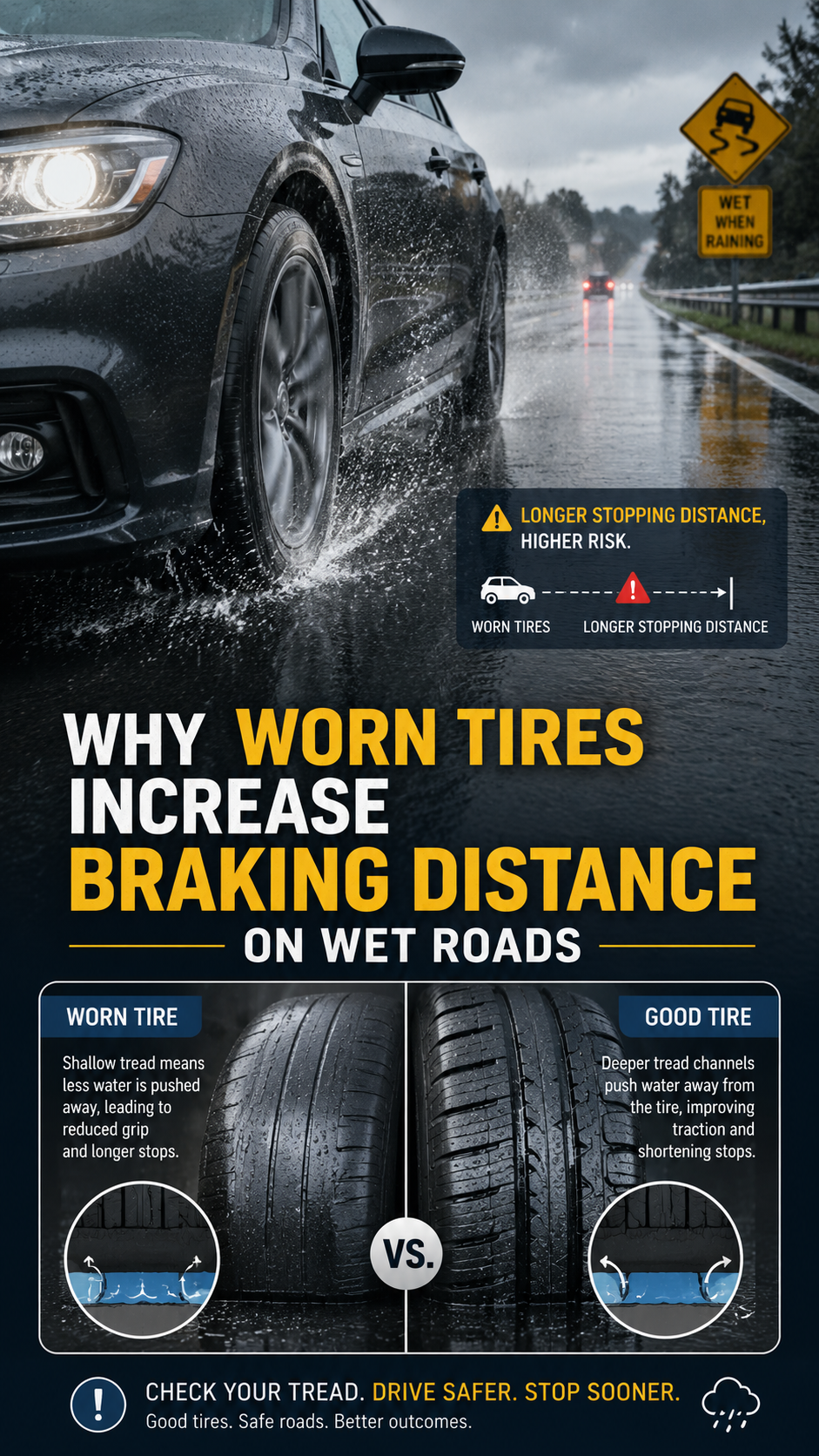
On a dry road, even a tire with some wear may still feel acceptable during everyday driving. But on a wet road, tire tread has a much bigger job. It has to move water out from under the tire so the rubber can keep contact with the pavement. When the tread is too shallow, water has fewer places to go. The tire may slide more easily, and the car may need more distance to stop.
This is why a tire that feels “fine” on a sunny day can feel very different in the rain.
The issue is not just about dramatic hydroplaning on the highway. It can show up in ordinary moments: stopping at a yellow light, slowing for traffic, turning into a neighborhood, or braking behind a school bus. A few extra feet of stopping distance may matter more than people realize.
The good news is that tire safety does not have to be complicated. With a few simple checks and better rainy-day habits, you can reduce the risk and feel more confident behind the wheel.
What Tire Tread Actually Does
Tread Gives Water Somewhere to Go
A tire is not just a round piece of rubber. The grooves in the tread are designed to channel water away from the contact patch, which is the small area where the tire touches the road.
When roads are wet, water sits between the tire and the pavement. The tread grooves help squeeze that water out so the tire can maintain grip.
As the tread wears down, those grooves become shallower. That means the tire cannot move as much water as quickly. The rubber has a harder time reaching the pavement, and traction can drop.
This is why tread depth matters so much in the rain.
The Contact Patch Needs Grip
Only a small part of each tire touches the road at any moment. That small contact patch is responsible for steering, braking, and acceleration.
When the tire has good tread and proper pressure, that patch can do its job more effectively. When the tread is worn, the patch may lose grip sooner, especially on wet pavement.
Braking depends on friction. If the tire cannot grip the road well, the brakes can still work, but the car may not slow down as quickly as expected.
This can be confusing for drivers because the brake pedal may feel normal. The problem is not always the brake system. Sometimes the tires simply do not have enough wet-road grip left.
Why Worn Tires Take Longer to Stop in the Rain
Less Tread Means Less Water Evacuation
The biggest reason worn tires increase wet braking distance is simple: they cannot clear water as well.
Imagine trying to walk through a shallow puddle in shoes with deep tread compared with smooth-bottom shoes. The deep tread gives water places to move. The smoother sole slides more easily.
Tires work in a similar way. The grooves, channels, and tread blocks help manage water. When those features are worn down, the tire becomes less effective in wet conditions.
Even if the road does not look flooded, a thin layer of water can reduce grip. A worn tire has less ability to cut through that layer.
The Tire Can Start Sliding Earlier
When braking on wet pavement, a worn tire can reach its grip limit sooner. This means the tire may begin sliding with less braking force than a healthier tire would handle.
Modern vehicles often have anti-lock braking systems, commonly called ABS. ABS helps prevent the wheels from locking up, but it cannot create grip that the tires do not have. If the tire is worn and the road is slick, ABS may help you maintain some control, but stopping distance can still be longer.
That is an important point. Safety technology helps, but it does not replace good tire condition.
Wet Roads Reduce Margin for Error
On dry pavement, you may have more room for small mistakes. On wet pavement, everything becomes less forgiving.
A slightly late reaction, a worn tire, following too closely, or braking hard on a slick patch can combine quickly. Each one adds a little risk. Together, they can make the car take longer to stop than the driver expected.
This is why worn tires are especially concerning during the first part of a rainstorm, when oil, dust, and road grime can mix with water and make the surface slick.
Everyday Situations Where Worn Tires Matter
Stopping at a Traffic Light
A common rainy-day scenario is approaching a traffic light that turns yellow. With good tires, proper speed, and enough following distance, stopping may be smooth.
With worn tires, the same stop may feel longer and less controlled. The car may continue rolling farther than expected, especially if the road is slick or slightly downhill.
This is one reason rainy weather is not the time to rush through intersections.
Braking Behind Another Car
In stop-and-go traffic, drivers often follow too closely without realizing it. On a dry day, the car may stop in time. In rain, worn tires can increase the distance needed.
If the vehicle ahead brakes suddenly, you need enough space for both reaction time and braking distance. Worn tires make that second part longer.
A safer habit is to increase following distance whenever roads are wet, even if traffic feels slow.
Driving Through Puddles
A puddle may look shallow, but it can hide uneven pavement, slick spots, or deeper water than expected.
Worn tires have a harder time pushing water away. If you hit standing water too fast, the tires may lose contact with the road surface for a moment. That can reduce steering and braking control.
It is better to slow down before reaching a puddle, not while you are already in it.
Turning While Braking
Turning and braking at the same time asks a lot from your tires. They have to grip in more than one direction.
On a wet road with worn tires, the car may feel less stable during a turn, especially if you brake suddenly. This can happen at freeway ramps, neighborhood corners, parking lots, or curved roads.
The safer approach is to slow down before the turn, then steer smoothly through it.
Common Mistakes Drivers Make With Worn Tires
Waiting Until Tires Look Completely Bald
Many drivers think tires are fine until they look nearly smooth. But wet-road performance can decline before a tire looks obviously bald.
The tread does not have to disappear completely to become less effective in rain. Shallow grooves may still be visible, but they may not be deep enough to manage water well.
By the time a tire looks completely worn out, it may have already been performing poorly in wet conditions for a while.
Checking Tires Only Before Long Trips
Long trips are a good time to check tires, but tire wear matters during normal weekly driving too. Most sudden stops happen during everyday errands, commutes, school drop-offs, and neighborhood driving.
A five-minute drive in the rain still involves braking, turning, and reacting to other drivers.
Tire checks should be part of regular car care, not just vacation prep.
Assuming All Tires Wear Evenly
Tires do not always wear at the same rate. One tire may wear faster because of alignment issues, underinflation, overinflation, suspension problems, or driving habits.
If you only glance at one tire, you may miss uneven wear on another. Check all four tires, including the inner and outer edges when possible.
Uneven wear can reduce traction and may also point to a maintenance issue that needs attention.
Believing All-Season Tires Are Always Enough
All-season tires are convenient and common in the United States, but they are not magic. They still need enough tread depth to work properly.
A worn all-season tire will not perform like a newer one simply because the label says “all-season.” Tire type matters, but tire condition matters too.
Warning Signs Your Tires May Be Struggling in Rain
The Car Takes Longer to Stop
If you notice the car seems to need more distance to stop in the rain, pay attention. It may be a sign that your tires are worn, improperly inflated, or not suited to the conditions.
Do not ignore the feeling just because the car stops eventually. A small change in stopping behavior can be an early warning.
The Tires Spin or Slip Easily
If your tires spin when accelerating from a stop on wet pavement, they may not be gripping well.
This can happen occasionally on very slick surfaces, but if it becomes common, it is worth checking tread depth and tire condition.
The Car Feels Light Over Water
If the steering suddenly feels light or vague when driving through water, the tires may not be maintaining strong contact with the road.
This can be a sign of hydroplaning or near-hydroplaning. Ease off the accelerator, avoid sudden steering, and let the car slow gradually.
Afterward, consider whether your speed, tire condition, or tread depth may have played a role.
You See Uneven or Smooth Areas
Look for areas where the tread is much shallower than the rest of the tire. Also watch for bald spots, cracks, bulges, exposed cords, or unusual patterns.
These are signs the tire needs attention. Some issues are about wear, while others may be about damage or alignment.
How to Check Tire Tread at Home
Use the Penny Test
One common at-home method is the penny test. Place a penny into the tire tread with Lincoln’s head facing down into the groove. If you can see the top of Lincoln’s head, the tread is very low and the tire may need replacement.
This is a simple check, not a full professional inspection. It can help you notice obvious wear, but it does not tell the whole story.
Check several spots across each tire, not just one groove.
Look for Tread Wear Bars
Most tires have built-in tread wear indicators. These are small raised bars inside the tread grooves. When the tread wears down to the level of these bars, the tire is at the point where replacement is generally needed.
If the tread is flush with the wear bars, do not wait for the tire to look worse.
Use a Tread Depth Gauge
A tread depth gauge is inexpensive and easy to use. It gives a more specific measurement than a penny.
This is helpful if you want to track tire wear over time or compare all four tires. You can find these gauges at many auto parts stores or online.
Ask During Routine Service
If you are already getting an oil change, tire rotation, or inspection, ask the technician to check tread depth and tire pressure.
Many shops will provide tread measurements. Ask for the numbers, not just “looks okay,” so you have a clearer sense of wear.
Tire Pressure Also Affects Wet Braking
Underinflated Tires Can Reduce Performance
Tread depth is important, but tire pressure matters too. Underinflated tires may flex more than they should and may not maintain the best contact with the road.
This can affect handling, fuel economy, tire life, and braking performance.
Check your tire pressure when the tires are cold, using the recommended pressure listed on the driver’s door sticker or in the owner’s manual. Do not rely only on the number printed on the tire sidewall, because that is usually a maximum pressure, not the vehicle’s recommended setting.
Overinflated Tires Can Be a Problem Too
Too much air can reduce the amount of tire surface contacting the road. It may also cause the center of the tire to wear faster.
Proper pressure is the goal. Not too low, not too high.
Pressure Changes With Temperature
Tire pressure can change as outdoor temperatures rise and fall. This is especially noticeable during seasonal changes.
Make it a habit to check pressure monthly and before longer drives. It only takes a few minutes, and it supports safer braking and better tire life.
Driving Tips for Rainy Roads With Tire Safety in Mind
Slow Down Before You Need To
Speed has a major effect on stopping distance. In rain, slowing down gives your tires more time to move water and maintain grip.
This is especially important if your tires are older or you are not sure about their tread depth.
You do not have to drive nervously. Just give yourself more room and avoid rushing.
Increase Following Distance
In wet weather, leave more space between your car and the vehicle ahead. This gives you more time to react and more distance to stop.
A bigger gap may feel unnecessary until the moment traffic suddenly slows. In rainy conditions, that extra space is one of the easiest safety tools you have.
Brake Smoothly
Sudden braking can overwhelm tire grip, especially on wet roads. When possible, brake earlier and more gently.
Of course, unexpected situations happen. But in normal driving, smooth braking helps maintain control and reduces the chance of sliding.
Avoid Cruise Control in Heavy Rain
Cruise control can be convenient, but in heavy rain it is better to stay fully engaged with speed control. Wet-road conditions can change quickly, and you may need to slow down sooner than expected.
Keeping your foot in control helps you respond more naturally to puddles, traffic, and changing visibility.
Watch for Shiny or Dark Patches
Wet roads can look uneven. Some areas may be wetter, slicker, or more polished than others. Intersections, painted lines, metal plates, bridge surfaces, and shaded areas can be especially slippery.
Slow down before reaching these areas when conditions look questionable.
When Tire Replacement Becomes the Safer Choice
Do Not Wait for a Scary Moment
Some drivers only replace tires after a close call in the rain. It is better to act before that happens.
A driver in a dry climate with short city trips may wear tires differently from someone who drives daily in heavy rain, on highways, or through hilly areas.
If you live in a region with frequent storms, wet-road performance should matter when choosing tires. Look at tire ratings and ask about wet traction, not just price.
Replace in Sets When Needed
Sometimes all four tires are worn. Other times, only two are near the end of their life. Follow professional guidance for your vehicle, especially if it is all-wheel drive, because mismatched tire sizes or tread depths may cause problems.
The key point is to avoid mixing badly worn tires with better ones without understanding the effect on handling.
A Simple Monthly Tire Safety Routine
Check Tread
Look at all four tires. Check the center, inner edge, and outer edge. Use a penny or tread gauge.
Check Pressure
Use a tire pressure gauge when the tires are cold. Adjust to the pressure recommended for your vehicle.
Look for Damage
Watch for cracks, bulges, nails, cuts, or uneven wear. Do not ignore a tire that looks different from the others.
Notice How the Car Feels
Pay attention to pulling, vibration, slipping, or longer stopping distance. Your daily driving experience can give you useful clues.
Schedule Rotations
Regular tire rotation can help tires wear more evenly. Follow your vehicle’s maintenance schedule or ask a trusted service shop.
Conclusion: Good Tread Gives You More Room to Stop
Worn tires increase braking distance on wet roads because they cannot move water away as effectively. With less tread, the tire has a harder time staying in contact with the pavement, which reduces grip when you need it most.
This matters in everyday driving, not just during severe storms. A quick stop at a traffic light, a sudden slowdown on the highway, or a turn on a wet neighborhood street can all feel different when tires are worn.
The practical takeaway is simple: check your tread, keep your tires properly inflated, slow down in rain, and leave more room to stop. Tires are easy to forget when everything feels normal, but they are one of the main things connecting your car to the road.
A few minutes of tire care can make rainy driving calmer, smoother, and safer for everyone in the car.
Hi, I’m the creator and editor behind ZestyHabit. I research everyday safety, first aid, and practical wellness topics using official guidance and reliable public sources, then turn that information into clear, realistic steps for daily life.
My goal is to help readers make safer, better-informed choices at home and beyond.