
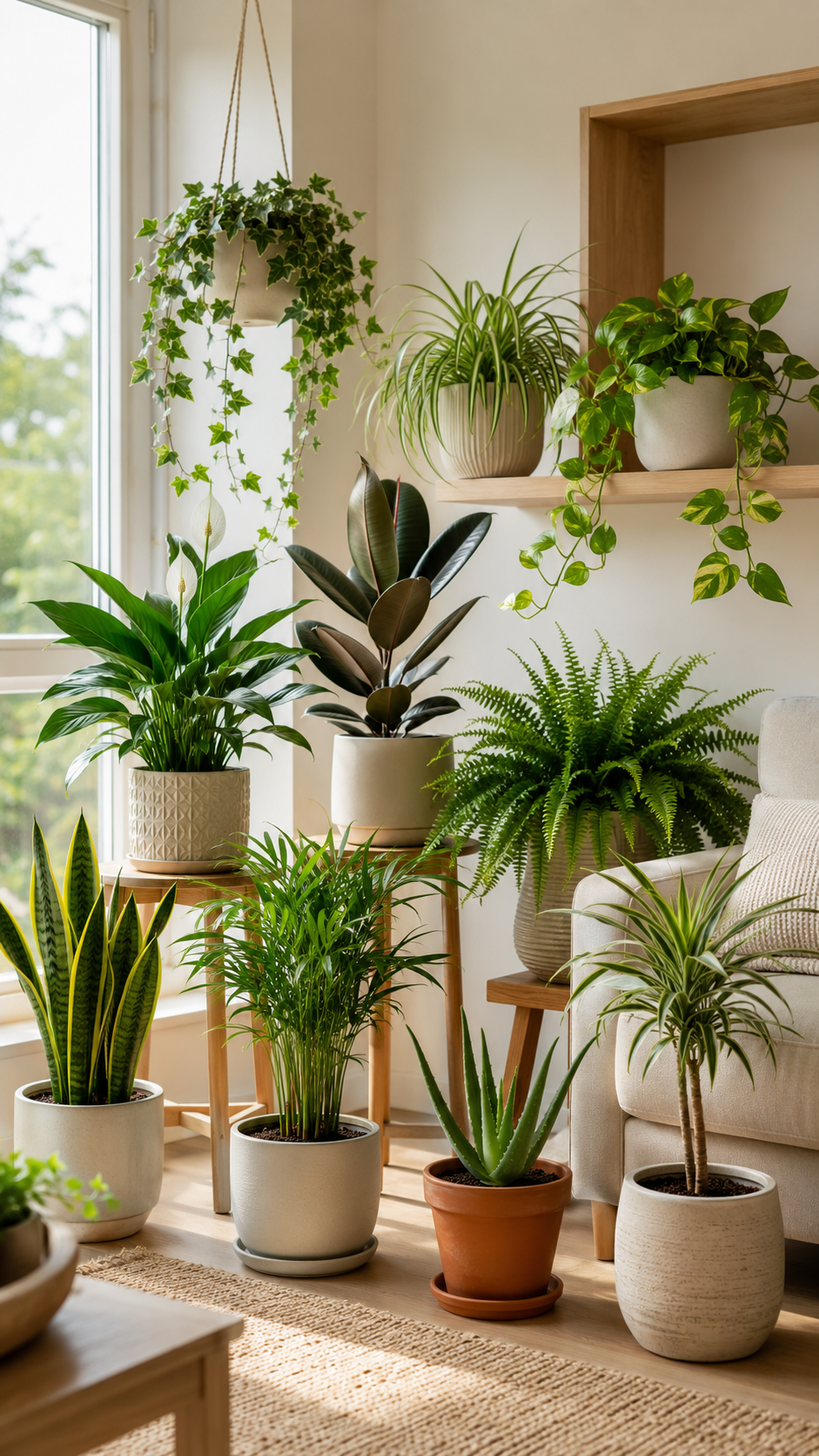

Houseplants can transform a plain room into a calmer, more inviting space. They add color, soften hard edges, and bring a small piece of nature indoors. Many are also sold as “air-purifying plants” capable of removing harmful chemicals, producing oxygen, and creating a healthier home.
There is some science behind these claims—but the full story is more complicated than the labels at a garden center might suggest.
Plants can absorb certain airborne chemicals under controlled laboratory conditions. Their leaves, roots, potting material, and associated microorganisms may all play a role. However, a few plants on a windowsill cannot replace ventilation, source control, or a properly selected air cleaner.
That does not make houseplants useless. Their possible benefits include modest humidity changes, psychological comfort, visual appeal, and a stronger connection to nature. The key is to choose plants for realistic reasons rather than expecting them to function like powerful air-filtration machines.
Do Air-Purifying Plants Really Work?
Much of the enthusiasm surrounding air-purifying plants can be traced to a well-known NASA study published in 1989. Researchers examined whether common houseplants and their associated soil microorganisms could help remove pollutants in sealed environments. The work was particularly relevant to closed space habitats, where maintaining air quality presents a unique challenge.
The plants were tested against chemicals such as benzene, formaldehyde, and trichloroethylene. The experiments showed that plant systems could remove some of these pollutants from enclosed test chambers. NASA also explored an active system that used a fan to move contaminated air through an activated-carbon bed connected to plant roots. You can read the original NASA technical report.
The problem arose when results from small, sealed chambers were applied directly to ordinary houses and offices.
Real homes are much larger and constantly exchange air through doors, windows, ventilation systems, and small gaps in the building. They also contain continuing pollution sources, including cooking, cleaning products, furniture, paint, candles, tobacco smoke, and hobby supplies.
A later review analyzed 12 published chamber studies and converted their findings into a standard clean-air delivery rate. The researchers estimated that a building could require roughly 10 to 1,000 plants per square meter of floor space for passive plant filtration to compete with normal air exchange. In other words, you might need something closer to a dense indoor forest than a few attractive pots. The findings were published in the Journal of Exposure Science & Environmental Epidemiology.
The most accurate conclusion is therefore:
Houseplants can interact with airborne pollutants, but a reasonable number of ordinary potted plants is unlikely to produce a significant improvement in the air quality of a typical home.
How Plants Interact With Indoor Air
The plant itself is only one part of the system. Airborne chemicals may settle on leaf surfaces or enter leaves through microscopic openings called stomata. Some compounds may then be broken down, stored, or transported within the plant.
Roots and microorganisms living in the potting medium may also contribute. This is one reason active botanical filters, which intentionally move air through a root zone, may perform differently from passive pots sitting in a corner.
Plants also release water vapor through transpiration. Several plants grouped together may slightly increase local humidity, particularly in a small room. That can feel pleasant in a dry environment, although the effect depends on plant size, temperature, light, watering, and ventilation.
A systematic review of 95 articles found that reported effects included the removal of pollutants such as formaldehyde, benzene, and toluene, along with increased humidity and decreased temperature. However, the studies used widely different environments and methods, so the results should not be interpreted as proof that a few plants can clean an entire home. Details are available through PubMed.
10 Popular Air-Purifying Plants
1. Snake Plant
The snake plant, also called Dracaena trifasciata, is one of the most forgiving indoor plants. Its upright, patterned leaves tolerate irregular watering and a wide range of indoor lighting conditions.
Snake plants appeared in research involving volatile organic compounds, but their greatest practical advantage is durability. They are well suited to beginners, bedrooms, and offices where plant care may occasionally be forgotten.
Allow the potting mix to dry before watering again. Constantly wet soil can cause root rot. Snake plants may also irritate dogs and cats if eaten, so place them out of reach of curious pets.
2. Spider Plant
The spider plant has arching green-and-white leaves and produces small plantlets that hang from long stems. It grows quickly, adapts to ordinary household conditions, and is easy to propagate.
Spider plants have been included in laboratory research involving indoor pollutants, but they are especially valuable as low-maintenance decorative plants. They prefer bright, indirect light but can tolerate lower-light locations.
They are commonly listed as non-toxic to cats and dogs, although chewing large amounts of any plant material can still cause stomach upset.
3. Peace Lily
Peace lilies are recognizable by their glossy leaves and white, sail-shaped flowers. They tolerate lower light better than many flowering houseplants, although they usually bloom more reliably with bright, indirect light.
Their broad leaves and relatively high rate of transpiration make them popular in conversations about air-purifying plants. However, they should not be treated as a substitute for mechanical filtration or ventilation.
Peace lilies contain irritating calcium oxalate crystals. Chewing the plant can cause mouth pain, drooling, and difficulty swallowing in pets or children. Despite its name, the peace lily is not a true lily, but it should still be kept out of reach.
4. Golden Pothos
Golden pothos is a vigorous trailing plant with heart-shaped leaves. It can climb a support, hang from a shelf, or trail along a bookcase. It also tolerates lower light, although its variegation may fade in darker rooms.
Pothos was among the plants examined in the NASA-era research. In daily life, its strongest qualities are rapid growth, easy propagation, and the ability to survive occasional neglect.
Let the upper layer of soil dry between waterings. Pothos is toxic if chewed because it contains calcium oxalate crystals, so it may not be the best choice for an accessible shelf in a home with pets or small children.
5. Boston Fern
Boston ferns have soft, arching fronds that bring texture and movement to a room. Because they prefer moist soil and relatively humid conditions, they can be more demanding than snake plants or pothos.
Their transpiration may add a small amount of moisture to the immediate environment. This can be welcome during a dry winter, but one fern will not humidify an entire house.
Boston ferns prefer bright, filtered light and should be kept away from heating vents. They are generally considered non-toxic to cats and dogs, but confirming the exact species before purchase is still wise.
6. Areca Palm
The areca palm creates a lush, tropical appearance with multiple stems and feathery fronds. A healthy, mature plant has far more leaf area than a small desktop plant, making it visually impressive and capable of releasing more moisture through transpiration.
Areca palms prefer bright, indirect light and evenly moist—but never waterlogged—soil. Dry air may cause brown leaf tips.
They are commonly considered pet-friendly, making them a popular alternative to several toxic foliage plants. Be sure that the plant is correctly labeled, since common names can sometimes be confusing.
7. Bamboo Palm
The bamboo palm is another attractive indoor palm with slender, cane-like stems. It was included in NASA’s plant research and is frequently marketed as an air-cleaning plant.
In the home, it works best as a floor plant in a bright room without harsh midday sun. It appreciates consistent moisture and may struggle if allowed to remain completely dry for extended periods.
Bamboo palms can become fairly large, so consider their mature size before placing one beside furniture or in a narrow hallway.
8. Dracaena
Dracaena is a large group that includes several popular indoor varieties with narrow, striped, or colorful leaves. These plants are often chosen for offices because they grow vertically and do not occupy much floor space.
Many dracaenas appeared in controlled studies of pollutant removal. They usually prefer bright, indirect light but tolerate less-than-perfect indoor conditions.
Avoid overwatering, since the roots are vulnerable to rot. Dracaena plants can be toxic to cats and dogs if eaten.
9. Rubber Plant
The rubber plant, or Ficus elastica, has thick, glossy leaves that can become quite large. Its substantial foliage makes it an eye-catching choice for living rooms and bright offices.
Dust can accumulate on the broad leaves, so wipe them periodically with a damp cloth. This keeps the plant looking healthy and allows more light to reach the leaf surface.
Rubber plants need bright, indirect light and well-draining soil. Their sap can irritate the skin, and the plant should be kept away from pets that tend to chew leaves.
10. Aloe Vera
Aloe vera is best known for the gel inside its fleshy leaves, but it is also frequently included on lists of air-purifying plants. As a succulent, it needs much brighter light and less frequent watering than tropical foliage plants.
Aloe uses a water-conserving form of photosynthesis called crassulacean acid metabolism, or CAM. This allows it to exchange gases mainly at night, but one aloe plant will not noticeably raise the oxygen level of a bedroom.
Place it near a bright window and allow the soil to dry thoroughly between waterings. Aloe is toxic to cats and dogs when ingested and should not be confused with pet-safe succulents.
Benefits Beyond Air Filtration
Even if houseplants do not dramatically remove pollutants, they can still improve how a room feels.
Indoor greenery may create a sense of calm, make workspaces more attractive, and provide a small restorative break from screens. Research into indoor plants and human functioning has reported possible psychological benefits, although results differ between studies and environments.
Caring for a plant can also become a gentle routine. Checking new growth, watering when necessary, or rotating a pot toward the light offers a brief moment of attention that is unrelated to emails, notifications, or household stress.
These benefits are difficult to measure with an air-quality monitor, but they may be more meaningful in everyday life than the tiny amount of VOC removal provided by a passive plant.
The Best Way to Improve Indoor Air Quality
If you are concerned about indoor pollution, begin with the source rather than the plant shelf. The U.S. Environmental Protection Agency identifies three main strategies: source control, improved ventilation, and air cleaning or filtration.
Source control may involve avoiding indoor smoking, using exhaust fans while cooking, storing solvents safely, choosing lower-emission products, addressing moisture problems, and following label directions for cleaners and paints.
Ventilation can dilute pollutants when outdoor air conditions are suitable. A properly selected air cleaner may help with airborne particles, but its effectiveness depends on its filter, airflow rate, room size, and maintenance.
The EPA specifically notes that there is currently no evidence that a reasonable number of houseplants removes significant quantities of pollutants in homes and offices. Its full recommendations can be found in the agency’s guide to improving indoor air quality.
Plants should therefore be viewed as a pleasant addition to a healthy-air strategy—not the foundation of one.
Potential Problems With Indoor Plants
Houseplants are generally safe when cared for properly, but they can introduce a few problems:
- Overwatered soil may support mold or microorganisms, particularly in poorly ventilated rooms.
- Standing water in saucers can attract pests.
- Fragrant flowers or moldy potting material may bother people with allergies or asthma.
- Some plants are poisonous or irritating to pets and children.
- Large numbers of heavily watered plants may add unwanted humidity to an already damp home.
- Pesticides or leaf-shine products can introduce additional chemicals indoors.
Use pots with drainage holes, discard standing water, remove dead leaves, and isolate any plant showing signs of insects. If someone in the home has severe allergies, discuss suspected triggers with an appropriate medical professional.
Frequently Asked Questions
How many plants are needed to purify a room?
There is no practical number supported by strong real-world evidence. Studies suggest that an extremely high plant density would be required for passive pots to compete with ordinary air exchange. Choose a manageable number for decoration and well-being instead.
Do plants remove mold from indoor air?
A houseplant should not be used as a mold treatment. In fact, excessively wet soil can encourage microbial growth. Visible mold or persistent moisture requires identification of the water source, drying, cleaning, and sometimes professional remediation.
Do bedroom plants provide more oxygen at night?
Some CAM plants, including snake plants and aloe, exchange gases mainly at night. However, the effect of one or two plants on bedroom oxygen levels is negligible compared with the room’s air volume and ventilation.
Which air-purifying plant is best for beginners?
Snake plants, golden pothos, and spider plants are among the easiest options. Your best choice will depend on available light, watering habits, and whether children or pets can reach the plant.
Final Thoughts
The best air-purifying plant is not necessarily the one with the most impressive marketing claim. It is the plant that suits your light, lifestyle, available space, and household safety needs. Houseplants will not replace fresh-air ventilation or effective filtration, but they can make a home feel greener, calmer, and more enjoyable. Which indoor plant has grown best in your home, and have you noticed any difference in comfort, humidity, or mood since adding it? Share your experience in the comments so other readers can learn from it too.

Hi, I’m the creator and editor behind ZestyHabit. I research everyday safety, first aid, and practical wellness topics using official guidance and reliable public sources, then turn that information into clear, realistic steps for daily life.
My goal is to help readers make safer, better-informed choices at home and beyond.


