
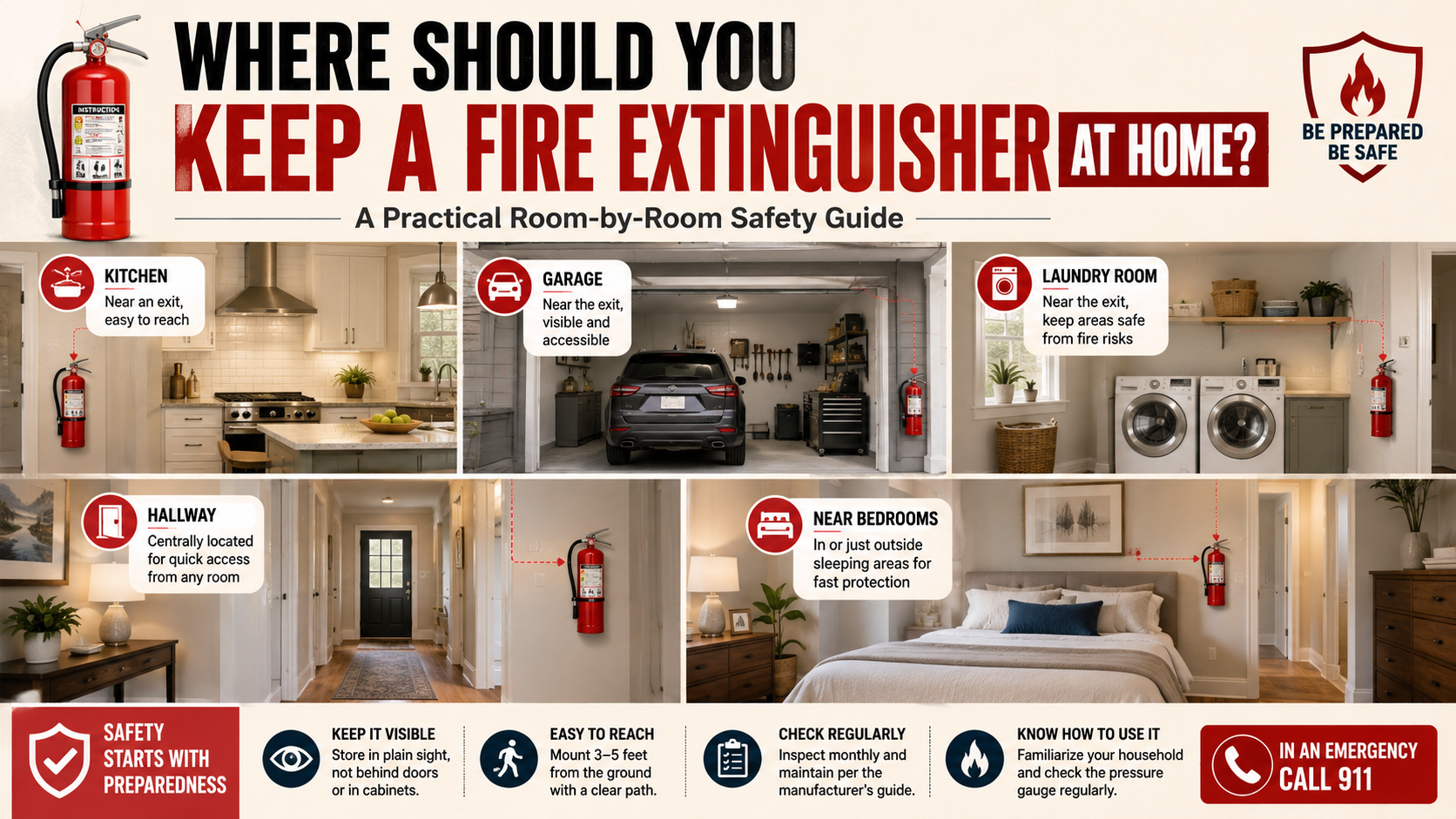

Learn where to keep fire extinguishers at home, which rooms matter most, common placement mistakes, and simple habits that make extinguishers easier to find in an emergency.
Why Fire Extinguisher Placement Matters More Than People Think
Buying a home fire extinguisher is a smart safety step. But where you put it matters just as much as having one.
A fire extinguisher that is buried behind cleaning supplies, hidden in a garage cabinet, or tucked away in a closet may not help when you need it quickly. In a stressful moment, you do not want to search through boxes, open several doors, or wonder where you stored it “just in case.”
The goal is simple: a fire extinguisher should be easy to see, easy to reach, and close to areas where small household fires are more likely to start.
This does not mean turning your home into a fire station. Most families just need a thoughtful plan. A few well-placed extinguishers can make your home feel more prepared without adding clutter or worry.
Let’s walk through the best places to keep fire extinguishers at home, what mistakes to avoid, and how to make sure everyone in the household knows where they are.
Start With the Kitchen, But Do Not Put It Too Close to the Stove
The kitchen is one of the most common places people think about when they imagine a home fire. That makes sense. Cooking, hot pans, grease, appliances, towels, paper packaging, and distracted moments all come together in one room.
So yes, the kitchen is one of the best places to keep a fire extinguisher.
But there is one important detail: do not place it right next to the stove.
Why “Right Beside the Stove” Is Not Ideal
At first, it may seem logical to keep the extinguisher directly beside the stove. After all, that is where a cooking fire might happen.
But if flames, smoke, or heat are coming from the stovetop, you may not be able to safely reach the extinguisher if it is mounted too close. You do not want to move toward the source of the problem just to grab your safety tool.
A better option is to place the extinguisher near the kitchen exit, on a wall, in a clearly visible spot, or inside an easy-to-open cabinet close to the doorway.
That way, you can access it while keeping a path behind you.
Good Kitchen Locations
Good kitchen extinguisher spots include:
- Near the kitchen doorway
- On a wall away from the stove
- Inside a clearly labeled, easy-to-open cabinet
- Near the pantry entrance, if it is not blocked
- Close to the dining area side of the kitchen
The key is that you should not need to reach over the stove, pass through smoke, or move around hot cookware to get to it.
Keep One Near the Garage or Workshop
If your home has a garage, basement work area, or hobby workshop, that is another smart place for a fire extinguisher.
Garages often hold items that need extra care: gasoline, paint, motor oil, power tools, lawn equipment, extension cords, cardboard boxes, and stored household items. Even if you are careful, garages can become cluttered quickly.
A small fire in a garage can be harder to notice right away, especially if the door is closed or the space is separate from the main living area.
Where to Place It in the Garage
Keep the extinguisher near the garage exit or the door that leads into the house. Avoid placing it behind parked cars, behind storage shelves, or deep inside a workbench cabinet.
If you have a workbench where you use tools, chargers, or small equipment, you may want the extinguisher nearby, but still easy to reach from the exit side of the room.
A good rule is this: if you had to leave the garage quickly, could you grab the extinguisher without going deeper into the space?
If the answer is no, move it.
Place One Near Bedrooms or Hallways
Many people only think about kitchens and garages, but sleeping areas matter too.
You do not necessarily need a fire extinguisher inside every bedroom, but having one in a central hallway near bedrooms can be helpful. This is especially true in larger homes, two-story homes, or homes where bedrooms are far from the kitchen.
At night, people are groggy. The house is dark. You may not be thinking clearly. A visible, easy-to-reach extinguisher in the hallway can be more useful than one hidden downstairs in a cabinet.
Make It Easy to Find in Low Light
If you keep an extinguisher near bedrooms, avoid placing it behind a door that is usually open, under a pile of coats, or inside a crowded linen closet.
A wall-mounted location in the hallway is often better. If you prefer not to mount it, place it in a consistent, clear spot that everyone knows.
For families with children, the extinguisher should be visible to responsible adults but not treated like a toy. It is also helpful to explain that it is safety equipment and should not be moved or played with.
Consider One on Each Floor
If you live in a multi-story home, one extinguisher in the kitchen may not be enough for everyday practicality.
Imagine a small electrical issue starts in an upstairs office, but the only extinguisher is downstairs under the kitchen sink. Even if the situation is minor, you would lose time going up and down the stairs.
For multi-level homes, consider keeping at least one extinguisher on each floor.
Simple Placement by Floor
A practical home setup might look like this:
- First floor: kitchen or main hallway near the kitchen
- Second floor: hallway near bedrooms
- Basement: near the stairs or exit
- Garage: near the door to the house or exterior exit
This kind of setup keeps things simple. You are not overcomplicating the home. You are just making sure safety equipment is not too far away when it matters.
Do Not Hide It Under the Sink Without Thinking
Many people keep fire extinguishers under the kitchen sink. This can work, but only if the spot is easy to access and everyone knows it is there.
The problem is that under-sink cabinets often become crowded with cleaning sprays, sponges, trash bags, dishwasher tabs, and random bottles. Over time, the extinguisher may get pushed to the back.
In a calm moment, that does not seem like a big deal. But during a stressful moment, digging through a messy cabinet is not ideal.
If You Use an Under-Sink Cabinet
If under the sink is your only good option, make it intentional.
Keep the extinguisher near the front. Do not block it with cleaning supplies. Consider adding a small label on the inside or outside of the cabinet door so household members can find it quickly.
Check the cabinet once in a while. If the extinguisher has disappeared behind a bulk pack of trash bags, move it back.
Wall-Mounted Is Often Best
A mounted fire extinguisher is easier to find and less likely to be moved.
When an extinguisher sits loose on the floor or inside a cabinet, it may slowly migrate. Someone moves it while cleaning. A box gets placed in front of it. It gets knocked over. Eventually, nobody is completely sure where it went.
A wall bracket solves many of those problems.
Benefits of Wall-Mounting
Wall-mounted extinguishers are:
- Easier to see
- Less likely to be blocked
- Less likely to be damaged
- Easier for household members to remember
- More consistent during stressful moments
You do not need to mount it in the middle of your living room like a commercial building. A neat spot near a doorway, hallway, garage entrance, or pantry wall can work well.
Just make sure it is not too high. Adults should be able to reach it easily without standing on a stool.
Keep It Away From Heat and Moisture
A fire extinguisher should be stored in a clean, dry, accessible place.
Avoid placing it directly next to ovens, stovetops, heaters, water heaters, fireplaces, or areas with extreme heat. Also avoid damp areas where moisture could damage the canister, label, hose, or pressure gauge over time.
Bathrooms, very damp basements, and outdoor spots without weather protection are usually not ideal.
Watch for Everyday Damage
Now and then, look at the extinguisher and check for obvious problems:
- Rust
- Dents
- Cracked hose
- Missing pin
- Damaged label
- Pressure gauge not in the recommended range
- Powder or residue around the nozzle
- Signs it was dropped or tampered with
You do not need to inspect it obsessively, but it should not be ignored for years.
Think About the Exit Path
One of the most practical placement tips is also one of the easiest to remember: keep the extinguisher near an exit path.
This helps because you do not want to move deeper into a room to get it. You want to stay positioned so you can leave if the situation becomes unsafe.
For example, in the kitchen, place it closer to the doorway than to the stove. In the garage, place it near the door, not behind the car. In the basement, place it near the stairs or exit, not in the far storage corner.
A Simple Mental Test
Stand in the room and ask yourself:
“If something happened here, could I reach the extinguisher while still keeping a clear way out?”
If the answer is no, the location probably needs to change.
Match the Extinguisher to Household Needs
Placement is important, but so is choosing the right type.
Many homes use multipurpose extinguishers labeled for common household fire types. These are often designed to handle ordinary combustibles, flammable liquids, and electrical equipment. For many homeowners, a multipurpose extinguisher is a practical choice.
For kitchens, some people also choose extinguishers designed with cooking-related fires in mind. The best option depends on your home, appliances, and comfort level.
Read the Label Before You Need It
Do not wait until a stressful moment to read the instructions.
Take a few minutes when you buy the extinguisher to look at:
- What types of fires it is rated for
- How to use it
- How far away to stand
- How to check the pressure gauge
- When it expires or needs service
- Any storage limits
This small habit makes the extinguisher feel less mysterious.
Make Sure Everyone Knows Where It Is
A fire extinguisher is not very helpful if only one person knows where it is.
Once you decide where to keep it, tell the people in your household. Show them the location. Explain that it should not be moved unless it is being used or checked.
This is especially important if you have older children, roommates, guests who stay often, or elderly family members in the home.
Keep the Explanation Simple
You do not need to turn it into a scary lecture. You can simply say:
“This is the fire extinguisher. It stays here so we can find it quickly. Do not move it or block it.”
That is enough for everyday awareness.
Avoid Clutter Around the Extinguisher
Even a good location can become a bad one if clutter builds up around it.
This happens often in garages, laundry rooms, pantries, and basements. A fire extinguisher starts in a clear spot, then holiday decorations, bulk paper towels, pet food bags, or storage bins slowly pile around it.
Make the area around the extinguisher a “do not block” zone.
Monthly Visual Check
Once a month, glance at the extinguisher location. You do not need a formal checklist. Just ask:
- Can I see it?
- Can I reach it?
- Is anything blocking it?
- Does it look damaged?
- Is the pressure gauge okay?
This takes less than a minute and helps keep the extinguisher ready.
Do Not Store It Behind Locked Doors
Avoid keeping your only extinguisher in a locked room, locked cabinet, or storage area that not everyone can access.
In an emergency, keys and combinations create delays. A locked location also makes it harder for guests, family members, or neighbors to help if needed.
If you are concerned about children touching it, choose a visible adult-height location rather than hiding it completely. Safety equipment works best when it is accessible to responsible people.
Special Spots to Think About
Every home is different, so your extinguisher placement should fit your actual routines.
Laundry Room
Dryers, lint, electrical outlets, and stored cleaning products make the laundry area worth considering, especially if it is far from the kitchen or garage extinguisher.
Keep the extinguisher near the laundry room door rather than behind baskets or detergent bottles.
Home Office
Home offices often have power strips, chargers, printers, computers, lamps, and cables. If your office is far from the main part of the house, a nearby extinguisher may be useful.
This is especially true if you run multiple devices or work in a converted basement, attic, or garage room.
Fireplace or Wood Stove Area
If your home has a fireplace or wood stove, keep an extinguisher nearby but not so close that heat or flames could block access.
It should be reachable from the room’s exit side, not tucked behind firewood or fireplace tools.
Outdoor Cooking Area
If you grill often, think about where a fire extinguisher would be reachable from the patio, deck, or back door.
Do not store a regular indoor extinguisher outside unless it is appropriate for the conditions and protected as recommended by the manufacturer. Many people keep one just inside the door that leads to the grill area.
Common Fire Extinguisher Placement Mistakes
Here are some common mistakes that make extinguishers harder to use when needed:
- Keeping the only extinguisher under a cluttered sink
- Placing it directly next to the stove
- Hiding it in a closet nobody checks
- Storing it behind boxes in the garage
- Mounting it too high to reach
- Forgetting to tell family members where it is
- Letting furniture block it
- Keeping it near heat, moisture, or outdoor weather
- Buying one and never reading the label
- Forgetting to check the pressure gauge
Most of these mistakes are easy to fix. You do not need a complicated system. You just need a visible, reachable, sensible location.
A Simple Home Fire Extinguisher Placement Plan
If you want a practical starting point, use this simple plan.
For Small Apartments
Keep one extinguisher near the kitchen exit, not beside the stove. Make sure it is visible or clearly labeled. If your bedroom is far from the kitchen, consider a second small extinguisher near the sleeping area.
For Single-Story Homes
Place one near the kitchen exit and one near the garage or utility area if you have one. If the home is large, consider another near the bedroom hallway.
For Two-Story Homes
Keep one on each floor. Place one near the kitchen on the main level and one in the upstairs hallway near bedrooms. Add one in the garage or basement if applicable.
For Homes With Basements
Keep an extinguisher near the basement stairs or exit. Avoid placing it deep in a storage area where it could be blocked by boxes.
This kind of plan covers the most practical areas without making the home feel crowded.
Remember: Extinguishers Are for Small, Early Problems
A home fire extinguisher is meant for small, contained situations where you have a clear exit and feel safe using it. It is not meant to make anyone take unnecessary risks.
The most important safety habits are still prevention, working smoke alarms, clear exits, and knowing when to leave the home.
For everyday awareness, think of the extinguisher as one helpful tool, not the whole safety plan.
Final Thoughts: Keep It Visible, Reachable, and Practical
The best place for a home fire extinguisher is not the most hidden place or the place that looks neatest. It is the place you can actually reach quickly and safely.
For most homes, that means keeping one near the kitchen exit, one near the garage or utility area, and one on each floor if the home has multiple levels. Avoid placing it too close to the stove, behind clutter, near heat, or in locked spaces.
Once you choose the locations, show everyone in the household. Keep the area clear. Check the pressure gauge once in a while. Replace or service the extinguisher when needed.
Small safety habits like these are easy to overlook, but they make a real difference. A fire extinguisher does not need to be dramatic or intimidating. It just needs to be in the right place, ready to use, and easy to find when a calm, quick response matters.

Hi, I’m the creator and editor behind ZestyHabit. I research everyday safety, first aid, and practical wellness topics using official guidance and reliable public sources, then turn that information into clear, realistic steps for daily life.
My goal is to help readers make safer, better-informed choices at home and beyond.


