
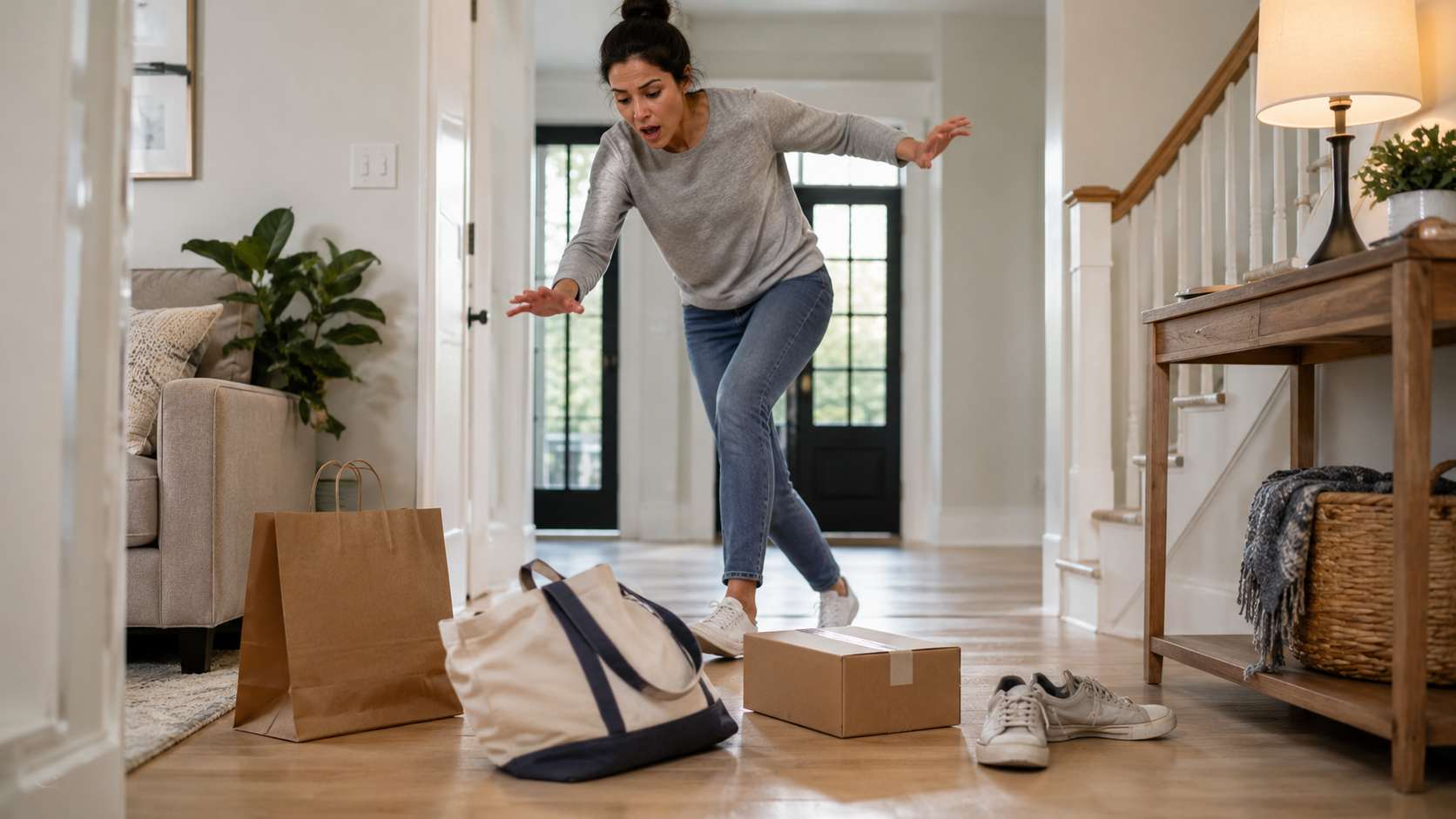

Bags and boxes left on the floor may seem harmless, but they can create trip hazards, blocked walkways, cluttered exits, and hidden risks for kids, pets, and older adults. Learn simple ways to keep floors safer at home.
The Everyday Clutter That Feels Too Normal to Notice
Most homes have a few things sitting on the floor.
A work bag by the couch.
A grocery bag near the kitchen.
A delivery box by the front door.
A backpack in the hallway.
A laundry tote waiting beside the stairs.
A cardboard box that was supposed to be unpacked “later.”
At first, none of this seems like a big deal. Bags and boxes are part of daily life. We carry them in, set them down, and tell ourselves we will move them soon.
But floor clutter has a way of becoming invisible.
After a bag has been sitting in the same spot for two days, your brain stops treating it like an obstacle. The box near the hallway becomes part of the background. The backpack by the door feels normal. Then someone walks through the room in dim light, turns a corner too quickly, or carries a full laundry basket and does not see it.
That is when a small object becomes a trip hazard.
Bags and boxes are especially tricky because they do not always look dangerous. They are not sharp. They are not hot. They are not broken. But they change the way people move through a home. They block walking paths, hide cords or small objects, reduce open space, and create unexpected obstacles right where feet need to land.
Keeping floors clear is one of the simplest home safety habits, but it is also one of the easiest to ignore.
Why Floor Clutter Leads to Accidents
Walking through your home feels automatic because you know the space so well. You know where the couch is, where the hallway turns, and how many steps it takes to reach the kitchen.
That familiarity is helpful, but it can also make clutter more dangerous.
When something is left on the floor, it interrupts a path your body expects to be clear. You may not look down every time because you do not think you need to. A bag strap, box corner, or loose handle can catch your foot before you notice it.
Bags and boxes change your walking path
A clear floor lets people walk naturally. A cluttered floor makes people step around things, shorten their stride, twist sideways, or walk closer to furniture.
Those small adjustments may not seem risky, but they add up. A person carrying groceries, holding a child, or walking in socks may not have the balance to recover from a sudden awkward step.
They are easy to miss in low light
Dark bags, brown boxes, and soft backpacks can blend into floors, rugs, or shadows. This is especially true in hallways, bedrooms, entryways, and stairs.
At night, a box that was obvious during the day may be almost invisible. A black gym bag on a dark floor can disappear until your foot hits it.
They create “surprise obstacles”
One of the reasons floor clutter is risky is that it changes from day to day. A chair is always in the same place. A bag may not be.
If someone else in the home leaves a package near the door, you may not expect it. If a child drops a backpack in the hallway, an adult walking through with laundry may not see it. If a pet knocks a bag into a walkway, the path changes without warning.
Surprise is what makes many trips happen quickly.
Bag Straps Are a Bigger Hazard Than the Bag Itself
The bag may sit to the side, but the strap often reaches into the walkway.
This is one of the most common reasons bags cause trips. A purse, backpack, laptop bag, gym bag, or tote may look mostly out of the way, while a long strap lies across the floor like a loop.
A foot can slide under that strap, catch it, and stop suddenly. The person keeps moving forward, but the foot does not. That is how a small strap can cause a hard stumble.
Handles and cords can tangle
Some bags have multiple handles, drawstrings, bungee cords, or loose attachments. These can hook around shoes, slippers, canes, walker legs, or pet paws.
Backpacks are especially messy because they often have shoulder straps, side pockets, dangling keychains, and loose zippers.
If a bag must sit on the floor briefly, tuck the straps in and keep it completely out of the walking path. Better yet, give bags a hook, shelf, bench, or cubby.
Boxes Create Different Risks
Boxes are usually more rigid than bags, which makes them risky in another way.
A person may kick a cardboard box and lose balance. A box corner may catch the foot. A low box may be hard to see when someone is carrying something. A stacked box may tip over.
Delivery boxes often become hallway clutter
Online shopping has made boxes part of everyday home life. Packages arrive, get opened, and then the empty box stays near the door until recycling day.
The problem is that front doors, entryways, and hallways are high-traffic areas. People come in carrying groceries, children, work bags, umbrellas, or pet leashes. A box near the entrance can quickly become an obstacle.
Empty boxes are still trip hazards
An empty box may feel too light to be dangerous, but it can slide, collapse, or shift underfoot. If someone steps on the edge, the box may crush unevenly and throw off balance.
Flattening boxes right away is a simple habit that reduces clutter and makes recycling easier.
Stacked boxes can fall
A small stack of boxes may seem tidy, but if it is unstable, it can tip into a walkway. This is common in garages, closets, storage rooms, and near entryways.
Boxes should be stacked on shelves or against a stable wall, not in paths where people walk.
Why This Matters More in Busy Homes
The busier the home, the more floor clutter matters.
In a quiet household with one adult, a bag on the floor may be easier to remember. In a household with kids, pets, roommates, visitors, deliveries, laundry, and school gear, the floor can change constantly.
People move while distracted
Most people are not fully focused while walking through the house. They are thinking about dinner, carrying coffee, answering a message, talking to someone, or heading out the door.
A safe home setup should not depend on perfect attention every time.
Morning and evening routines are rushed
Bags and boxes often pile up during the most rushed parts of the day.
In the morning, backpacks, lunch bags, work totes, and shoes gather near the door. In the evening, grocery bags, packages, laundry baskets, and mail land wherever there is space.
These are also the times when people are tired or moving quickly.
Guests do not know your clutter patterns
You may remember that there is a box beside the couch, but a guest may not. A visiting grandparent, friend, babysitter, or delivery helper may walk through the space expecting a clear path.
Floor clutter is more risky for people who do not know the home layout.
Who Is Most at Risk?
A bag or box on the floor can trip anyone, but some people are more likely to be affected.
Older adults
Older adults may have changes in balance, vision, strength, or reaction time. A small obstacle can be harder to step over or recover from.
Clear walking paths are especially important in homes where older adults live or visit.
Children
Children run, skip, carry toys, and do not always watch their feet. They may also climb onto boxes or hide inside them, creating other risks.
A child may leave a backpack on the floor, then trip over it five minutes later.
People carrying items
Anyone carrying groceries, laundry, a baby, a pet, or a large box has limited visibility and fewer free hands. A small floor obstacle becomes much more dangerous when the person cannot see their feet.
People with mobility aids
Canes, walkers, crutches, and wheelchairs need clear floor space. Bag straps, box corners, and narrow pathways can interfere with safe movement.
Even a small tote bag can make a hallway harder to navigate.
Pets
Pets can trip over bags and boxes, but they can also move them. A dog may drag a bag. A cat may climb into a box. A rabbit or small pet may chew cardboard or straps. Pets make floor clutter less predictable.
Common Places Bags and Boxes Become Hazards
Some areas of the home are more likely to collect bags and boxes.
Entryways
The entryway is the classic drop zone. Work bags, shoes, shopping bags, packages, umbrellas, and backpacks all land near the door.
But the entryway is also where people enter with limited visibility. A cluttered entrance can cause trips right as someone steps inside.
Hallways
Hallways are narrow by design. A bag that seems “against the wall” may still take up too much space.
Hallway clutter is especially risky at night or when people are carrying laundry or luggage.
Stairs and landings
Bags and boxes should never sit on stairs. Even on a landing, they can create a turning hazard.
If something needs to go upstairs, use a basket placed off the stair path, not on the steps.
Bedrooms
Bedrooms collect laundry bags, backpacks, shopping bags, and storage boxes. At night, those objects can be hard to see between the bed and the bathroom.
A clear path from bed to door is important.
Living rooms
Boxes near the couch, game bags near the TV, and tote bags beside chairs can become trip points. Rugs and furniture may already make movement tighter, so floor clutter adds another layer.
Garages and storage rooms
Garages often have boxes, tools, bags, sports gear, and seasonal items. Because the floor may already be uneven or dim, clutter here can be especially easy to trip over.
Common Mistakes People Make
Mistake 1: Treating the floor as temporary storage
The floor feels convenient because it is always available. But once the floor becomes a storage area, walking paths shrink quickly.
Temporary storage should still have a safe location.
Mistake 2: Leaving bags “just to the side”
A bag near the wall may still have straps or handles extending outward. If people have to step around it, it is not truly out of the way.
Mistake 3: Keeping delivery boxes until later
Boxes are easy to delay. You may want to check the item first, save the packaging for returns, or wait for recycling day.
That is understandable, but boxes should not sit in walking paths. Flatten them or move them to a designated storage spot.
Mistake 4: Stacking boxes too high
Tall stacks can tip. They also block visibility and make a room feel cramped.
Store boxes on shelves or in a closet, and avoid unstable piles.
Mistake 5: Ignoring nighttime paths
A room that feels safe during the day may be risky at night. Any path used after dark should be especially clear.
This includes the path to the bathroom, kitchen, nursery, pet area, and front door.
Mistake 6: Not giving bags a real home
If bags do not have a place to go, they will end up on the floor. Hooks, shelves, cubbies, and benches solve the problem better than constant reminders.
Warning Signs Your Floor Clutter Is Becoming Unsafe
Your home may need a clutter reset if:
People regularly step over bags or boxes.
Bag straps lie across walkways.
Delivery boxes sit near the door for days.
Hallways feel narrow.
You have to move things with your foot to pass.
Someone has tripped or nearly tripped.
The path to the bathroom is not clear at night.
Older adults or guests seem cautious walking through.
Pets play in or drag floor clutter.
Boxes are stacked where they could fall.
A near-trip is not just a funny moment. It is a sign that the space needs adjustment.
Safer Ways to Handle Bags
The easiest way to keep bags off the floor is to create a drop zone that is not the walking path.
Use hooks
Wall hooks are great for backpacks, purses, reusable grocery bags, dog leashes, and work totes. They keep straps off the floor and make bags easy to grab.
Place hooks near the entry, in a mudroom, inside a closet, or behind a door.
Add a bench with storage
An entry bench with cubbies or baskets can hold bags, shoes, and small items. It also gives people a place to sit while putting on shoes.
The key is to keep the floor in front of it clear.
Use labeled baskets
Baskets work well for family homes. Each person can have one basket for bags, school items, or sports gear.
This reduces the chance of backpacks landing in the hallway.
Empty bags regularly
Reusable grocery bags, gym bags, and work bags often stay on the floor because they are still full. Empty them as soon as possible so they can be stored properly.
Tuck straps in
When a bag must be set down briefly, tuck straps inside or place the bag fully under a table, bench, or desk where it will not catch feet.
Safer Ways to Handle Boxes
Boxes need a simple system too.
Open packages away from walkways
Instead of opening boxes at the front door and leaving them there, move them to a table, counter, or designated unpacking spot.
Flatten boxes quickly
Once you know you do not need the box for a return, flatten it. Flat cardboard is easier to store and less likely to become a trip hazard.
Create a recycling zone
Choose one location for broken-down boxes. A closet corner, garage wall, or laundry room spot may work, as long as it does not block a walkway or exit.
Keep return boxes separate
If you need to keep a box for a possible return, label it and store it neatly. Do not leave it in the entryway “just in case.”
Avoid unstable stacks
If boxes must be stacked, put heavier boxes on the bottom and keep the stack low. Do not stack boxes where children or pets may climb them.
Keep Exits and Emergency Paths Clear
Bags and boxes near doors create another issue: they can slow people down when leaving the home.
In everyday life, this is annoying. In an urgent situation, it matters more.
A front door, back door, hallway, stairway, and path to bedrooms should stay clear enough for people to move through quickly and safely.
Do not store boxes, luggage, donation bags, or shopping bags in front of exits. Even if there is still “some space,” it may not be enough when people are rushing, carrying children, helping pets, or moving in the dark.
Floor Clutter and Fire Safety
Floor clutter can also affect fire safety in a practical way.
Cardboard boxes are combustible. Paper bags, fabric bags, and clutter near heaters, candles, power strips, fireplaces, or kitchen appliances are not a good idea.
A cardboard box near a space heater or a pile of bags beside an overloaded outlet adds unnecessary risk.
Keep bags and boxes away from heat sources and electrical equipment. This includes radiators, heating vents, baseboard heaters, extension cords, chargers, and power strips.
Making the Habit Stick
The solution is not to become perfectly tidy. It is to make clear floors easier to maintain.
Try a five-minute floor reset
Once a day, walk through the main paths and pick up anything on the floor that does not belong there. Focus on entryways, hallways, stairs, and bedroom paths.
This does not have to be a full cleaning session. It is just a safety reset.
Use the “no bags in walkways” rule
A simple rule is easier to remember than a complicated system. Bags can go on hooks, benches, chairs, shelves, or inside closets — not in walkways.
Deal with boxes the same day
When possible, break down delivery boxes the day they arrive. If you need the box for returns, move it to a labeled storage spot.
Make the safe choice convenient
If the hook is too far away, the bag will land on the floor. If the recycling area is inconvenient, boxes will sit by the door.
Place storage where people naturally drop things.
A Simple Floor Safety Checklist
Use this quick check for your home:
Entryway is clear.
No bags are sitting in hallways.
Bag straps are not lying across the floor.
Delivery boxes are flattened or stored.
Stairs and landings are free of bags and boxes.
Nighttime paths are clear.
Boxes are not blocking doors or exits.
Bags and boxes are kept away from heaters and power strips.
Older adults, children, pets, and guests have clear walking space.
A daily drop zone exists for bags and packages.
This checklist takes very little time, but it can prevent a lot of small household accidents.
Final Thoughts: Clear Floors Make a Home Easier to Live In
Bags and boxes on the floor may not seem dangerous at first. They are ordinary objects, and most of the time we step around them without thinking.
But that is exactly why they can become risky. A bag strap can catch a foot. A box can block a hallway. A package can disappear into shadows at night. A stack can tip. A cluttered entryway can make it harder to move safely through the home.
The fix is simple and practical: keep walking paths clear.
Give bags a hook, shelf, cubby, or basket. Break down boxes quickly. Keep exits open. Clear nighttime paths. Move clutter away from stairs, heaters, and electrical areas. Pay attention to near-trips instead of brushing them off.
A safer home does not have to be perfectly organized. It just needs floors that let people walk without stepping over everyday obstacles. That small habit makes daily life smoother, calmer, and safer for everyone who comes through the door.

Hi, I’m the creator and editor behind ZestyHabit. I research everyday safety, first aid, and practical wellness topics using official guidance and reliable public sources, then turn that information into clear, realistic steps for daily life.
My goal is to help readers make safer, better-informed choices at home and beyond.


