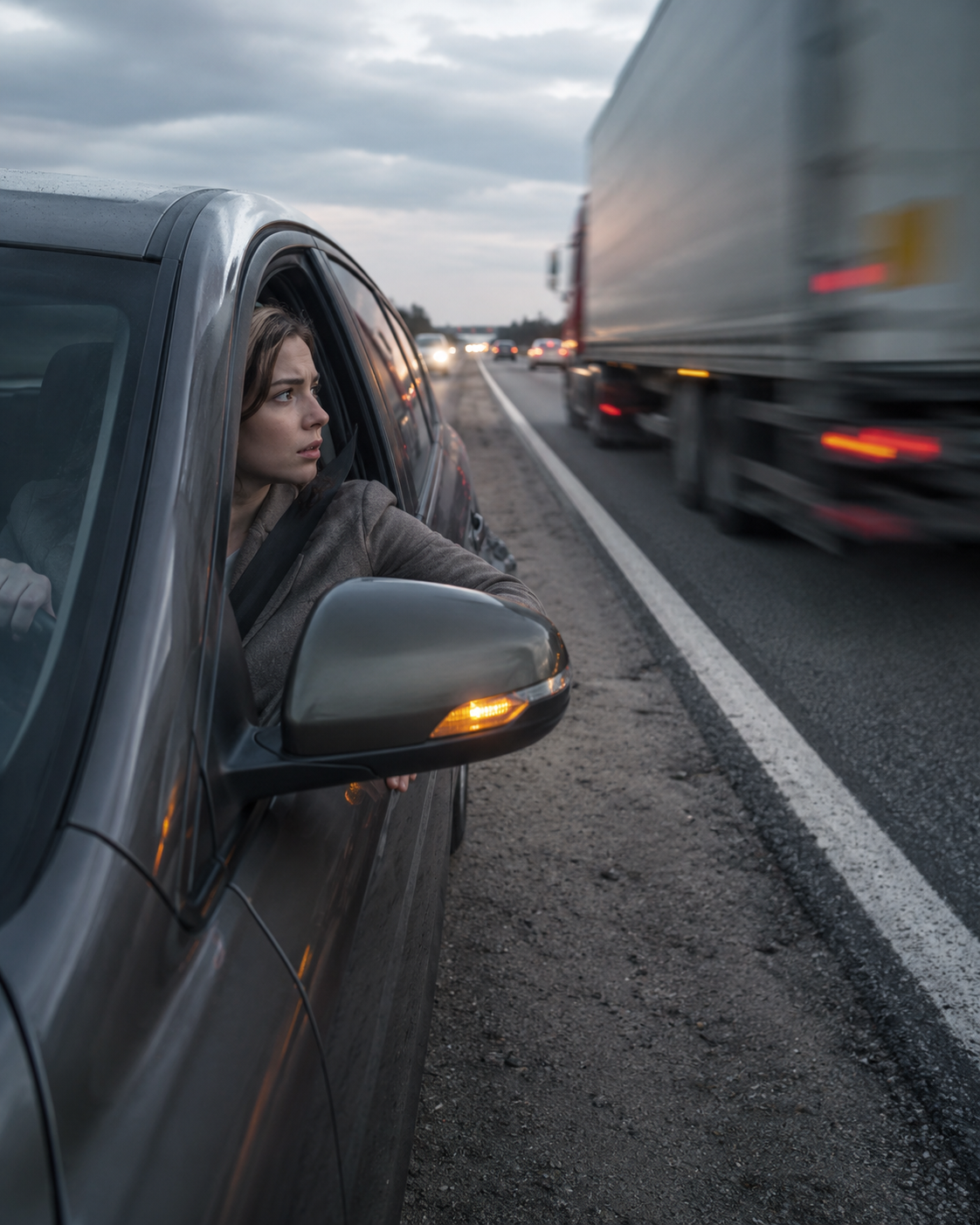
Why You Shouldn’t Step Out of Your Car Right Away on the Highway
Minjin Park
·
Getting out of your car immediately on the highway can put you dangerously close to fast-moving traffic. Learn what to check first, when to stay inside, and simple roadside safety habits.
A car problem on the highway can make anyone nervous.
Maybe a tire pressure light comes on. Maybe the engine starts overheating. Maybe you hear a loud noise and pull onto the shoulder. Or maybe there has been a minor fender bender, and your first instinct is to jump out and look at the damage.
That instinct is understandable. When something feels wrong, most people want to see what happened right away.
But on a highway, stepping out of the car too quickly can be one of the riskiest things you do.
Highway traffic moves fast. Drivers may be tired, distracted, changing lanes, dealing with glare, or not expecting a person to be standing near the road. Even if your car is on the shoulder, you may still be only a few feet away from vehicles traveling at high speed.
The safest response is not always the same in every situation. Sometimes staying inside with your seat belt on is safer. Sometimes getting out on the side away from traffic and moving behind a guardrail may be safer. What matters is that you pause, look, and think before opening the door.
A few seconds of calm decision-making can make a difficult roadside moment much safer.
Why Getting Out Immediately Can Be Dangerous
Highway Speeds Leave Little Room for Mistakes
On neighborhood streets, drivers usually have more time to react. On highways, everything happens faster.
A vehicle moving at highway speed can cover a long distance in just a few seconds. If another driver drifts onto the shoulder, changes lanes suddenly, or reacts late to your stopped vehicle, there may be very little time for you to move.
This is why standing next to your car on a busy highway can feel so exposed. You are close to traffic, and traffic is moving much faster than it may appear from inside the car.
The Shoulder Is Not a Safe Walking Area
Many people think of the shoulder as a safe zone. It is safer than stopping in a traffic lane, but it is not the same as a parking lot.
The shoulder may be narrow, uneven, sloped, or full of debris. There may be broken glass, tire pieces, gravel, or metal scraps. In bad weather, it may be slippery. At night, it may be hard for other drivers to see where the lane ends and the shoulder begins.
If your door opens toward traffic, you may also step directly into a dangerous space without realizing how close passing vehicles are.
Other Drivers May Not See You
A stopped vehicle is easier to see than a person standing beside it.
Your car has lights, reflective surfaces, and size. You are much smaller. If you are wearing dark clothing at night, standing in rain, or walking near a curve, drivers may not notice you until they are very close.
This is especially true during dawn, dusk, fog, heavy rain, or snow. Visibility can change quickly, and drivers may be focused on the road ahead rather than the shoulder.
You May Be Distracted by the Problem
When something goes wrong with the car, your attention naturally shifts to the problem.
You may be looking at the tire, checking the bumper, reading a warning light, or trying to call someone. That distraction can make you less aware of traffic around you.
The highway is not a good place to bend down near a tire, walk around the car, or stand between vehicles while trying to figure things out. Even simple tasks can become risky when traffic is passing close by.
Common Situations Where People Step Out Too Quickly
After a Flat Tire
A flat tire is one of the most common reasons drivers pull over.
The urge to get out and inspect the tire is strong, especially if you hear a thumping sound or feel the car pulling. But changing a tire on a busy highway shoulder can be dangerous, particularly on the side facing traffic.
If the tire is on the traffic side, standing there with your back to passing cars is especially risky. In many situations, calling roadside assistance and waiting in a safer position is the better choice.
After a Minor Crash
After a small collision, people often jump out to look at the damage or talk to the other driver.
On a highway, that can put both drivers in danger. Standing between cars, walking in a lane, or arguing near traffic can turn a minor crash into a much more serious situation.
If the vehicles can be moved and it is safe to do so, getting them out of traffic matters more than inspecting every scratch right away. Damage can be photographed later from a safer place.
Some warning lights do need quick attention, especially oil pressure or overheating warnings. But that does not mean you should step out into highway traffic without looking.
First, pull as far from traffic as safely possible. Turn on hazard lights. Check mirrors. Think about whether the location is safe enough to exit.
When Something Falls From the Car
If something falls off a roof rack, trailer, or open trunk, the instinct may be to run back and grab it.
That can be extremely dangerous on a highway. Objects can be replaced. A person walking into traffic is much harder for drivers to avoid.
If cargo falls into the roadway, move to a safe location and contact the appropriate help. Do not try to retrieve items from active lanes yourself.
What to Do First Before Opening the Door
Turn On Your Hazard Lights
Hazard lights help make your vehicle more noticeable. They tell approaching drivers that something is wrong and that your car is not moving normally.
Turn them on as soon as you realize you need to slow down, pull over, or stop.
Pull Over as Far as You Safely Can
If the car is still drivable, try to move to the right shoulder, an exit ramp, a rest area, a parking lot, or another safer location away from active traffic.
Do not make a sudden lane change just to reach the shoulder. Use your signal, slow down gradually, and keep control of the vehicle.
The best place to stop is not always the nearest place. If you can safely reach an exit or wide shoulder, that may be better than stopping on a narrow curve.
Keep Your Seat Belt On While You Assess
Once stopped, take a moment before opening the door.
Keep your seat belt fastened while you check mirrors, look at traffic, and decide what to do next. This is especially important if your vehicle is still close to moving traffic.
A stopped car on the shoulder can still be hit. Staying buckled while you assess the situation gives you an extra layer of protection.
Look for Smoke, Fire, or Immediate Danger
There are times when staying in the vehicle may not be the best choice. If you see smoke, fire, smell fuel, or believe the vehicle itself is unsafe, getting away may be necessary.
The important point is to exit carefully. Use the door farthest from traffic when possible. Move away from the roadway. Do not stand next to the car if you can reach a safer spot.
Exit Away From Traffic If You Must Get Out
If you need to leave the vehicle, try to get out on the passenger side or the side facing away from traffic.
This simple habit can reduce the chance of stepping into the path of passing vehicles. It also keeps the open door farther from traffic.
Once out, move away from the vehicle and traffic if there is a safe place to stand, such as behind a guardrail or up an embankment.
When Staying Inside May Be Safer
There is no one-size-fits-all rule, but staying inside can be safer in many highway situations.
If your car is fully on the shoulder, traffic is heavy, there is no guardrail or safe walking area, and there is no smoke, fire, or immediate danger inside the vehicle, staying in the car with your seat belt on may be the safer choice while you call for help.
This is especially true at night, in bad weather, on bridges, in construction zones, or on narrow shoulders.
Inside the vehicle, you are more visible than if you are standing outside. You also have some protection around you. That does not make the shoulder completely safe, but it may be safer than walking near traffic.
When Getting Out May Be Safer
In some situations, getting out carefully and moving away from the road may be the better option.
This may include situations where the vehicle is stopped in a travel lane, smoke or fire is present, there is a fuel smell, or the car is in a location where staying inside feels clearly unsafe.
If you exit, do not stand in front of or behind the vehicle. Do not stand between vehicles after a crash. Do not lean into the trunk from the traffic side. Move away from traffic as soon as you can.
If there is a barrier, stand behind it if you can reach it safely. If there is no safe place to stand, call for help and follow the dispatcher’s guidance.
Warning Signs That the Location Is Especially Dangerous
Some highway stops are more hazardous than others. Be extra cautious if you notice any of these conditions.
You Are Near a Curve or Hill
Approaching drivers may not see your vehicle until the last moment if you are stopped just after a curve or over a hill.
If your car can move safely, try to reach a more visible location. If it cannot, turn on hazards and avoid standing near traffic.
The Shoulder Is Very Narrow
A narrow shoulder leaves little space between your car and the traffic lane. Opening the driver-side door may place you directly next to moving vehicles.
In this situation, getting out on the traffic side is especially risky.
It Is Dark or Raining
Low visibility makes everything harder. Drivers may not see you, and you may have trouble judging speed and distance.
Rain, fog, snow, and glare from headlights can all make the shoulder more dangerous.
Traffic Is Heavy or Fast
Fast-moving traffic creates more risk even when drivers are paying attention. Heavy traffic adds another problem: drivers may change lanes suddenly to avoid your vehicle, leaving less room for everyone.
If traffic is heavy, do not casually walk around the car.
You Are in a Construction Zone
Construction zones often have narrow lanes, concrete barriers, no shoulder, uneven surfaces, and distracted drivers.
If your vehicle breaks down in a construction zone, stay calm, use hazards, and call for help. Do not step into active lanes unless remaining in the vehicle presents a greater immediate danger.
Simple Steps to Follow During a Highway Breakdown
Step 1: Signal and Move Right Carefully
If the car starts acting strange, do not slam on the brakes unless necessary. Signal, slow down smoothly, and move toward the shoulder or exit when safe.
Step 2: Turn On Hazard Lights
Make your car visible. Use hazard lights before and after stopping.
Step 3: Stop as Far From Traffic as Possible
Choose the safest available spot. A wide shoulder, exit ramp, rest area, or parking lot is better than a narrow roadside.
Step 4: Pause Before Opening the Door
Check mirrors. Look over your shoulder. Think about traffic, weather, lighting, and whether you actually need to get out.
Step 5: Call for Help
Use your phone to call roadside assistance, insurance roadside service, highway patrol, or emergency services depending on the situation.
Give clear details about your location, direction of travel, mile marker, nearby exits, and what happened.
Step 6: Stay Visible and Away From Traffic
If you stay inside, keep your seat belt on and hazards flashing. If you exit, move away from the roadway and stand in a safer area if available.
Mistakes to Avoid on the Highway Shoulder
Standing Behind the Car
Standing behind your vehicle can be dangerous because another driver may drift onto the shoulder and hit the stopped car from behind.
If you are outside, move away from the vehicle and traffic.
Checking Damage in the Traffic Lane
After a crash, do not stand in a lane to inspect damage, pick up pieces, or take photos.
Photos can wait until you are in a safer location. Your safety matters more than documenting the scene immediately.
Opening the Driver-Side Door Without Looking
This is a common mistake. On many highways, the driver-side door opens toward traffic.
Before opening it, check mirrors carefully. If possible, exit from the passenger side instead.
Letting Passengers Wander Around
Passengers, especially children, may not understand how dangerous the shoulder is.
Ask everyone to stay calm and follow one simple instruction: no one gets out unless it is clearly safer to do so, and if they do, they move away from traffic together.
Trying to Make Repairs Next to Traffic
Changing a tire, checking under the hood, or searching the trunk can place you close to moving vehicles.
If the repair requires you to stand on the traffic side, it may be safer to wait for roadside assistance.
What to Keep in Your Car
A few basic items can help if you ever have to stop on the highway.
Keep a charged phone, car charger, flashlight, reflective vest, warning triangles, basic first aid kit, water, and roadside assistance information in your vehicle.
Store these items somewhere reachable, not buried under luggage. If you need them during a stressful moment, you do not want to dig around near traffic.
Reflective gear can be especially helpful at night, but it should not give you a false sense of safety. Visibility helps, but distance from traffic is still the priority.
Teaching Teen Drivers and Family Members
Highway breakdown safety is a good topic to discuss before anyone needs it.
Teen drivers often learn how to park, merge, and use turn signals, but they may not know what to do if the car breaks down. Families can also benefit from having one shared plan.
Talk about where to stop, when to use hazard lights, why not to jump out immediately, and who to call. Make sure everyone knows that the shoulder is not a safe waiting area.
A short conversation now can prevent panic later.
Conclusion: Pause Before You Step Out
When something goes wrong on the highway, getting out of the car right away may feel natural. You want to check the tire, inspect the damage, or figure out what happened.
But highways are not ordinary parking spaces. Fast-moving traffic, narrow shoulders, poor visibility, distracted drivers, and road debris can make standing outside the vehicle risky.
The safer habit is simple: pull over as far as you safely can, turn on hazard lights, keep your seat belt on while you assess the situation, and think before opening the door. If you must exit, use the side away from traffic and move to a safer place if one is available.
You do not need to memorize every possible scenario. Just remember this calm rule: on the highway, do not rush out. Pause, look, and choose the safest next step.
Hi, I’m the creator and editor behind ZestyHabit. I research everyday safety, first aid, and practical wellness topics using official guidance and reliable public sources, then turn that information into clear, realistic steps for daily life.
My goal is to help readers make safer, better-informed choices at home and beyond.