What Every Child Should Know to Help Prevent Dog Bites
Minjin Park
·
Teach children how to approach, pet, and behave around dogs safely. These simple dog-bite prevention rules can help families recognize warning signs and avoid risky interactions.
Dogs can be wonderful companions for children. They can encourage outdoor play, teach responsibility, and become an important part of family life.
But even a gentle, familiar dog can bite when it feels frightened, trapped, startled, sick, or protective of something important.
That is why dog-bite prevention should not be taught as “Stay away from mean dogs.” A dog does not need to look aggressive or belong to a particular breed to become uncomfortable. Many bites involving young children happen during ordinary interactions with dogs they already know, including family pets.
The goal is not to make children afraid of dogs. It is to teach them that dogs have boundaries, just as people do.
With a few simple rules, regular supervision, and practice at home, children can learn how to enjoy dogs while giving them the space and respect they need.
Adults often tell children to “be careful,” but that instruction is too vague for a young child.
Children need clear actions they can remember:
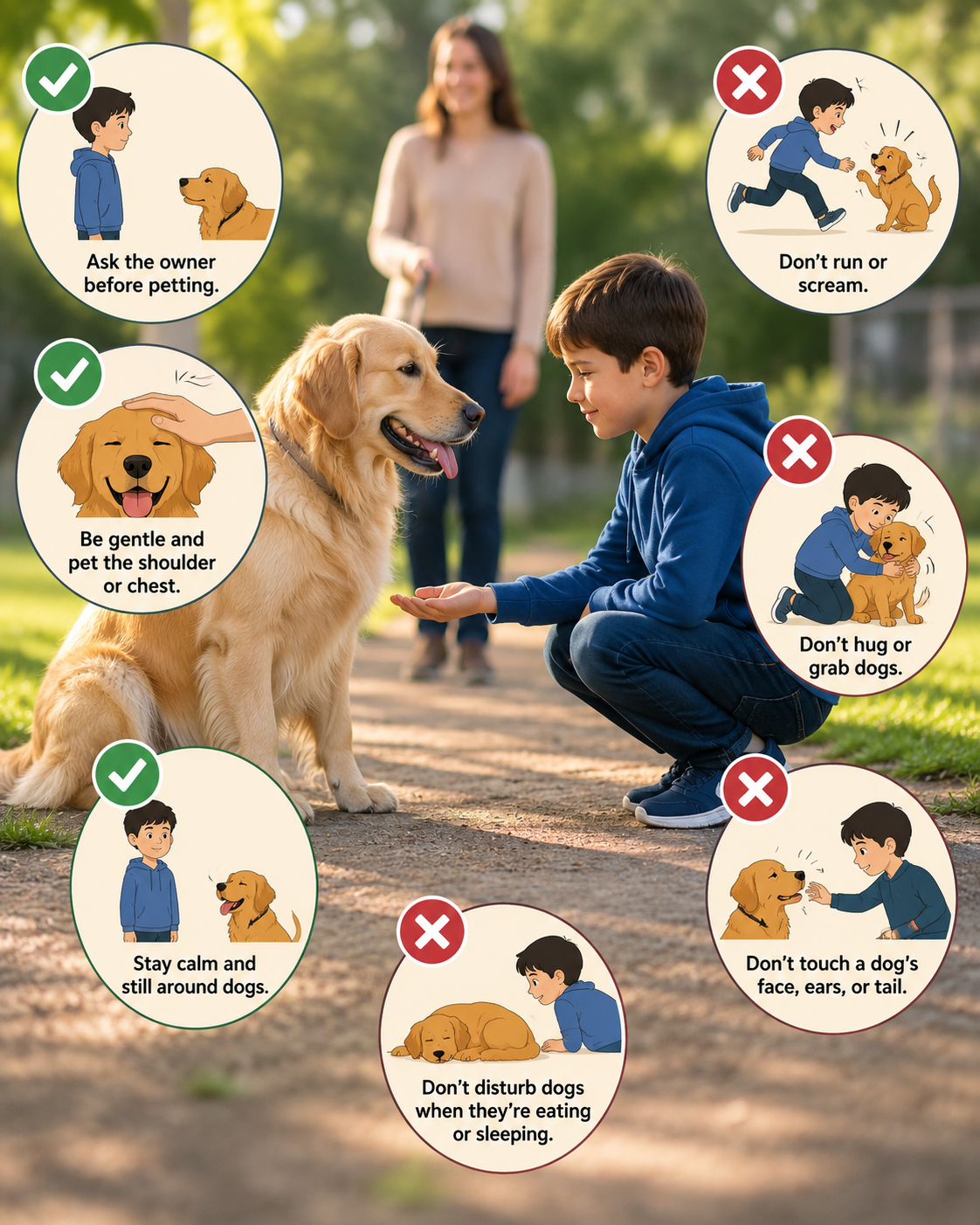
Ask before petting. Do not run toward a dog. Leave dogs alone while they are eating or sleeping. Move away when a dog looks uncomfortable.
These rules matter because children naturally behave in ways that can be overwhelming to dogs. They move quickly, make sudden noises, stare closely, hug tightly, and sometimes grab fur, ears, tails, toys, or food without understanding the effect.
A child may think a hug shows love. A dog may experience the same hug as being trapped.
A child may be more cautious around a stray dog but climb onto the family dog, kiss its face, or take a toy from its mouth. Familiarity can make both children and adults less alert.
The CDC advises adults to supervise young children around dogs even when the dog is a trusted family pet or has met the child before.
A dog that has patiently tolerated an activity in the past may react differently when it is tired, injured, eating, startled, or simply ready to be left alone.
Teach Children to Ask Before Petting a Dog
A child should never pet an unfamiliar dog without permission.
Teach your child to stop several feet away and ask the owner:
“May I pet your dog?”
The owner may know that the dog is nervous around children, recovering from an injury, in training, or uncomfortable with strangers. A yellow ribbon, special harness, or friendly appearance does not replace permission.
Children should also check with their own parent or caregiver. The dog’s owner may say yes without noticing that the dog is showing signs of stress.
A “Yes” Does Not Mean Rush Forward
Even after receiving permission, the child should remain calm and allow the dog to approach.
There is no need to push a hand directly into the dog’s face. The child can stand still with hands relaxed and let the dog decide whether it wants to come closer.
If the dog stays behind its owner, turns away, backs up, or does not approach, the child should accept that answer.
A useful phrase is:
“The dog gets to choose too.”
This helps children understand that the owner’s permission does not require the dog to interact.
Show Children How to Pet Gently
When the dog appears relaxed and the owner agrees, the child can gently pet the dog on the shoulder, chest, or side.
Children should avoid reaching suddenly over the dog’s head. They should also stay away from the eyes, ears, muzzle, paws, and tail unless the owner specifically guides the interaction.
Keep the first interaction brief. A few gentle strokes are usually enough.
Then stop and see what the dog does. If the dog moves closer or calmly asks for more attention, the interaction may continue. If it steps away, the child should let it go.
Do Not Hug or Kiss Dogs
Pictures of children hugging dogs may look sweet, but many dogs do not enjoy being held tightly around the neck.
A face-to-face hug also places a child’s face very close to the dog’s teeth. The child may not have time to move away if the dog becomes uncomfortable.
Teach children to show affection by gently petting the dog’s side, tossing an approved toy, or helping an adult provide a treat.
They should not kiss a dog’s face, lie across its body, sit on its back, or use it as a pillow.
Leave Dogs Alone While They Are Eating
Children should never reach into a dog’s food bowl, take away a chew, or try to retrieve something from the dog’s mouth.
Some dogs guard food, toys, bones, sleeping areas, or objects they have found. A dog may become stiff, stare, hover over the item, growl, or snap when someone comes close.
Even if the dog has never guarded food before, children should not be responsible for testing its patience.
Do Not Turn It Into a Game
Adults sometimes encourage children to “show the dog who is boss” by touching the bowl or taking food away.
That is not an appropriate child-safety exercise.
If a dog has something it should not have, the child should step away and tell an adult. An adult can manage the situation using safe handling or training methods.
The same rule applies when two dogs are eating or playing with a highly valued toy. Children should stay out of the space rather than trying to separate them.
Do Not Disturb a Sleeping or Resting Dog
A sleeping dog may bite reflexively if it wakes suddenly to a child touching its face or climbing onto its bed.
Teach children to call the dog’s name from a distance and let it wake up before approaching. Better yet, allow the dog to rest without interruption.
Dogs should also have a quiet place where children do not follow them.
This may be a crate, dog bed, gated room, or quiet corner. The rule should be simple:
“When the dog goes to its resting place, we leave it alone.”
Dogs that are hiding, recovering from illness, caring for puppies, or trying to move away should also be given space. Public-health guidance specifically advises against disturbing dogs that are eating, sleeping, caring for puppies, hiding, or seeking time alone.
Teach Children to Recognize “I Need Space”
Dogs cannot say, “Please stop petting me.” They communicate through posture, movement, facial expression, and sound.
Some warning signs are obvious, such as growling or showing teeth. Others are much easier to miss.
A dog may be uncomfortable if it:
Becomes suddenly still or stiff
Turns its head or whole body away
Tries to leave or hide
Tucks its tail
Holds its ears back
Licks its lips when no food is present
Yawns repeatedly
Pants when it is not hot or exercising
Shows the whites of its eyes
Stares intensely
Raises the fur along its back
Growls, bares its teeth, or snaps at the air
Lip licking, yawning, turning away, tucked ears or tail, stiff posture, hard staring, and visible whites of the eyes can all be signs of stress or discomfort.
Children do not need to become experts in canine behavior. Give them one dependable rule:
If a dog becomes still, stiff, scared, or growly, stop and move away slowly.
Never Punish a Dog’s Warning
A child should never yell at, hit, or challenge a dog that growls.
A growl is a warning that the dog is uncomfortable and needs more distance. The child should stop interacting, move away calmly, and tell an adult.
Teach children that backing away is not “letting the dog win.” It is the safe and respectful response.
Do Not Run, Scream, or Tease
Fast movement and high-pitched noises can excite, frighten, or trigger chasing behavior in some dogs.
Children should not run directly toward a dog, bark at it, wave objects in its face, pull its tail, or pretend to take its food.
They should also avoid rough games such as wrestling, riding the dog, or encouraging it to chase hands and clothing.
The American Academy of Pediatrics advises children to move calmly around dogs and warns against aggressive games such as wrestling or tugging that may increase the chance of a bite.
Appropriate play depends on the individual dog and adult guidance. Fetching a toy or participating in calm, supervised training is generally easier to control than physical roughhousing.
What a Child Should Do When a Loose Dog Approaches
Children sometimes encounter an unfamiliar dog while walking, biking, waiting for the school bus, or playing outside.
Their first instinct may be to run. However, running can encourage the dog to chase.
Teach your child the “be a tree” method.
Stand Like a Tree
The child should:
Stop moving
Keep hands close to the body
Look down rather than staring into the dog’s eyes
Stay quiet
Turn slightly sideways
Wait for the dog to lose interest
Slowly back away when it is safe
The CDC recommends staying still and calm, avoiding direct eye contact, and not running or making loud noises when approached by an unfamiliar dog.
Children should not attempt to pet, catch, feed, or help a loose dog. They should tell a trusted adult, who can contact local animal control if necessary.
What If the Child Is Knocked Down?
Teach the “be a log” position as well.
The child should curl into a ball, tuck the head down, and use the arms and hands to protect the ears, face, and neck.
The child should remain as quiet and still as possible rather than kicking or trying to wrestle with the dog. This protective position is recommended by both the CDC and the American Academy of Pediatrics.
Practice these positions at home so they feel familiar rather than frightening.
Places Where Children Should Be Extra Careful
Dog interactions can happen in many ordinary places.
Parks and Sidewalks
A dog on a leash is not automatically comfortable with children.
Children should not run up from behind, lean over a dog, or pet it while passing. They should give the dog and owner enough room to move.
Behind Fences or Inside Cars
A child should never reach through a fence, gate, kennel, crate, or open car window to touch a dog.
Dogs may feel trapped or protective of their home, yard, vehicle, or owner. A wagging tail alone does not guarantee that the dog wants contact.
Friends’ and Relatives’ Homes
Before visiting a home with a dog, adults should ask how the dog behaves around children.
Give the dog time to settle when guests arrive. Excited greetings at a doorway can quickly become chaotic, especially when children are running, carrying food, or shouting.
Dogs Wearing Working Gear
Children should not approach a service dog, police dog, search-and-rescue dog, or other working dog without clear permission.
These dogs may be performing an important task even when they appear to be resting.
Common Mistakes Parents Make
Teaching rules is important, but adults still carry most of the responsibility for preventing bites.
Assuming a Friendly Breed Cannot Bite
Breed, size, age, and appearance do not guarantee behavior.
Any dog may bite when it feels threatened, frightened, in pain, or protective. Safety decisions should be based on the individual dog and the situation, not a stereotype.
Mistaking Supervision for Being Nearby
An adult sitting in the same room while looking at a phone may not notice the dog becoming tense.
Active supervision means watching the interaction closely enough to step in before either the child or dog becomes overwhelmed.
For babies, toddlers, and young children, the safest choice is often physical separation when an adult cannot actively supervise.
Expecting the Child to Remember Every Time
Young children are impulsive. They may know the rule and still grab a toy or hug the dog when excited.
Use gates, closed doors, crates, and separate resting or feeding areas so safety does not depend entirely on a child’s self-control.
Forcing a Dog to Tolerate Affection
A child should not be told, “The dog has to let you hug him because he is our pet.”
Respecting a dog’s signals creates safer interactions and teaches children empathy at the same time.
Make Dog-Safety Lessons Easy to Remember
Long lectures are less effective than short rules practiced regularly.
Try teaching these five:
Ask before you pet.
Let the dog come to you.
Pet gently—no hugs or face-to-face contact.
Leave eating, sleeping, hiding, or resting dogs alone.
If a dog worries you, be a tree and call an adult.
Role-play different situations using a stuffed animal. Practice asking permission, noticing when the pretend dog wants space, standing like a tree, and curling up like a log.
Review the rules before visiting a dog park, friend’s house, farm, campground, or family gathering.
What to Do If a Bite Happens
Even with good prevention, bites can still occur.
Move the child and dog apart without placing another person between fighting or highly agitated animals. Once the child is safe, an adult should identify the dog and owner when possible.
A bite that breaks the skin should be washed with soap and water, and the child’s pediatrician should be contacted for guidance. More serious wounds, uncontrolled bleeding, or injuries to the face, hands, or other sensitive areas need prompt medical attention.
Do not blame or interrogate the child in the moment. First address safety and care. Later, calmly review what happened so adults can prevent a similar situation.
Final Thoughts
Dog-bite prevention is not about teaching children that dogs are dangerous. It is about teaching them that dogs are animals with their own comfort levels, fears, and boundaries.
Children should know to ask before petting, approach calmly, avoid hugs and face-to-face contact, and leave dogs alone while they are eating, sleeping, hiding, or caring for puppies.
They should also recognize simple warning signs such as stiffness, backing away, growling, or trying to escape.
Most importantly, adults should not expect safety lessons to replace supervision. Young children and dogs need active adult attention, including when the dog is familiar and usually gentle.
With calm teaching, regular practice, and sensible boundaries at home, children can build positive relationships with dogs while reducing the chance of an avoidable bite.
Hi, I’m the creator and editor behind ZestyHabit. I research everyday safety, first aid, and practical wellness topics using official guidance and reliable public sources, then turn that information into clear, realistic steps for daily life.
My goal is to help readers make safer, better-informed choices at home and beyond.