
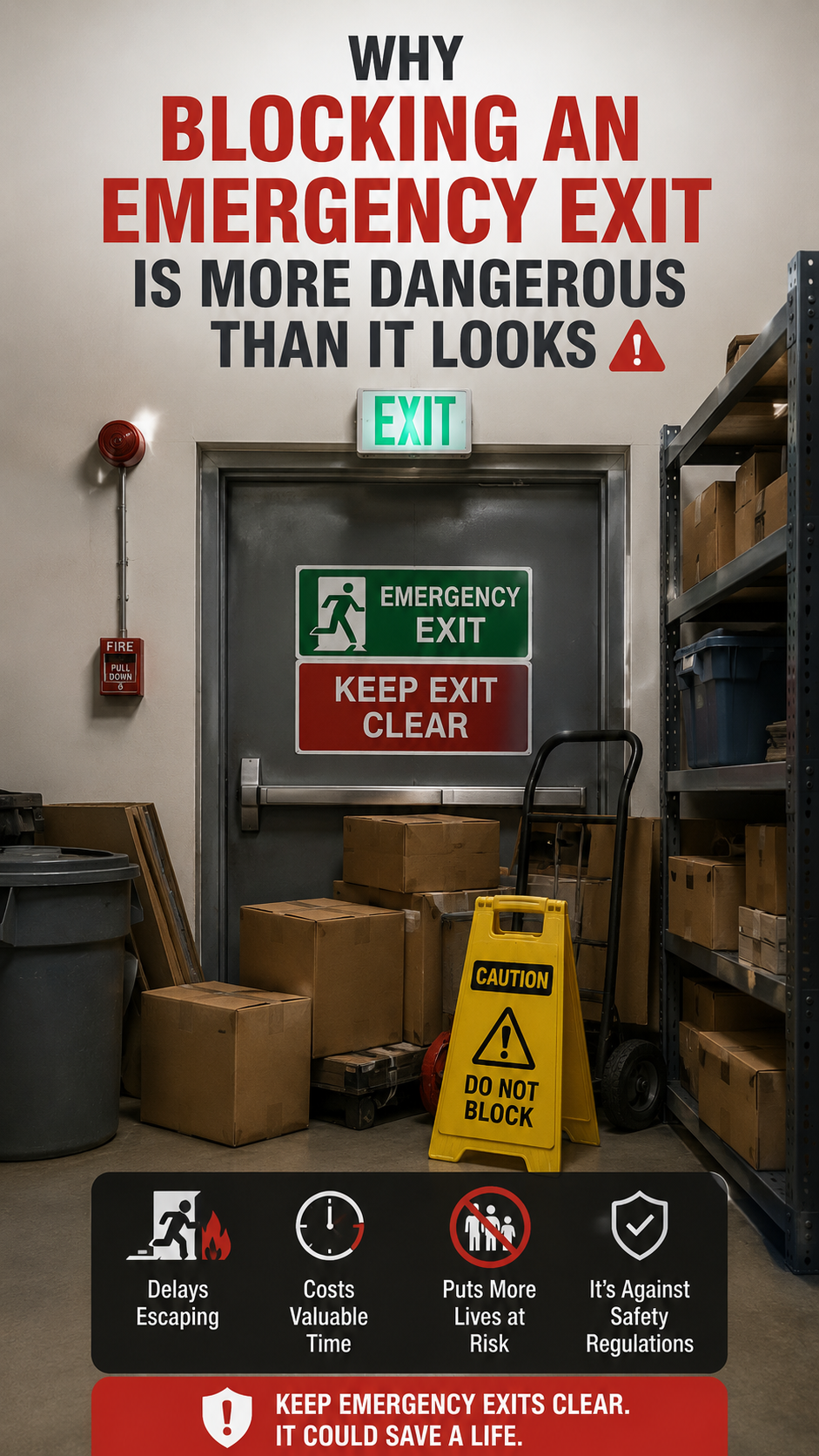

Storing boxes, equipment, or supplies near an emergency exit can delay evacuation and create serious hazards. Learn why clear exit routes matter and how to keep them safe.
Emergency exits are easy to ignore during an ordinary day.
Most of the time, they are simply doors at the end of a hallway, beside a stockroom, or behind a row of tables. Because they are rarely used, the space in front of them can start to look like convenient extra storage.
A delivery arrives, so a few boxes are placed near the exit “for just a minute.” A cleaning cart is parked there until the hallway is mopped. Folding chairs, building supplies, trash bags, or unused equipment slowly collect in the area.
Nothing seems wrong because everyone can still squeeze past.
The problem is that emergency exits are not designed for calm, everyday movement. They are meant to help many people leave quickly when visibility may be poor, stress is high, and every second matters.
Keeping materials away from an emergency exit is one of the simplest safety habits a workplace, apartment building, school, restaurant, or community space can follow.
An Emergency Exit Must Work Without Warning
Emergencies rarely arrive at a convenient time.
A fire alarm may sound while employees are unloading a shipment. Smoke may begin spreading while customers are seated in a restaurant. A power outage may leave a hallway dark. A severe weather event, electrical problem, or other unexpected situation may require people to leave immediately.
In those moments, nobody should have to move boxes, push aside a cart, or search for another way out.
An emergency exit needs to be ready at all times, not only after someone has had a chance to clean up the area.
Even materials that seem small can become serious obstacles when people are frightened or moving quickly. A person carrying a child, helping an older adult, or navigating with limited mobility may need much more space than someone casually walking through the same doorway.
Obstructions Slow Everyone Down
One box in front of a door may not look like a major problem. However, evacuation involves more than one person stepping around an object.
People tend to follow one another toward the nearest familiar exit. If the first person slows down, everyone behind that person may also slow down. A small delay can quickly turn into a crowded bottleneck.
Imagine a narrow hallway leading to an exit. Several cartons are stacked along one wall, leaving just enough room for one person to pass at a time. During a normal workday, employees may not notice the inconvenience.
During an evacuation, however, people may approach from several rooms at once. Some may be carrying bags. Others may stop when they see the obstruction. The flow of people can become disorganized very quickly.
A clear exit route allows people to keep moving instead of stopping, turning sideways, or backing up.
“There Is Still Enough Room” Is Not a Safe Standard
A common mistake is assuming an exit is acceptable as long as the door can technically be reached.
That standard ignores how people move during an emergency.
The route should be comfortably clear, not barely passable. People should not have to step over cords, walk around stored furniture, or turn their bodies to fit between objects.
An exit that works for one able-bodied adult in good lighting may not work well for a crowd, a wheelchair user, someone with an injury, or a person trying to guide children.
Smoke and Darkness Make Obstacles Harder to See
Many people picture an evacuation happening in a brightly lit room with everyone calmly walking toward the door.
Real conditions may be very different.
Smoke can reduce visibility. Emergency lighting may be dimmer than normal lighting. A power outage can make familiar spaces difficult to recognize. Alarm sounds, flashing lights, and confusion can make it harder to focus.
Objects that are easy to avoid during the day can become tripping hazards when people cannot see clearly.
A low box, loose roll of carpet, bucket, extension cord, or stack of supplies may blend into the floor. Someone can trip, fall, or block the path for the people behind them.
This is one reason emergency routes should remain simple and predictable. The fewer obstacles people must identify and avoid, the easier it is to leave safely.
Stored Materials Can Interfere With the Door Itself
The area in front of an emergency exit is not the only space that matters. The door must also be able to open fully and easily.
Boxes, furniture, pallets, displays, or equipment can prevent a door from opening through its complete range. Materials may shift after being stacked, especially if they are bumped, loaded unevenly, or placed on a sloped surface.
A door may appear usable while it is closed, but the obstruction becomes obvious only when someone tries to open it.
Items placed behind an outward-opening door are especially easy to overlook. From inside the building, the doorway may look clear. Outside, however, trash containers, construction materials, snow, merchandise, or landscaping equipment may block the door.
Both sides of the exit need attention.
Door Hardware Can Also Become Blocked
Emergency doors often have handles, push bars, signs, or locking hardware that must remain accessible.
Hanging items from a door, leaning tools against it, or placing tall supplies nearby can make the hardware difficult to reach. Decorations and temporary signs can also cover important instructions.
A good rule is to treat the entire door and the surrounding area as a no-storage zone.
Materials May Hide Exit Signs
Emergency exit signs are meant to be visible from a distance. They help people find the correct route, especially if they are unfamiliar with the building.
Tall boxes, shelving, banners, equipment, or temporary displays can block the view of those signs.
This often happens gradually. One object is placed below the sign, followed by another. Eventually, the word “EXIT” may be visible only from certain angles.
Visitors, customers, delivery workers, substitute employees, and new staff members may not know where the exits are. They rely more heavily on signs than people who use the building every day.
If a person has to walk farther into a hallway before seeing the sign, valuable time can be lost.
Clutter Can Create Additional Hazards
Some materials do more than block the route. They may also increase the danger in the area.
Cardboard boxes, paper products, packaging, fabric, wood, and certain supplies can add fuel to a fire. If they are stored near an exit, the route people depend on may become harder to use.
Leaking cleaning products, oils, paint, or other substances can create slippery surfaces. Unstable stacks may fall into the walkway. Sharp tools or metal objects can cause injuries if someone brushes against them while moving quickly.
Even nonflammable materials can become dangerous when they collapse or roll.
For example, a hand truck left beside an emergency door may shift into the path if it is bumped. A stack of folding chairs may tip over. Loose pipes or long pieces of trim may slide across the floor.
Emergency exit areas should not double as general storage zones.
“Temporary” Storage Often Becomes Permanent
One of the most common reasons exits become blocked is temporary convenience.
Someone sets down a shipment while looking for a storage location. A contractor leaves tools near a door during a project. Employees place broken equipment in the hallway until maintenance can remove it.
The intention may be to move everything soon.
But busy workplaces are full of interruptions. The person responsible may leave for the day, forget the items, or assume someone else will handle them. A temporary pile can remain for hours or even days.
Once clutter is present, other people may begin adding to it. The area starts to look like an accepted storage space.
This is sometimes called the “broken window” effect of workplace organization: when one unsafe practice appears normal, it becomes easier for others to repeat it.
The best solution is to avoid placing materials there in the first place, even briefly.
Common Places Where Exit Blocking Happens
Blocked exits are not limited to warehouses or industrial buildings. They can happen almost anywhere.
Offices
Printer paper, archived files, unused desks, recycling bins, and delivery boxes often end up in hallways or near stairwell doors.
An office may have limited storage, making the empty space near an exit look useful. However, hallway storage can narrow the evacuation route and make signs harder to see.
Restaurants and Retail Stores
Extra chairs, seasonal displays, beverage crates, trash bags, and incoming merchandise may be placed near back exits.
During busy hours, employees may prioritize serving customers and plan to clear the area later. That delay can allow an obstruction to remain much longer than expected.
Apartment and Condominium Buildings
Residents may leave bicycles, strollers, shoe racks, packages, or furniture in shared hallways.
These items can make everyday life more convenient, but shared exit routes need to remain usable for everyone in the building.
Schools and Childcare Centers
Art supplies, sports equipment, lunch carts, backpacks, and stacked chairs can collect near doors.
Children may also move less predictably during an alarm, making wide, uncluttered routes especially important.
Workshops and Construction Areas
Tools, lumber, extension cords, ladders, and building materials can quickly spread into walkways.
Because the layout may change from day to day, exit access needs to be checked regularly rather than assumed to be clear.
Warning Signs That an Exit Area Needs Attention
A blocked exit is not always a completely sealed doorway. Smaller signs may show that the area is becoming unsafe.
Watch for conditions such as:
- People needing to turn sideways to pass
- Boxes or equipment placed inside marked walkways
- Materials stacked close to the door
- A door that cannot open fully
- Items leaning against the door or wall
- Exit signs hidden from part of the room
- Cords, mats, or supplies creating trip hazards
- Deliveries regularly left in the same area
- Outdoor objects blocking the other side of the door
- Clutter returning soon after it is removed
Another warning sign is when employees say, “We always put things there.”
That statement may mean an unsafe habit has become part of the normal routine.
How to Keep Emergency Exits Clear
Preventing blocked exits usually does not require expensive equipment. It requires clear expectations and consistent habits.
Create a Clearly Marked No-Storage Zone
Use floor markings, signs, or both to show where materials should never be placed.
The marked area should include enough space for people to approach the door and for the door to open fully.
A sign that says “Emergency Exit—Keep Clear” can be helpful, but signs work best when everyone understands that they apply at all times.
Give Deliveries a Designated Location
If boxes regularly arrive near an exit, create another temporary receiving area.
People are more likely to follow a safety rule when there is a practical alternative. Simply telling employees not to use the exit area may not work if they have nowhere else to place incoming supplies.
Include Exits in Routine Walk-Throughs
A quick daily check can catch problems before they become normal.
Look at the entire route, not just the doorway. Check hallways, stairs, signs, door hardware, and the outside landing.
Walk the path as if you were unfamiliar with the building. Is the exit obvious? Is there enough space? Can the door open without hitting anything?
Assign Responsibility
When everyone is responsible, sometimes nobody feels responsible.
A manager, shift leader, building employee, or designated safety coordinator can include emergency exits in regular opening or closing checks.
This does not remove responsibility from others. Anyone who sees an obstruction should know how to report or correct it.
Avoid Moving the Problem Somewhere Else
Clearing one emergency exit by placing materials in another hallway is not a real solution.
Move items to an approved storage area where they will not block doors, stairs, fire equipment, electrical panels, or normal walkways.
What to Do When You Notice an Obstruction
If you see materials near an emergency exit, do not assume someone else has already reported them.
When it is safe and appropriate, move lightweight items to a proper storage area. Report larger, unstable, leaking, or potentially hazardous materials to the person responsible for the building or work area.
In a shared residential building, contact building management rather than creating conflict with another resident. At work, follow the normal reporting process for safety concerns.
The goal is not to blame the person who placed the item there. The goal is to restore a clear route and prevent the problem from happening again.
A Clear Exit Is a Simple Form of Preparedness
Emergency preparedness often sounds complicated. People may think first about special equipment, detailed plans, or major training exercises.
But some of the most useful safety steps are very basic.
A door that opens properly, a visible exit sign, and a hallway free from clutter can make a meaningful difference when people need to leave quickly.
Boxes and equipment may seem harmless on an ordinary afternoon. In an emergency, the same objects can delay movement, hide signs, prevent doors from opening, and create trip hazards.
The practical takeaway is simple: treat the space around every emergency exit as space that must remain available, even when the building is busy and storage is limited.
Keep materials away from the doorway, check both sides of the exit, and address clutter before it becomes part of the normal routine. A few minutes of attention today can help make the route easier for everyone to use when it matters most.

Hi, I’m the creator and editor behind ZestyHabit. I research everyday safety, first aid, and practical wellness topics using official guidance and reliable public sources, then turn that information into clear, realistic steps for daily life.
My goal is to help readers make safer, better-informed choices at home and beyond.


