Exit Row Seat Responsibilities: Air Travel Safety Risks and How to Prepare
Minjin Park
·
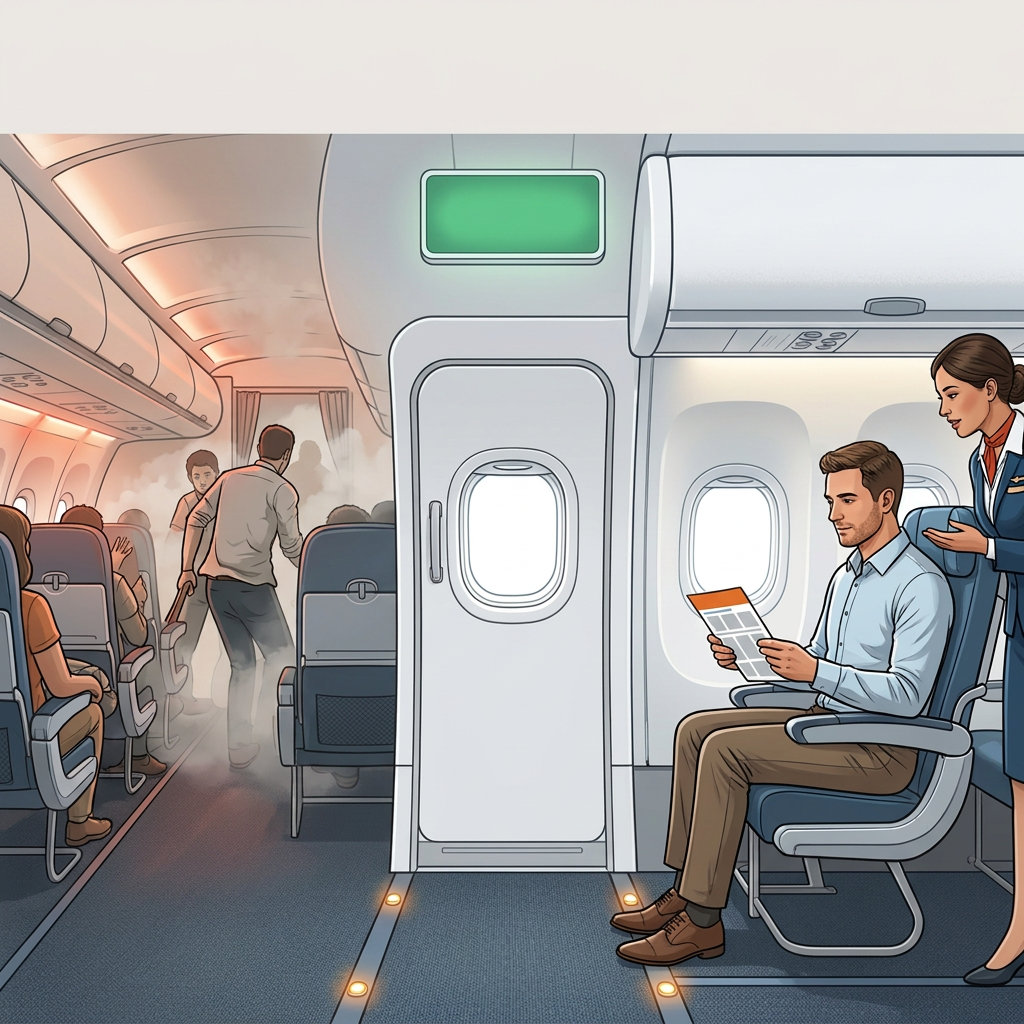
An illustrated guide explains exit-row safety risks and preparation steps for air travelers.
Sitting in an airplane exit row comes with real safety responsibilities. Learn who qualifies, what you may need to do during an evacuation, and how to prepare before takeoff.
For many travelers, an airplane exit row looks like one of the best seats in the cabin. It often offers more legroom, fewer obstacles in front of the knees, and a little more breathing space on a long flight. Some airlines even charge an additional fee for the privilege.
That extra space, however, comes with a serious responsibility.
An exit row passenger may be expected to help open an emergency exit, assess whether the exit is safe to use, direct other passengers, and move quickly away from the aircraft. In an unplanned emergency, the person sitting next to an overwing exit may need to act before a flight attendant can reach that part of the cabin.
This does not mean you are expected to become a trained rescuer. Cabin crew members remain responsible for managing an evacuation whenever they are available. It does mean that choosing an exit row is more than choosing a comfortable seat. You are agreeing that you are both willing and capable of performing specific safety functions under pressure.
Understanding those responsibilities before boarding can help you decide whether an exit row is truly the right place for you.
An exit row is generally a row that provides access to an emergency exit. Depending on the aircraft, the exit may be a full-size cabin door, a smaller overwing hatch, or another approved emergency opening.
Under current U.S. regulations, the definition can include more than the seat immediately beside the exit. It may also include seats in a row through which passengers must pass to reach that exit. Airlines must identify the affected seats in each aircraft configuration and determine whether the passengers occupying them are suitable.
Exit designs vary significantly. One aircraft may have a relatively light removable hatch, while another may have a heavier door with an assisted opening mechanism. Some exits deploy evacuation slides automatically when opened; others lead directly onto the wing.
This is why the safety card and personal exit-row briefing matter even to frequent travelers. Knowing how an exit worked on your previous flight does not guarantee that the mechanism on your current aircraft operates the same way.
What Are Exit Row Passengers Agreeing to Do?
In the United States, airlines operating under the applicable regulations must ensure that exit-seat passengers can perform the emergency functions associated with their seats. These functions may include locating the exit, recognizing and operating its opening mechanism, removing or securing a hatch, assessing exterior hazards, following crew instructions, helping with an evacuation slide, passing through the exit quickly, and selecting a safe route away from the aircraft.
In practical terms, an exit row passenger may need to:
Listen to and understand emergency commands
Find the exit handle in poor visibility
Push, pull, turn, or lift the opening mechanism
Remove a hatch or move it out of the escape path
Check for fire, smoke, water, debris, or other dangers outside
Prevent passengers from using an unsafe exit
Direct people toward another usable exit
Leave the aircraft quickly without blocking the opening
Assist other passengers if instructed
European aviation guidance follows the same general principle: passengers seated beside exits must be willing and able to assist the crew during an evacuation. At unstaffed exits, including many overwing exits, a suitable passenger may need to assess conditions and decide whether the opening can be used safely.
Who Should Not Sit in an Exit Row?
Being healthy in everyday life does not automatically make someone suitable for an exit row. The relevant question is whether that passenger could perform the required functions quickly during a stressful emergency.
Under U.S. rules, a passenger may be unsuitable if the person lacks sufficient strength, mobility, balance, or dexterity in the arms, hands, or legs. The rules also consider whether the passenger can understand written or graphic instructions, hear and understand shouted commands with permitted hearing assistance, communicate directions to other passengers, and act without help from a companion. Passengers younger than 15 cannot occupy regulated exit seats on covered U.S. operations.
You should request another seat when you:
Have a temporary injury, recent surgery, or significant joint pain
Cannot lift, push, pull, or maneuver an exit hatch
Would have difficulty balancing or climbing through the opening
Cannot understand the crew’s emergency language
Cannot read or understand the aircraft-specific safety instructions
Are responsible for assisting a small child or another traveler
Have a condition that could be aggravated by operating the exit
Feel unable to react reliably under pressure
Simply do not want the responsibility
Traveling with an infant or young child is particularly important. In an emergency, your instinct and responsibility will naturally be to protect that child. You cannot reasonably be expected to operate an exit, manage the passenger flow, and care for a child at the same time.
Airlines and national authorities may use additional restrictions, so eligibility can differ by carrier, route, and country. The airline’s cabin crew makes the final safety determination for the particular flight.
You Do Not Have to Explain a Private Condition
Some passengers remain silent because they are embarrassed about changing seats. They may have an invisible disability, anxiety disorder, recent injury, pregnancy-related concern, reduced hearing, medication side effects, or another private reason for not accepting the responsibility.
You do not need to prove your willingness by staying in a seat that feels unsafe.
Under U.S. regulations, passengers can request relocation if they cannot or do not wish to perform the required functions. The airline is not permitted to demand that the passenger disclose the specific reason for requesting a non-exit seat.
Tell a flight attendant quietly and as early as possible. A simple statement such as, “I’m not able to perform the exit-row duties and need another seat,” is enough.
Being reseated is not a punishment or a judgment about your health. It protects you, the crew, and everyone who might need to pass through that exit.
Why the Flight Attendant Asks for a Verbal Answer
A flight attendant discusses safety requirements with a passenger during an onboard verification.
Before departure, a flight attendant will usually explain the exit-row responsibilities and ask whether each passenger is willing and able to assist. A nod, silence, or distracted expression may not be accepted. The crew may require a clear verbal response.
This is not a formality to rush through while wearing headphones.
The flight attendant is verifying that you are awake, attentive, able to understand the briefing, and prepared to accept the role. U.S. airlines may not begin taxiing or pushback until a required crew member has verified that unsuitable passengers are not occupying regulated exit seats.
Pause what you are doing, remove your headphones, make eye contact, and listen. Read the exit-row information card even when you have flown many times. Focus on where the handle is located, the direction it moves, what happens to the hatch after it opens, and whether a slide is associated with that exit.
Never Open an Exit Automatically
One of the most dangerous misconceptions is that an exit row passenger should immediately open the door or hatch whenever something goes wrong.
An exit should be opened only when an evacuation is required and that particular exit is safe to use. Unless the situation makes communication impossible, follow the crew’s commands.
Before opening, look through the window and assess the conditions outside. Hazards may include:
Flames or heavy smoke
Fuel on the ground
Deep water or flooding
Debris blocking the route
A damaged or burning engine
An operating propeller
Emergency vehicles approaching the aircraft
A collapsed wing or unstable surface
A slide that has failed to deploy correctly
Opening an exit toward a fire can expose the cabin to smoke, heat, or flames. It may also draw passengers toward a route that cannot be used safely. Both U.S. regulations and European guidance specifically recognize hazard assessment as part of an exit-seat passenger’s potential role.
When an exit is unsafe, keep it closed, block access if necessary, and loudly direct passengers toward another exit. Use short, forceful commands such as “Blocked—go back!” or “Use the other exit!”
What to Do When an Evacuation Is Ordered
When the crew orders an evacuation, speed matters—but controlled action is safer than panic.
Listen for instructions. Check the conditions outside. Open the exit using the exact sequence shown on the safety card and explained during the briefing. Some overwing hatches must be pulled inward and placed on a seat or thrown outside in a specified direction. Other exits open outward or use powered assistance.
Once the opening is usable, move out quickly. Do not remain in the doorway unless the instructions for that aircraft require you to assist there. After reaching the ground or wing, move away from the aircraft and encourage others to do the same.
The FAA advises passengers to move quickly to the nearest safe exit, follow crew instructions, avoid pushing or stopping, and clear the area after leaving the aircraft. The nearest safe exit may be behind you rather than in front of you.
Do not improvise a complicated rescue plan. Perform the actions from the briefing, respond to crew commands, and keep the exit route moving.
Leave Every Carry-On Bag Behind
Grabbing luggage is one of the most dangerous mistakes passengers make during an aircraft evacuation.
A suitcase can block the aisle, strike another passenger, tear an evacuation slide, or force people behind you to wait while conditions inside the aircraft worsen. The FAA emphasizes that passengers must leave all carry-on baggage behind during an evacuation. Its current safety campaign notes that stopping for belongings delays evacuation and increases injury risks.
This rule is especially important for exit row passengers. You cannot operate an exit effectively while holding a backpack, shopping bag, laptop case, or suitcase.
Before departure, place essential small items such as identification, medication, keys, or a phone securely in a pocket when practical. Do not stop to retrieve them once an evacuation begins. Do not record video, take photographs, or make a phone call while people are trying to escape.
No possession is worth delaying an evacuation.
Keep the Exit Area Completely Clear
Exit rows often have stricter baggage-storage rules because even a small object can become an obstruction. A loose purse strap, charging cable, jacket, or shopping bag may trip someone or interfere with the hatch.
Follow the flight attendant’s instructions about overhead-bin and under-seat storage. Some exit-row configurations do not permit any baggage on the floor during taxi, takeoff, and landing.
Keep your seatbelt fastened when seated, and keep shoes on during takeoff and landing unless instructed otherwise. Normal closed footwear may protect your feet from sharp debris after an emergency landing. High-heeled shoes, however, may need to be removed before using an evacuation slide because they can damage the slide. The FAA specifically advises removing high heels before sliding when possible.
Prepare Before the Aircraft Moves
A few minutes of preparation can make your response faster and more accurate.
First, read the safety card rather than relying on memory. Look at the illustrations showing the exit mechanism and escape route. Count the seat rows to another exit in front of and behind you in case the exit beside you becomes unusable. This can be valuable in darkness or smoke, when visual landmarks may disappear.
Next, mentally rehearse a simple sequence:
Listen for the evacuation command.
Check outside conditions.
Open only if the route is safe.
Move the hatch or door as instructed.
Direct passengers clearly.
Exit and move away from the aircraft.
Keep the sequence simple. Emergencies are confusing, noisy, and fast-moving. A brief mental rehearsal is more useful than imagining every possible disaster.
Finally, reconsider your suitability if circumstances change. Fatigue, alcohol, sedating medication, illness, a new injury, or responsibility for another passenger may affect your ability to perform the role. Tell the crew rather than hoping the issue will not matter.
Common Exit Row Mistakes to Avoid
The first mistake is choosing the seat solely for legroom and automatically saying yes to the briefing. Extra space is not worth accepting a responsibility you cannot perform.
Another mistake is assuming physical strength is the only requirement. An exit passenger must also understand instructions, recognize danger, communicate clearly, and make a rapid judgment.
Do not open an exit simply because another passenger shouts at you. Do not ignore an unsafe condition outside. Do not argue with a flight attendant who asks you to change seats, and never attempt to open or touch an armed aircraft door during normal operations.
Most importantly, do not allow embarrassment to influence your decision. Asking to move before takeoff is far safer than discovering during an emergency that you cannot manage the exit.
Final Takeaway
An exit row seat is not merely a premium place with additional legroom. It is a safety position that may require strength, mobility, comprehension, communication, judgment, and a willingness to act. Listen carefully to the briefing, study the aircraft-specific safety card, check the conditions outside before opening anything, follow crew commands, leave every bag behind, and move quickly toward a safe route. When you are uncertain about your ability or willingness, request another seat without hesitation. The responsible decision may be accepting the exit-row role—or recognizing that someone else is better prepared to take it.
Have you ever been seated in an airplane exit row or asked to move from one? Share how the crew explained the responsibilities, whether the briefing felt clear, and what you think travelers should understand before selecting these seats in the comments below.
Hi, I’m the creator and editor behind ZestyHabit. I research everyday safety, first aid, and practical wellness topics using official guidance and reliable public sources, then turn that information into clear, realistic steps for daily life.
My goal is to help readers make safer, better-informed choices at home and beyond.