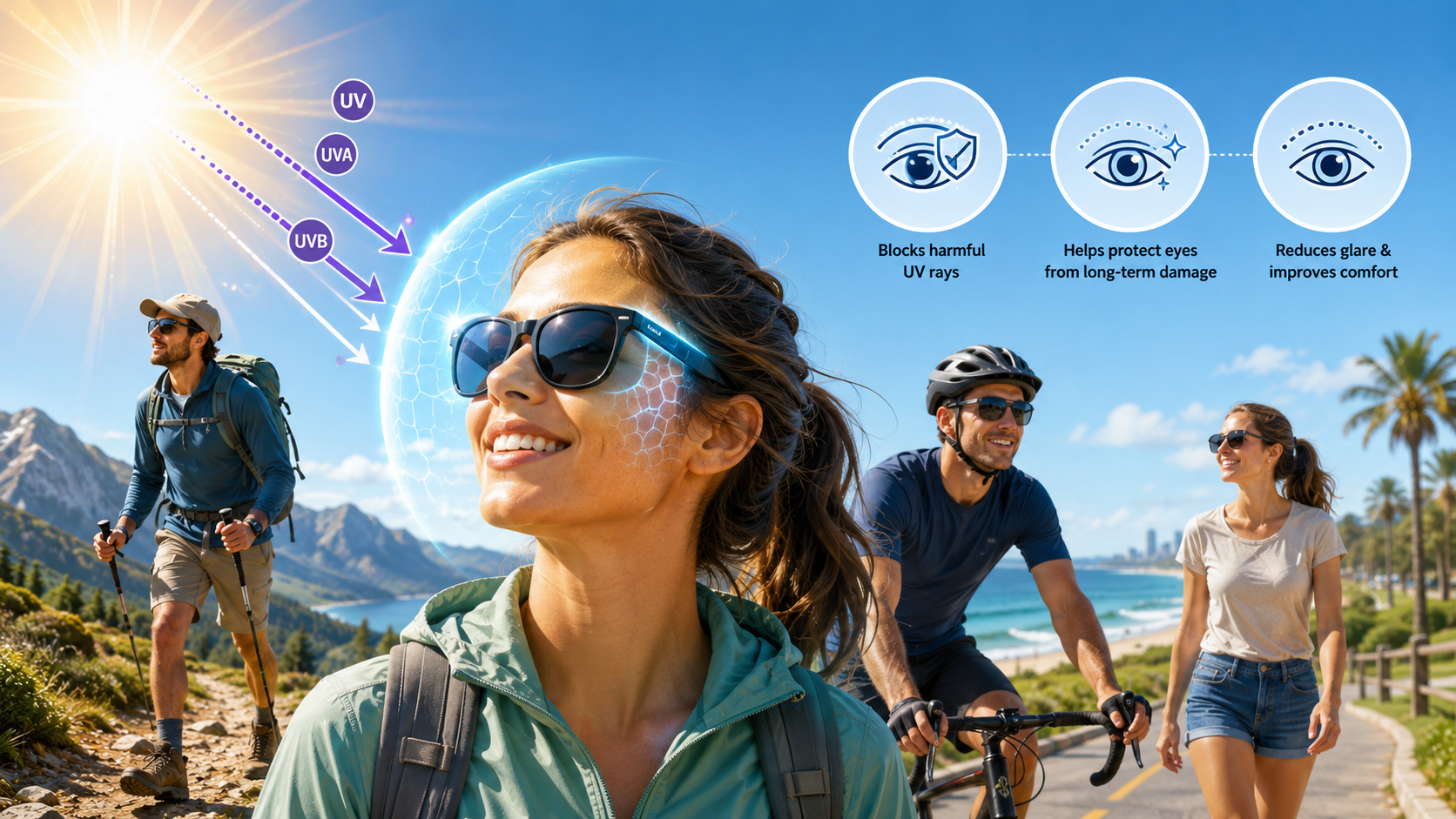
Why Sunglasses Matter for Eye Health During Outdoor Activities
Minjin Park
·
Learn how UV-blocking sunglasses protect your eyes outdoors, reduce glare, and make everyday activities more comfortable—plus how to choose the right pair.
Most of us remember sunscreen when the weather is hot, but sunglasses are easier to treat as an optional accessory. We grab them when the sun feels painfully bright, leave them at home on cloudy days, and sometimes choose a pair mainly because the lenses look dark.
The right sunglasses do much more than make it easier to keep your eyes open. They help limit ultraviolet exposure, reduce harsh reflected light, and protect the delicate area around your eyes. That matters whether you are hiking for several hours or simply driving to the grocery store.
You do not need designer frames or complicated lens technology. You need sunglasses that clearly provide strong UV protection and fit well enough to cover your eyes. Here is why that simple habit can support eye health during everyday outdoor activities.
Ultraviolet radiation is invisible, so you cannot judge your exposure by brightness alone. Your eyes may still receive UV on hazy or cloudy days, and reflected light from water, sand, pavement, and snow can increase exposure.
Repeated UV exposure is associated with eye problems such as cataracts and growths on the eye’s surface. Intense exposure can also cause photokeratitis, sometimes described as a sunburn of the cornea. The National Eye Institute recommends sunglasses that block 99% to 100% of both UVA and UVB radiation, even on cloudy days.
Your Eyes Receive Sunlight From Different Angles
Sunlight does not only come straight down from the sky. It can enter from above, below, and around the sides of your frames.
That is why large lenses, close-fitting frames, and wraparound styles can offer better coverage than very small fashion frames. A wide-brimmed hat adds another useful layer, but it does not replace UV-protective sunglasses.
Sunglasses Help Limit UV Exposure
The most important feature in sunglasses is not lens color, frame shape, or price. It is UV protection.
Look for wording such as:
“100% UVA and UVB protection”
“Blocks 99% to 100% of UV rays”
“UV400”
UV400 generally means the lenses are designed to block ultraviolet wavelengths up to 400 nanometers, covering UVA and UVB. The FDA advises choosing sunglasses labeled UV400 or 100% UV protection.
Dark Lenses Are Not Automatically Safer
One common mistake is assuming darker lenses block more UV.
Lens darkness controls visible light. UV protection depends on the lens material or a UV-filtering treatment. A lightly tinted pair can provide excellent UV protection, while a very dark pair may provide little if it is not properly made or labeled.
Dark lenses without UV protection can be especially unhelpful because they encourage your pupils to widen in the lower visible light. That may allow more UV radiation to enter the eye. Instead of judging sunglasses by appearance, check the label or ask an eye-care professional whether the lenses can be tested.
Expensive Does Not Necessarily Mean More Protective
A high price may reflect the brand, design, frame material, prescription, or special coatings. It does not guarantee better UV protection.
An inexpensive pair with a reliable UV400 or 100% UV label can protect against UV as effectively as a costly designer pair. The better purchase is usually the pair that meets the protection standard, fits comfortably, and is easy enough to wear regularly.
Sunglasses Reduce Glare and Visual Discomfort
UV protection is the health priority, but comfort matters too. Bright sunlight and reflected light can make you squint, tense the area around your eyes, and struggle to see details clearly.
Sunglasses reduce visible brightness, making outdoor activities more comfortable. This is especially noticeable while driving, boating, fishing, walking near water, or spending time on snow-covered ground.
Polarized Lenses Can Help With Reflected Glare
Polarized lenses reduce glare reflected from flat surfaces such as roads, water, and snow. They can be useful for driving, fishing, boating, and other activities where reflected light makes it harder to see.
However, polarization and UV protection are different features. A polarized lens should still be labeled UV400 or 100% UV protection. Polarization improves visual comfort; the UV label tells you whether the lens blocks ultraviolet radiation.
Outdoor Situations Where Sunglasses Matter Most
Sunglasses are useful whenever you spend time outside during daylight, but some settings deserve extra attention.
Driving
Drivers often experience sunlight from changing angles, especially early in the morning and late in the afternoon. Glare can reflect from windshields, wet roads, and nearby vehicles.
Keep a UV-protective pair near your keys. Choose lenses that reduce brightness without making traffic signals or road details difficult to distinguish.
Sunglasses should also fit securely enough that you do not need to adjust them while driving. Clean lenses regularly, since fingerprints and scratches can make glare and visual distortion more distracting.
Beaches, Pools, Lakes, and Boats
Water and sand reflect sunlight. Even under an umbrella, light can reach your eyes from the open sides and reflective surfaces around you.
A wraparound pair, brimmed hat, and shade work well together. For swimming or water sports, use eyewear designed for that activity rather than ordinary sunglasses that may fall off or break.
A floating strap can also be useful while boating, kayaking, or fishing. It will not improve UV protection, but it can prevent a good pair of sunglasses from disappearing into the water.
Hiking, Walking, and Yard Work
Long periods outside add up even when the day does not feel extremely bright. Sunglasses can also provide a modest barrier against wind, dust, pollen, and small airborne debris.
However, regular sunglasses are not safety glasses. When mowing, trimming, using power tools, or doing work that may send particles toward your face, wear proper impact-rated protective eyewear.
This distinction is important. Sunglasses are designed mainly for sunlight and glare, while safety glasses and goggles are made to withstand particular types of impact.
Snowy and High-Altitude Environments
Snow can reflect UV toward the eyes, and exposure can be stronger at higher elevations. Skiers, snowboarders, hikers, and winter travelers should use sunglasses or goggles with strong UV protection and good side coverage.
Cloud cover does not remove the risk. Intense reflected UV exposure can cause snow blindness, sometimes with symptoms that appear later.
Protective goggles are often more practical than ordinary sunglasses during skiing or snowboarding because they cover a larger area and help block sunlight, wind, and snow from the sides.
Children’s Outdoor Activities
Children need UV-protective sunglasses too. They may spend hours outside at recess, sports practices, camps, pools, and playgrounds.
Choose durable, well-fitting sunglasses that clearly state the UV protection level. Toy or novelty glasses may be dark without offering meaningful protection. For sports with an impact risk, children need activity-specific protective eyewear rather than ordinary sunglasses.
Comfort is especially important for children. Sunglasses that pinch, slide down, or feel too heavy are unlikely to stay on for long. Flexible frames and a simple strap may make them easier to wear during active play.
Common Sunglasses Mistakes
Even people who wear sunglasses regularly can accidentally reduce their protection.
Wearing Them Only in Summer
UV radiation is present throughout the year. Winter sun, snow, and low-angle sunlight can be surprisingly intense.
Make sunglasses part of your outdoor routine rather than a seasonal item. A cool temperature does not necessarily mean UV exposure is low.
Skipping Them on Cloudy Days
Clouds reduce some visible brightness, but they do not block all UV. A day can feel cool and gray while your eyes are still exposed.
You may not need the darkest tint on an overcast day, but you should still choose lenses with verified UV protection.
Choosing Tiny Frames With Large Gaps
Small frames may look stylish but allow light to enter from the top and sides. Larger or wraparound frames usually provide more complete coverage.
The best frame does not have to touch your face everywhere, but it should cover the eye area without leaving unnecessarily wide openings.
Assuming Contact Lenses Are Enough
Some contact lenses include UV-blocking technology, but they do not cover the entire eye or the surrounding eyelid skin. UV-protective sunglasses are still recommended over contacts.
Sunglasses also help reduce brightness, glare, wind, and airborne particles that contact lenses alone cannot block.
Using Sunglasses as Sports Protection
Ordinary sunglasses are not designed to stop a fast-moving ball, branch, stone, or tool fragment.
For cycling, racquet sports, yard work, construction, or similar activities, choose impact-rated eyewear made for the task. Sports eyewear should fit securely and meet the safety requirements for that particular activity.
Wearing Badly Scratched or Distorted Lenses
Scratches can scatter light and make vision less comfortable. Uneven tint or optical distortion may also interfere with clear vision.
Hold the sunglasses at arm’s length and look through them at a straight line, such as a doorframe. Move the glasses slowly from side to side. If the line appears to bend, ripple, or shift noticeably, consider replacing the pair.
A few tiny surface marks may not make much difference, but lenses that are heavily scratched or difficult to see through should not be your everyday driving pair.
Warning Signs After Intense Sun Exposure
Ordinary brightness discomfort usually improves after you move into shade or put on suitable sunglasses. More intense UV exposure, especially around snow, water, or high elevations, can cause stronger symptoms.
These symptoms can appear several hours after exposure. Move out of bright light and avoid rubbing your eyes. Persistent, severe, or sudden symptoms deserve prompt attention from an eye-care professional, especially when vision changes are involved.
Regular sunglasses should never be used to look directly at the sun or view a solar eclipse. Even very dark lenses do not provide the specialized protection required for direct solar viewing.
How to Choose a Practical Pair
A good pair of outdoor sunglasses should be protective, comfortable, and easy to use.
1. Check the UV Label First
Look for UV400 or 99% to 100% protection from both UVA and UVB. Do not rely on vague wording without a clear protection level.
When buying from an unfamiliar seller, check the product description and packaging carefully. An eye-care office or optical shop may also be able to test a pair when the protection level is uncertain.
2. Choose Enough Coverage
Large lenses, wraparound frames, or side shields help reduce light entering around the edges. The frame should sit comfortably without leaving large gaps.
Coverage becomes especially useful near water, snow, or other reflective surfaces where light may reach your eyes from below and from the sides.
3. Match the Lens to the Activity
Gray lenses preserve colors naturally and work well for general use. Brown or amber lenses may improve contrast in some settings. Polarized lenses can reduce reflected glare.
Tint is mainly a comfort and visibility choice. It does not replace verified UV protection.
Extremely dark lenses may also be unsuitable for low-light conditions. Choose a tint that allows you to see clearly in the environment where you plan to use it.
4. Prioritize a Secure Fit
Sunglasses that slide down, pinch, fog constantly, or feel heavy are less likely to be worn.
For walking, running, cycling, or boating, choose a stable fit and consider a strap when appropriate. Frames should stay in place when you look down or turn your head.
5. Use Prescription Options When Needed
Prescription sunglasses, photochromic lenses, and clip-ons can all be practical. Choose the option that lets you see clearly and wear eye protection consistently.
People who switch between regular glasses and sunglasses may find it helpful to keep both pairs in the same case or bag.
6. Add a Hat for Stronger Coverage
A wide-brimmed hat helps block overhead and angled sunlight. Sunglasses and a hat work better together than either one alone during long outdoor activities.
A standard baseball cap can reduce some overhead glare, but a wider brim usually covers more of the face and eye area.
Make Sunglasses an Easy Everyday Habit
The most protective sunglasses are the ones you actually wear.
Keep a pair near the door, in your everyday bag, or with your outdoor gear. Use a hard case to reduce scratches. Clean the lenses with a microfiber cloth instead of a shirt sleeve or paper towel, which may drag dust across the surface.
Let children help choose a comfortable style while you confirm the UV rating. Adults who often forget sunglasses can keep a spare pair in a work bag or travel kit.
Before a long outdoor day, use this simple check:
UV400 or 100% UV protection
Comfortable, secure fit
Enough coverage around the eyes
Appropriate eyewear for the activity
Hat or shade when practical
A Simple Layer of Protection for Everyday Life
Sunglasses are not only for beach vacations or very bright summer afternoons. They are a practical form of everyday protection for driving, walking, sports, yard work, travel, and family outings.
Choose lenses that block 99% to 100% of UVA and UVB, do not assume dark or expensive lenses are automatically safer, and consider larger frames for better side coverage. Add polarized lenses when glare is a problem, while remembering that polarization does not replace UV protection.
Most importantly, make sunglasses easy to reach. A reliable pair by the door can turn eye protection from something you occasionally remember into a normal part of going outside.
Hi, I’m the creator and editor behind ZestyHabit. I research everyday safety, first aid, and practical wellness topics using official guidance and reliable public sources, then turn that information into clear, realistic steps for daily life.
My goal is to help readers make safer, better-informed choices at home and beyond.