Stocking Up on Batteries? The Small Details People Often Forget
Minjin Park
·
Keeping extra batteries at home sounds simple, but storage, expiration dates, device types, and safety habits matter more than most people realize. Here’s how to build a smarter battery stash.
The battery drawer feels prepared… until it doesn’t
Most homes have some version of a battery drawer.
Maybe it is an actual drawer in the kitchen. Maybe it is a plastic bin in the hallway closet. Maybe it is a chaotic little pile next to tape, birthday candles, loose screws, expired coupons, and one mystery key nobody dares throw away.
The idea is sensible: keep extra batteries around so you are not stuck when the remote dies, the flashlight flickers out, or the smoke alarm starts chirping at the worst possible hour.
But battery storage is one of those small household habits that can look prepared on the surface and still fail when you actually need it.
You may have plenty of batteries, but not the right size.
You may have the right size, but they are old.
You may have batteries loose in a drawer, where the terminals can touch metal or other batteries.
You may have rechargeable batteries but no charged ones ready.
You may have emergency flashlights, but the batteries inside leaked months ago.
Stocking batteries is not complicated. It just needs a little more thought than buying a giant pack and tossing it somewhere.
Buying a lot is not the same as being prepared
There is something comforting about a bulk pack of batteries. It feels practical. Adult. Responsible in a very suburban way.
And sometimes it is a smart purchase. If your household uses a lot of AA or AAA batteries, buying a larger pack can save money and reduce last-minute store runs.
The mistake is assuming “more” automatically means “better.”
Batteries age, even when they are not being used. Different types have different shelf lives. Some devices drain batteries quickly. Others sit untouched for months or years. If you buy too many of a size you barely use, you may end up with a drawer full of stale batteries and still no working flashlight during a power outage.
A better approach is to stock based on your actual devices.
Walk through your home and check what you use. Remotes, clocks, flashlights, wireless mice, game controllers, smoke detectors, carbon monoxide alarms, toys, bathroom scales, door locks, thermometers, blood pressure monitors, lanterns, emergency radios, and holiday decorations may all use different types.
This quick check is boring for about ten minutes and useful for years.
You might realize you need mostly AA and AAA batteries, a few 9V batteries for alarms, some coin batteries for small devices, and maybe D cells for an older flashlight. Or you may find that half your emergency items are rechargeable now, which changes the plan.
The “right size” problem
The most common battery failure is not dramatic. It is simply needing a battery you do not have.
A drawer full of AAA batteries will not help if your flashlight takes D cells. A pile of AA batteries will not help if your smoke alarm needs a 9V. Coin batteries are especially easy to overlook because they are small, specific, and often hidden inside devices you barely think about until they stop working.
That is why it helps to make a short list.
Nothing fancy. Just write down:
Flashlight: AA, 3 batteries Smoke alarm: 9V TV remote: AAA, 2 batteries Wireless mouse: AA Kitchen scale: CR2032 Emergency radio: AA or rechargeable pack
Once you know the sizes, stocking becomes much less random.
You do not need to become a battery spreadsheet person unless that brings you joy. A note in your phone is enough. The next time you are at the store, you will know what actually belongs in your home backup supply.
Expiration dates are not decoration
Batteries often have dates printed on the package or the battery itself. These are easy to ignore. Most people do not lovingly rotate their battery inventory like a grocery store shelf.
But dates matter, especially for batteries you keep for emergencies.
An expired battery may still work, depending on the type and storage conditions. But the older it gets, the less reliable it becomes. It may have less power, a shorter run time, or a higher chance of leaking.
If you are stocking batteries for low-stakes items like a TV remote, that may not feel urgent. Annoying, yes. Life-threatening, no.
But for smoke alarms, flashlights, medical devices, emergency radios, and weather-related supplies, reliability matters more.
When you buy batteries, check the date before putting them away. Use older ones first. Place newer packs behind older packs, just like you might do with pantry food. If that sounds too organized, just put a sticky note on the storage box that says, “Use oldest first.” Sometimes we need our systems to be embarrassingly obvious.
Loose batteries in a drawer can be a bad idea
A lot of people store batteries loose.
They open a pack, use two, and dump the rest into a drawer. Over time, the drawer collects random AA, AAA, 9V, coin cells, old rechargeables, and probably a paper clip or two.
The problem is that batteries have terminals. If those terminals touch metal objects or each other in the wrong way, there can be a risk of heat, short-circuiting, leakage, or other safety issues. This is especially concerning with 9V batteries because both terminals are on the same end and can be bridged by metal more easily.
A simple fix: keep batteries in their original packaging until you use them.
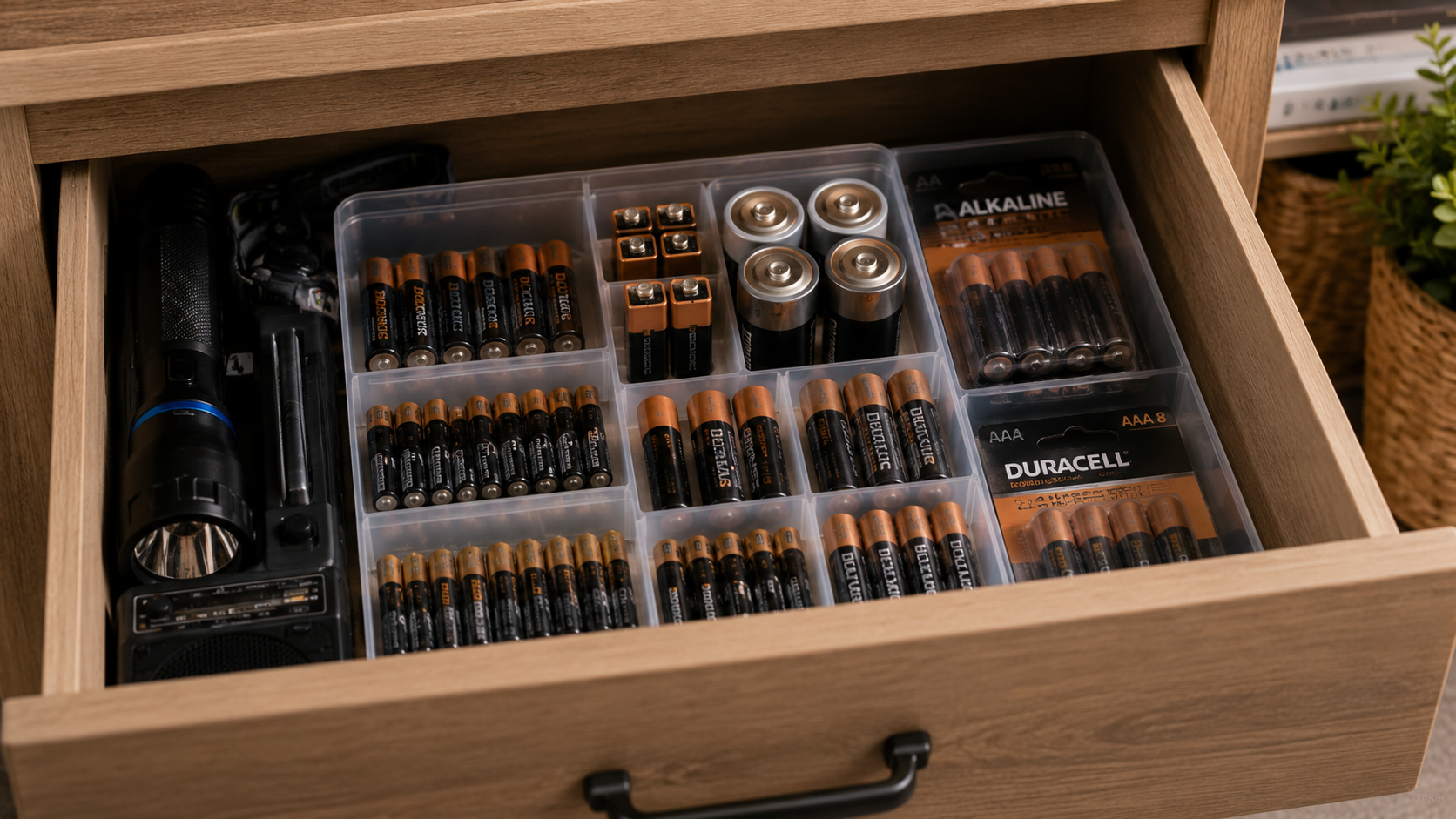
If the package is already open, store batteries in a plastic battery organizer, small case, or even separate plastic bags by type. For 9V batteries, keep the terminals covered. Some people use the original cap, electrical tape, or individual storage cases.
This is not about being overly cautious. It is about not letting a junk drawer become an electrical experiment.
Mixing old and new batteries is easy to forget
When a device needs two or three batteries, it is tempting to grab whatever is available.
One new battery, one old battery, maybe one from a remote you “borrowed” and forgot to return. Very normal. Not ideal.
Mixing old and new batteries can reduce performance and may increase the chance of leakage. The weaker battery can drag down the set. The device may act unreliable, and you may end up replacing batteries sooner anyway.
The same idea applies to mixing different brands, types, or chemistries in the same device. It is usually better to use matching batteries from the same package when possible.
This is especially important for devices that sit for a long time, like flashlights, lanterns, and emergency radios. You do not want to discover during a storm that your “fresh” batteries were actually a mismatched little team from three different years.
Devices stored with batteries inside can leak
This is one of the most annoying household surprises: you open a flashlight or toy and find crusty white residue around the battery compartment.
Battery leakage can damage devices. Sometimes you can clean the contacts and save the item. Sometimes it is done.
The risk is higher when batteries sit unused for a long time, especially in devices stored in hot, humid, or forgotten places.
For items you rarely use, consider storing the batteries separately. Keep them next to the device, not inside it. You can tape a small bag of batteries to the flashlight handle, put them in the same emergency bin, or label the device with what size it needs.
There is one exception worth thinking through: emergency devices need to be ready quickly. If you remove batteries from all your flashlights, make sure you can find and install them in the dark. A compromise is to keep one or two flashlights loaded and checked regularly, while storing extra batteries separately.
Preparedness should not create a puzzle for future tired you.
Heat and humidity are not your friends
Batteries do best in cool, dry conditions.
That does not mean they need to live in a climate-controlled vault. But storing them in a hot garage, car, attic, damp basement, or sunny windowsill is not ideal. Heat can shorten battery life. Moisture can contribute to corrosion. Temperature swings can be rough on stored supplies.
A better spot is a closet, cabinet, pantry shelf, or indoor utility area away from direct sunlight and moisture.
The kitchen junk drawer can work if it is dry and not near the stove or sink. The laundry room may not be great if it gets humid. A car glove box is convenient for emergency items, but batteries stored in cars deal with heat and cold, so check and replace them more often.
The main rule is simple: store batteries where you would not worry about keeping paper, medicine, or electronics.
Rechargeable batteries need their own plan
Rechargeable batteries are great for devices you use often: game controllers, wireless keyboards, toys, flashlights, and some household gadgets. They can save money and reduce waste over time.
But they do not automatically solve the preparedness problem.
Rechargeables need charging. Some lose charge while sitting, though newer low-self-discharge types hold power much better than older ones. If your rechargeable batteries are always dead when you need them, your system is not working.
A good rechargeable setup includes:
A reliable charger.
A place for charged batteries.
A place for batteries waiting to be charged.
A habit of recharging after use.
That last one is where things fall apart.
You use the flashlight, toss the batteries somewhere, and three months later wonder why nothing works. Or you have eight rechargeable batteries, but somehow all eight are in random devices or sitting empty in a drawer.
One practical trick is to label a small case “charged” and another “needs charge.” It is not glamorous, but it prevents a lot of guessing.
For emergency supplies, you may still want some long-shelf-life disposable batteries as backup. Rechargeables are useful, but if the power is out and everything is dead, you will be grateful for sealed batteries that are ready to go.
Coin batteries deserve extra care
Coin batteries are tiny, easy to lose, and more serious than they look.
They are used in watches, key fobs, kitchen scales, thermometers, hearing aid devices, small remotes, toys, and many little electronics. Because they are shiny and small, they can be dangerous if swallowed, especially by children or pets.
If you keep coin batteries at home, store them in secure packaging and out of reach. Do not leave them loose on counters, in drawers children can access, or inside devices with loose battery compartments.
Also check devices that use coin batteries. A remote with a broken battery cover is not just annoying. It can become a safety risk.
This is one of those details that feels small until it matters. Treat coin batteries more like medicine than like office supplies.
Emergency kits need testing, not just batteries
Putting batteries in an emergency kit is a good start.
Testing the kit is better.
A flashlight that worked three years ago may not work today. An emergency radio may need a battery type you forgot. A lantern may have batteries inside that leaked. A power bank may be fully drained. A headlamp may still have old batteries from that camping trip you barely survived and now refuse to discuss.
Pick a simple schedule. Twice a year is reasonable for many households. Some people check emergency supplies when changing clocks for daylight saving time, though not every place observes it. You can also tie it to the start of summer and winter storm seasons.
This does not need to become a full emergency-prepper afternoon. Ten minutes can catch the most obvious problems.
Smoke alarms are not the place to improvise
Smoke alarms and carbon monoxide detectors deserve special attention.
Some use replaceable batteries. Some have sealed long-life batteries. Some are hardwired with battery backup. The exact type matters.
Do not assume every alarm in the house uses the same battery. Check each one. Write it down. Follow the manufacturer’s instructions for testing and replacement.
If an alarm starts chirping, do not remove the battery and forget about it. Everyone says they will replace it “in a minute.” Then the alarm sits open on a shelf, useless and judging you silently.
Keep the correct replacement batteries available, especially if your alarms use 9V batteries. If your alarms are older, check whether the whole unit needs replacement rather than just a new battery.
A battery stash is not only about convenience. In this case, it is part of home safety.
Labeling saves future frustration
A little labeling goes a long way.
You can label battery storage by type: AA, AAA, C, D, 9V, coin cells, rechargeable. You can label emergency devices with the battery size they need. You can write purchase dates on battery packs with a marker.
This sounds like the kind of thing an extremely organized person would do on a Sunday morning while listening to a podcast about minimalism. But it is actually useful for normal messy households too.
When the power goes out, when a child’s toy dies, when a remote stops working during a movie, or when a smoke alarm chirps at midnight, you do not want to inspect tiny battery compartments and guess.
Labeling is a gift to your future annoyed self.
Do not forget safe disposal
Dead batteries should not live forever in a bowl by the door.
Different communities have different rules for battery disposal and recycling. Alkaline batteries may be handled differently from rechargeable lithium-ion batteries, button cells, or specialty batteries. Rechargeable batteries and lithium batteries often need special recycling or disposal because of fire and environmental concerns.
The safest habit is to create a small “used batteries” container and check your local disposal guidelines. Keep used batteries away from children and pets, and avoid tossing damaged, swollen, leaking, or overheated batteries into regular trash without checking what your area recommends.
For 9V batteries or lithium batteries, covering the terminals before disposal is often a smart precaution to reduce short-circuit risk.
Battery disposal is not the most exciting errand. I will not pretend otherwise. But letting dead batteries pile up loose in a drawer is not a system. It is clutter with voltage.
A simple battery setup that works for most homes
You do not need an elaborate system. A useful home battery setup can be very basic.
Choose one storage spot indoors.
Keep batteries in original packaging or a proper organizer.
Separate new, used, and rechargeable batteries.
Store coin batteries securely.
Write down which devices need which sizes.
Keep at least one working flashlight easy to reach.
Check emergency devices a couple of times a year.
Replace old or leaking batteries promptly.
That is enough for most households.
The point is not to become obsessed with battery management. The point is to avoid the common situation where you technically have batteries, but none of them are safe, fresh, charged, or the right size.
The small habit that makes the stash useful
The best battery stash is not the biggest one. It is the one you can trust.
That means fresh enough, organized enough, stored safely enough, and matched to the devices you actually use.
A few minutes of checking can prevent a lot of irritating little moments later: the dead remote, the useless flashlight, the chirping alarm, the toy meltdown, the emergency radio that refuses to turn on when the weather gets serious.
Batteries are easy to ignore because they are small. They sit quietly until something needs power.
But that is exactly why a little planning helps.
So go ahead and keep extras. Just do it with a bit of intention. Keep them cool and dry. Keep them sorted. Keep an eye on dates. Keep loose terminals from touching random metal objects. And maybe, just maybe, rescue that battery drawer from becoming the place where preparedness goes to expire.
Hi, I’m the creator and editor behind ZestyHabit. I research everyday safety, first aid, and practical wellness topics using official guidance and reliable public sources, then turn that information into clear, realistic steps for daily life.
My goal is to help readers make safer, better-informed choices at home and beyond.
[…] a winter football game, skiing, sledding, or attending a holiday parade, plan for standing still. People often dress for walking but forget that sitting or standing in cold wind feels much […]
Loading...
Discover more from
Subscribe now to keep reading and get access to the full archive.



[…] a winter football game, skiing, sledding, or attending a holiday parade, plan for standing still. People often dress for walking but forget that sitting or standing in cold wind feels much […]