Everyday Household Items That Can Choke or Suffocate Babies and Toddlers
Minjin Park
·
Discover common household choking, suffocation, and strangulation hazards for babies and toddlers, plus practical childproofing and emergency-response tips.
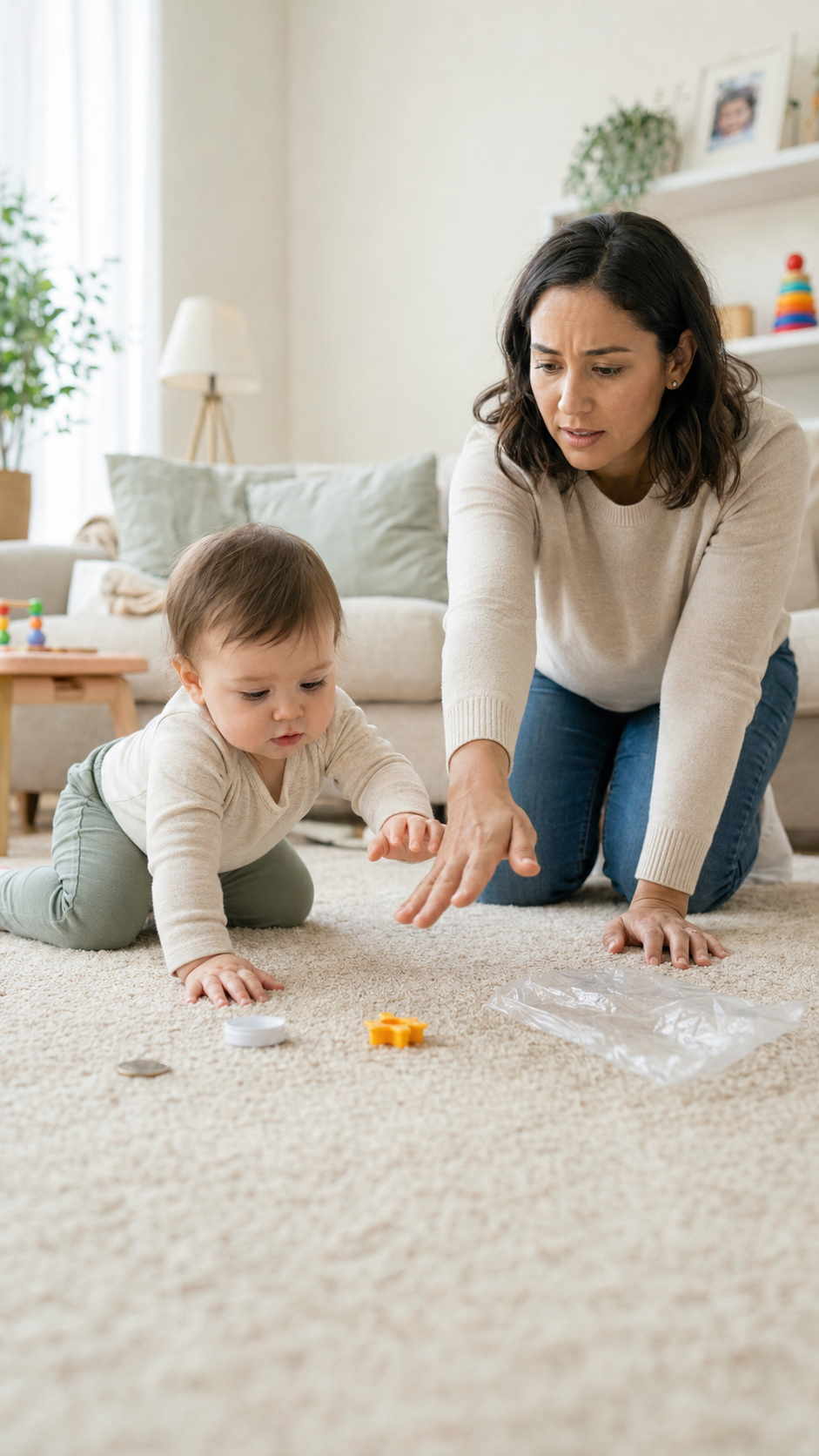
A baby exploring the floor does not see a coin, bottle cap, or loose battery as dangerous. To them, it is simply something new to touch, examine, and often put in their mouth. This natural curiosity is part of healthy development, but it also makes babies and toddlers especially vulnerable to choking and suffocation accidents.
The hazards are not limited to toys. Everyday homes contain small objects, plastic packaging, loose cords, soft bedding, button batteries, magnets, and other products that can restrict a child’s breathing or cause serious internal injuries.
Because these emergencies can develop quickly and quietly, prevention depends on looking at the home from a child’s perspective. That means checking the floor, furniture, bags, drawers, sleep spaces, and products used by older family members—not just the items marketed for babies.
Safety note: This article provides general prevention and first-aid information. Caregivers should complete a certified infant and child CPR course for hands-on emergency training.
Choking, Suffocation, and Strangulation Are Different
These terms are sometimes used interchangeably, but they describe different hazards.
Choking happens when food or another object becomes lodged in the airway, partially or completely blocking airflow.
Suffocation happens when a child’s nose and mouth are blocked or when the child becomes trapped in a position where breathing is restricted. Plastic bags, soft bedding, gaps beside mattresses, and an adult’s body can create suffocation hazards.
Strangulation occurs when a cord, string, strap, or similar object tightens around the neck and restricts breathing or blood flow.
All three can deprive the brain of oxygen. A choking child may be unable to cry or cough, while a child caught in a cord may not make any sound at all. Active adult supervision helps, but it cannot replace removing hazards from the environment.
Why Babies and Toddlers Are at High Risk
Young children explore objects with their mouths before they fully understand what is safe. They also have smaller airways, limited chewing ability, and less-developed coordination than adults.
A household item does not have to be tiny to cause choking. Flexible objects can compress and enter the airway, while smooth, round items may completely seal it. Objects can also break apart after being dropped, chewed, or handled by an older sibling.
The U.S. Consumer Product Safety Commission classifies an object as a small part if it fits completely into its official small-parts test cylinder, which approximates the throat of a child younger than three. Products intended for children under three are generally prohibited from containing these hazardous small parts, but ordinary household products are not necessarily designed to the same standard.
1. Coins
Coins are among the most common small objects children find on floors, counters, nightstands, couches, and inside bags.
A coin may become lodged in the airway or esophagus. Even if a child appears to breathe normally after swallowing one, the coin may still be stuck and require medical removal.
Store loose change in a closed container that children cannot access. Check:
Couch cushions
Entryway tables
Cup holders
Laundry baskets and pockets
Purses, wallets, and backpacks
Areas around vending machines or coin banks
Teach older children not to leave money where a younger sibling can reach it.
2. Balloons and Broken Balloon Pieces
Latex balloons are particularly dangerous because the soft material can conform to the shape of a child’s airway. A child may inhale an uninflated balloon while trying to blow it up or place a torn fragment in their mouth after a party.
Unlike a hard object, thin balloon material can be difficult to grasp and remove.
Keep uninflated balloons away from babies and toddlers. An adult should inflate balloons, and broken or deflated pieces should be picked up immediately. After birthday parties, check under furniture, behind curtains, beneath tables, and inside toy boxes for fragments.
Do not allow a young child to chew on a balloon, even while supervised.
3. Button and Coin-Cell Batteries
Small round batteries are found in many ordinary products, including:
Remote controls
Key fobs
Digital scales
Watches
Toys
Flameless candles
Hearing aids
Calculators
Greeting cards
Thermometers
Tracking devices
Small lights
A button battery may cause choking, but swallowing it creates another medical emergency. A battery lodged in the esophagus can generate an electrical reaction and severely burn nearby tissue, sometimes before obvious symptoms appear.
Choose products with battery compartments secured by screws or another child-resistant mechanism. Store spare and used batteries in locked storage, and inspect devices after they are dropped or damaged.
If you suspect a child swallowed a button or coin battery, do not wait for symptoms and do not induce vomiting. In the United States, immediately contact the National Battery Ingestion Hotline at 800-498-8666, Poison Help at 800-222-1222, or emergency services. The CPSC’s battery safety guidance treats suspected ingestion as an urgent situation.
4. High-Powered Magnets
Loose magnets may fall out of toys, building sets, jewelry, refrigerator decorations, phone accessories, and novelty products.
A magnet can be inhaled or swallowed. If a child swallows two or more powerful magnets—or a magnet and another metal object—they may attract through different sections of the intestine. This can cause trapped tissue, intestinal blockage, perforation, infection, and death.
Seek immediate medical care if magnet ingestion is possible. Do not wait for abdominal pain, vomiting, or other symptoms.
5. Water Beads
Water beads are small absorbent polymer balls used in sensory play, crafts, vase decorations, gardening products, stress toys, and activity kits. When dry, they can be extremely small and easy to lose. After contact with water, they expand dramatically.
A baby may swallow a dry bead without anyone noticing. The bead can continue growing inside the digestive system and cause an intestinal blockage. Water beads can also be inhaled or inserted into the nose or ear.
The safest approach is not to keep loose water beads in a home where babies or toddlers live or visit. If they are present, store them in locked containers and clean the surrounding area carefully. Seek prompt medical advice if ingestion is suspected, even when the child initially looks well.
6. Small Toy Parts and Older Children’s Toys
A toy labeled safe for a six-year-old may contain pieces that are dangerous to a two-year-old. Common examples include:
Building pieces
Doll shoes and accessories
Game tokens and dice
Puzzle pegs
Toy wheels
Marbles and small balls
Beads
Miniature figures
Craft eyes and decorations
Create a separate play and storage area for older children’s toys. Closed bins placed on a high shelf may not be enough once a toddler learns to climb, so consider child-resistant cabinets or a room the toddler cannot enter.
Regularly examine baby toys for cracks, loose parts, exposed filling, broken seams, and accessible batteries. Stop using damaged toys immediately.
7. Bottle Caps, Pen Caps, and Cosmetic Containers
Everyday packaging can be the right size and shape to block a child’s airway. Look for:
Water-bottle caps
Toothpaste and lotion caps
Pen and marker caps
Lip balm caps
Cosmetic lids
Medicine caps
Small spray-nozzle covers
Disposable valve caps
Contact-lens case lids
Closing the cap is not always enough. A toddler may watch an adult open a container and then imitate the action. Keep these objects inside latched drawers or cabinets and immediately retrieve caps that fall on the floor.
8. Jewelry, Hair Accessories, and Sewing Supplies
Earrings, rings, necklace pieces, beads, hair clips, elastic bands, safety pins, buttons, and decorative charms can all end up in a young child’s mouth.
Sewing supplies present additional puncture hazards. Store needles, pins, snaps, loose buttons, and craft materials in a closed container inside locked storage.
Check clothing for loose buttons and decorations before dressing a baby. Small bows, sequins, beads, and zipper pulls may detach during chewing or washing.
Visitors may unknowingly bring these hazards into the home. Ask guests to keep handbags, medication organizers, jewelry, and craft supplies out of reach.
9. Hardware and Office Supplies
Home repairs and office work often leave small objects behind, including:
Screws and nails
Nuts and bolts
Washers
Thumbtacks
Staples
Paper clips
Pencil erasers
Removable keyboard keys
Earbud tips
Small electronic components
After completing a repair or project, count the pieces and clean the area thoroughly. Sweep or vacuum underneath furniture rather than checking only the visible floor.
Toolboxes and desk drawers should be secured because toddlers quickly learn to open ordinary handles.
10. Plastic Bags and Thin Packaging Film
Plastic shopping bags, produce bags, trash bags, dry-cleaning covers, diaper bags, mattress packaging, and thin product wrappers can cover a child’s nose and mouth.
A baby may be unable to pull the material away, especially if it clings to the face. Thin plastic can also be torn into pieces and mouthed.
Keep plastic bags in a secured cabinet. Remove packaging from new mattresses, furniture, toys, and baby products immediately, and place it in a closed trash container. Never use a loose plastic bag as a mattress protector or allow children to play with bags as costumes.
Plastic bags should never be stored inside a crib, play yard, stroller, or toy box.
11. Window Blind and Curtain Cords
Window covering cords can form loops that tighten around a child’s neck. These incidents may happen quickly and silently, even when an adult is nearby.
Move cribs, beds, couches, chairs, and toys away from windows.
Do not place climbable furniture below a cord.
Check the front, back, and inside of blinds for hidden cords.
Simply tying a cord in a knot or placing it on a nearby cleat may reduce access but does not completely eliminate the hazard.
12. Charging Cables, Monitor Cords, and Straps
Baby-monitor cords, phone chargers, lamp cords, lanyards, drawstrings, and long straps can become wrapped around a child’s neck.
Keep electrical cords against the wall, secured behind furniture, and completely beyond the reach of the crib or play area. Remember that a baby who cannot reach a cord today may be able to reach it after learning to roll, crawl, stand, or move the crib mattress level.
Never attach a pacifier to a long ribbon, necklace, or homemade cord. Use only a product designed for that purpose and follow its age and use instructions. Do not place pacifier clips, bib ties, necklaces, or hood strings around a sleeping baby.
13. Pillows, Blankets, Bumpers, and Stuffed Toys
Soft nursery products may look comfortable, but they can cover an infant’s face or create an entrapment space.
For every sleep, place the baby on their back on a firm, flat mattress in a safety-approved crib, bassinet, or play yard. Use only a properly fitted sheet. The CDC’s safe-sleep guidance recommends keeping pillows, loose blankets, bumper pads, and soft toys out of the infant sleep area.
The same warning applies to nursing pillows, sleep positioners, thick mattress pads, couch cushions, and adult bedding. Nursing pillows are designed to assist with feeding—not unsupervised sleep.
Use an appropriately sized wearable blanket or sleep sack instead of placing loose blankets over an infant.
14. Adult Beds, Couches, and Recliners
A baby can become trapped between a mattress and a wall, beneath an adult, or against soft cushions. Couches and recliners contain gaps where a small body or face can become wedged.
Do not leave a baby sleeping unattended on a couch, recliner, adult bed, beanbag, or cushioned chair. If a caregiver feels sleepy while holding or feeding the baby, move the baby to a separate, approved sleep space.
Car seats, swings, and bouncers should not become routine sleep environments outside their intended use. Follow the product instructions and transfer a sleeping baby to a firm, flat sleep surface when appropriate.
How to Check Your Home for Hidden Hazards
Get down on your hands and knees and examine each room from a crawling child’s height. Look under couches, beds, tables, appliances, and cabinets.
Repeat this check regularly because household items move constantly. Pay particular attention after:
A party or family visit
Older children have played
Opening packages
Repairing furniture or electronics
Doing crafts
Emptying pockets or bags
Moving furniture
Staying in a hotel or rental home
Check the CPSC recall database for toys, nursery products, and household items that may have been recalled because of choking, entrapment, or strangulation hazards.
What to Do If a Child Is Choking
If a child can cough forcefully, cry, or make sounds, encourage coughing and watch closely. Do not perform a blind finger sweep, as this can push the object deeper.
If the child cannot breathe, cry, or cough effectively, call 911 or your local emergency number and begin age-appropriate choking first aid.
For an infant younger than one year, trained rescuers use cycles of five back blows and five chest thrusts. Do not perform abdominal thrusts on an infant.
For a conscious child older than one year, current first-aid guidance generally uses five back blows followed by five abdominal thrusts, repeated until the object comes out or the child becomes unresponsive.
If the child becomes unconscious, place them on a firm surface and begin CPR according to your training and the emergency dispatcher’s instructions. Seek medical evaluation after a serious choking episode, even if the object comes out, particularly if the child received back blows, chest thrusts, or abdominal thrusts or continues coughing or wheezing.
Preventing choking and suffocation is less about creating a perfectly empty home and more about developing reliable habits: secure small objects, separate older children’s belongings, keep sleep spaces bare, choose cordless window coverings, and inspect each room from a toddler’s viewpoint. Which household item on this list surprised you the most, and what childproofing habit has worked best in your home? Share your experience or safety tip in the comments below.
Hi, I’m the creator and editor behind ZestyHabit. I research everyday safety, first aid, and practical wellness topics using official guidance and reliable public sources, then turn that information into clear, realistic steps for daily life.
My goal is to help readers make safer, better-informed choices at home and beyond.