Why Window Blind Cords Can Wrap Around a Child’s Neck—and How to Make Your Home Safer
Minjin Park
·
Window blind cords can create hidden strangulation hazards for young children. Learn why these accidents happen, which cords are most dangerous, and simple ways to make every room safer.
Window blinds are so common that most of us barely notice them.
We open them in the morning, close them at night, and may never think twice about the cords hanging beside the window. But for babies, toddlers, and young children, those cords can become an unexpected safety hazard.
The concern is not that children are deliberately doing something dangerous. In many cases, they are simply exploring, climbing, looking out the window, or playing near furniture. A loose cord can easily become looped around a child’s neck before an adult realizes what is happening.
The good news is that this is a preventable household risk. A few simple changes—such as choosing cordless blinds, securing loose cords, and moving furniture away from windows—can make a meaningful difference.
Young children naturally explore their surroundings with their hands and bodies. They pull, twist, climb, reach, and wrap objects around themselves while playing.
A window blind cord may look harmless to an adult, but to a child, it can resemble a toy, necklace, rope, or handle.
The main danger comes from cords that form a loop or can become wrapped around the neck. If a child becomes caught, the cord may tighten as the child moves, struggles, slips, or falls.
Because this can happen quietly and quickly, adults may not immediately notice that something is wrong.
Children May Not Understand the Risk
A toddler does not understand that a cord can tighten around the neck. They may place it over their head while pretending it is a necklace or use it as part of an imaginative game.
Older children may try to swing from it, pull on it, or wrap it around their arms and body.
Even if a child has been told not to touch the blinds, curiosity and impulsive behavior can take over—especially when an adult is busy, cooking, showering, working, or caring for another child.
The Cord Can Tighten During a Fall
One common scenario involves a child climbing onto a bed, couch, chair, toy box, or windowsill to look outside.
If a cord is nearby, the child may grab it for balance or accidentally place their head through a loop. If they slip or step down, their body weight can cause the cord to tighten.
This is why moving furniture away from windows is just as important as securing the cord itself.
Which Types of Window Coverings Can Create a Risk?
Not all window coverings are designed the same way. Some have visible pull cords, while others contain loops or cords that are less noticeable.
It is helpful to inspect every window covering in the home, including older blinds that may have been installed before your family moved in.
Loop-Style Pull Cords
Some blinds and shades are operated using a continuous loop. The user pulls one side of the loop to raise the shade and the other side to lower it.
If the loop hangs freely, a child may place their head or body through it.
A tension device can help keep the loop tight against the wall or window frame, but it must be installed correctly and remain securely attached.
Long, Dangling Pull Cords
Traditional blinds may have one or more pull cords hanging from the side.
These cords can become tangled together, tied into knots, or wrapped around nearby objects. A child may also pull them onto a bed, crib, couch, or floor.
Tying the cords together or making a larger knot does not necessarily make them safer. In some cases, it may create a larger loop.
Inner Cords Between Blind Slats
Some blinds have cords running through or behind the slats. These cords may become accessible if the blinds are damaged, raised unevenly, or pulled apart.
A child may reach through the slats and pull on the inner cord, creating enough space for a loop to form.
This hazard can be easy to miss because the cord may not be visible during normal use.
Cords Hidden Behind Furniture
A cord does not need to be hanging in the middle of a room to create a problem.
It may fall behind a couch, bed, dresser, changing table, or playpen. A child who climbs between the furniture and the wall may still be able to reach it.
Hidden cords can actually be more difficult for adults to notice during routine cleaning or safety checks.
Why the Risk Is Easy to Overlook
Window cords often feel like part of the background. They are not sharp, hot, heavy, or obviously dangerous.
The Blinds Were Installed Before the Child Arrived
Many families do not replace window coverings when they have a baby. The blinds may have been installed years earlier, long before child safety became a daily concern.
Parents may babyproof cabinets, cover outlets, and install safety gates without realizing that an older blind cord is still within reach.
The Cord Seems Too High to Reach
A cord may appear safely out of reach when a child is sitting or crawling.
However, children quickly learn to stand, climb, and move furniture. A toddler who could not reach the cord last month may suddenly be able to reach it from a nearby chair or bed.
Children may also use toys, storage bins, or stacked cushions as makeshift steps.
Parents Assume Supervision Is Enough
Supervision matters, but no adult can watch a child every second of the day.
A parent may turn around to fold laundry, answer the door, prepare a bottle, or help another child. The safer approach is to remove or control the hazard rather than rely only on constant observation.
Temporary Cord Fixes Become Permanent
A family may wrap the cord around the top of the blinds “for now” or tuck it behind a curtain.
Over time, the cord may fall back down, loosen, or become reachable. Temporary fixes are easy to forget, especially in rooms that are not used every day.
Everyday Situations That Can Increase the Risk
Blind cord incidents often involve normal household activities rather than unusual behavior.
Understanding these everyday situations can help families notice risks before a problem occurs.
A Crib Placed Near a Window
A crib may be positioned near a window for natural light, airflow, or convenience.
As the baby grows, they may learn to stand and reach through the crib rails. A blind cord that once seemed far away can suddenly become accessible.
The same concern applies to bassinets, toddler beds, play yards, and changing tables.
A Child Standing on a Couch
Children often climb onto a couch to look outside, wave at a parent, watch birds, or see a passing truck.
If the couch is directly under the window, the child may be at the same height as the blind cord.
A Bed Pushed Against the Wall
In bedrooms, blinds may hang beside a bed or bunk bed. A child may play with the cord while lying down, sitting on the bed, or climbing onto the top bunk.
At night, the cord may be harder to see, especially if it falls behind pillows or blankets.
Playtime Near Curtains and Blinds
Children may include cords in pretend play. They may use them as pretend jump ropes, animal leashes, necklaces, belts, or rescue ropes.
A child does not need to be misbehaving for the situation to become dangerous.
Visiting Another Home
A child’s own home may have cordless blinds, but a grandparent’s home, rental property, hotel room, babysitter’s home, or vacation rental may still have older corded window coverings.
It is worth doing a quick scan whenever young children spend time in an unfamiliar space.
Common Mistakes to Avoid
Many parents and caregivers try to reduce the risk but accidentally use solutions that are incomplete or unreliable.
Tying the Cord in a Knot
A knot may shorten the cord, but it can also create a loop large enough for a child’s head.
Knots can also loosen over time or slide lower when the blinds are used.
Wrapping the Cord Around the Blind
Wrapping the cord around the top of the blind may work temporarily, but it is easy for the cord to fall down.
Guests, cleaners, babysitters, or older children may also lower the cord without knowing it needs to be secured again.
Hiding the Cord Behind a Curtain
Curtains do not prevent access. A curious child can pull the curtain aside or reach behind it.
The hidden cord may also be harder for adults to notice during safety checks.
Cutting a Continuous Loop Without Guidance
Some cord systems are designed to operate as a loop. Cutting the cord may damage the blind or create two long, loose ends.
It is better to follow the manufacturer’s instructions, use an appropriate tension device, or replace the window covering.
Assuming Older Children Are Completely Safe
Babies and toddlers face the highest risk, but older children may still play with cords, climb near windows, or use cords in ways adults do not expect.
A cord-free setup is safer for children of all ages.
Simple Ways to Make Window Blinds Safer
The most effective safety changes are usually the ones that do not depend on daily reminders.
Choose Cordless Window Coverings
Cordless blinds and shades are generally the simplest option for homes with young children.
Many cordless models can be raised or lowered by gently pushing or pulling the bottom rail. Others use a wand, motor, or remote control.
When replacing blinds, check the product description carefully. A window covering may look cordless from the front but still have an accessible loop or cord on the side.
Replace Older Blinds
Older blinds may have long cords, accessible inner cords, or safety devices that are missing or outdated.
Inspect blinds in children’s bedrooms, playrooms, living rooms, and any area where a child spends time.
You may not need to replace every blind at once. Start with the rooms where children sleep, play, climb, or spend the most unsupervised time.
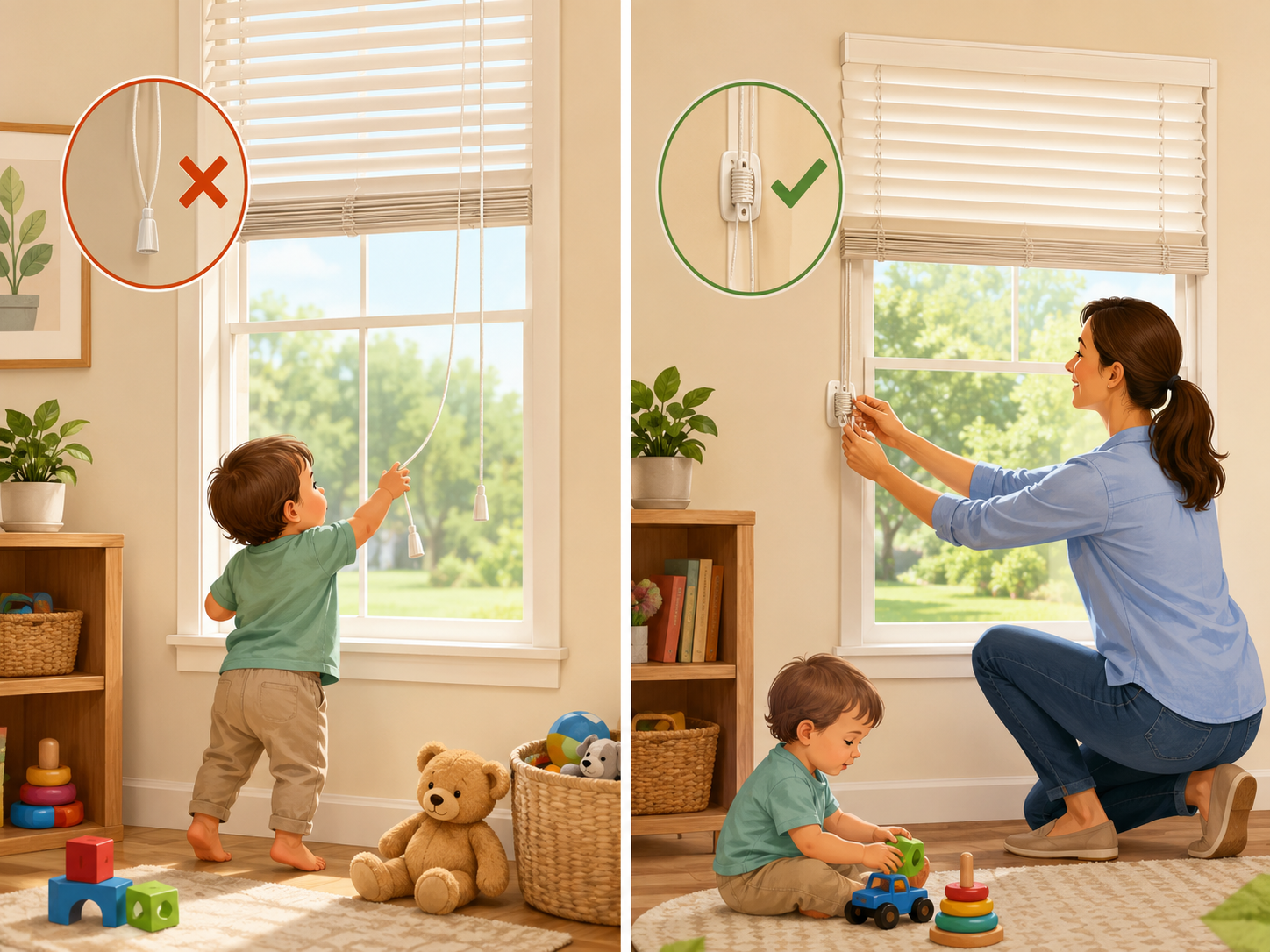
Install Cord Cleats
A cord cleat is a small device attached high on the wall or window frame. The pull cord is wrapped securely around it after each use.
The cleat should be installed high enough that a child cannot reach it, even when standing on nearby furniture.
Remember that a cleat only works when the cord is wrapped around it every time.
Secure Continuous Loops
Continuous-loop cords should be kept tight using a properly installed tension device.
The device should be firmly attached so the loop cannot hang freely. Check it regularly to make sure it has not loosened, cracked, or pulled away from the wall.
Move Furniture Away From Windows
Keep cribs, beds, couches, chairs, benches, toy chests, and climbing toys away from windows with cords.
Even a small piece of furniture can give a child enough height to reach a cord.
This step also helps reduce the risk of falls from open windows.
Keep Cords Short and Out of Reach
Loose cords should never hang near the floor, bed, crib, or play area.
Use the safety devices recommended for your particular blind system. Avoid homemade fixes that create loops or rely on tape that may lose its grip.
Check Rental Homes and Guest Rooms
When traveling, inspect the room before allowing a child to play or sleep near a window.
Move the crib or bed if necessary. Secure loose cords temporarily in a way that keeps them fully out of reach, and supervise closely until a permanent solution is available.
Warning Signs That a Blind Needs Attention
A quick visual check can reveal many problems.
Look for:
A loop hanging freely beside the window
Long cords resting on furniture or the floor
Missing or broken tension devices
Cords tied into large knots
Frayed or damaged cords
Inner cords pulled out from between the slats
Furniture placed directly below the window
A crib or bed within reaching distance
Safety devices that have come loose
Blinds that no longer raise or lower evenly
A damaged blind may expose cords that were previously hidden. If the blind cannot be repaired safely, replacing it may be the better option.
A Quick Room-by-Room Safety Check
You do not need to turn this into a major home project.
Take a few minutes and walk through each room.
Nursery or Child’s Bedroom
Check the crib, bed, changing table, and rocking chair. Make sure none are close enough for a child to reach the blinds or cords.
Look behind curtains and furniture.
Living Room
Children often climb on couches and chairs. Sit or kneel at your child’s height and see what cords are within reach.
Pay special attention to windows behind sofas.
Playroom
Move toy boxes, play kitchens, stools, and climbing equipment away from windows.
Children may move toys themselves, so leave more space than you think is necessary.
Guest Room
Guest rooms are often overlooked because they are used less frequently.
If grandchildren, nieces, nephews, or visiting families use the room, check the window coverings before they arrive.
Home Office
A child may enter a home office while a parent is working. Check blinds behind desks, chairs, and storage cabinets.
Rolling office chairs can make it easier for a child to climb or reach higher.
Tell children that blind cords are not toys and should not be wrapped around the neck, arms, toys, or furniture.
Use clear language, such as:
“Window cords are for adults to use. Please do not play with them.”
Avoid making the cord seem exciting or mysterious. A calm, consistent reminder is usually more effective than a dramatic warning.
For younger children, physical prevention remains more important than verbal instructions.
Make Blind Cord Safety Part of Regular Babyproofing
Children grow quickly, and their abilities change faster than most parents expect.
A safety setup that worked when your baby was crawling may not work once they begin standing, climbing, and moving furniture.
Recheck window coverings when:
Your baby starts pulling up to stand
Your toddler begins climbing
You move a crib or bed
You rearrange furniture
You move into a new home
You install new blinds
A safety device breaks or loosens
A child begins sleeping in a new room
It is also helpful to check blind cords when visiting relatives or preparing a room for young guests.
Final Thoughts
Blind cords are easy to ignore because they are such a familiar part of the home. But for young children, a loose or looped cord can become dangerous during ordinary activities such as climbing, looking out the window, or playing near a bed or couch.
The safest approach is to remove accessible cords whenever possible.
Choose cordless window coverings, secure continuous loops, wrap pull cords on properly installed cleats, move furniture away from windows, and check each room from a child’s point of view.
You do not need to feel anxious every time your child walks near a window. A few thoughtful changes can reduce the risk and make your home easier to manage.
Start with the rooms your child uses most, fix the most obvious hazards first, and include window coverings in your regular household safety checks.
Hi, I’m the creator and editor behind ZestyHabit. I research everyday safety, first aid, and practical wellness topics using official guidance and reliable public sources, then turn that information into clear, realistic steps for daily life.
My goal is to help readers make safer, better-informed choices at home and beyond.