
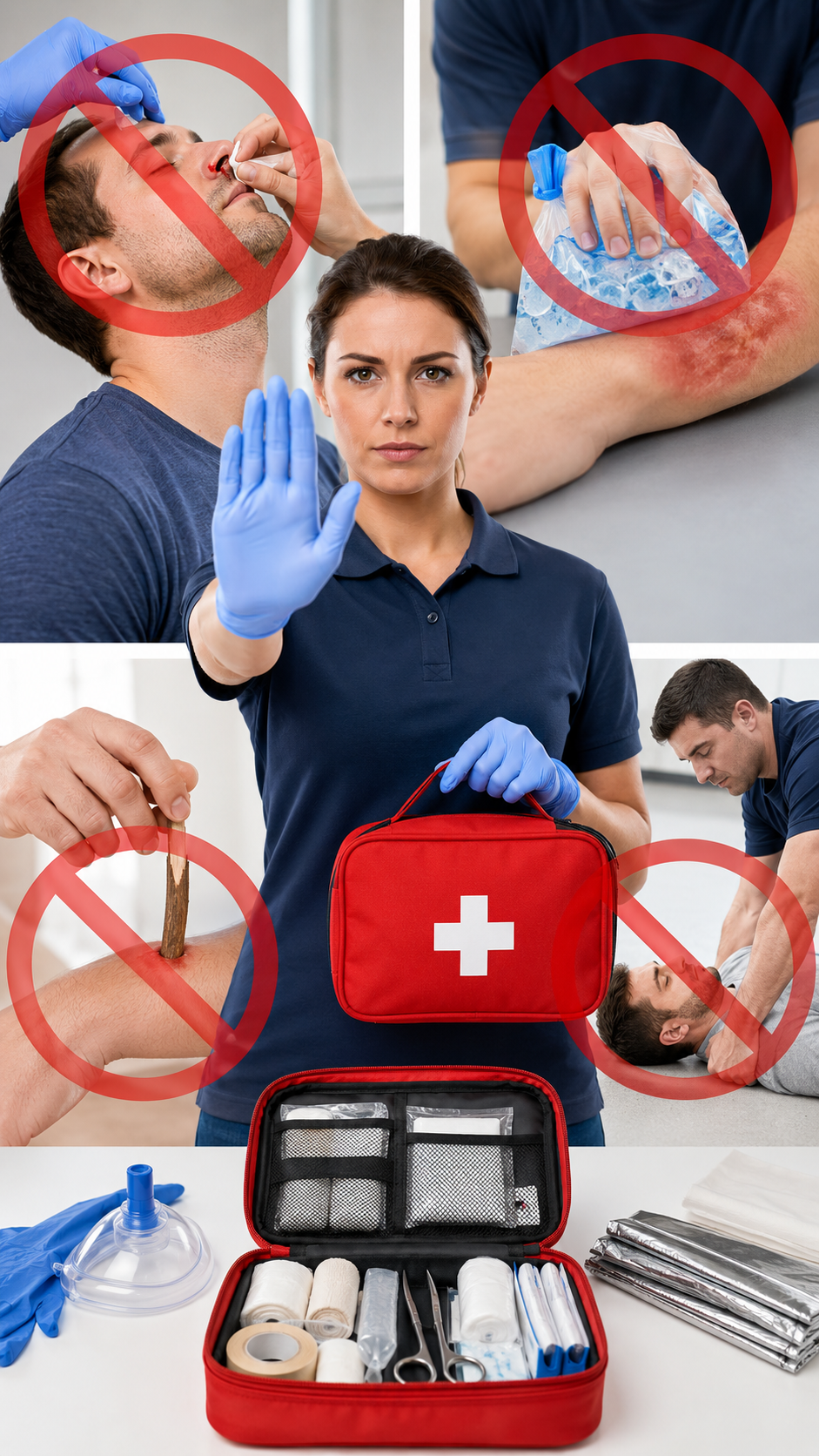

When someone is bleeding, choking, burned, or unconscious, most people instinctively want to do something immediately. That impulse can save a life—but only if the action is appropriate for the emergency.
Many harmful first-aid practices come from outdated advice, movies, family traditions, or social media. People put butter on burns, force objects into the mouths of people having seizures, make poisoned children vomit, or cut into snakebites. These actions may feel helpful in the moment, but they can cause additional injuries, delay professional treatment, and make it harder for emergency responders to manage the original problem.
Good first aid is not about performing the most dramatic intervention. It is about recognizing immediate threats, contacting emergency services, preventing further harm, and providing simple care within your level of training.
Here is why wrong first aid can make an emergency worse—and how to avoid some of the most dangerous mistakes.
Why Well-Meaning First Aid Goes Wrong
Incorrect first aid can harm someone in several different ways.
First, it may directly injure tissue. Ice placed on a serious burn can further damage already vulnerable skin, while cutting a snakebite adds an open wound without removing a meaningful amount of venom.
Second, an incorrect action can create a new emergency. Forcing an object into the mouth of someone having a seizure may break teeth, injure the jaw, or block the airway.
Third, home remedies can interfere with medical treatment. Applying butter, toothpaste, powder, or oil to a burn may trap heat and leave material that healthcare professionals must remove before assessing the wound.
Finally, focusing on an ineffective remedy can waste critical time. Minutes spent searching online, attempting to make someone vomit, or moving an injured person unnecessarily could have been used to call 911, begin CPR, control bleeding, or follow instructions from a dispatcher.
In a serious emergency, delayed care may be just as dangerous as incorrect care.
Mistake 1: Trying to Handle Everything Before Calling for Help
One of the most common first-aid errors is waiting too long to contact emergency services. A bystander may spend several minutes trying home remedies because they are embarrassed, uncertain, or worried about overreacting.
Call 911 in the United States—or the appropriate emergency number in your country—when someone is unresponsive, not breathing normally, having severe breathing difficulty, bleeding heavily, showing signs of stroke or heart attack, experiencing a prolonged seizure, or suffering another potentially life-threatening emergency.
Put the phone on speaker if you need both hands to provide care. The dispatcher can send help while giving instructions based on the situation.
Emergency responders need an accurate location, so provide the street address, apartment number, floor, building entrance, or recognizable landmark. Do not hang up until the dispatcher tells you to do so.
The American Red Cross summarizes the basic approach as Check, Call, Care: check the scene and the person, call for help, and provide appropriate care. Its three emergency action steps offer a useful framework for unfamiliar situations.
Mistake 2: Delaying CPR Because You Are Afraid of Hurting the Person
A person in cardiac arrest needs immediate chest compressions. Shaking the person repeatedly, splashing water on their face, or waiting to see whether they recover wastes time while their brain and other organs are deprived of oxygen.
If a teen or adult suddenly collapses, is unresponsive, and is not breathing normally, call 911 and begin Hands-Only CPR. Place your hands in the center of the chest and push hard and fast at approximately 100 to 120 compressions per minute. Use an automated external defibrillator, or AED, as soon as one becomes available and follow its spoken instructions.
Occasional gasping is not normal breathing and can occur during cardiac arrest.
People sometimes hesitate because chest compressions can cause injuries. However, the consequences of withholding CPR from someone in cardiac arrest are far more serious. The American Heart Association emphasizes that bystanders should call 911 and push hard and fast in the center of the chest. Its Hands-Only CPR guidance includes demonstrations and training resources.
Hands-Only CPR is intended primarily for a witnessed sudden collapse in a teen or adult. Infants, children, drowning victims, and people whose arrest began with a breathing problem may benefit from conventional CPR with rescue breaths when the rescuer is trained.
Mistake 3: Putting Ice, Butter, or Toothpaste on a Burn
A fresh burn can be intensely painful, so reaching for ice feels logical. Unfortunately, direct ice or extremely cold water can reduce blood flow and add a cold injury to heat-damaged tissue.
Butter, cooking oil, petroleum jelly, toothpaste, egg white, and similar home remedies are also inappropriate. Greasy substances may trap heat, while nonsterile products can contaminate the injury. Toothpaste and other chemicals may irritate damaged skin.
For a minor thermal burn, remove the person from the heat source and place the affected area under clean, cool running water. The American Red Cross recommends cooling a burn with running water for 5 to 20 minutes. Remove rings, watches, and other tight items before swelling develops, but do not pull away clothing stuck to the skin.
After cooling, loosely cover the area with a clean, nonstick dressing. Do not break blisters.
Call 911 for extensive or deep burns, electrical burns, serious chemical burns, inhalation injuries, or burns involving the face, airway, hands, genitals, or another critical area. Red Cross instructions are available in its burn first-aid guide.
Mistake 4: Making a Poisoned Person Vomit
For years, some families kept syrup of ipecac at home to induce vomiting after a suspected poisoning. That recommendation has changed.
Vomiting does not reliably remove a swallowed poison. A corrosive substance may burn the esophagus a second time on the way back up, while petroleum products or vomit may enter the lungs. A drowsy or convulsing person is at particularly high risk of choking.
Do not induce vomiting unless a poison specialist or healthcare professional specifically instructs you to do so. Do not assume that milk, lemon juice, vinegar, salt water, or another household ingredient will neutralize the substance. The correct response depends on what was swallowed, how much was involved, the person’s age and weight, and whether symptoms are present.
In the United States, contact Poison Control at 1-800-222-1222 or use the online tool at Poison Control. Do not wait for symptoms before seeking guidance.
If the person collapses, cannot be awakened, has a seizure, or has trouble breathing, call 911 immediately. Keep the product container, medication bottle, or label available for responders, but do not endanger yourself by handling a leaking chemical without protection.
Mistake 5: Putting Something in the Mouth During a Seizure
The myth that people can swallow their tongues during a seizure has led bystanders to insert spoons, wallets, towels, fingers, and other objects into their mouths.
A person cannot swallow their tongue. Forcing an object between the teeth can break teeth, injure the jaw, damage soft tissue, or obstruct the airway. The rescuer may also be bitten.
Do not restrain the person or attempt to stop the movements. Instead, clear hard or sharp objects from the surrounding area, cushion the head, loosen restrictive clothing around the neck, and time the seizure. When safely possible, turn the person onto their side to help fluids drain from the mouth.
Do not give food, water, or medication until the person is fully awake and able to swallow.
Call 911 if the seizure lasts longer than five minutes, another seizure begins before recovery, it is the person’s first known seizure, the person is injured or pregnant, the seizure occurs in water, or breathing does not return normally. The CDC’s seizure first-aid guidance specifically warns against restraint and placing anything in the mouth.
Mistake 6: Using a Tourniquet for Every Bleeding Wound
Tourniquets can save lives when used correctly for life-threatening bleeding from an arm or leg. They are not, however, the first response to every cut.
Applying a narrow cord, belt, or improvised tourniquet too loosely may increase bleeding by restricting venous return without stopping arterial flow. Applying one unnecessarily or leaving it in place without urgent medical care can damage nerves and tissues.
Begin with firm, steady pressure directly over the wound using gauze, a clean cloth, or another suitable material. If blood soaks through, keep pressing and add more material rather than repeatedly lifting the original dressing to inspect the wound.
For life-threatening limb bleeding that cannot be controlled promptly, use a commercially designed tourniquet if one is available and you have been trained. Place it according to the manufacturer’s instructions, tighten it until bleeding stops, note the time, and do not remove it yourself.
The American Red Cross recommends direct pressure and, for life-threatening bleeding from a limb, a tourniquet when the responder is trained. Its severe bleeding guidance explains the basic steps.
Mistake 7: Pulling Out an Embedded Object
A knife, shard of glass, piece of metal, or other object embedded in the body may be partially blocking a damaged blood vessel. Pulling it out can trigger severe bleeding and injure surrounding structures.
Do not remove an impaled object unless it is obstructing the airway and can be safely addressed under appropriate emergency guidance. Call 911, keep the person still, and apply pressure around—not directly on—the object. Use bulky dressings to stabilize it without pushing it deeper.
Let emergency professionals remove the object in a controlled setting where bleeding and internal injuries can be treated immediately.
An object that appears small externally may extend much farther into the body than expected. Never assume that a short visible section means the injury is superficial.
Mistake 8: Performing a Blind Finger Sweep on Someone Who Is Choking
When someone is choking, a panicked rescuer may put fingers into the person’s mouth and sweep around for the obstruction.
If the object is not clearly visible, this can push it deeper into the airway or injure the mouth and throat. Red Cross scientific guidance cites reported injuries and complications following blind finger sweeps and advises never performing one unless the object can actually be seen.
If a conscious adult or child has a complete airway obstruction and cannot cough, speak, or breathe, provide the recommended sequence of back blows and abdominal or chest thrusts. Techniques differ for infants, pregnant people, and individuals whose body shape makes abdominal thrusts impractical, which is one reason hands-on training is valuable.
If the person becomes unresponsive, lower them safely, call 911, and begin CPR. Each time the airway is opened, remove an object only if you can see it. The Red Cross provides further instructions in its choking first-aid guide.
Mistake 9: Cutting, Sucking, Icing, or Tightening a Snakebite
Movies have helped preserve some of the most dangerous snakebite myths. Cutting the bite and sucking out venom does not remove a useful amount of venom. Instead, it damages tissue, introduces bacteria, exposes the rescuer to bodily fluids, and delays antivenom treatment.
Ice may worsen local tissue damage, and an improvised tourniquet can restrict circulation without safely stopping venom movement. Electric shocks and folk remedies are also ineffective and potentially harmful.
Call 911 or arrange emergency transportation immediately. Keep the person calm and still, remove rings or tight items before swelling develops, and position the affected limb in a neutral, comfortable position. Do not try to capture or kill the snake. If it can be done from a safe distance, remember its color and pattern or take a photograph without delaying care.
CDC/NIOSH guidance warns against cutting, sucking, icing, immersing, or applying a tourniquet to a venomous snakebite. See the agency’s venomous snake safety guidance.
Mistake 10: Moving Someone After a Serious Fall or Collision
After a car crash, fall from height, diving accident, or major blow to the head, immediately helping the person sit or stand may feel reassuring. It can also worsen an unstable injury involving the spine, pelvis, or internal organs.
If you suspect a head, neck, or back injury, tell the person not to move and support them in the position found. Do not twist the neck to “check” it, pull the person upright, or remove a motorcycle helmet unless airway access makes it necessary and you know how to do so.
There are exceptions. A person may need to be moved if they face immediate danger from fire, traffic, rising water, collapsing debris, or another unavoidable threat. Movement may also be necessary to provide CPR or control otherwise inaccessible life-threatening bleeding.
Outside those situations, wait for trained responders who can stabilize the body and move the person with appropriate equipment.
Why Outdated First Aid Advice Persists
Bad advice survives because it is memorable. “Put butter on a burn” is easier to remember than a detailed evidence-based protocol. Dramatic actions also look more convincing on television than calling for help, applying steady pressure, or monitoring breathing.
First-aid recommendations can change as researchers examine outcomes and identify previously overlooked harms. That is why a training course taken many years ago should not be treated as permanent certification.
Consider refreshing CPR and first-aid training regularly through a recognized organization. Keep a stocked first-aid kit at home and in the car, save Poison Control’s number, learn where AEDs are located at work or school, and review emergency plans with family members.
The most reliable rescuer is not the person who remembers the most home remedies. It is the person who can stay calm, recognize what is immediately life-threatening, call for expert help, and avoid causing additional harm.
Which incorrect first-aid belief have you heard most often, and is there an emergency response you plan to relearn after reading this guide? Share your experience or question in the comments—your contribution may help another reader replace a dangerous myth with a safer response.

Hi, I’m the creator and editor behind ZestyHabit. I research everyday safety, first aid, and practical wellness topics using official guidance and reliable public sources, then turn that information into clear, realistic steps for daily life.
My goal is to help readers make safer, better-informed choices at home and beyond.


