
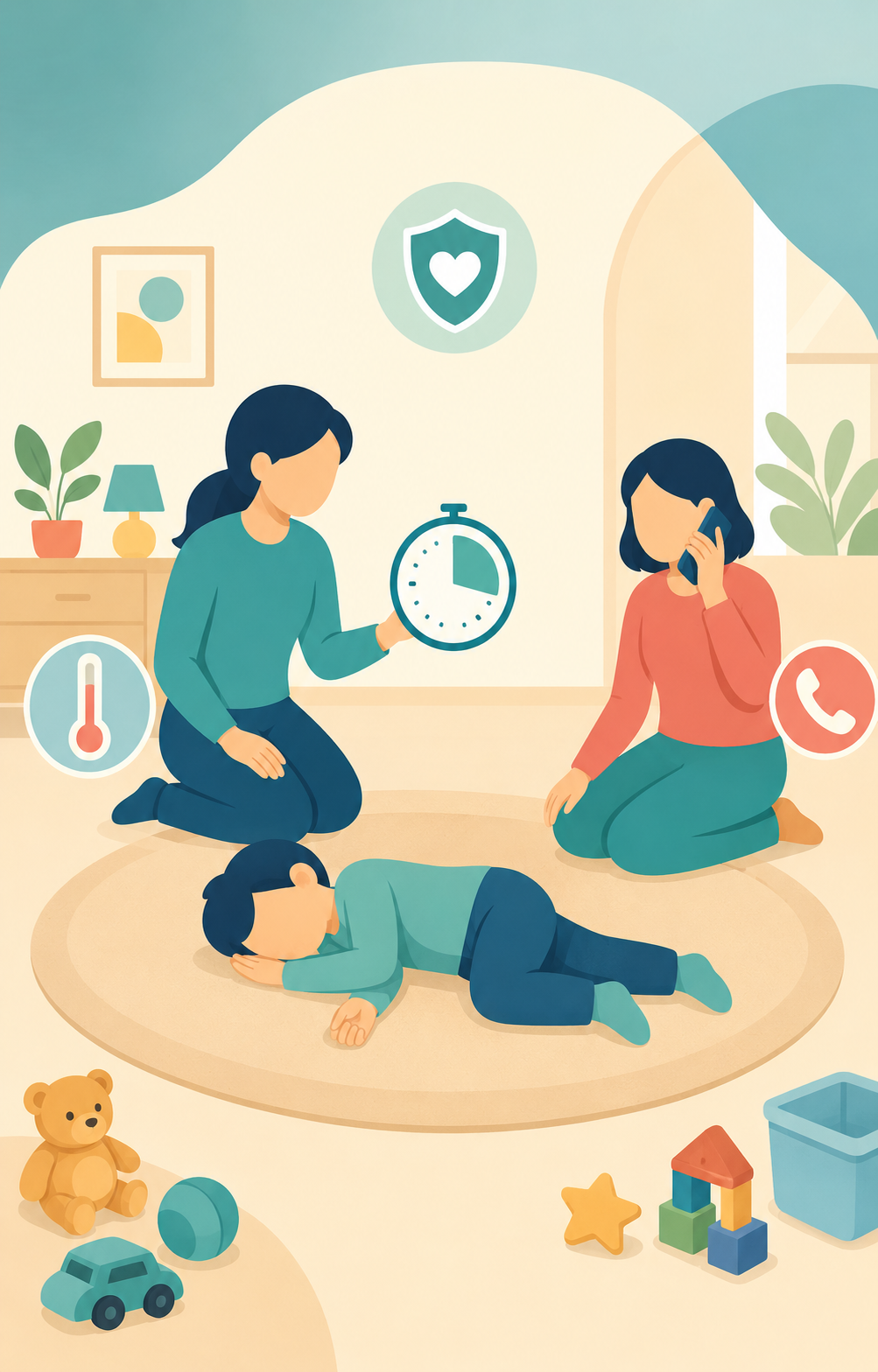

Learn how to respond safely when a child has a febrile seizure, what not to do, when to call 911, and how to care for the child afterward.
Watching a child have a seizure is terrifying. Their body may suddenly stiffen, their arms and legs may jerk, their eyes may roll upward, and they may stop responding. For a parent or caregiver, those few minutes can feel much longer than they really are.
A seizure that occurs during a fever may be a febrile seizure, also called a febrile convulsion. Most febrile seizures are brief and do not cause brain damage or lasting health problems. However, a first seizure must be medically evaluated because caregivers cannot safely assume that fever is the only cause.
During the seizure, the most important priorities are preventing injury, watching the child’s breathing, timing the episode, and knowing when to call emergency services. Trying to stop the movements, forcing something into the child’s mouth, or rapidly cooling the child can cause additional harm.
This guide explains what febrile seizures look like and how to respond calmly and safely.
What Is a Febrile Seizure?
A febrile seizure is a seizure associated with a fever in a young child who does not have a known central nervous system infection or another clear cause for the seizure.
Febrile seizures most commonly affect otherwise healthy children between about 6 months and 5 years of age. They often occur during the first day of an illness and may happen before a caregiver realizes that the child has a fever.
According to the American Academy of Pediatrics, febrile seizures occur in approximately three or four out of every 100 children and are especially common between 12 and 18 months of age. They can occur with relatively mild fevers as well as higher temperatures. HealthyChildren.org
Common triggers include viral respiratory infections, influenza, ear infections, roseola, and other illnesses that produce a fever. The seizure may happen as the temperature rises, but it is not always caused by the highest temperature reached during the illness.
A fever-related seizure does not automatically mean that a child has epilepsy. The International League Against Epilepsy notes that febrile seizures usually do not indicate epilepsy or require long-term antiseizure medication. ILAE
What Does a Febrile Seizure Look Like?
A febrile seizure may begin with the child suddenly becoming unresponsive. The child may fall if standing, become stiff, or develop rhythmic jerking movements.
Possible signs include:
- Stiffening of the arms, legs, or entire body
- Repeated jerking or twitching
- Eyes rolling upward or moving to one side
- Loss of consciousness or lack of response
- Changes in breathing or skin color
- Drooling or foaming at the mouth
- Vomiting
- Loss of bladder or bowel control
- Sleepiness or confusion after the seizure
Not every febrile seizure looks the same. Some are dramatic, while others may involve only brief stiffness, unusual eye movements, or reduced responsiveness.
Most febrile seizures end on their own within a few minutes. The child may then be sleepy, irritable, or confused. This recovery period is known as the postictal period.
Because other serious conditions can also cause seizures and fever, including meningitis, encephalitis, poisoning, low blood sugar, and electrolyte problems, a caregiver should not attempt to diagnose the episode at home.
What to Do During a Febrile Seizure
The goal of first aid is not to stop the seizure physically. Your job is to keep the child as safe as possible while monitoring the time and waiting for the seizure to end or for emergency help to arrive.
1. Place the Child in a Safe Area
Gently lower the child to the floor, bed, or another flat surface. Move furniture, toys, glass, hot drinks, and sharp or hard objects away.
If the child is near stairs, water, traffic, fire, or another immediate danger, move them only as far as necessary to reach safety. Otherwise, avoid carrying or repositioning the child unnecessarily.
Do not place the child on a high bed, changing table, or couch where they could roll off.
2. Protect the Child’s Head
Place something soft and flat under the child’s head, such as a folded jacket, towel, or thin pillow. You can also protect the head with your hands without holding it tightly.
Remove glasses if the child is wearing them. Loosen tight clothing around the neck, but do not completely undress the child during the seizure.
3. Turn the Head or Body to the Side
If it can be done safely, gently turn the child’s head to one side so saliva or vomit can drain from the mouth. After the jerking stops, place the child on their side in the recovery position while monitoring their breathing.
Do not force the child into a position while their muscles are stiff or actively jerking. The NHS recommends placing the child in the recovery position after the seizure and checking that nothing is interfering with breathing. NHS
4. Start Timing the Seizure
Look at a clock or start a timer immediately. Do not rely on your sense of time, since fear can make a short event seem much longer.
Record when the seizure started and stopped. A seizure lasting five minutes or longer is generally treated as a medical emergency because it may need medication to stop.
If another responsible adult is present, one person can monitor the child while the other calls for help. A short video may help the doctor understand what happened, but only record it if the child is already safe and doing so does not delay emergency care.
5. Stay With the Child
Do not leave the child alone. Watch their breathing, skin color, and movements. Speak calmly, although the child may not be able to hear or respond during the seizure.
If the seizure ends before emergency help arrives, continue observing the child. It is common to be sleepy afterward, but breathing should become regular and the child should gradually begin responding.
6. Call Emergency Services When Necessary
Call 911 or your local emergency number if the seizure reaches five minutes. Do not wait several additional minutes to see whether it will stop.
If the child has been prescribed a rescue medication for prolonged seizures, follow the individualized plan provided by the child’s doctor. Do not use another person’s medication or give an unprescribed drug.
7. Check Breathing After the Seizure
Breathing can look irregular during a seizure. Once the movements have stopped, check whether the child is breathing normally.
If the child is not breathing normally, call emergency services, begin CPR if you know how, and follow the dispatcher’s instructions. Do not begin chest compressions merely because the child is stiff or temporarily appears to hold their breath during active convulsions.
What Not to Do During a Febrile Seizure
Several traditional responses to seizures are ineffective and potentially dangerous.
Do Not Put Anything in the Child’s Mouth
Never insert a spoon, finger, cloth, wallet, medicine, or any other object between the child’s teeth. A child cannot swallow their tongue.
Placing an object in the mouth can break teeth, injure the jaw, block the airway, or cause the caregiver to be bitten. The American Academy of Pediatrics specifically advises against putting anything in a child’s mouth during a febrile seizure.
Do Not Restrain the Child
Do not hold the arms or legs down or attempt to stop the jerking. Restraint will not end the seizure and may cause muscle, joint, or bone injuries.
Instead, clear the surrounding space and protect the child from striking nearby objects.
Do Not Give Food, Water, or Oral Medicine
Do not give fever medicine, water, or food while the child is convulsing, unconscious, confused, or very sleepy. The child could choke or inhale the substance into their lungs.
Wait until the child is fully awake, swallowing normally, and a medical professional has advised you about appropriate care.
Do Not Use Cold Water, Ice, or Alcohol Rubs
Do not place the child in a cold bath, apply ice, or sponge them with cold water during a seizure. Rapid cooling does not stop the electrical activity causing the seizure and can create additional distress.
Alcohol rubs should never be used because alcohol can be absorbed through the skin or inhaled.
Do Not Shake or Slap the Child
The child is not choosing to be unresponsive. Shaking, shouting, or slapping will not stop the seizure and may cause injury.
When Should You Call 911?
Call 911 or the appropriate local emergency number immediately if:
- The seizure lasts five minutes or longer
- This is the child’s first seizure and the cause is unknown
- The child has trouble breathing after the seizure
- The child’s lips or face remain blue or gray
- Only one side or one part of the body is affected
- Another seizure begins before the child fully recovers
- The child has more than one seizure within 24 hours
- The seizure occurs in a child younger than 6 months
- The child does not gradually regain normal responsiveness
- The child has a stiff neck, severe headache, unusual rash, or repeated vomiting
- The child may have swallowed medicine, chemicals, or another toxic substance
- The seizure followed a head injury
- The child has a known serious medical condition
- You are unsure whether the child is safe
If the child is still convulsing or unconscious, call an ambulance rather than attempting to drive. Moving a seizing child into a vehicle can be unsafe, and a driver cannot provide care while traveling.
What to Do After the Seizure Stops
Keep the child on their side and allow them to rest while staying nearby. Speak softly and reassure them as they wake. They may be frightened, confused, or unable to remember what happened.
Check for injuries, especially if the child fell before the seizure. Note the child’s temperature and write down details for the doctor:
- How long the seizure lasted
- Whether the entire body or only one area moved
- Which side moved first
- Whether the child vomited
- Any breathing or color changes
- How quickly the child recovered
- Recent symptoms, medicines, illnesses, or vaccinations
Contact the child’s pediatrician immediately after the event. A first febrile seizure generally requires urgent medical evaluation to identify the source of the fever and rule out more serious causes.
The evaluation does not necessarily mean that the child will need brain imaging, an electroencephalogram, or a spinal tap. Testing depends on the child’s age, symptoms, examination, seizure pattern, and possible source of infection.
Caring for the Fever Afterward
Once the child is fully awake and can swallow safely, offer fluids to reduce the risk of dehydration. Dress the child comfortably without bundling them in heavy clothing or blankets.
Acetaminophen or ibuprofen may be recommended to relieve discomfort. Use the child’s current weight and follow the product label or pediatrician’s instructions. Do not give aspirin to children because of its association with Reye syndrome. Ibuprofen is not appropriate for every infant or child, so ask a clinician when uncertain.
Importantly, fever-reducing medicines can make a child more comfortable, but they do not reliably prevent another febrile seizure. The American Academy of Pediatrics states that acetaminophen and ibuprofen do not prevent febrile seizures. HealthyChildren.org
Avoid alternating medicines unless the child’s clinician provides a clear schedule. Medication errors can occur when caregivers use multiple products containing the same ingredient.
Simple and Complex Febrile Seizures
Doctors often describe febrile seizures as simple or complex.
A simple febrile seizure generally affects the whole body, ends within 15 minutes, and occurs only once in a 24-hour period. Most febrile seizures are simple.
A complex febrile seizure may last 15 minutes or longer, affect only one part or side of the body, or happen more than once within 24 hours. Complex seizures require closer medical evaluation and may lead to additional testing.
The five-minute emergency threshold is still important. Do not wait until 15 minutes to call for help. A seizure continuing for five minutes may require urgent treatment even though the medical classification of a complex febrile seizure uses a longer duration.
Can Febrile Seizures Be Prevented?
In many cases, no. A seizure may be the first noticeable sign of an illness, and it can happen before anyone knows the child has a fever.
Giving fever medicine at the first sign of warmth may improve comfort, but it cannot guarantee prevention. Febrile seizures are not evidence that a parent failed to recognize or treat a fever quickly enough.
Some children will experience another febrile seizure during a future illness, while many will never have a second one. Most children outgrow the tendency by school age. Simple febrile seizures usually do not cause brain damage, learning problems, paralysis, or death, and only a small number of affected children later develop epilepsy.
Children with prolonged or recurrent seizures may be prescribed a rescue medication. Parents, relatives, teachers, and childcare providers should receive hands-on instruction about when and how to use it.
Prepare a Febrile Seizure Action Plan
After a child’s first seizure, ask the pediatrician for a written action plan. It should include:
- When to call 911
- When to give prescribed rescue medicine
- The correct dose and administration method
- What to do if the medicine does not stop the seizure
- Which fever medicines are safe for the child
- Who should be notified after an episode
- Any special instructions for daycare or school
Keep the plan with the medication and share it with every regular caregiver. Consider taking a pediatric first-aid and CPR course so you can respond more confidently to future emergencies.
Staying Calm and Acting Safely
Most febrile seizures end quickly and do not cause lasting harm, but every seizure deserves careful attention. Place the child somewhere safe, protect their head, turn them to the side when possible, time the episode, and never put anything in their mouth. Call emergency services if the seizure lasts five minutes, breathing is abnormal, recovery is delayed, or anything about the event worries you.
Has your family ever received guidance about febrile seizure first aid, and which part of the response do you think caregivers are least prepared for? Share your thoughts or experience in the comments so other parents can feel better prepared.

Hi, I’m the creator and editor behind ZestyHabit. I research everyday safety, first aid, and practical wellness topics using official guidance and reliable public sources, then turn that information into clear, realistic steps for daily life.
My goal is to help readers make safer, better-informed choices at home and beyond.


