
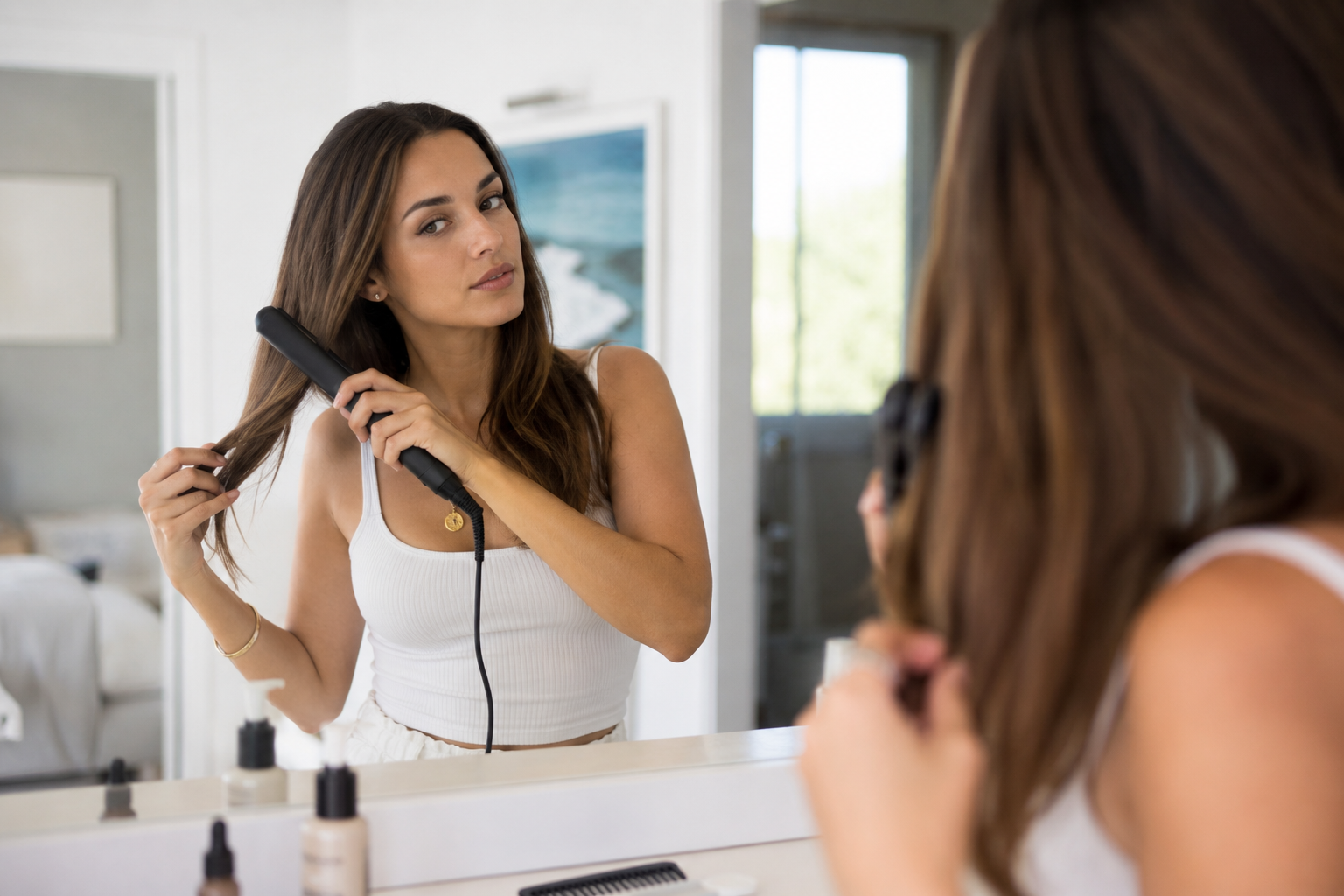

A curling iron has a very specific kind of power.
One minute your hair looks flat, tired, or confused. Ten minutes later, it has shape. Movement. Volume. That soft bend around the face that makes you feel slightly more put together, even if the rest of your life is running on iced coffee and unfinished errands.
So it makes sense that daily curling becomes a habit.
You curl your bangs. Then the front pieces. Then the ends look strange if you leave them alone, so you curl those too. Before you know it, the curling iron is part of your morning routine, sitting right next to your toothbrush and sunscreen like it pays rent.
But if you use heat every day, your hair eventually starts to tell you.
The ends feel rough. Your curls do not hold like they used to. Your hair looks frizzier after washing. The texture feels dry, stiff, or oddly uneven. Maybe your scalp feels more sensitive around the hairline from all the pulling and styling.
So, is curling your hair every day bad for your scalp and hair texture?
It can be, yes. Not because curling irons are evil, and not because one pretty hairstyle ruins your hair. But daily heat styling can slowly weaken the hair fiber, dry out the cuticle, increase breakage, and change the way your natural texture behaves. Your scalp can also get irritated if you are pulling, burning, using too much product, or styling too close to the roots.
The good news is that you do not have to break up with your curling iron completely.
You just need to stop treating your hair like it is heat-proof.
What Heat Actually Does to Hair
Hair looks simple, but it is not.
Each strand has layers. The outer layer, called the cuticle, acts a little like shingles on a roof. When the cuticle is smooth and healthy, hair looks shinier and feels softer. When it is damaged, lifted, or rough, hair looks dull, frizzy, dry, and more prone to tangling.
Heat changes the shape of the hair temporarily. That is why curling irons work. They break and reshape weak bonds inside the hair so the strand can hold a curl.
The problem is that high heat also removes moisture and can damage the cuticle over time. If you curl your hair every day, especially at high temperatures, your hair may gradually lose flexibility.
At first, you may not notice anything.
That is the tricky part.
Heat damage is usually not dramatic in one day. It builds quietly. Then suddenly your ends feel crunchy and your hair refuses to behave, and you think, “Wait, when did this happen?”
The answer is usually: slowly.
Very rude of hair, honestly.
Daily Curling Can Dry Out Your Hair

The most obvious effect of daily curling is dryness.
Heat pulls moisture from the hair. If you use a curling iron every day, your strands may become less able to hold hydration. The ends are usually the first place you notice it because they are the oldest and most fragile part of your hair.
Dry ends may feel rough, straw-like, or stiff. They may tangle more easily. They may look frizzy even after conditioner. They may also stop forming a clean curl and instead bend in strange, uneven directions.
This is especially common if your hair is already color-treated, bleached, permed, relaxed, naturally curly, or fine. Those hair types can be more vulnerable to heat damage.
And here is the annoying cycle: damaged hair often looks messier, so you curl it more to make it look polished. But curling it more causes more damage. Then it looks messier again.
A truly unfair loop.
Heat Damage Can Change Your Natural Texture
Daily curling can affect the way your hair behaves even when you are not styling it.
If you naturally have waves or curls, repeated heat can loosen the pattern. Some sections may stop curling properly. Others may turn frizzy instead of forming smooth waves. You might notice that the front pieces, which often get styled the most, become straighter, drier, or more fragile than the rest of your hair.
If you have straight hair, heat damage may show up differently. Your hair may look puffier, rougher, less shiny, or harder to smooth. It may not “swing” the same way. The texture can feel uneven, with healthy hair near the roots and rougher hair toward the ends.
This does not always mean your actual hair type has changed permanently. New hair growing from the scalp will still have your natural texture. But the damaged lengths can behave differently until they grow out or are trimmed.
That is why heat damage can feel so frustrating.
You are not just dealing with one bad hair day.
You are dealing with hair history.
The Front Pieces Usually Suffer First
Most people curl the front pieces more carefully than the back.
It makes sense. The front is what you see in the mirror. It frames your face. If those pieces look good, the whole hairstyle feels better. The back? Well, sometimes the back is between you and God.
But because the front pieces get the most attention, they often get the most heat damage.
Bangs, face-framing layers, and hair near the temples can become dry, broken, or frizzy from repeated curling. You may notice short pieces that will not lie flat, ends that look thin, or hair that feels rougher around the face.
This can also happen because people re-curl the front throughout the day. One curl falls, so you fix it. Then you fix it again before going out. Then again the next morning.
Those small repeated passes add up.
If one area of your hair looks more damaged than the rest, ask yourself whether that is the section you heat-style the most.
Usually, the answer is painfully obvious.
Can Curling Every Day Affect the Scalp?
The curling iron mainly damages the hair shaft, not the scalp, but the scalp can still be affected by daily styling habits.
If you curl too close to the roots, you risk burning the scalp. Even a small burn can make the area tender, red, flaky, or irritated. The hairline and temples are especially vulnerable because the skin there is delicate and you are often working close to the face.
Your scalp may also become irritated from styling products. Heat protectants, hairsprays, texture sprays, dry shampoos, mousse, and oils can build up near the roots. If you do not wash properly, buildup can cause itching, flakes, clogged follicles, or a greasy-but-dry feeling that makes no sense but somehow happens.
Then there is tension.
If you pull sections tightly while curling, clip hair aggressively, or wrap strands with too much force, your scalp can feel sore. This is more common if you style daily or if you have a sensitive scalp.
A curling iron should not make your scalp hurt.
If your head feels tender after styling, something in the routine needs to calm down.
The Temperature Matters More Than People Think
A lot of curling irons go up to very high temperatures, and it is tempting to use the hottest setting because it curls faster.
But faster is not always kinder.
Fine, fragile, bleached, damaged, or color-treated hair usually needs lower heat. Thick, coarse, or resistant hair may need more heat, but even then, “as hot as possible” is rarely necessary.
The goal is to use the lowest temperature that still gives you the result you want.
That sounds boring, but it matters.
If your hair curls at a lower temperature, there is no prize for using a hotter one. You are just giving your hair extra stress for no reason.
Also, do not hold the iron on the hair for too long. A few seconds is usually enough for many hair types. If you need to clamp the same section for a long time to get a curl, either the temperature, technique, section size, or product prep may be off.
Hair should not smell toasted after styling.
That scent is not “salon.”
That is your hair sending a complaint.
Heat Protectant Helps, But It Is Not Armor
Heat protectant is important.
It can reduce heat damage, help the iron glide more smoothly, and create a protective layer over the hair. If you curl your hair regularly, using heat protectant is not optional in my opinion. It is one of the easiest ways to lower the damage.
But heat protectant is not a magical shield.
It does not make your hair invincible. It does not mean you can use maximum heat every day and expect soft, healthy ends forever. Think of it like sunscreen for your hair styling routine. Helpful, necessary, but not permission to bake.
Apply it evenly before using heat. Let damp products dry fully before curling, unless the product specifically says it is for use with hot tools on dry hair.
Never use a curling iron on wet or damp hair unless it is specifically designed for that. Wet hair is more fragile, and direct heat can cause serious damage.
That sizzling sound? Absolutely not.
No hairstyle is worth that.
Product Buildup Can Make Hair Feel Worse
Daily curling often comes with daily styling products.
A little heat protectant. A little hairspray. Maybe dry shampoo. Maybe shine spray. Maybe texture spray because the curls fall too quickly. Maybe oil on the ends. Maybe more hairspray because the weather has chosen violence.
Individually, these products can be useful. Together, they can build up.
Buildup can make hair feel stiff, sticky, dull, greasy, or heavy. It can make curls look less soft and more crunchy. It can also make you think your hair is more damaged than it actually is, because coated hair often feels rough and strange.
On the scalp, buildup can cause itching or flakes. Some people mistake this for dandruff when it is really product residue or irritation.
If you style daily, make sure you are washing your hair well enough for your product use. That does not always mean washing every day, but it does mean your shampoo has to actually remove buildup.
Occasionally using a clarifying shampoo can help, especially if your hair feels heavy no matter what conditioner you use. Just do not overdo clarifying, because that can dry your hair out too.
Hair care is basically a lifelong balancing act with better packaging.
Why Your Curls Stop Holding
One strange thing about heat-damaged hair is that it may stop holding curls well.
You would think damaged hair would hold shape easily because it feels rougher. Sometimes it does. But often, damaged hair loses elasticity. It becomes dry and weak, so it cannot bounce or hold a smooth curl the way healthier hair can.
This leads to another frustrating cycle.
Your curls fall faster, so you use more heat.
Then your hair gets more damaged.
Then the curls fall even faster.
If your hair used to hold curls easily and now drops within an hour, heat damage, product buildup, dryness, or over-conditioning could all be involved.
Before raising the temperature, try improving the foundation: clarify gently, condition properly, use a lightweight heat protectant, curl smaller sections, let curls cool before brushing, and avoid touching them too much.
Sometimes the answer is technique, not more heat.
The Cooling Step Matters
When you curl your hair, the curl sets as it cools.
If you curl a section and immediately pull it, brush it, or run your fingers through it, the curl may fall faster. This makes people think they need more heat, when really they need to let the hair cool in the new shape.
After releasing a curl from the iron, let it sit for a while before styling it. You can even hold the curl in your palm for a few seconds or clip it up to cool if you want more hold.
This is not just about making curls last longer. It can also help you avoid repeated passes with the iron.
Fewer passes mean less damage.
And less damage means your hair may actually style better over time.
A rare win.
Daily Curling and Split Ends
Split ends are one of the most common signs of heat damage.
When the hair cuticle weakens, the ends can split, fray, or break. Once a hair strand splits, no product can truly glue it back together permanently. Some products can temporarily smooth the appearance, but the split is still there.
This is why trims matter.
I know trims can feel emotionally complicated, especially if you are trying to grow your hair. But damaged ends can travel upward if left alone. Keeping the ends neat can make the whole head of hair look healthier.
If you curl daily and your ends look thin, uneven, or rough, a trim may do more for your hair than another expensive mask.
Painful truth, but truth.
Can Hair Masks Repair Heat Damage?
Hair masks can help, but they have limits.
Moisturizing masks can make dry hair feel softer. Protein treatments can help strengthen weakened hair temporarily. Bond-building products may help improve the feel and resilience of chemically or heat-damaged hair.
But no mask can fully reverse severe heat damage.
Once the cuticle is badly damaged or the hair is split, the only real fix is time and trimming.
That does not mean masks are useless. They can absolutely improve manageability, softness, shine, and breakage resistance. They just cannot turn fried ends into brand-new hair.
Use them as support, not a miracle.
And if your hair feels stiff or brittle after protein treatments, do not keep adding more protein. Hair can get overloaded. Sometimes it needs moisture instead.
Yes, even hair care has drama.
How to Curl Your Hair With Less Damage
You can keep curling your hair and still be smarter about it.
Start with dry hair. Apply heat protectant evenly. Use the lowest effective temperature. Curl each section once instead of going over it repeatedly. Do not hold the iron on the hair too long. Let curls cool before brushing. Avoid curling the same front pieces multiple times a day.
Also, vary your style.
If you curl every single day, try taking heat-free days. Maybe loose waves from braids. Maybe a claw clip. Maybe a low bun. Maybe a heatless curling method. Maybe just accepting your natural texture one day a week and calling it confidence.
Your hair needs recovery time.
Not because it is weak.
Because it is hair, not metal wire.
Heatless Curling Options
Heatless curls can be surprisingly good once you find a method that works for your hair.
There are robe curls, sock curls, foam rollers, flexi rods, braids, buns, twist methods, and satin heatless curling rods. Some look ridiculous while you sleep, but the results can be worth it.
The trick is not to make the style too tight. Heatless does not automatically mean damage-free. If you wrap hair tightly, sleep with uncomfortable tension, or tie the ends with harsh elastics, you can still cause breakage.
Use soft materials. Keep tension gentle. Avoid doing it on soaking wet hair. Slightly damp hair often works better, depending on your texture.
Heatless methods can reduce daily curling iron use, which gives your hair a break while still letting you have shape.
And yes, you may look like a Victorian ghost at bedtime.
Beauty has its sacrifices.
How Often Is Too Often?
There is no single number that works for everyone.
Some people can curl their hair a few times a week with minimal issues because their hair is strong, they use low heat, and they protect it well. Others see damage quickly because their hair is fine, bleached, dry, or already fragile.
Daily curling is where risk increases.
If you curl every day and your hair still feels soft, shiny, elastic, and healthy, your routine may be working for now. But still be careful. Damage can creep up over time.
If your hair is dry, breaking, frizzy, dull, or not holding curls, daily heat may be too much.
A realistic goal might be reducing heat from seven days a week to three or four. Then add heatless styling or low-tension updos on the other days.
You do not need perfection.
You need fewer chances for damage to pile up.
When to Take a Heat Break
Your hair may need a break if you notice:
Ends feel rough or crunchy.
Hair tangles more than usual.
Curls do not hold.
Natural waves or curls look stretched or limp.
Hair breaks around the front pieces.
Split ends are increasing.
Hair looks dull even after washing.
Scalp feels tender after styling.
You smell burning while curling.
That last one is not a subtle sign. That is a red flag waving directly in your bathroom.
A heat break does not have to be forever. Even a week or two can help you understand your hair’s actual condition. During that time, focus on gentle cleansing, conditioning, masks if needed, and protective styles that do not pull too tightly.
Your hair may not transform overnight, but it can start feeling calmer.
Protecting Your Scalp While Styling
Most curling advice focuses on the hair, but the scalp matters too.
Do not place the iron too close to your scalp. Be especially careful around the hairline, ears, and nape of the neck. Use clips to separate sections instead of pulling hair aggressively. Avoid piling too much product directly on the roots unless it is meant for the scalp.
If your scalp burns or feels irritated after styling, give it a break from heat and heavy products. Wash gently. Avoid scratching. If you see blistering, severe redness, or pain that does not improve, get medical advice.
A healthy scalp is the foundation for healthy hair growth.
It is also attached to your head, which is reason enough to treat it kindly.
The Bottom Line
Curling your hair every day can affect both your scalp and hair texture.
Daily heat can dry out the hair, roughen the cuticle, increase frizz, cause breakage, create split ends, and make natural waves or curls look less defined over time. The front pieces and ends usually suffer first. Your scalp can also become irritated if you style too close to the roots, use too much product, or pull too tightly while curling.
But curling irons are not forbidden.
You can still enjoy styled hair. Just use heat protectant, lower the temperature, avoid repeated passes, let curls cool, clean product buildup, and give your hair regular heat-free days. Add moisture, trim damaged ends, and be honest when your hair starts showing signs of stress.
A good curl should make you feel better.
It should not cost you the health of your hair every single morning.

Hi, I’m the creator and editor behind ZestyHabit. I research everyday safety, first aid, and practical wellness topics using official guidance and reliable public sources, then turn that information into clear, realistic steps for daily life.
My goal is to help readers make safer, better-informed choices at home and beyond.


