
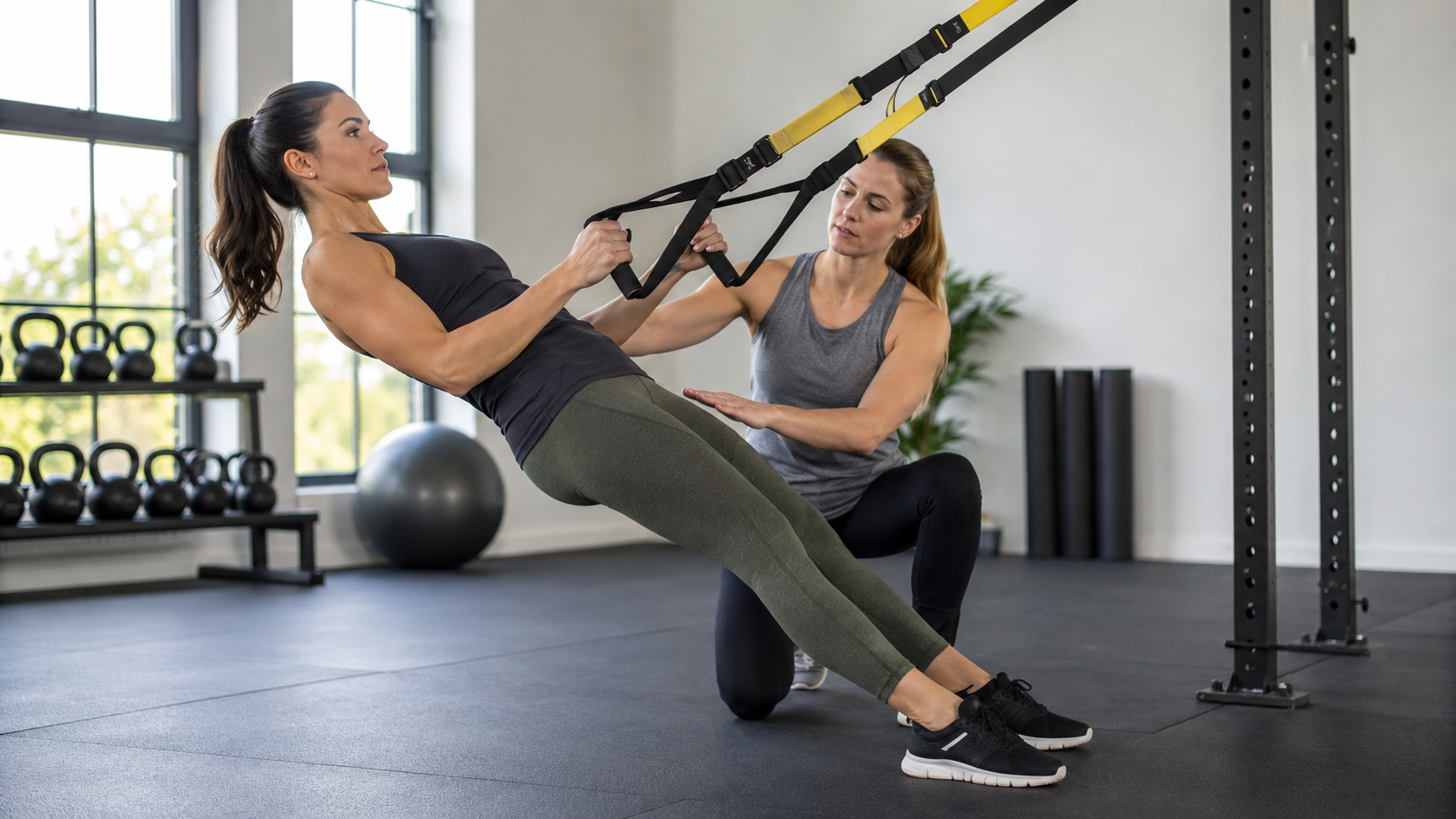

TRX workouts look simple at first glance. You have two straps, your body weight, and a few basic movements like rows, presses, planks, squats, and lunges. No heavy machines, no complicated setup, and no need for a huge training space.
But TRX training is not automatically easy just because the equipment is minimal.
Suspension training challenges your body in a different way. Your hands or feet are supported by straps that can move, swing, or shift if you lose control. That means your shoulders, core, hips, and stabilizing muscles have to work constantly to keep your body aligned. A movement that feels simple on the floor can become much harder once the straps are involved.
This is exactly what makes TRX training useful. It builds strength, balance, body awareness, and control. But it is also why poor setup, bad angles, rushed reps, or weak core control can irritate the shoulders, lower back, wrists, or neck.
The goal is not to avoid TRX training. The goal is to use it intelligently. With the right precautions, TRX can be a joint-friendly, effective workout for beginners and experienced exercisers alike.
Here is how to protect your shoulders and core during TRX workouts while getting the most out of each movement.
Why TRX Training Requires Extra Control
TRX exercises use your body weight as resistance. You change the difficulty by adjusting your body angle, foot position, strap length, or range of motion.
That sounds convenient, and it is. But it also means the challenge can change quickly. A small step forward or backward can make an exercise much harder. A slight loss of tension in the straps can change your shoulder position. A tired core can turn a strong plank into a sagging lower back.
Unlike fixed machines, TRX does not guide your path for you. Your body has to create the path.
This is why shoulder stability and core control matter so much. During rows, presses, flys, planks, mountain climbers, and pikes, the shoulders must stay organized while the core keeps the ribs, pelvis, and spine from collapsing out of position.
If you move too fast or choose an angle that is too difficult, the body often compensates. The shoulders shrug, the lower back arches, the neck tightens, or the hips drop. These small mistakes can create strain over time.
Check the Anchor Before Every Workout
Anchor security is the first TRX safety rule.
Before you start, make sure the straps are attached to a solid, stable anchor point. This might be a properly installed wall mount, a sturdy overhead beam, a secure gym rig, or a door anchor designed for suspension training.
Do not attach straps to weak furniture, unstable railings, lightweight doors, or anything that could shift, break, or tip. If the anchor fails during an exercise, you can fall suddenly and get hurt.
If you are using a door anchor, the door should close securely, and the anchor should be placed according to the product instructions. In many cases, the door should open away from you so your body weight pulls it closed rather than open. Check that nobody can open the door from the other side while you train.
Before each session, give the straps a firm pull. Look at the stitching, handles, buckles, carabiner, and anchor point. If anything looks worn, frayed, cracked, or loose, do not use it.
A safe workout starts before the first rep.
Start With an Easier Body Angle
One of the most common TRX mistakes is making the exercise too hard too soon.
With suspension training, your body angle controls intensity. The more horizontal your body becomes, the more challenging many exercises feel. For example, a TRX row is much easier when you stand more upright. It becomes harder as you walk your feet forward and lean back more.
Beginners often copy advanced angles they see online, then lose control after a few reps. The shoulders rise, the core collapses, and the movement becomes messy.
Start with a conservative angle. You should be able to complete the exercise with clean form, steady breathing, and controlled straps. If you cannot maintain alignment, step back and make the movement easier.
There is nothing wrong with a smaller angle. In fact, it is often the smarter choice. TRX works best when you can control the movement from start to finish.
Keep Tension in the Straps
TRX straps should usually stay under light tension during an exercise.
If the straps go slack, your body may suddenly drop or shift when tension returns. This can surprise the shoulders and make the movement less controlled. Slack straps often happen when you move too quickly, shorten the range too much, or lose awareness of your body position.
During rows, presses, and core movements, aim for smooth tension. The straps should feel connected to your movement. You do not need to yank them tight, but they should not be flopping around.
Keeping tension also helps you maintain better shoulder position. When the straps are steady, your muscles can stabilize more effectively.
If you notice the straps repeatedly going loose, slow down. Adjust your stance. Reduce the difficulty. Quality matters more than speed.
Protect Your Shoulders During Pulling Exercises
TRX rows are one of the most useful suspension exercises, but they need good shoulder mechanics.
During a row, avoid shrugging your shoulders toward your ears. Keep the neck relaxed and the shoulder blades moving back and down as you pull. Your elbows should bend naturally, and your chest should move toward the handles without the ribs flaring dramatically.
At the bottom of the row, do not let your shoulders dump forward aggressively. You can allow a controlled reach, but avoid hanging passively from the straps. Your shoulder joint should feel supported, not stretched under strain.
Think of the movement as pulling with your upper back, not just your arms. The shoulder blades should guide the motion.
If you feel pinching in the front of the shoulder, reduce the angle, shorten the range, or stop the exercise. Shoulder discomfort is not something to force through.
Be Careful With TRX Presses and Flys
TRX chest presses, push-ups, and fly variations can be challenging for the shoulders because the straps move independently.
A regular push-up already requires core and shoulder control. Adding straps increases the demand. If your hands drift too wide, your elbows flare, or your core sags, your shoulders may feel overloaded.
For TRX pressing, keep the handles under control and avoid letting the arms spread too far apart. Your elbows should not flare straight out to the sides. A slightly angled elbow position is usually more shoulder-friendly.
Flys are more advanced than they look. Because the arms move wide while the body is supported by the straps, the shoulders experience more stress. Beginners should usually build strength with rows, presses, planks, and controlled push-up variations before attempting deep fly movements.
If you do perform flys, keep the range small at first. Do not chase a deep stretch. The movement should feel controlled through the chest and shoulders, not like your shoulders are being pulled open.
Brace Your Core Without Holding Your Breath
Core control is central to TRX training.
Many TRX exercises are basically moving planks. Your body must stay aligned while your arms or legs move against the instability of the straps. If your core is not engaged, your lower back may arch, your ribs may flare, or your hips may sag.
A good core brace feels firm but breathable. You are not sucking in your stomach or holding your breath. You are gently tightening around the midsection as if preparing for a light push.
During planks, mountain climbers, pikes, body saws, and suspended lunges, pay attention to your ribs and pelvis. Your ribs should not pop forward. Your lower back should not dip. Your hips should not swing wildly.
If you cannot breathe normally while holding position, the exercise may be too hard. Make it easier by shortening the lever, changing your angle, or reducing the range of motion.
Avoid Sagging in TRX Planks
TRX plank variations are popular, but they can strain the lower back if done poorly.
When your feet are suspended in the straps, your body has to work harder to resist swinging and sagging. Many people start strong, then slowly lose position. The hips drop, the lower back arches, and the shoulders start to bear too much tension.
Before trying suspended planks, make sure you can hold a solid floor plank. If a regular plank is already difficult, start there first.
In a TRX plank, keep your body in a long line from head to heels. Press the floor away with your hands or forearms. Keep the glutes lightly engaged and the core firm. Avoid letting the head hang down or the shoulders collapse.
Short holds are better than long sloppy holds. Ten clean seconds are more useful than one minute of sagging.
Move Slowly and Control the Return
TRX exercises become safer and more effective when you control both directions of the movement.
Many people focus only on the pulling or pushing part, then let gravity take over on the way back. That can create sudden strain, especially around the shoulders and core.
In a row, lower yourself slowly instead of dropping back. In a press, return with control instead of falling forward. In a lunge, move smoothly instead of bouncing. In a core exercise, avoid swinging the legs.
A slower tempo helps you feel where your body is losing alignment. It also reduces momentum, which forces your muscles to do the work instead of relying on swinging.
If you need speed for a specific athletic drill, earn it after you can control the basic version. For general fitness, slow and steady is usually the safer choice.
Keep Your Wrists Neutral
Wrist position matters during TRX exercises.
The handles allow some freedom, which can be helpful, but it also means your wrists may bend awkwardly if you are not paying attention. Excessive bending can irritate the wrists and affect shoulder alignment.
Try to keep your wrists neutral, meaning the hand, wrist, and forearm stay mostly in one line. Do not let the wrists collapse backward during presses or twist excessively during rows.
Grip the handles firmly enough to feel secure, but do not squeeze so hard that your forearms and shoulders tense up. A relaxed but controlled grip usually works best.
If your wrists bother you during certain movements, adjust the handle angle, reduce difficulty, or choose a different exercise.
Warm Up the Shoulders and Core First
A good warm-up helps your body handle the instability of the straps.
Before starting TRX exercises, spend a few minutes raising your body temperature and activating the muscles you will use. This can include light cardio, arm circles, shoulder blade squeezes, band pull-aparts, wall slides, bodyweight squats, hip hinges, and floor planks.
For the shoulders, focus on gentle activation rather than aggressive stretching. You want the shoulder blades, rotator cuff, and upper back ready to stabilize.
For the core, practice simple bracing drills. Dead bugs, bird dogs, and short planks can help remind your body how to keep the ribs and pelvis controlled.
Your first TRX exercise should not be your hardest one. Ease into the session.
Do Not Let the Neck Take Over
Neck tension is common during TRX training, especially when the shoulders are tired.
If you find yourself clenching your jaw, lifting your shoulders, or poking your head forward, pause and reset. The neck should not be doing the work of the upper back and shoulders.
During rows, keep the back of the neck long. During planks, look slightly ahead of your hands or down at the floor depending on the position. Avoid craning your head upward.
A tense neck often means the exercise is too difficult, your shoulders are shrugging, or your breathing is restricted.
Relaxing the neck can improve the whole movement.
Choose Exercises That Match Your Level
TRX training is easy to modify, but that also means it is easy to overestimate your readiness.
Beginners should start with foundational exercises: assisted squats, rows, supported lunges, chest presses at an easy angle, standing core presses, and basic planks. These movements teach strap control, posture, and body alignment.
More advanced exercises, such as suspended push-ups, pikes, atomic push-ups, single-leg suspended movements, flys, and deep core rollouts, require more strength and stability.
Do not rush into advanced movements because they look impressive. The risk is not worth it if your form is not ready.
A good TRX workout should challenge you while still allowing clean reps. If you are shaking uncontrollably, losing alignment, or fighting the straps every second, scale back.
Watch Your Footing
Your feet create your base of support during many TRX exercises.
If your feet slip, your body angle can change suddenly. This may strain the shoulders, wrists, or lower back. Use a surface with good traction, and wear shoes that grip well if you are training on a smooth floor.
Pay attention to foot position. A wider stance usually provides more stability, while a narrow stance makes the exercise harder. Beginners often do better with a slightly wider stance until they learn control.
For lunges or single-leg movements, move slowly and keep the straps steady. Do not let the support from the straps trick you into taking a range of motion you cannot control.
Stop When Form Breaks Down
TRX training can fatigue stabilizing muscles quickly.
At first, you may feel fine. Then suddenly the straps start shaking, your shoulders rise, your core softens, and your reps become uneven. That is a good time to stop or rest.
Do not push far past the point of control. Suspension training rewards quality. Poor reps often shift stress into the joints instead of the muscles.
Use shorter sets if needed. For example, six controlled reps may be better than fifteen messy reps. Rest enough between sets so you can repeat good form.
Stopping early is not failure. It is smart training.
Pay Attention to Pain Signals
Muscle effort is normal. Joint pain is not something to ignore.
You may feel your core working, your upper back engaging, or your legs burning. That is expected. But sharp shoulder pain, pinching, numbness, tingling, wrist pain, lower back pain, or pain that changes your movement should be taken seriously.
If something hurts, stop the exercise. Adjust the angle, reduce the range, or choose a different movement. If pain continues, consider getting advice from a qualified trainer, physical therapist, or healthcare professional.
TRX exercises can be modified in many ways. There is rarely a reason to force one movement that does not feel right for your body.
Practical Takeaways for Safer TRX Workouts
TRX training can be a powerful way to build strength, stability, and body control, but it requires attention to setup and form.
Check the anchor before every session. Start with easier body angles. Keep tension in the straps. Protect your shoulders by avoiding shrugging, uncontrolled ranges, and deep flys before you are ready. Brace your core while continuing to breathe. Keep planks short and clean. Move slowly. Maintain neutral wrists. Warm up first. Choose exercises that match your level. Stop when your form breaks down.
The best TRX workouts do not feel wild or chaotic. They feel controlled, strong, and connected.
When your shoulders stay stable and your core supports your spine, suspension training becomes much more effective. You can challenge your body without letting the straps pull you out of position. That is the real value of TRX: not just making exercises harder, but teaching your body to stay strong under control.

Hi, I’m the creator and editor behind ZestyHabit. I research everyday safety, first aid, and practical wellness topics using official guidance and reliable public sources, then turn that information into clear, realistic steps for daily life.
My goal is to help readers make safer, better-informed choices at home and beyond.


