What Can Happen If You Keep Delaying Your Air Purifier Filter Change?
Minjin Park
·
An air purifier can only work well when its filter is clean enough to move air properly. Learn what can happen when filter replacement is delayed, how to spot warning signs, and simple habits that keep your purifier working better.
An air purifier is one of those appliances that quietly blends into the background.
You plug it in. It hums softly in the corner. Maybe a little light tells you the air quality is “good.” After a while, you stop thinking about it. It becomes part of the room, like a lamp or a fan.
Maybe the replacement filter feels too expensive. Maybe you are not sure which one to buy. Maybe the purifier still turns on, so it seems fine. Or maybe you think, “I’ll order one later,” and later turns into several weeks.
Delaying an air purifier filter change is common, but it can make the purifier less useful. A clogged, dusty, or old filter may move less air, trap fewer particles, create odors, strain the motor, and give you a false sense that your indoor air is being cleaned better than it really is.
This does not mean you need to panic the moment a filter reminder appears. But if the filter is clearly dirty or far past its recommended replacement window, the purifier may no longer be doing the job you bought it for.
Why the Filter Matters So Much
An air purifier is only as effective as the air that passes through it.
The filter is the part that captures dust, pollen, pet dander, smoke particles, lint, and other airborne particles depending on the model. Some purifiers also have activated carbon filters that help reduce certain odors and gases.
When the filter is new or properly maintained, air can flow through it more easily. The purifier pulls room air in, passes it through the filter, and pushes cleaner air back out.
But as the filter collects particles, it gradually fills up. That is normal. In fact, a dirty filter means it has been doing work. The problem begins when the filter becomes too loaded to function well.
At that point, the purifier may still sound like it is running, but its performance can drop.
What Happens When You Delay a Filter Change?
The Purifier May Move Less Air
A clogged filter makes it harder for air to pass through the machine. The purifier may still be on, but it may be moving less air through the filter.
That matters because air cleaning depends on circulation. If less air passes through the filter, fewer particles are removed from the room over time.
You may notice the room feels dustier, smells stale, or takes longer to feel fresh after cooking, cleaning, or opening windows. The purifier may also seem louder because the fan is working harder to pull air through a restricted filter.
Dust Can Build Up Faster Around the Room
One of the first practical signs of a neglected filter is dust.
You may see dust settling more quickly on shelves, TV stands, nightstands, electronics, window sills, or dark furniture. Of course, no air purifier removes all dust. Regular cleaning is still needed.
But if your purifier used to help reduce visible dust and now it does not seem to make much difference, the filter may be part of the problem.
This is especially noticeable in bedrooms, pet areas, home offices, and rooms with carpet or fabric furniture.
Odors May Linger Longer
If your air purifier has a carbon filter, it may help reduce certain everyday odors from cooking, pets, smoke, mustiness, or household smells.
But carbon filters do not last forever. Over time, they become less effective at absorbing odors. Once the carbon is used up, the purifier may keep blowing air while doing very little for smell.
A HEPA-style particle filter and a carbon filter do different jobs, so check your model. Some units require replacing both. Others have separate schedules.
The Purifier May Work Harder Than It Should
When airflow is blocked by a dirty filter, the fan motor may have to work harder.
That can lead to:
Louder operation
More heat from the unit
Reduced efficiency
Higher energy use
Shorter appliance lifespan
You may not notice this right away. The purifier may simply sound a little strained, run at higher speeds more often, or seem less smooth than before.
Like a vacuum with a full dust bin, it can still turn on while performing poorly.
The Filter Can Become a Source of Musty Smell
A filter that collects dust, pet hair, moisture, and household particles over time can start to smell unpleasant. This is more likely if the purifier is used in a humid room, near a bathroom, close to a kitchen, or in a space with poor ventilation.
A musty smell does not always mean mold, but it does mean the filter and machine need attention.
If the purifier smells worse when running than when it is off, stop and inspect it. A fresh filter and a cleaned pre-filter or outer grille may solve the problem.
You May Get a False Sense of Clean Air
This is one of the biggest issues.
An air purifier can look like it is helping simply because it is running. The fan is on. The lights are on. Air is coming out. That can make you feel like the room is being cleaned.
But if the filter is clogged, old, or the wrong type, the actual cleaning may be much weaker.
This matters most during high-particle situations, such as:
Wildfire smoke days
High pollen season
Heavy cooking smoke
Dusty home projects
Pet shedding season
After vacuuming or sweeping
When outdoor air quality is poor
In those moments, you want the purifier working properly, not just making noise in the corner.
Common Reasons People Delay Filter Changes
Replacement Filters Feel Expensive
Air purifier filters can be surprisingly pricey. Some people stretch the filter life because they do not want to keep buying replacements.
That is understandable. But stretching a filter too far can make the purifier less effective and may strain the unit.
A practical approach is to check filter costs before buying a purifier. Sometimes a cheaper machine has expensive filters, while a slightly more expensive model has more affordable replacements.
The Filter Still Looks “Fine”
Some filters do not look terrible even when they are past their best performance window. Others look dusty very quickly but still have some life left.
Appearance helps, but it should not be the only guide. Follow the manufacturer’s replacement schedule and adjust based on your home conditions.
A filter in a pet-heavy home, smoky environment, or dusty area may need changing sooner than one in a lightly used guest room.
The Filter Light Is Easy to Ignore
Many filter reminder lights are based on time or usage hours, not the actual dirt level. That means the light is useful, but not perfect.
Still, it should not be ignored forever. Treat it as a reminder to inspect the filter, check the manual, and decide whether replacement is due.
People Forget About Pre-Filters
Some air purifiers have a washable or vacuumable pre-filter that catches larger particles like hair, lint, and dust.
If the pre-filter is clogged, the main filter may not work as well. Cleaning the pre-filter can improve airflow and may help the main filter last closer to its expected lifespan.
Do not wash a HEPA filter unless the manufacturer specifically says it is washable. Many are not.
Warning Signs Your Air Purifier Filter Needs Attention
You do not need to guess. Your purifier often gives clues.
The Airflow Feels Weak
Put your hand near the outlet while the purifier is running. If the airflow seems much weaker than usual, the filter may be clogged or the intake may be blocked.
Also check that the purifier is not pushed against a wall, curtain, furniture, or pile of laundry.
The Unit Sounds Louder Than Before
A purifier that suddenly sounds strained, rattly, or louder may be struggling with airflow. Dust buildup can also affect fan noise.
The Room Smells Dusty or Musty
If the purifier gives off a stale odor, inspect the filter and clean the exterior vents.
Dust Collects on the Intake Grille
Dust on the intake area is normal, but heavy buildup means the purifier needs cleaning. If the outside is dusty, the inside may be too.
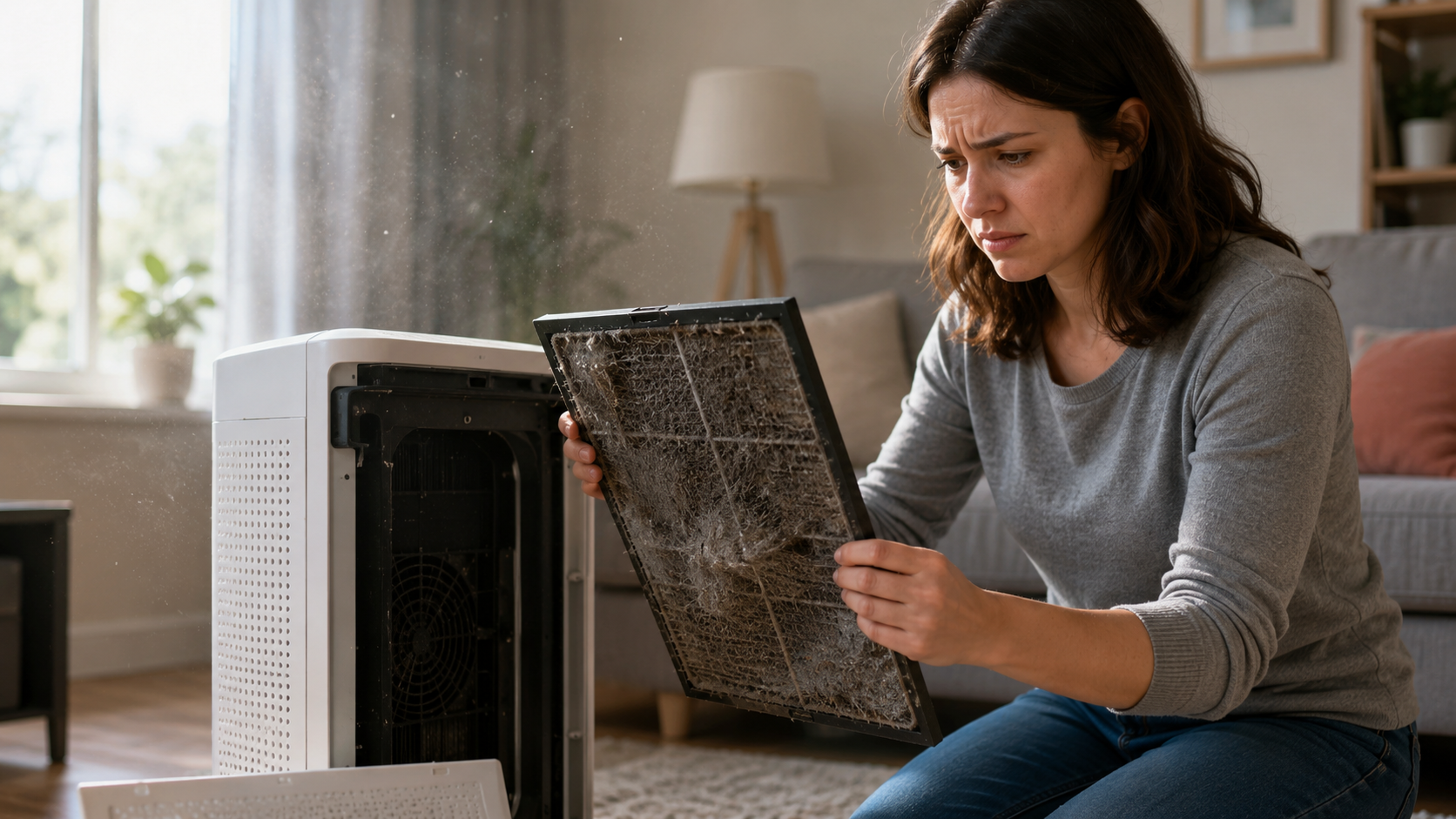
The Filter Looks Dark, Matted, or Packed
A filter covered with thick dust, pet hair, or gray buildup is ready for replacement or cleaning, depending on the type.
Allergy-Like Irritation Seems Worse Indoors
This is not a medical diagnosis, but if you notice more sneezing, scratchy throat, itchy eyes, or stuffiness in a room where the purifier used to help, the filter may be overdue.
The Filter Indicator Light Is On
Do not panic, but do not ignore it for months. Use it as your cue to check the filter and the manual.
How Often Should You Replace an Air Purifier Filter?
There is no single schedule that fits every purifier or every home.
Some filters need replacement every few months. Others last six months, nine months, or a year. Carbon filters may need replacement more often than particle filters. Pre-filters may need cleaning every couple of weeks or monthly.
Your best guide is the manufacturer’s instructions for your specific model.
But your home conditions matter too. You may need more frequent filter care if you have:
Pets
Smokers in or near the home
Wildfire smoke exposure
High pollen levels
Dusty roads nearby
Recent renovation or sanding work
Frequent cooking smoke
A humid or musty room
Heavy daily use
On the other hand, a purifier used occasionally in a clean guest room may not need replacement as often as one running 24/7 in a bedroom with two dogs.
The Difference Between Cleaning and Replacing
This is where people get into trouble.
Some purifier parts can be cleaned. Some cannot.
Pre-Filters
Pre-filters often catch large particles. Many can be vacuumed or rinsed, but only if the manual says so. Let washable parts dry completely before reinstalling.
HEPA or Main Particle Filters
Many HEPA filters are not washable. Washing them can damage the fibers and reduce effectiveness, even if they look cleaner afterward.
If the manual says replace, replace.
Carbon Filters
Activated carbon filters generally need replacement once they stop controlling odors well. Vacuuming the surface will not restore the carbon’s odor-absorbing ability.
Exterior Grilles and Sensors
The outside intake grille, outlet, and sensors may collect dust. These can often be wiped gently or vacuumed according to the manual.
Keeping the outside clean helps airflow and sensor accuracy.
Common Mistakes That Reduce Air Purifier Performance
Running the Purifier With a Dirty Filter
This is the main one. The purifier may still run, but the cleaning power can drop.
Buying the Wrong Replacement Filter
Filters often look similar but are not interchangeable. A filter that does not fit correctly can allow air to bypass it, which defeats the point.
Use the correct model number.
Leaving the Plastic Wrap on a New Filter
This happens more often than people admit. Many replacement filters come sealed in plastic. If the plastic is not removed, the purifier cannot work properly.
If your purifier seems weak right after a filter change, check this first.
Blocking the Intake or Outlet
A purifier needs open space. Do not place it tightly against curtains, walls, furniture, bedding, or under a desk where airflow is blocked.
Using One Small Purifier for a Large Room
Even with a fresh filter, a small purifier may not be enough for a big room. Match the unit to the room size and keep doors open or closed depending on how you want air to circulate.
Forgetting About Humidity
Air purifiers are not dehumidifiers. If a room smells musty because humidity is too high, changing the filter may help odor a little, but it will not solve the moisture problem.
High humidity can also make filters smell worse over time.
Practical Filter Replacement Routine
A simple routine makes filter care less annoying.
Step 1: Check the Manual
Find the recommended schedule for your model. Take a photo of the filter number so you can reorder easily.
Step 2: Set a Calendar Reminder
Do not rely on memory. Set a reminder for inspection and another for likely replacement.
For example:
Check pre-filter monthly.
Inspect main filter every three months.
Replace according to manual or sooner if needed.
Step 3: Keep One Spare Filter
If you can, keep one replacement filter at home. That way, when the light turns on or the filter looks bad, you do not have to wait for shipping.
Step 4: Clean the Exterior Regularly
Wipe dust from the outside vents and vacuum the intake grille gently if recommended.
Step 5: Reset the Filter Indicator
After changing the filter, reset the indicator according to the manual. Otherwise, the light may stay on and confuse you later.
Step 6: Write the Date on the Filter
Use a marker or small label to write the installation date on the filter frame if there is a safe place to do so. This makes it easier to track real use.
When You Should Replace the Filter Sooner
Sometimes the normal schedule is not enough.
Replace or inspect sooner after:
Wildfire smoke exposure
Heavy renovation dust
A nearby construction project
A pest issue
A water leak or musty room problem
Heavy pet shedding
Smoke from cooking mishaps
Strong odors that do not clear
Visible dust loading on the filter
The purifier has been running nonstop for weeks
Think of the filter like a sponge. If it has been through a lot, it may fill up faster.
Air Purifiers Are Helpful, But Not Magic
It is also important to set realistic expectations.
An air purifier can reduce airborne particles in a room, but it cannot replace basic source control. You still need to clean dust, vacuum, ventilate when outdoor air is good, control moisture, change HVAC filters, avoid indoor smoke, and reduce clutter that traps dust.
A purifier with an old filter is even less magical.
The best results come from combining habits:
Use the right size purifier.
Place it where air can circulate.
Keep doors and windows managed based on outdoor air quality.
Vacuum and dust regularly.
Control humidity.
Replace filters on schedule.
That is how the purifier becomes part of a healthier home routine instead of a forgotten appliance.
A Quick Filter Check You Can Do Today
Walk over to your air purifier and look at it for one minute.
Ask:
Is the filter light on?
Is the airflow strong?
Does it smell clean when running?
Is the intake grille dusty?
Is the unit blocked by furniture or curtains?
Do I know when the filter was last changed?
Do I have the right replacement filter?
Is the room still dusty even when it runs?
If you cannot remember the last filter change, that is your clue to check.
Final Thoughts: A Clean Filter Helps the Purifier Do Its Job
Delaying an air purifier filter change may not seem like a big deal at first. The machine still turns on. The fan still hums. The lights may still glow.
But inside, the filter may be packed with dust, pollen, pet dander, smoke particles, and everyday debris. Once it is overloaded, the purifier may move less air, reduce fewer particles, smell stale, run louder, and work harder than it should.
The fix is not complicated. Follow your model’s replacement schedule, clean the pre-filter if it has one, keep the intake clear, and check the filter more often during heavy use.
An air purifier is only useful when air can actually pass through a clean enough filter.
A few minutes of maintenance can help the room feel fresher, protect the appliance, and make sure the purifier is doing more than just making background noise.
Hi, I’m the creator and editor behind ZestyHabit. I research everyday safety, first aid, and practical wellness topics using official guidance and reliable public sources, then turn that information into clear, realistic steps for daily life.
My goal is to help readers make safer, better-informed choices at home and beyond.
[…] is especially risky when the color change keeps happening, cannot be clearly linked to a food or medication, or appears along with other symptoms like […]
Loading…
Discover more from
Subscribe now to keep reading and get access to the full archive.



[…] a month, check HVAC filters, air purifier filters, pet beds, and rarely cleaned […]
[…] is especially risky when the color change keeps happening, cannot be clearly linked to a food or medication, or appears along with other symptoms like […]