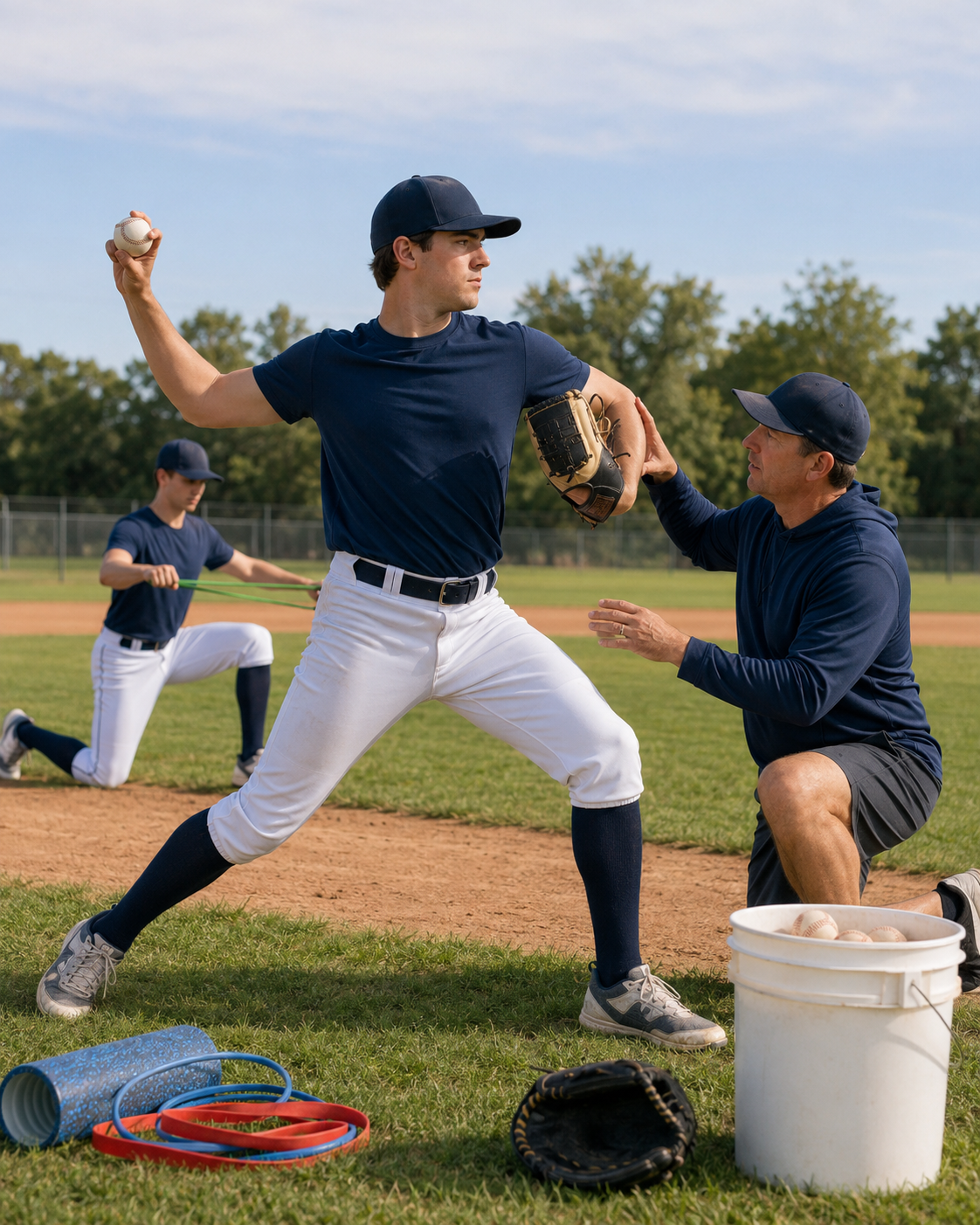
Baseball Precautions: How to Avoid Shoulder and Elbow Strain
Minjin Park
·
Baseball throwing can be tough on the shoulder and elbow. Learn practical warm-up habits, throwing volume precautions, recovery tips, and arm-care basics to reduce strain.
Baseball can look simple from the outside. A player throws, catches, swings, runs, and repeats. But anyone who has played the sport knows that throwing is not a casual movement. It is fast, explosive, and highly repetitive.
The shoulder and elbow do a lot of work in baseball, especially for pitchers, catchers, infielders, and outfielders who make repeated throws during practice and games. Even young recreational players can feel arm soreness if they throw too much, warm up poorly, or try to force speed before their body is ready.
That does not mean baseball is dangerous by nature. It means players need to treat throwing like a skill and a physical load, not just something they can do endlessly.
A healthy throwing arm depends on preparation, gradual volume, good mechanics, shoulder mobility, core strength, rest, and listening to early warning signs. The American Academy of Orthopaedic Surgeons recommends warming up before baseball activity and notes that shoulder and elbow injuries are common concerns in the sport.
This guide is not only for pitchers. Even if you play casually, coach kids, or join weekend games with friends, these baseball precautions can help protect your shoulder and elbow from unnecessary strain.
Throwing a baseball is one of the fastest movements in sports. The arm moves through a large range of motion, the shoulder rotates quickly, and the elbow experiences stress as the ball is accelerated and released.
The shoulder is naturally mobile, which is helpful for throwing. But that mobility also means it needs good control from the surrounding muscles. The rotator cuff, shoulder blade muscles, upper back, chest, core, hips, and legs all contribute to a smooth throw.
The elbow, meanwhile, has to handle force as the arm whips forward. When mechanics are poor or the player is fatigued, the elbow can take more stress than it should.
This is why throwing injuries are rarely about one body part alone. A sore elbow may be related to poor shoulder control. Shoulder discomfort may be connected to weak core stability. Arm fatigue may come from throwing too many high-effort balls without enough recovery.
Baseball throwing is a chain. When one link is weak, stiff, or tired, another link often compensates.
Throwing Volume Matters More Than You Think
One of the biggest mistakes in baseball is assuming that more throwing always equals better performance.
Practice matters, of course. But throwing volume must be managed carefully. Too much throwing, too soon, too often, or too hard can overload the shoulder and elbow.
This is especially important for pitchers. Pitch counts exist because fatigue changes mechanics and increases stress. MLB’s Pitch Smart program states that workload limits help reduce the likelihood of pitching with fatigue, and that pitch counts are one of the most practical tools for managing that workload.
But even non-pitchers should pay attention to total throws. Warm-up throws, practice throws, long toss, fielding drills, bullpen sessions, and game throws all add up.
A player may think, “I only pitched three innings,” but that does not include the throws before the game, between innings, during practice, or while playing another position.
For young players, this matters even more because growing bodies are more vulnerable to overuse. USA Baseball’s Pitch Smart program provides age-based guidelines designed to help players, parents, and coaches reduce overuse injuries and support long-term throwing health.
A simple rule is this: do not count only the obvious throws. Count the stressful ones too.
The first throw of the day should not be a hard throw across the field. Your shoulder, elbow, trunk, hips, and legs need time to prepare for speed and force.
Start with general movement. Jog lightly, skip, do jumping jacks, or move through dynamic warm-up drills. The goal is to increase blood flow and raise body temperature.
Then move into baseball-specific preparation. Do arm circles, shoulder blade squeezes, trunk rotations, hip openers, and gentle throwing progressions. Start close, throw lightly, and slowly increase distance and intensity.
Do not rush this part.
A good throwing warm-up usually moves from easy to moderate to game-like. It should not jump from standing still to maximum effort.
The AAOS also recommends warming up before baseball or softball activity, including light running and gentle stretching, especially for areas such as the shoulders.
Think of warming up as turning on the whole throwing system, not just loosening the arm.
Do Not Stretch Aggressively Right Before Throwing
Stretching can be useful, but timing and intensity matter.
Before throwing, dynamic mobility is usually better than long, aggressive static stretching. You want your body to feel warm, active, and responsive. Holding intense stretches for a long time right before throwing may leave some players feeling loose but less powerful or less controlled.
Instead, use controlled movements:
Arm circles. Shoulder taps. Band pull-aparts. Trunk rotations. Walking lunges. Light medicine-ball movements, if appropriate. Easy progressive throws.
Save longer static stretching for after practice or separate mobility sessions, especially if you are working on long-term flexibility.
The key is not to force your shoulder into extreme positions. The shoulder already moves through a large range during throwing. Before practice, it needs controlled readiness, not aggressive pulling.
Build Throwing Intensity Gradually
Throwing intensity matters just as much as throwing count.
A short, easy toss is not the same as a full-effort throw from the outfield. A bullpen fastball is not the same as casually playing catch. Long toss, high-velocity pitching, and repeated maximum-effort throws create more stress.
Many arm problems begin when players increase intensity too quickly. This can happen at the start of a season, after a break, after illness, or after trying to “get ready fast” for a tournament.
Your body needs time to adapt.
If you have not thrown hard in a while, start with light catch sessions. Then slowly add distance, volume, and intensity over days or weeks. Avoid suddenly throwing 100 percent because you feel excited or because someone is watching.
This is also important for adults who played baseball in the past and decide to join a weekend game. Your brain may remember how to throw hard, but your shoulder and elbow may not be conditioned for it anymore.
Respect the ramp-up period.
Watch for Fatigue Before Pain Starts
Pain is not the only warning sign. Fatigue often comes first.
When a player gets tired, throwing mechanics may change. The arm may drag behind the body. The elbow may drop. The player may open the front side too early. Throws may become less accurate. The shoulder may feel heavy. The player may start using more arm and less lower body.
These are signs to slow down or stop.
Do not wait until pain appears. By the time a player says, “My elbow hurts,” the arm may already have been overloaded for a while.
Coaches and parents should watch for changes in body language, accuracy, velocity, and recovery between throws. Players should also learn to speak up early.
A tired arm is not a badge of honor. It is information.
Take Elbow Pain Seriously
Elbow pain in baseball should not be ignored, especially in young throwers.
The elbow handles significant stress during pitching and hard throwing. Continuing to throw on a painful elbow can make a mild problem worse. For youth players, there are also growth plate concerns that should be assessed properly.
A review on youth baseball elbow injury prevention notes that safety rules, education, recommendations, and common-sense precautions can help prevent some elbow injuries in young pitchers.
If elbow pain keeps coming back or affects throwing, stop throwing and get evaluated by a qualified medical professional.
Protect the Shoulder With Better Shoulder Blade Control
Many players think shoulder care means only strengthening the rotator cuff. That is part of it, but shoulder blade control is just as important.
The shoulder blade, or scapula, gives the shoulder a stable base. If the shoulder blade does not move well, the throwing arm may have to work harder. This can lead to irritation, tightness, or poor mechanics.
Helpful exercises often include band rows, band external rotations, wall slides, serratus punches, and controlled Y-T-W movements.
Good shoulder care should include the muscles around the shoulder blade, upper back, and rotator cuff. Titleist Performance Institute, while golf-focused, also highlights the importance of scapular stability and shoulder mobility for efficient upper-body movement, and the same general principle applies to throwing sports.
For baseball players, a simple band routine done consistently can be more valuable than occasional heavy training.
Use the Whole Body, Not Just the Arm
Throwing should not be an arm-only movement.
A strong, efficient throw uses the legs, hips, core, trunk, shoulder, arm, and hand. When the lower body and core do not contribute well, the shoulder and elbow may absorb more stress.
This is why baseball arm care should also include lower-body and core training.
Glute strength, hip mobility, trunk rotation, balance, and single-leg control all matter. A player who cannot control the body during the stride and follow-through may put more stress on the arm.
Simple exercises like lunges, step-ups, glute bridges, side planks, dead bugs, bird dogs, and medicine-ball rotational drills can support better throwing mechanics.
You do not need to train like a professional athlete to benefit. Even basic strength and control work can help the body share the load more evenly.
Do Not Chase Velocity Too Early
Throwing harder is exciting. Many players want more speed, especially pitchers.
But chasing velocity before the body is ready can increase risk. Maximum-effort throwing places high stress on the shoulder and elbow. If a player lacks strength, mobility, mechanics, or recovery, trying to throw harder may create problems.
A recent MLB injury study identified rising velocity, pitch shaping, and maximum-effort pitching as likely contributors to the increase in pitcher injuries, with the trend also affecting younger levels because players want to get noticed.
This does not mean players should never train for velocity. It means velocity should be built carefully.
Good velocity development includes mechanics, strength, mobility, recovery, gradual workload, and supervision. It should not be reduced to “throw as hard as possible every day.”
For younger players especially, control, command, movement quality, and healthy development should come before radar-gun numbers.
Be Careful With Year-Round Baseball
Playing baseball all year may sound like dedication, but the throwing arm needs breaks.
Year-round throwing can increase the risk of overuse because the shoulder and elbow never get a proper recovery period. This is especially concerning for young players who are still growing.
An offseason does not mean doing nothing. It means giving the arm a break from competitive throwing while building general strength, mobility, and athleticism.
Players can work on conditioning, lower-body strength, core control, speed, coordination, and general movement skills. They can also play other sports or do non-throwing activities.
Rest is not wasted time. It is part of development.
The goal is not to throw forever without stopping. The goal is to keep throwing well for years.
Catchers Need Arm Care Too
Pitchers get most of the attention, but catchers also throw a lot.
A catcher may make many throws back to the pitcher, throw to bases, warm up pitchers, and practice pop throws. These throws can be quick, repetitive, and sometimes overlooked when tracking volume.
Catchers also spend long periods in a crouched position, which can affect hips, back, and throwing mechanics.
If a young player pitches and catches, adults should be especially careful. Both roles can place significant load on the throwing arm.
Catchers should warm up properly, track total throwing, strengthen the shoulder and core, and avoid making unnecessary hard throws during practice.
Every throw counts, even when it does not show up in the pitch count.
Practice Good Recovery Habits
Recovery is not complicated, but it is often ignored.
After throwing, cool down. Do easy movement, gentle stretching, and light band work if it feels good. Hydrate. Eat enough to support training. Sleep matters too, especially for young athletes.
Some players use ice after throwing, especially if recommended by a trainer or medical professional. Nationwide Children’s Hospital notes that young pitchers should rest based on age-related pitch count guidelines and mentions icing the shoulder and elbow after throwing as one recovery approach.
However, recovery should not be used as permission to overload the arm. Ice, stretching, or massage cannot fully erase poor workload management.
The best recovery strategy begins before pain starts: reasonable volume, good warm-up, and enough rest between high-intensity throwing days.
Know When to Stop Throwing
Players often want to keep going. They do not want to seem weak, disappoint the team, or lose their position.
But stopping early can prevent a small problem from becoming a long-term one.
Stop throwing if you feel sharp pain, elbow pain, shoulder pain that changes your mechanics, numbness, tingling, sudden weakness, loss of control, or pain that gets worse as you continue.
Also stop if your arm feels unusually heavy, dead, or difficult to control.
A tired or painful arm is not something to prove yourself against. It is a signal to protect your future playing time.
Coaches should create a team culture where players can speak honestly about arm discomfort. A player should not feel punished for reporting pain.
A Simple Baseball Arm-Care Routine
A practical arm-care routine does not have to take an hour.
Before practice, do five to ten minutes of general warm-up, followed by dynamic shoulder, trunk, and hip mobility. Then begin throwing slowly and gradually increase distance and effort.
During practice, avoid unnecessary maximum-effort throws. Track total throwing, not just official pitches. Pay attention to fatigue and mechanics.
After practice, cool down with easy movement, gentle stretching, and light recovery work. Make sure there is enough rest before the next hard throwing session.
Between practices, build strength in the rotator cuff, shoulder blade muscles, core, hips, and legs. Keep the work controlled and consistent.
This routine may sound simple, but simple routines are often the ones players actually follow.
Final Thoughts
Baseball rewards repetition, but the arm has limits. Shoulder and elbow strain often comes from doing too much, too fast, too hard, or too often without enough preparation and recovery.
The best baseball precautions are not dramatic. Warm up before throwing hard. Increase volume gradually. Respect pitch counts and rest days. Strengthen the shoulder, core, hips, and legs. Watch for fatigue. Stop when pain appears.
A healthy throwing arm is built through patience.
Whether you are a pitcher, catcher, infielder, outfielder, coach, parent, or casual player, the goal is the same: throw well, recover well, and keep enjoying the game without turning every practice into an arm-risk test.
Baseball should challenge your skills, not punish your shoulder and elbow.
Hi, I’m the creator and editor behind ZestyHabit. I research everyday safety, first aid, and practical wellness topics using official guidance and reliable public sources, then turn that information into clear, realistic steps for daily life.
My goal is to help readers make safer, better-informed choices at home and beyond.