
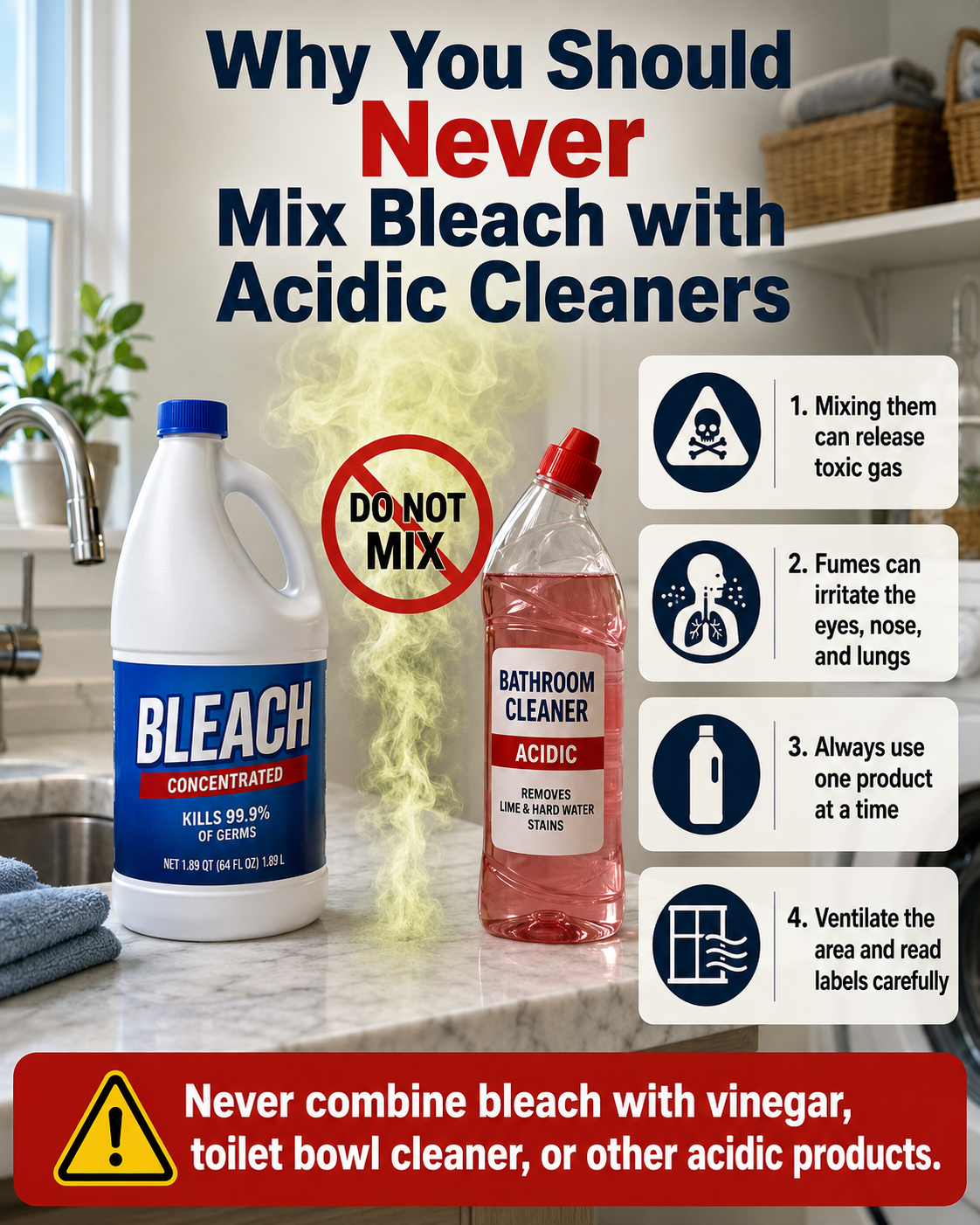

Mixing bleach with acidic cleaners can release irritating and potentially dangerous fumes. Learn which products to avoid combining, common cleaning mistakes, warning signs, and safer household habits.
The Cleaning Shortcut That Can Backfire
Most of us have had a moment where a sink, toilet, shower, or kitchen surface looks so dirty that one cleaner does not feel like enough.
Maybe you spray a bathroom cleaner first, then think, “I’ll add a little bleach to really disinfect it.” Or you pour bleach into a toilet bowl after using a limescale remover. Or you clean a mildew-stained shower with bleach, then follow up with vinegar to remove hard water spots.
It feels like stronger cleaning.
But with bleach, mixing products is one of the most important things not to do.
Household bleach should never be mixed with acidic cleaners. That includes vinegar, toilet bowl cleaners, rust removers, lime and scale removers, some bathroom sprays, and other products that contain acids. When bleach and acids are combined, they can release chlorine gas and other irritating fumes.
This does not mean you need to be afraid of cleaning. Bleach can be useful when used correctly. Acidic cleaners can also be useful for mineral deposits, soap scum, rust stains, and hard water marks. The issue is using them together, one after another without rinsing, or in a small poorly ventilated space.
A safer habit is simple: use one product at a time, read the label, rinse between different cleaners, and never “boost” bleach with another chemical.
Why Bleach and Acidic Cleaners Do Not Belong Together
Household bleach usually contains sodium hypochlorite. It is a strong cleaning and disinfecting product when diluted and used as directed.
Acidic cleaners are a different category. They are often used to dissolve mineral buildup, hard water stains, rust, and soap scum. Common acidic cleaning ingredients may include vinegar, citric acid, hydrochloric acid, sulfamic acid, phosphoric acid, or other acid-based formulas.
When bleach meets acid, the chemistry can shift in a dangerous direction. Instead of simply making the surface cleaner, the mixture may release chlorine gas.
Chlorine gas can irritate the eyes, throat, nose, and lungs. Even lower-level exposure can feel sharp, uncomfortable, and alarming. In a small bathroom or laundry room, fumes can build quickly.
The big problem is that this can happen during very ordinary cleaning.
You do not need to pour a whole bottle of one product into another. Sometimes the mistake is residue left behind on a surface, inside a toilet bowl, in a drain, or on a sponge.
Common Acidic Cleaners People Accidentally Mix with Bleach
Vinegar
Vinegar is often treated as a harmless “natural” cleaner, and it can be useful for some light cleaning tasks. But vinegar is still acidic.
Bleach and vinegar should not be mixed.
This mistake often happens in bathrooms, kitchens, laundry areas, and drains. Someone uses vinegar for odors, mineral spots, or “natural cleaning,” then adds bleach for disinfecting or whitening.
Natural does not automatically mean safe to combine.
Toilet bowl cleaners
Many toilet bowl cleaners are acidic because they are designed to remove mineral stains and buildup.
This is one of the most common risky combinations. A person pours toilet cleaner into the bowl, scrubs, and then adds bleach because the stain is still there. Or they use a bleach cleaner first, then follow with a strong toilet descaler.
Toilet bowls are small spaces where chemicals can sit together and release fumes close to your face. Use one product at a time and follow the label.
Lime, calcium, and rust removers
Products made to remove hard water deposits, lime scale, calcium buildup, and rust are often acidic.
These are useful for showerheads, faucets, tubs, toilets, and sinks. But they should not be used with bleach or directly after bleach unless the surface has been thoroughly rinsed and the product labels allow it.
Bathroom sprays
Some bathroom cleaners are acidic even if the front label does not make it obvious. Phrases like “removes soap scum,” “hard water stain remover,” “limescale remover,” or “rust remover” can be clues.
Do not assume a cleaner is safe to combine just because it is sold for the same room.
Drain cleaners
Drain cleaners vary widely. Some are acidic, some are alkaline, and some contain other harsh ingredients.
Bleach should not be poured into drains after other drain chemicals. Drain pipes can trap chemical residue, making accidental mixing more likely. If you used a drain cleaner, follow its label carefully and do not add bleach as a follow-up.
Why This Mistake Happens So Easily
We think “more products” means “more clean”
Cleaning has a way of making people impatient. If one product does not remove the stain, it is tempting to add another.
But cleaning products are not like seasonings in a recipe. They are formulated to work in specific ways. Mixing them can change the chemistry and create fumes, heat, splattering, or surface damage.
With bleach, more is not automatically better.
We forget about residue
You may not pour two liquids together in a bucket, but residue can still mix.
Bleach residue may remain on a shower wall. Acidic cleaner may sit under a toilet rim. Vinegar may still be in a spray bottle, sponge, drain, or mop bucket.
If you switch products too quickly, those leftovers can combine.
Product labels are easy to overlook
Most cleaning labels are small, crowded, and not exactly fun to read. But the warning section matters.
Look for phrases like:
“Do not mix with bleach.”
“Do not use with other household cleaners.”
“Do not mix with acids.”
“Use only in a well-ventilated area.”
“Rinse surface before using other products.”
If a product tells you not to mix it, believe the label.
Bathrooms are small and poorly ventilated
A mistake that might be less noticeable in a large, open space can feel much stronger in a tiny bathroom.
Small rooms trap fumes. If the door is closed, the fan is weak, and you are leaning over a toilet or tub, exposure can happen quickly.
Practical Examples Around the House
Cleaning the toilet
You use an acidic toilet bowl cleaner to remove hard water stains. The stain improves, but the bowl still looks dull. You reach for bleach.
That is the moment to stop.
Flush and rinse according to the first product’s directions. Do not add bleach to a bowl that still contains toilet cleaner. If you want to use a bleach-based product another time, wait, rinse thoroughly, and follow both labels.
Cleaning shower mold and hard water stains
Bleach-based cleaners are often used on mildew stains. Acidic cleaners are often used on mineral deposits.
A shower can have both problems at once, which makes mixing tempting.
Instead of layering products, separate the tasks. Clean one issue with one product, rinse well, ventilate the area, and choose a different cleaning session for the second product if needed.
Cleaning a sink drain
You pour vinegar into the drain to reduce odor. Later, you pour bleach because the sink still smells.
That combination can be risky, especially because drains can hold residue out of sight.
For drains, avoid experimenting with chemical combinations. Use one method at a time and do not add bleach after vinegar or drain cleaners.
Laundry whitening
Bleach is common in laundry, but vinegar is sometimes used as a rinse additive.
Do not combine them in the same load or same dispenser area. If you use bleach, use it according to the washer and product instructions. If you use vinegar for laundry, keep it separate from bleach and avoid using both in the same cycle unless your machine and product instructions clearly say it is appropriate.
Mopping floors
A mop bucket is another place where accidental mixing happens.
Someone uses vinegar water to mop, dumps most of it, then adds bleach solution to the same bucket without rinsing. Or a sponge used with an acidic cleaner is later dipped into bleach water.
Rinse buckets, mops, and sponges thoroughly when changing cleaning products.
Warning Signs of a Bad Cleaner Combination
Sometimes people realize the mistake immediately. Other times, they only notice the fumes.
Warning signs may include:
A strong chlorine-like smell
A sharp, irritating odor
Coughing or throat irritation
Burning eyes
Runny nose
Chest discomfort
Difficulty breathing
Dizziness or nausea
A cloud or visible vapor near the mixture
Sudden bubbling or fizzing
Do not lean closer to smell it. Do not try to “finish the job.”
Move away from the area. Get fresh air. Keep others and pets away from the space. If symptoms are serious, worsening, or do not quickly improve, contact emergency services or poison control for guidance.
This article is general household safety information, not medical advice. The main practical point is simple: fumes are a sign to stop cleaning and leave the area.
What to Do If You Accidentally Mix Bleach and an Acidic Cleaner
If you realize you mixed bleach with vinegar, toilet cleaner, rust remover, or another acidic product, do not stir it, sniff it, carry it around, or try to neutralize it with another product.
The safest general steps are:
Stop cleaning immediately.
Move away from the fumes.
Open ventilation only if you can do so without staying in the affected area too long.
Keep people and pets away.
Call poison control, emergency services, or your local guidance line if you feel symptoms or are unsure what to do.
Do not pour more chemicals into the mixture.
Do not put your face close to the surface to inspect it.
Do not assume the smell is harmless just because the amount was small.
For a small accidental surface mix with no symptoms, leaving the area and allowing ventilation may be enough. But if anyone has breathing trouble, chest tightness, persistent coughing, or strong irritation, treat it seriously.
How to Clean Safely Without Mixing Products
Choose one cleaning goal at a time
Before you start, decide what you are actually trying to do.
Are you removing mineral deposits?
Are you disinfecting?
Are you cutting grease?
Are you removing soap scum?
Are you whitening stains?
Different jobs may need different products. But they do not need to happen at the same moment.
For example, if your shower has hard water stains and mildew stains, handle one job first. Rinse thoroughly. Let the space air out. Then handle the second job later with the appropriate product.
Read the label before you spray
A quick label check can prevent most mixing mistakes.
Look for the active ingredients, warnings, and “do not mix” statements. Pay special attention if the product is for toilets, rust, lime, calcium, soap scum, mold, mildew, drains, or disinfecting.
Rinse between products
If you need to use a different cleaner later, rinse the surface thoroughly with water first. Wipe away residue. Let the area ventilate.
This is especially important for tubs, shower walls, toilet bowls, sinks, drains, buckets, and sponges.
Use separate tools when needed
Do not use the same sponge, rag, or brush with multiple strong cleaners unless it has been washed thoroughly.
It is easy for cleaner residue to hide in scrub brushes, sponge pores, and mop heads.
For bathrooms, it may help to keep separate tools for toilet cleaning, shower cleaning, and general surfaces.
Improve ventilation
Ventilation is not a license to mix chemicals, but it does help reduce exposure when using cleaning products correctly.
Turn on the bathroom fan if it is safe and already available. Open a window before cleaning if possible. Keep the door open when appropriate. Take breaks if the smell feels strong.
Store products separately and clearly
Keep bleach in its original container with the label intact. Do the same with acidic cleaners.
Do not transfer cleaners into unlabeled bottles. Do not reuse spray bottles unless they are fully cleaned and clearly relabeled. A mystery spray bottle under the sink is a common household problem waiting to happen.
Products That Should Not Be Mixed with Bleach
Bleach should not be mixed with:
Vinegar
Toilet bowl cleaner
Rust remover
Lime or calcium remover
Some bathroom descalers
Drain cleaners
Ammonia
Glass cleaners that contain ammonia
Some oven cleaners
Hydrogen peroxide
Rubbing alcohol
Other disinfectants unless the label clearly allows it
This article focuses on acidic cleaners, but the broader rule is even easier:
Do not mix bleach with other household cleaning products.
Use bleach only with water when diluting, and follow the product directions.
A Simple Bathroom Cleaning Routine That Avoids Mixing
If you want a safer, calmer bathroom-cleaning habit, try this approach.
First, choose one product for one job. For example, use a toilet bowl cleaner only in the toilet bowl and follow the label.
Second, rinse or flush thoroughly after the required contact time.
Third, wipe surfaces with water if you are switching products.
Fourth, let the room ventilate before using a different type of cleaner.
Fifth, put each product away before opening another.
This sounds slow, but it often saves time because you are not dealing with strong smells, coughing, residue, or uncertainty.
Common Myths About Bleach and Acidic Cleaners
“A little vinegar makes bleach clean better”
No. Vinegar can make bleach more hazardous by encouraging chlorine gas release. It is not a safe booster.
“Natural cleaners are always safe”
Vinegar and citric acid may be common household ingredients, but they are still acids. Natural products can still react with bleach.
“If it did not foam, it is fine”
A dangerous reaction does not always look dramatic. Fumes can form without a big bubbling reaction.
“I’ve done it before and nothing happened”
Past luck is not a safety method. The amount, room size, ventilation, product strength, and residue can vary each time.
“The smell means it is disinfecting”
A strong chemical smell is not proof of better cleaning. It may mean you are being exposed to irritating fumes.
Safer Alternatives to Mixing
Instead of combining bleach and acidic cleaners, match the product to the job.
For hard water spots, use an appropriate descaling product or vinegar-based method, then rinse well.
For disinfecting, use a disinfectant according to its label, including the recommended contact time.
For soap scum, use a bathroom cleaner designed for soap scum.
For mildew stains, use a product labeled for that purpose and follow directions carefully.
For toilets, use one toilet product at a time.
The key is not finding the harshest combination. It is using the right product in the right way.
Final Thoughts: Stronger Cleaning Is Not Always Safer Cleaning
Bleach and acidic cleaners should never be used together because the combination can release irritating and potentially dangerous fumes. The mistake often happens during normal chores: toilet cleaning, shower scrubbing, drain deodorizing, laundry, or switching products without rinsing.
The safest habit is simple. Use one cleaner at a time. Read labels. Rinse between products. Keep bleach away from vinegar, toilet cleaners, rust removers, and limescale products. Store cleaners in their original containers so you always know what you are using.
A clean home should not come at the cost of breathing in harsh fumes. With a little patience and a few clear rules, you can clean effectively without turning everyday products into an avoidable household risk.

Hi, I’m the creator and editor behind ZestyHabit. I research everyday safety, first aid, and practical wellness topics using official guidance and reliable public sources, then turn that information into clear, realistic steps for daily life.
My goal is to help readers make safer, better-informed choices at home and beyond.


[…] a general rule, do not mix bleach with other cleaners or […]
[…] mix bleach with ammonia, vinegar, acids, or any other household cleaner. Mixing products can release dangerous […]