
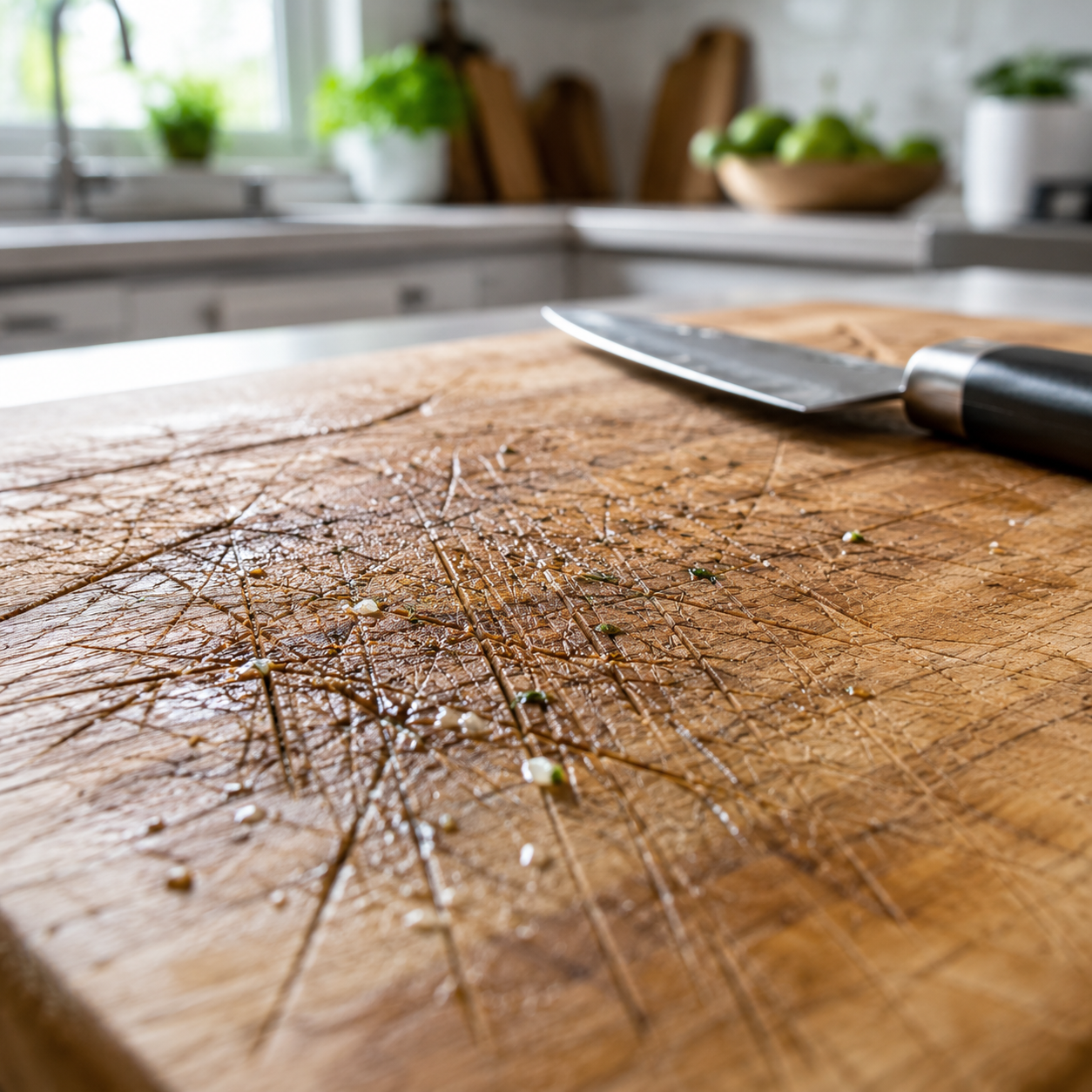
Knife marks on cutting boards can trap food residue and bacteria over time. Learn why it happens, when to replace a board, and simple habits to keep food prep safer.

Why Cutting Board Knife Marks Matter More Than They Seem
A cutting board is one of those kitchen tools we use almost without thinking. We chop onions on it, slice chicken on it, cut sandwiches in half, dice fruit, mince garlic, and sometimes use it as a quick landing spot for whatever is coming out of the fridge.
Over time, all that slicing and chopping leaves marks.
At first, those knife marks may look like normal wear and tear. And in many ways, they are. A cutting board is meant to take the pressure of a knife so your countertop does not have to.
But deep cuts, grooves, cracks, and rough areas can become harder to clean than a smooth surface. Tiny bits of food and moisture can settle into those spaces. When that happens repeatedly, bacteria can remain in places your sponge or dishcloth may not reach well.
This does not mean every scratched cutting board is automatically dangerous. It does mean an old, deeply scarred board deserves more attention than many people give it.
The good news is that cutting board safety is very manageable. With a few simple habits, you can reduce cross-contamination, keep boards cleaner, and know when it is time to replace one.
How Knife Marks Can Trap Food and Moisture
When a knife cuts into a board, it creates a small line in the surface. On a newer board, those marks may be shallow and easy to wash. But after months or years of use, the surface can become filled with grooves.
Those grooves can collect tiny food particles.
You may not see them clearly, especially if the board looks clean after rinsing. But small pieces of meat juice, vegetable pulp, fruit sugar, bread crumbs, garlic, or onion can cling inside the cuts.
Moisture is another issue. A cutting board that stays wet in those grooves can become a more welcoming place for odor and buildup. This is especially true if the board is washed quickly, stacked while damp, or left flat on the counter where air cannot circulate.
A smooth surface is usually easier to clean because soap, water, and scrubbing can reach it evenly. A rough or deeply cut surface gives residue more places to hide.
That is the main reason knife marks matter.
The Real Concern Is Cross-Contamination
The biggest kitchen safety issue with cutting boards is not the board itself. It is what the board touches next.
Cross-contamination happens when bacteria or food residue from one food or surface moves to another. In a busy home kitchen, this can happen easily.
For example, you cut raw chicken on a board. Then you rinse the board quickly and use it to slice tomatoes for a salad. The tomatoes will not be cooked, so anything transferred from the raw chicken prep area could remain on the food.
Or maybe you cut raw meat, wipe the board with a dishcloth, and later use the same cloth on the counter. Now the cloth may spread residue to another surface.
This is why cutting board habits matter in everyday life. Most people are not trying to be careless. They are cooking dinner, answering a text, helping a child with homework, and trying to get food on the table.
A cleaner system makes the safe choice easier.
Why Deep Grooves Are Harder to Clean
A lightly used cutting board can usually be washed well with hot, soapy water and proper drying. But deep grooves create a cleaning challenge.
Soap May Not Reach Every Crevice
If a groove is narrow and deep, a sponge may pass over the top without scrubbing inside it. Food residue can stay tucked into the cut.
This is especially common with plastic cutting boards that develop many thin knife lines over time.
Food Can Dry Inside the Cuts
Food residue is easier to remove right after cutting. Once it dries, it can stick more firmly to the surface.
Think about dried oatmeal on a bowl or tomato sauce on a plate. The longer it sits, the harder it is to wash off. The same idea applies to food particles in cutting board grooves.
Moisture Can Linger
If water settles into cuts and the board does not dry completely, the surface may start to smell unpleasant. A sour, musty, or old-food smell is a sign the board needs better cleaning or may be past its useful life.
Rough Boards Can Damage Cleaning Tools
When a board becomes very rough, sponges and cloths may snag or slide unevenly. That can make cleaning less effective, especially if you are doing a quick rinse instead of a full wash.
Plastic, Wood, and Bamboo: Does the Material Matter?
People often ask whether plastic, wood, or bamboo is safest. The answer is less about finding a perfect material and more about using each one properly.
Plastic Cutting Boards
Plastic boards are popular because they are lightweight, affordable, and often dishwasher-safe. They are commonly used for raw meat, poultry, and seafood because nonporous boards can be easier to sanitize.
The downside is that plastic can develop many knife grooves. Once those grooves become deep or hard to clean, the board may need replacing.
A plastic board with heavy scarring, staining, or trapped odor should not be kept forever just because it can go in the dishwasher.
Wooden Cutting Boards
Wooden boards are sturdy and attractive, and many people love using them for bread, fruit, vegetables, and serving. But wood needs proper care.
Wood should not be soaked in the sink for a long time. It should be washed, rinsed, and dried well. If a wooden board cracks, splits, warps badly, or develops moldy spots, it is time to stop using it for food prep.
Wooden boards may also need occasional food-grade mineral oil, depending on the type of board and manufacturer instructions. This helps reduce drying and cracking.
Bamboo Cutting Boards
Bamboo boards are often harder than many wood boards. They can be a practical choice, but they still get knife marks and still need cleaning and drying.
Like wood, bamboo should not be left soaking in water. It can crack or warp if treated carelessly.
No matter which material you choose, the safest cutting board is one that is clean, dry, in good condition, and used for the right job.
Common Mistakes That Make Cutting Boards Dirtier
Most cutting board problems come from small habits that feel harmless at the time.
Using One Board for Everything
One board for raw chicken, apples, sandwiches, herbs, and bread may seem convenient. But it increases the chance of cross-contamination.
A better habit is to keep separate boards for different foods. At minimum, use one board for raw meat, poultry, and seafood, and another for produce, bread, and ready-to-eat foods.
Color-coded boards can make this easier. For example, red for raw meat and green for produce. You do not need a fancy set, but a clear system helps.
Only Rinsing With Water
A quick rinse may remove visible pieces of food, but it is not enough after most food prep.
Cutting boards should be washed with hot, soapy water after use. Scrub the surface, including corners and edges. Then rinse and dry.
If the board touched raw meat, poultry, seafood, or eggs, it may also need sanitizing according to the board’s care instructions.
Letting Boards Sit Dirty
Food residue is easier to remove before it dries. If you finish chopping and leave the board on the counter for hours, cleaning becomes harder.
Try to wash the board soon after use, especially after cutting raw animal products or sticky foods like fruit, garlic, or onions.
Stacking Boards While Damp
A board that is clean but damp can still develop odor if it cannot dry well.
After washing, stand the board upright or place it where air can circulate. Avoid stacking wet boards together or laying a wet board flat against the counter.
Ignoring Deep Cuts
Some people keep a cutting board until it looks completely worn out. But deep grooves are a sign to pay closer attention.
If the board has cuts you cannot scrub clean, dark lines that do not wash away, or odors that keep returning, it may be time to replace it.
Warning Signs Your Cutting Board Needs Replacing
A cutting board does not need to look brand-new forever. Normal knife marks are expected. But certain signs suggest it is no longer easy to clean well.
Deep Grooves
If you can feel deep cuts with your fingertips, food can likely settle into them too. When grooves become hard to scrub, replacement is a smart choice.
Persistent Odor
A board that smells sour, musty, or like old food even after washing may be holding residue. If cleaning and drying do not fix the smell, do not keep using it for food prep.
Cracks or Splits
Cracks are more serious than shallow knife marks. They can collect moisture and food particles deep inside the board.
This is especially important for wooden and bamboo boards. If a board splits, it is usually time to retire it from kitchen use.
Stains That Keep Getting Darker
Some stains are harmless, like beet or turmeric marks. But dark lines inside knife cuts can be a sign of trapped residue. If the board looks dirty even after a proper wash, it may be too worn.
Warping
A warped board may not sit flat. That can make cutting less stable and cleaning less even. If the board rocks on the counter, it can also become annoying or unsafe to use with a sharp knife.
How to Clean a Cutting Board After Everyday Use
For everyday foods like bread, fruit, vegetables, and cooked foods, a simple routine usually works well.
First, scrape off food pieces. Then wash the board with hot, soapy water. Use a brush or sponge that can reach the surface well. Pay attention to edges, corners, and textured areas.
Rinse thoroughly so no soap remains.
Dry the board with a clean towel or let it air-dry upright. The key is to make sure it dries fully before storing.
This simple routine may sound basic, but it is often where people rush. A cutting board that is washed well and dried completely is much less likely to develop odor or buildup.
What to Do After Cutting Raw Meat, Poultry, or Seafood
Raw meat, poultry, seafood, and eggs need extra care because they can leave juices behind.
Use a separate board for these foods when possible. After use, wash it thoroughly with hot, soapy water. If the board is dishwasher-safe, the dishwasher can be a practical option.
For boards that need sanitizing, follow reliable food safety guidance and the manufacturer’s instructions. Many nonporous boards can be sanitized with a properly diluted bleach solution, but the exact approach should fit the material.
Never place cooked food back on the same unwashed board that held raw food. This is one of the easiest cross-contamination mistakes to make, especially when grilling or cooking in a hurry.
A simple trick is to bring out a clean plate or second board before you start cooking. That way, the finished food has a clean place to land.
Should You Sand or Resurface a Cutting Board?
Some wooden cutting boards can be sanded and reconditioned if they are high quality and not cracked. This can help remove shallow surface marks.
However, not every board is worth resurfacing. Thin boards, split boards, moldy boards, or heavily damaged boards may be better replaced.
Plastic boards generally should not be sanded for home use. If a plastic board is deeply scarred, replacing it is usually the simpler and safer option.
If you have an expensive wooden board, check the maker’s care instructions. Some boards can last for years with proper cleaning, drying, and oiling.
Practical Prevention Tips for a Cleaner Cutting Board
You do not need a complicated routine. A few steady habits make the biggest difference.
Keep at least two cutting boards: one for raw animal products and one for ready-to-eat foods.
Wash boards soon after use.
Use hot, soapy water and scrub the surface, not just a quick rinse.
Let boards dry completely before storing.
Stand boards upright when drying.
Avoid soaking wood or bamboo boards.
Replace boards with deep cuts, cracks, or lasting odors.
Use a clean plate for cooked food, not the same board that held raw food.
Keep a small brush near the sink for scrubbing grooves and corners.
These habits are easy to repeat and do not require expensive tools.
A Simple Weekly Cutting Board Check
Once a week, take a closer look at your boards.
Run your hand over the surface. Do you feel deep grooves? Check the edges. Are there cracks or peeling areas? Smell the board after washing and drying. Does it still have an odor?
Look at the color. Are there dark lines inside cuts that do not scrub away?
This quick check takes less than a minute, but it helps you catch problems before they become part of your normal kitchen routine.
Final Thoughts: Small Cuts Can Create Big Cleaning Challenges
Knife marks on a cutting board are normal. They are part of cooking. But when those marks become deep, rough, or hard to clean, they can hold onto food residue and moisture.
That is why bacteria may remain in cutting board grooves even after a quick rinse.
The solution is not to worry every time you chop an onion. The solution is to build simple habits: use separate boards, wash them well, dry them fully, and replace them when they are too worn.
A clean cutting board helps keep everyday cooking safer and more organized. And like many kitchen safety habits, it does not have to be complicated. A little attention after each meal can make your whole kitchen feel fresher, calmer, and easier to trust.

Hi, I’m the creator and editor behind ZestyHabit. I research everyday safety, first aid, and practical wellness topics using official guidance and reliable public sources, then turn that information into clear, realistic steps for daily life.
My goal is to help readers make safer, better-informed choices at home and beyond.


