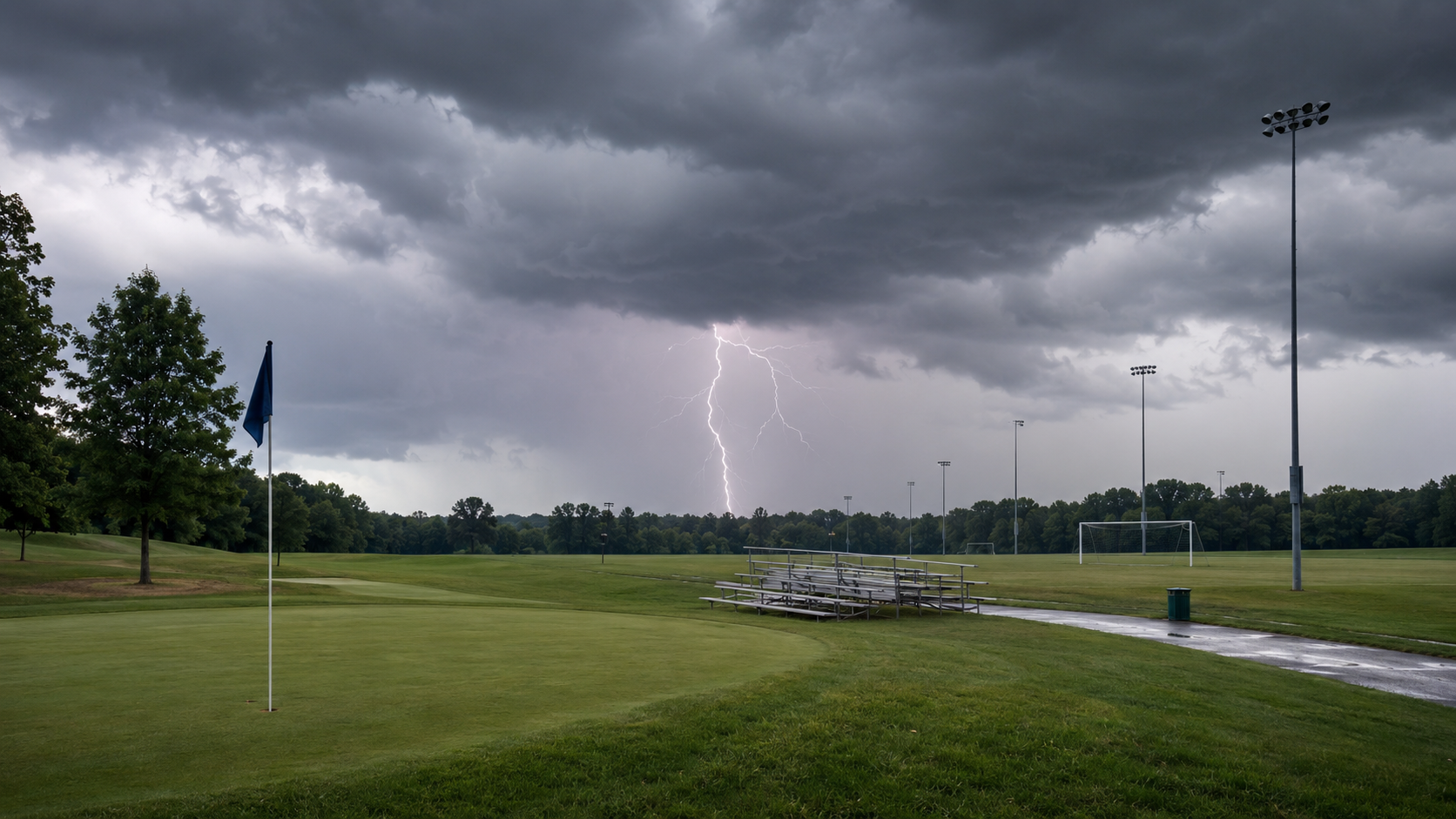
Why Golf Courses and Sports Fields Are More Vulnerable to Lightning
Minjin Park
·
Golf courses and sports fields can become risky places during thunderstorms because they are wide, open, and often have few safe shelters nearby. Learn why lightning safety matters and what simple steps can help.
A sunny afternoon can change quickly. One minute, you are finishing the back nine with friends, watching your child’s soccer game, or standing on a school sports field during practice. The next minute, the sky turns gray, the wind picks up, and thunder starts rumbling somewhere in the distance.
For many people, the first reaction is to keep going.
Golfers may think, “We only have two holes left.” Coaches may say, “Let’s wait and see if it passes.” Parents may stay near the bleachers because the rain has not started yet. Players may assume lightning is only a problem if it is directly overhead.
But golf courses and athletic fields are some of the most exposed places to be during a thunderstorm. They are usually wide open, flat, and far from sturdy shelter. People are often spread out across large areas, holding equipment, standing near metal fencing, or gathered around tall poles and bleachers.
The good news is that lightning safety does not have to be complicated. A few simple habits can make a big difference. The key is understanding why these places are more vulnerable and acting early, before the storm is right on top of you.
Why Golf Courses Are Especially Exposed
Golf Courses Are Large, Open Spaces
Golf courses are beautiful because they are open. Rolling fairways, long greens, water features, and scattered trees are part of the experience. Unfortunately, those same features can make them risky during a thunderstorm.
Lightning tends to seek a path between the cloud and the ground. In a wide-open area, people, golf carts, trees, flagsticks, and poles may stand out from the surrounding landscape. Even if you are not the tallest thing around, being in an open area increases your exposure.
A golfer walking down a fairway may be far from a clubhouse or shelter. A group on the course may also be separated from others, making it harder to communicate quickly when the weather changes.
Golf Clubs and Carts Can Create False Confidence
Many golfers worry about metal clubs, and it is true that carrying long metal objects during a thunderstorm is a bad idea. But the bigger issue is not simply that a golf club is metal. The bigger issue is that golfers are often standing in open areas while holding equipment.
A metal club does not “attract” lightning like a magnet, but it can conduct electricity if lightning strikes nearby or if current travels through the ground. Golf carts can also give people a false sense of safety. A regular open-sided golf cart is not the same as being inside a fully enclosed metal vehicle.
If a storm is approaching, sitting in a golf cart under a tree is not a safe plan. The safer move is to head to a substantial building or a fully enclosed vehicle as soon as thunder is heard or lightning is seen.
Trees on Golf Courses Can Be Dangerous Places to Wait
It is common to see golfers take shelter under a tree when rain starts. It feels natural. Trees block rain, provide shade, and seem like a quick place to pause.
During lightning, though, standing under a tree can be dangerous. Trees are often among the tallest objects on a course. If lightning strikes a tree, the electrical current can travel down the trunk and spread across the ground. People standing nearby can be affected by side flashes or ground current.
A tree may keep you drier, but it does not make you safer.
Why Sports Fields Are Vulnerable Too
Fields Are Designed to Be Open
Baseball diamonds, soccer fields, football fields, lacrosse fields, and track areas all share one thing: they are open spaces. That openness is perfect for visibility, movement, and play. It is not ideal during a thunderstorm.
Athletes may be the tallest objects in the middle of the field. Coaches may be standing along the sidelines. Parents may be sitting on metal bleachers. Referees may be carrying whistles, flags, or communication devices.
Even when buildings are nearby, the field itself may be far enough away that people need several minutes to reach shelter. That is why waiting until lightning is close can become a problem.
Metal Bleachers, Fences, and Light Poles Add Risk
Sports fields often have metal objects nearby: chain-link fences, bleachers, goal posts, dugout structures, backstops, scoreboards, and tall light poles. These objects are part of the field environment, but they are not safe places to gather during lightning.
Metal can conduct electricity. Tall poles and structures may be vulnerable to strikes. A person leaning against a fence, sitting on metal bleachers, or standing close to a pole may be exposed if lightning strikes nearby.
This is one reason spectators need a plan too. Lightning safety is not just for the players on the field. Parents, siblings, coaches, volunteers, and officials all need to move to safer shelter when storms approach.
Youth Sports Can Be Tricky Because People Hesitate
At youth games, people often hesitate to stop play. Coaches do not want to disappoint the kids. Parents drove a long way. A tournament may be running behind schedule. The sky may look dark in one direction but clear in another.
That hesitation is understandable, but it is one of the most common mistakes. Lightning can occur before heavy rain begins. A storm does not need to be directly overhead to create danger.
If thunder can be heard, the storm is close enough to take seriously. Pausing a game may feel inconvenient, but it is a much better choice than trying to squeeze in “just a few more minutes.”
Common Mistakes People Make Around Lightning
Mistake 1: Waiting for Rain Before Taking Action
Many people use rain as their cue to leave. With lightning, that is not reliable.
Lightning can strike before rain reaches the area. You may hear thunder while the field is still dry. You may see lightning in the distance while the sun is still partly shining. A storm can also approach quickly, especially during warm afternoons.
A better habit is to use thunder as the warning sign. If you hear thunder, it is time to head for shelter.
Mistake 2: Thinking a Small Shelter Is Enough
Not every shelter is safe during lightning. A dugout, picnic pavilion, rain canopy, golf cart cover, or open-sided shade structure may protect you from rain, but it does not provide the same protection as a substantial building.
A safe shelter is usually a sturdy enclosed building with wiring and plumbing, such as a clubhouse, school building, community center, or field house. A fully enclosed hard-topped vehicle can also be a safer option if a building is not available.
Small open shelters can be tempting because they are close, but they may not protect you from lightning.
Mistake 3: Standing Near the Tallest Object
People often move toward trees, poles, fences, or scoreboards because those places feel like landmarks or gathering spots. During a thunderstorm, that is not ideal.
Avoid standing near isolated trees, tall poles, metal fences, flagsticks, goal posts, or towers. These objects may increase exposure if lightning strikes nearby.
Mistake 4: Finishing the Game or Hole First
This happens all the time. A golfer wants to finish the hole. A soccer team wants to finish the half. A baseball coach wants to get one more inning in before the rain.
Lightning safety works best when decisions are made early. The delay should not start when the storm is already on top of you. It should start when warning signs appear.
Mistake 5: Returning Too Soon
Another common mistake is going back outside as soon as the rain lightens or the sky brightens. Storms can produce lightning even after the heaviest rain has passed.
A practical rule many organizations use is to wait at least 30 minutes after the last sound of thunder or visible lightning before returning to the field or course. This waiting period can feel long, but it helps prevent people from rushing back while the storm is still active.
Warning Signs to Watch For
Thunder, Even Far Away
Thunder is one of the clearest signs that lightning is close enough to matter. You do not need to see a lightning bolt for the risk to be real.
If you are on a golf course, sports field, playground, or open park and hear thunder, begin moving toward shelter. Do not wait for an announcement if you already know conditions are changing.
Darkening Skies and Fast-Moving Clouds
A sudden dark sky, rolling clouds, or a sharp change in wind can signal that a storm is approaching. Afternoon storms can build quickly, especially in warm and humid weather.
If you are responsible for kids, students, athletes, or a group outing, pay attention to the sky before the first rumble of thunder.
Static Feelings or Hair Standing Up
In rare situations, people may notice a tingling feeling, buzzing sound, or hair standing up before a nearby lightning strike. This is a serious warning sign to lower your profile and move away from tall or metal objects if immediate shelter is not reachable.
However, you should not wait for dramatic signs like this. The goal is to get indoors long before the situation feels urgent.
Simple Lightning Safety Steps for Golfers
Check the Weather Before You Tee Off
Before heading to the course, check the forecast. Pay special attention to thunderstorm chances, not just rain totals. A day can be warm and playable in the morning but stormy by afternoon.
If storms are likely, ask the course about its lightning policy, warning system, and shelter locations. Many courses have sirens or alerts, but you should still stay aware of the weather yourself.
Know Where Shelter Is
Before you start, notice where the clubhouse, restrooms, halfway house, maintenance buildings, and parking areas are located. Not every small structure is safe, but knowing your options helps you make quicker decisions.
If you are far from the clubhouse and hear thunder, do not continue deeper into the course. Start heading toward the safest available shelter.
Leave Clubs and Umbrellas Behind if Needed
If lightning is close, do not waste time gathering every club, towel, and umbrella. Equipment can be replaced. Your priority is getting to shelter.
Avoid holding a golf club or umbrella while crossing an open fairway during a storm. If you must move quickly, keep your hands free and head directly toward safety.
Simple Lightning Safety Steps for Sports Fields
Have a Weather Plan Before the Game
Coaches, league organizers, and parents should know the plan before the first whistle. Where will players go if thunder is heard? Who makes the call to pause play? Where should parents and spectators shelter?
A clear plan reduces confusion. It also prevents people from standing around debating while the weather gets worse.
Move Everyone, Not Just the Players
When a game is paused, players are not the only ones who need to move. Spectators, officials, coaches, younger siblings, and volunteers should also leave the field area.
Bleachers, fences, dugouts, and sideline tents are not ideal lightning shelters. Encourage everyone to go to cars or a sturdy building.
Do Not Let Kids Wait Near Equipment
Children may naturally gather near soccer goals, baseball fences, dugouts, or light poles while adults decide what to do. Guide them away from tall or metal structures and toward the planned shelter area.
Keeping the instructions simple helps: “Everyone to the cars,” or “Everyone inside the school building.”
Everyday Examples That Make This Real
The Soccer Practice That Almost Continues
A coach sees dark clouds but no rain. The team has only 15 minutes left, so practice continues. Then thunder rumbles. Some kids keep playing while others look toward the parking lot.
This is the moment to stop. Waiting for rain or visible lightning only adds risk. A calm, quick pause teaches kids that safety decisions do not need to be dramatic to be important.
The Golfer Under the Lone Tree
A golfer hears thunder and steps under a lone tree near the cart path. It feels like a smart way to avoid getting soaked. But that tree is one of the taller objects in the area, and the golfer is still outside in an open place.
A better choice is to leave the tree, avoid holding clubs or an umbrella, and move toward a substantial building or fully enclosed vehicle.
The Parents on Metal Bleachers
At a baseball game, the players leave the field, but parents stay on the bleachers because they want to watch what happens next. The bleachers are metal, exposed, and close to the field.
When lightning is possible, spectators need to take shelter too. The safest plan is not complete until everyone has moved away from exposed areas.
What to Do If Shelter Is Not Immediately Nearby
Sometimes people are caught in an open area before they can reach proper shelter. The best prevention is to leave early, but if you are already exposed, move quickly toward the safest available place.
Avoid isolated trees, metal fences, poles, water, and open hilltops. Spread out from others if you are in a group, so everyone is not clustered in one spot. Keep moving toward a building or fully enclosed vehicle as soon as possible.
This is not a substitute for shelter, but it is better than standing still in the most exposed area.
Building Better Habits Around Storms
Lightning safety is mostly about habits. Check the forecast. Notice the sky. Take thunder seriously. Know where shelter is. Do not wait until everyone feels scared.
For families, this can become a normal part of outdoor activities. Just like bringing sunscreen, water bottles, or a first-aid kit, checking storm risk can be part of getting ready.
For coaches and group leaders, the best approach is to make the decision early and confidently. People are more likely to cooperate when the instructions are clear and calm.
For golfers, it helps to remember that no round is worth pushing through a thunderstorm. The course will still be there later.
Conclusion: Open Spaces Need Earlier Decisions
Golf courses and sports fields are vulnerable to lightning because they are wide, open, and often filled with tall objects, metal structures, and people spread far from shelter. The risk is not always obvious at first. The grass may still be dry, the game may still be going well, and the storm may look like it is “over there.”
But thunder is a warning worth respecting.
The safest habit is simple: when you hear thunder or see lightning, stop the activity and move to a substantial building or fully enclosed vehicle. Stay away from trees, metal fences, bleachers, poles, golf clubs, umbrellas, and open fields. Wait until the storm has clearly passed before returning.
A calm pause can prevent a dangerous situation. Whether you are golfing, coaching, playing, or watching from the sidelines, taking lightning seriously is one of the simplest outdoor safety habits you can build.
Hi, I’m the creator and editor behind ZestyHabit. I research everyday safety, first aid, and practical wellness topics using official guidance and reliable public sources, then turn that information into clear, realistic steps for daily life.
My goal is to help readers make safer, better-informed choices at home and beyond.