
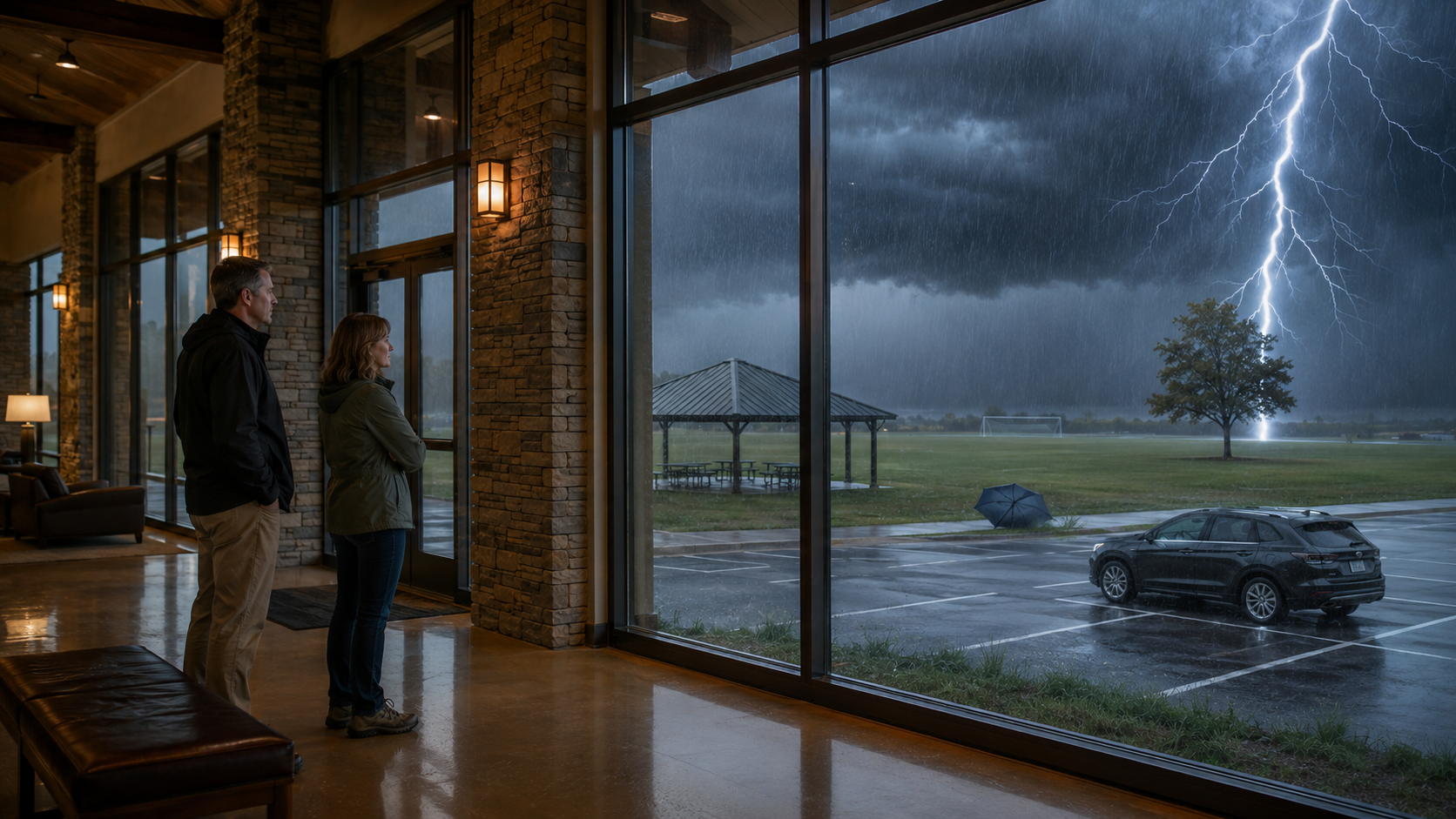

Discover the safest places during a lightning storm, which shelters offer no protection, and what to do if thunder catches you outdoors.
A dark cloud rolls over the horizon, a low rumble follows, and everyone begins debating the same question: Is it safer to stay under the pavilion, run to the car, or wait beneath a large tree?
The answer matters because many places that look like shelter provide little or no protection from lightning. A tent may keep you dry, but its thin fabric cannot protect you from an electrical discharge. A tree may block the rain, yet it can expose you to a direct strike, side flash, or dangerous ground current.
The safest options are usually a substantial enclosed building or a hard-topped metal vehicle with the windows closed. Everything else should be treated as risk reduction, not true protection.
The most important lightning safety rule is easy to remember: when you hear thunder, go indoors. Thunder means lightning is close enough to become a threat, even if rain has not reached your location or blue sky is still visible.
Why Thunder Means It Is Time to Find Shelter
You do not need to see lightning directly to be in danger. Lightning can travel beyond the rain shaft and strike miles away from the most obvious part of a storm.
According to the Centers for Disease Control and Prevention, lightning may strike more than 10 miles from a storm. That is why waiting for heavy rain, strong wind, or an overhead flash is a dangerous strategy.
If you can hear thunder, immediately stop outdoor activities and begin moving toward a safe location. Do not wait to count the seconds between a flash and thunder before deciding whether to leave. Although that method can provide a rough idea of distance, it does not establish a safe zone.
The beginning and ending stages of a storm can be particularly deceptive. People often delay taking shelter because the storm appears distant, or they return outside too soon because the rain has stopped.
Remain in a safe location for at least 30 minutes after the last sound of thunder. If thunder is heard again, restart the 30-minute waiting period.
The Safest Option: A Substantial Enclosed Building
A fully enclosed, substantial building is generally the best place to be during a lightning storm. Good examples include:
- A house or apartment building
- An office
- A school
- A library
- A shopping center
- A restaurant
- A large public facility
- A properly enclosed visitor center
A substantial building usually has walls, a roof, electrical wiring, and plumbing. These features can help carry electrical current through the building’s systems and toward the ground. However, the people inside still need to avoid direct contact with anything that could conduct that current.
Simply having a roof overhead does not make a structure safe. A building must be enclosed rather than open on one or more sides.
The following structures are not considered reliable lightning shelters:
- Picnic pavilions
- Gazebos
- Baseball dugouts
- Bus shelters
- Beach shelters
- Carports
- Open barns
- Small sheds
- Covered porches
- Outdoor restrooms without substantial construction
These structures may protect you from rain or sun, but they do not reliably isolate you from lightning.
If you arrive at a park, beach, sports field, campground, or trailhead, identify the closest substantial building before beginning your activity. Knowing where to go is far more effective than trying to choose a shelter while a storm is already overhead.
A Hard-Topped Metal Vehicle Is a Good Alternative
When a substantial building is unavailable, a fully enclosed, hard-topped metal vehicle can provide effective protection. Suitable examples may include a typical car, minivan, bus, or metal-roofed truck.
Get completely inside, close all doors and windows, and remain there until at least 30 minutes after the last thunder.
Contrary to a popular myth, the rubber tires are not what protect the occupants. The vehicle’s outer metal shell helps direct the electrical current around the passenger compartment and toward the ground. The National Weather Service explains that lightning may travel across a hard-topped vehicle’s metal exterior before passing to the ground.
While sheltering inside:
- Keep the windows closed.
- Avoid touching metal door frames and other exposed metal parts.
- Keep your hands in your lap when practical.
- Do not lean against the doors.
- Avoid using equipment connected to the vehicle’s external electrical system.
- Wait for the storm to pass before leaving to inspect possible damage.
A lightning strike may damage the vehicle’s antenna, electronics, windows, or tires. The vehicle could become inoperable, so remain alert for smoke, fire, shattered glass, or other immediate hazards. If a fire begins, exit and move to the safest available enclosed location.
Not every vehicle provides the same protection. Convertibles with soft roofs, motorcycles, bicycles, golf carts, tractors without enclosed metal cabs, and open utility vehicles are not safe lightning shelters.
Standing outside while touching a vehicle is also unsafe. You must be fully inside a suitable enclosed vehicle to benefit from its metal shell.
Places That Are Not Safe During Lightning
Under a Tree
Sheltering beneath a tree is one of the most dangerous mistakes people make during thunderstorms. A tree may be struck directly, allowing electricity to travel down the trunk and through the ground. Lightning may also jump from the tree to a nearby person in what is known as a side flash.
A person does not need to touch the tree to be injured. Ground current from a nearby strike can travel through the soil and enter the body through the feet.
Never stand under an isolated tree. Being wet is uncomfortable, but staying dry beneath a tree is not worth the risk.
Inside a Tent
A tent provides almost no meaningful lightning protection. Its fabric does not block an electrical discharge, and metal poles may conduct current if the tent or nearby ground is struck.
Camping tents, canopies, pop-up shelters, and fabric event tents should never be treated as safe alternatives to buildings or vehicles. If thunderstorms are forecast, camp where you can reach substantial shelter quickly or consider postponing the trip.
Under a Pavilion or Gazebo
Open-sided shelters can create a false sense of security. People tend to gather inside them because they are dry and convenient, potentially placing an entire group near conductive supports, wet surfaces, and open ground.
The CDC specifically warns that tents, picnic shelters, gazebos, and dugouts do not provide lightning protection. At a beach, leave the picnic shelter and move to a building or suitable vehicle.
Near Water
Swimming pools, lakes, rivers, ponds, and ocean beaches should be evacuated as soon as thunder is heard. Water can conduct electrical current, and open shorelines may leave people exposed as the tallest objects nearby.
Get out of the water, leave the beach, and enter a safe building or hard-topped vehicle. Do not remain under a beach umbrella. An umbrella does not provide protection, and holding it above your body may increase your height.
People in small boats should return to shore before the storm arrives. Once ashore, move well away from the water and enter a substantial shelter. A fully enclosed boat cabin may offer some protection, but an open boat does not.
On High Ground
Mountain summits, ridgelines, exposed hills, rooftops, and elevated observation decks are particularly hazardous during lightning. If thunder develops while hiking, descend immediately. Do not remain at a viewpoint to take photographs or watch the storm.
A rocky overhang or shallow cave is not a dependable shelter. Current may travel through wet rock, jump across an opening, or move along the surrounding ground.
Staying Safe Inside a Building
Going indoors greatly reduces the risk, but it does not make every activity inside completely safe. Lightning can enter a building through electrical wiring, plumbing, phone lines, antennas, and conductive materials.
During the storm, avoid the following:
Plumbing and Running Water
Do not shower, take a bath, wash dishes, or use running water. Lightning can travel through plumbing. Plastic pipes may present less risk than metal pipes, but avoiding plumbing entirely during a storm remains the safest choice.
Corded Telephones
Do not use a corded telephone unless it is necessary for an emergency. Mobile and cordless phones are generally safe when they are not connected to a wall outlet or charger.
Plugged-In Electronics
Avoid using computers, gaming systems, washers, dryers, stoves, and other devices connected to electrical outlets. Lightning can travel through a building’s electrical system.
Unplug sensitive equipment before a storm arrives rather than trying to disconnect it while thunder is already occurring. A whole-house surge protector can help protect equipment, but it does not replace personal safety precautions.
Windows, Doors, and Porches
Stay away from windows and exterior doors, and do not remain on a covered porch. Wind can break windows or throw debris, while certain parts of a building may contain conductive metal.
Concrete Walls and Floors
Do not lean against concrete walls or lie on concrete floors. Metal reinforcing bars or wires inside the concrete may carry electrical current. This type of injury is uncommon, but it is easily avoided by sitting in a regular chair away from walls and windows.
What If No Safe Shelter Is Available?
The uncomfortable truth is that there is no safe outdoor location during a thunderstorm. Outdoor actions may reduce certain risks, but they cannot make the situation safe.
If you are caught outside, keep moving toward a substantial building or hard-topped vehicle. Do not stop and lie flat. Lying down increases the amount of your body exposed to ground current.
The National Weather Service also stopped recommending the traditional “lightning crouch” because it does not provide significant protection. Crouching should not be treated as a substitute for reaching shelter.
While continuing toward safety:
- Get off ridges, peaks, and other elevated areas.
- Leave open fields and exposed shorelines.
- Stay away from isolated trees, utility poles, towers, and windmills.
- Avoid fences, power lines, bleachers, railings, and other long metal objects.
- Put down fishing rods, golf clubs, umbrellas, and metal-framed equipment.
- Stay away from water.
- Do not use cliffs or rocky overhangs as shelters.
- If in a forest, move toward an area of shorter trees rather than standing beneath the tallest tree.
- If traveling in a group, spread out to reduce the chance of multiple people being injured by one strike.
Metal does not “attract” lightning in the simple way people often imagine. Height, isolation, and shape are more important in determining where lightning may strike. However, metal conducts electrical current, so touching fences, rails, bleachers, or tools can worsen an exposure.
If your hair stands on end, your skin tingles, or you hear crackling or buzzing, the electrical field may be extremely strong. These signs require immediate action, but they may not always occur before a strike. Do not wait for them before seeking shelter.
Choosing Shelter in Common Outdoor Situations
At a Sports Field
Stop the game as soon as thunder is heard. Players, spectators, coaches, and officials should move to a designated building or their vehicles.
Dugouts, tents, open bleachers, and equipment sheds are not adequate. Event organizers should have a written weather plan and enough safe shelter for everyone present.
At the Beach
Leave the water and beach immediately. Do not gather beneath umbrellas or picnic structures. Move to a building or hard-topped vehicle and remain there for 30 minutes after the last thunder.
While Hiking
Check the forecast before leaving, especially when the route includes peaks, ridges, or long stretches above the tree line. Start early when afternoon thunderstorms are common, and choose a turnaround time that allows you to descend before storms develop.
A remote trail may offer no safe shelter, which is why prevention and timing are critical.
While Fishing or Boating
Return to shore at the first sign of a developing thunderstorm. Fishing rods held upright add height, while open water provides little opportunity to reach safe shelter once a storm arrives.
Do not wait until rain begins. Wind and waves may also make the return trip more difficult.
At a Campsite
A tent is not a safe location. Identify a substantial campground building or keep a suitable vehicle nearby. If neither is available and storms are likely, choose another campsite or postpone the trip.
Plan Before You Need Shelter
Lightning safety starts before thunder is heard. Check the hourly weather forecast, radar, and local alerts before outdoor activities. Remember that a low overall chance of rain does not guarantee that your specific location will remain storm-free.
Ask three questions before leaving:
- Where is the nearest safe building or vehicle?
- How long will it take to reach that shelter?
- What signal will tell everyone to stop the activity?
Parents, coaches, employers, tour leaders, and event organizers should make the decision to shelter early. People often lose valuable time collecting equipment, finishing a game, or waiting to see whether the storm gets closer. Equipment can be retrieved later.
Helping Someone Struck by Lightning
A lightning victim does not retain an electrical charge and is safe to touch. Call 911 immediately and begin first aid as soon as the scene is reasonably safe.
Lightning can cause cardiac arrest, breathing problems, burns, neurological injuries, hearing damage, eye injuries, and trauma from falling or being thrown. If the person is unresponsive and not breathing normally, begin CPR and use an automated external defibrillator if one is available. Follow the emergency dispatcher’s instructions until help arrives.
Be aware that lightning may strike the same area again. Move the victim and rescuers to safer shelter when this can be done without causing additional injury.
The best place during lightning is not simply the driest or closest structure—it is a substantial enclosed building or a fully enclosed, hard-topped metal vehicle. Have you ever been caught outdoors when a thunderstorm arrived unexpectedly, and did you know where to find proper shelter? Share your experience and your best lightning-safety planning tip in the comments below.

Hi, I’m the creator and editor behind ZestyHabit. I research everyday safety, first aid, and practical wellness topics using official guidance and reliable public sources, then turn that information into clear, realistic steps for daily life.
My goal is to help readers make safer, better-informed choices at home and beyond.


