
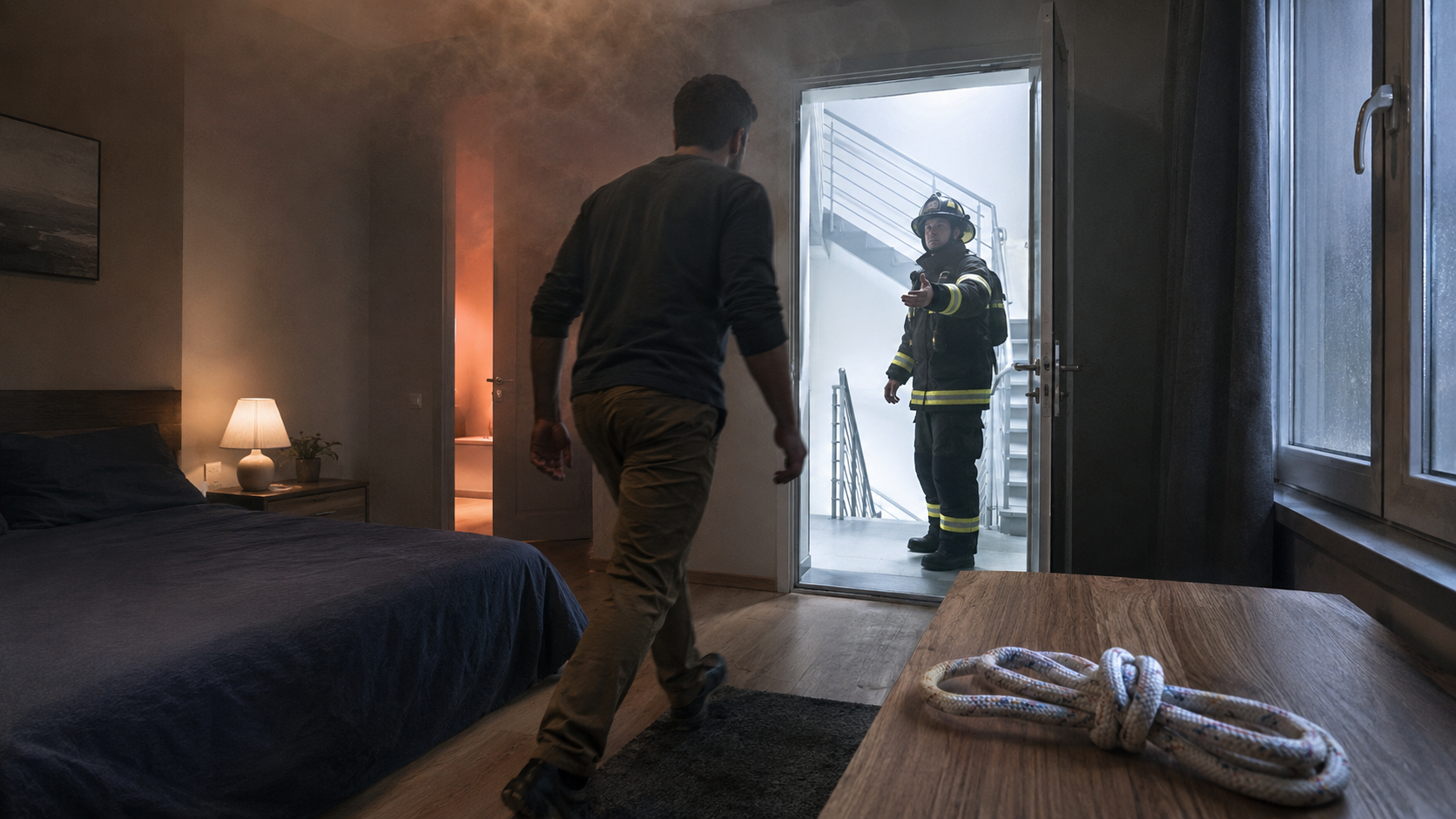

Learn which knots are used in professional fire and rope rescue, why improvised rope descents are dangerous, and how to create a safer home fire escape plan.
When people imagine being trapped by a fire on an upper floor, one dramatic solution often comes to mind: tie bedsheets together, secure them to a heavy object, and climb down through a window. It looks possible in movies, and knowing a few strong knots may seem like enough to make it work.
In reality, escaping a fire with an improvised rope is extremely dangerous. A knot that appears secure can slip, fabric can tear, furniture can move, and a person without a harness may lose their grip within seconds. Smoke, heat, darkness, and panic make those risks even greater.
Knots do have an important place in firefighting and technical rescue. Firefighters use them with certified life-safety ropes, harnesses, carabiners, tested anchors, backup systems, and extensive training. For an ordinary household, however, knots should be viewed as a preparedness skill, not a substitute for smoke alarms, clear exits, or a manufactured fire escape ladder.
This guide explains which knots are commonly associated with fire and rope rescue, what each one is designed to do, and why your primary fire escape plan should not depend on tying a rope during an emergency.
This article is for general safety awareness. It is not a substitute for hands-on rope-rescue training, certified equipment, or instructions from firefighters. Never attempt a life-safety rope descent based only on written or online instructions.
The Most Important Fire Escape Rule
In a home fire, your priority is to get outside quickly through a normal, safe exit. You should not spend valuable time looking for rope, tying knots, or building an improvised system.
The U.S. Fire Administration recommends identifying two ways out of every room, keeping doors and windows clear, choosing an outdoor meeting place, and practicing the plan with everyone in the household.
Your preferred escape order should generally be:
- Use the nearest safe door and the normal exit route.
- Use a second door, window, or stairway if the first route is blocked.
- Use a purpose-built escape ladder from an upper-floor window if it is part of your practiced plan.
- If you cannot escape safely, remain behind a closed door, call 911, and signal your location to firefighters.
Climbing down an improvised rope should not be treated as a routine backup plan.
Why Professional Rope Rescue Is Different
Professional rope rescue is a complete system. The knot is only one component.
A trained rescue system may include:
- Certified life-safety rope
- A properly fitted harness
- Load-rated carabiners
- Tested anchor points
- Edge protection
- A belay or secondary safety line
- Friction or descent-control devices
- Communication between trained rescuers
- Inspection before and after use
Professional rescue teams also consider the direction of the load, the strength of the anchor, damage from sharp edges, exposure to heat, and the effect of each knot on rope strength.
Every knot bends and compresses a rope, reducing some of its original strength. The Seattle Fire Department’s rope and knot training manual demonstrates that different knots retain different percentages of a rope’s strength. A strong-looking knot does not guarantee that the entire system can safely hold a person.
Household cord, clothesline, extension cords, curtains, and bedsheets are not substitutes for certified life-safety rope.
Understanding Knots, Bends, and Hitches
Although people often use the word “knot” for everything, rope-rescue terminology separates several types of connections:
- A knot is formed by intertwining a rope with itself.
- A bend joins two separate rope ends or pieces of webbing.
- A hitch secures a rope around an object.
- A backup or safety knot helps prevent the working end from slipping back through the main knot.
This distinction matters because a knot designed to create a loop may not be suitable for joining two ropes. Likewise, a hitch that holds when tension remains steady may loosen if the load repeatedly changes direction.
The following knots are worth recognizing because they appear in firefighter and rope-rescue training. Their inclusion here does not mean they should be used for an untrained window descent.
1. Figure-Eight Knot
The basic figure-eight is one of the most recognizable rescue knots. Its finished shape resembles the number eight, making it relatively easy for a trained person to inspect.
The basic version is often used as a stopper knot near the end of a rope. A stopper helps prevent the rope from unintentionally running through a device or connection point.
The larger figure-eight family includes several variations:
- Basic figure-eight stopper
- Figure-eight on a bight
- Figure-eight follow-through
- Double-loop figure-eight
- Figure-eight bend
The figure-eight is popular in rescue work because it is generally easy to identify, dress correctly, and inspect. “Dressing” a knot means arranging its strands neatly so they lie in the intended pattern without unnecessary crossing or twisting.
However, even a familiar figure-eight can be dangerous if it is tied incorrectly, attached to an unsuitable anchor, left with a short tail, or loaded in an unintended direction.
2. Figure-Eight on a Bight
A figure-eight on a bight creates a fixed loop without requiring access to the end of the rope. In professional systems, the loop may connect to properly rated rescue hardware or form part of an anchor system.
A bight is simply a U-shaped section of rope. It is different from a loop in which the rope crosses over itself.
This knot is widely used because its pattern can be inspected visually, but that does not make every loop safe for supporting a person. The rope must be appropriate, the knot must be correctly tied and dressed, the connecting hardware must be rated, and the anchor must withstand the expected forces.
Tying a figure-eight loop around a table leg or household railing does not transform that object into a safe rescue anchor.
3. Figure-Eight Follow-Through
The figure-eight follow-through is used when the rope must pass around or through an object before the knot is completed. In climbing and rescue environments, it may be used to connect a rope to a harness or a suitable anchor point.
The technique begins with a figure-eight pattern and then retraces that pattern with the working end. The completed knot should have clean, parallel strands and an adequate tail.
Although the concept sounds straightforward, errors are possible. A partially retraced knot may resemble a completed one at a glance. In professional settings, another trained person may inspect the connection before it is loaded.
A fire is not the right time to attempt this knot for the first time.
4. Bowline With a Backup Knot
The bowline creates a fixed loop that does not normally tighten around the object or person inside it. Firefighters and rescue personnel may use bowline variations for particular tasks.
A properly tied bowline can be useful, but it has an important limitation: it may loosen or deform when repeatedly loaded and unloaded, especially if it is poorly dressed or lacks a secure backup. Rescue applications therefore require the correct version, sufficient tail, an appropriate safety knot, and trained inspection.
The bowline should never be treated as a simple loop to place around someone’s waist for lowering. A rope loop around the torso is not a proper harness and may cause severe injury, restrict breathing, or allow the person to fall out.
For an untrained household user, knowing the bowline is valuable for general rope work. It should not create false confidence about conducting a high-angle rescue.
5. Clove Hitch With a Safety
A clove hitch is formed around an object and can be adjusted before it is fully loaded. Firefighters may use it when securing or hoisting certain tools and equipment.
Because a hitch depends on the object around which it is tied, its behavior can change with the object’s shape, surface, and diameter. It may slip on a smooth surface, loosen under changing tension, or shift when pulled from an unexpected direction.
A clove hitch may be appropriate for equipment-handling tasks when backed up and monitored by trained personnel. It should not be used as the sole connection for lowering a person from a building.
A pipe, radiator, bed frame, or balcony rail should also never be assumed to be a suitable life-safety anchor simply because a hitch fits around it.
6. Double Fisherman’s Knot and Figure-Eight Bend
Bends are used to join rope ends. The double fisherman’s knot—sometimes called a grapevine bend—is commonly associated with joining cord or forming closed accessory loops. A figure-eight bend can join two ropes of similar type and diameter in certain trained applications.
These knots are sometimes mentioned when people discuss making a longer escape rope. That creates a serious misunderstanding. A bend can connect two suitable ropes, but it cannot make weak or damaged material strong.
Joining bedsheets, towels, electrical cords, or different types of household rope creates unpredictable connections. The materials may stretch at different rates, melt at different temperatures, cut into one another, or slip through the knot.
A correctly tied bend is only as safe as the materials and system around it.
7. Water Knot for Webbing
The water knot, also called a ring bend, is commonly used to join the ends of flat webbing. Trained rescuers and climbers may use it to create a closed webbing loop for specific applications.
Flat rescue webbing is manufactured and rated differently from fabric cut from clothing, curtains, or bedding. A water knot tied in a strip of bedsheet is not equivalent to one tied in certified webbing.
Water knots also require adequate tails and regular inspection because the ends may gradually shift under repeated loading. This is another example of why memorizing a knot’s shape is not enough for life-safety use.
8. Prusik Hitch
A Prusik is a friction hitch made by wrapping a smaller loop of cord around a larger rope. When properly matched and loaded, it can grip the main rope. When unloaded, it may be moved along the rope.
Professional teams may use friction hitches in progress-capture, belay, or rope-management systems. Their performance depends on the diameter and material of both ropes, the number and arrangement of wraps, load direction, temperature, contamination, and other factors.
A Prusik is not a complete descending system. Attempting to climb or descend a rope using improvised friction hitches without instruction can result in uncontrolled sliding, burned hands, or a fatal fall.
Why Tied Bedsheets Are Not a Safe Escape Rope
Bedsheets are designed for bedding, not for supporting a moving human load. Even if the fabric seems strong when pulled by hand, several things can go wrong:
- Fabric may tear suddenly at a knot or seam.
- Knots may roll or slip in smooth material.
- Heat may weaken or ignite the fabric.
- Smoke can make knots difficult to see and check.
- The anchor may move, break, or tip over.
- The sheet may not reach the ground.
- A person may be unable to grip the fabric.
- Descending without a harness can lead to an uncontrolled fall.
- Broken glass or a sharp window frame may cut the material.
Tying multiple sheets together introduces several additional failure points. Wetting the fabric does not turn it into fire-resistant rescue equipment and may change how the knots hold.
A manufactured escape ladder is a much safer second-floor option because it provides steps, attachment hooks, and a design intended for emergency egress.
Choosing a Fire Escape Ladder
Ready.gov notes that a second escape route from an upper-level room can include an escape ladder. Choose a product intended for the height and window style of your home.
Before relying on it:
- Confirm that the ladder is long enough to reach safe ground.
- Check whether its hooks fit the window sill.
- Make sure the window opens fully.
- Remove furniture blocking access.
- Read all manufacturer instructions.
- Store the ladder where it can be reached quickly.
- Teach capable household members how it deploys.
- Follow the manufacturer’s rules about practice and reuse.
- Include the ladder in regular fire drills without taking unsafe climbing risks.
Some ladders are designed for one-time use or may require replacement after deployment. Never assume that a ladder used in a practice descent remains safe without checking its instructions.
A portable escape ladder is generally intended for lower residential floors. It is not a solution for escaping from a high-rise apartment.
What to Do If You Are Trapped
If smoke, heat, or flames block every safe exit, do not automatically break a window and climb onto an improvised rope.
Instead:
- Close the door between you and the fire.
- Call 911 and give your exact room, floor, and window location.
- Stay low where the air may be clearer.
- Signal from a window with a light-colored cloth or flashlight.
- Shout only when necessary to avoid inhaling more smoke.
- Follow the dispatcher’s instructions.
- Do not jump unless firefighters direct you to do so.
A closed door can slow the movement of smoke and heat, buying firefighters time to reach you. Opening or breaking a window may affect airflow and should not be done casually, especially if smoke is entering from outside.
In an apartment or high-rise building, follow the building’s fire plan and the instructions of emergency personnel. Use stairs rather than elevators when evacuation is ordered. Never attempt to rappel from a high-rise window using household rope or sheets.
Build a Plan That Does Not Depend on Knots
The best fire escape preparation happens long before smoke enters the room. The American Red Cross advises households to practice getting out in less than two minutes and to conduct home fire drills regularly.
A practical plan should include:
- Working smoke alarms on every level
- Alarms inside and outside sleeping areas
- Two possible exits from each room
- Clear doors, windows, stairs, and hallways
- A second-floor escape ladder where appropriate
- An outdoor family meeting place
- Assigned assistance for children, older adults, and people with disabilities
- A rule that no one re-enters the building
- Regular practice during both daytime and nighttime conditions
Knots are useful skills, and learning them through a certified climbing, fire-service, or rope-rescue course can improve your understanding of how rescue systems work. But in a real building fire, your life should not depend on finding rope and remembering a complicated knot under pressure. A working smoke alarm, two clear exits, a suitable escape ladder, and a practiced plan are far more valuable.
Have you checked whether every bedroom in your home has two usable escape routes, and do you keep a certified escape ladder on an upper floor? Share your fire-preparedness ideas or questions in the comments below.

Hi, I’m the creator and editor behind ZestyHabit. I research everyday safety, first aid, and practical wellness topics using official guidance and reliable public sources, then turn that information into clear, realistic steps for daily life.
My goal is to help readers make safer, better-informed choices at home and beyond.


