Static Electricity Dangers and Safety Tips: How to Prevent Shocks, Fires, and Equipment Damage
Minjin Park
·
Most people think of static electricity as a minor winter annoyance. You walk across a carpet, touch a doorknob, and feel a quick snap. Your clothes cling together, your hair stands up, or a blanket crackles in the dark. These everyday experiences are usually harmless.
However, static electricity can become a genuine safety hazard in the wrong environment. A tiny spark may ignite gasoline vapor, solvent fumes, flammable gases, or airborne combustible dust. A sudden shock can also startle someone into falling, dropping a hot object, or moving unexpectedly near machinery. Even when people are not in danger, electrostatic discharge can damage sensitive computer parts and other electronics.
Understanding the dangers of static electricity does not require being afraid of every small shock. The important thing is recognizing where a spark could have serious consequences and taking simple precautions before an accident occurs.
Static electricity is an imbalance of electrical charge on the surface of a person or object. Unlike current electricity, which continually travels through a circuit, static charge remains in one place until it finds a path to another object or to the ground.
Charge commonly builds when two different materials touch and then separate. Walking across carpet, sliding across a car seat, removing synthetic clothing, pouring liquid, and moving powder through a hose can all create static electricity.
When a charged person or object approaches something with a different electrical potential, the charge may jump across the gap. That sudden transfer is called an electrostatic discharge, or ESD. It may produce a visible spark, a clicking sound, or the familiar pinprick sensation of a static shock.
Dry air makes static buildup more noticeable because electrical charge does not dissipate as easily. This is why static shocks are especially common in heated buildings during winter.
Are Everyday Static Shocks Dangerous?
A typical household static shock contains very little energy. Although its voltage may be surprisingly high, it lasts for an extremely short time. For a healthy person in an ordinary environment, the shock itself is generally more startling than harmful.
The surrounding circumstances matter more than the shock.
A person who receives an unexpected spark could jerk a hand away from a stove, fall from a ladder, drop glassware, or move into machinery. Someone handling a fragile electronic component could damage it without seeing or feeling the discharge. Most seriously, a static spark can become an ignition source when flammable vapor, gas, or dust is present.
Therefore, the right question is not simply, “Can static electricity hurt me?” It is, “What is nearby when the discharge occurs?”
The Most Serious Danger: Fire and Explosion
Fire requires fuel, oxygen, and an ignition source. In certain situations, a static spark can provide that ignition source.
Potential fuels include:
Gasoline vapor
Propane and other flammable gases
Paint thinner and solvent fumes
Aerosols
Alcohol-based liquids
Flammable adhesives
Fine wood, grain, sugar, plastic, or metal dust
Vapors produced during industrial chemical processing
A spark does not need to be large or painful to ignite a suitable fuel-and-air mixture. Some hazardous discharges are too small to see.
This is why facilities that transfer flammable liquids or handle combustible powders use formal static-control systems. The Canadian Centre for Occupational Health and Safety explains that bonding and grounding conductive containers can drain accumulated charge and help prevent sparks during flammable-liquid transfer.
These controls should be designed, inspected, and maintained by qualified personnel. Attaching a random wire to equipment is not a safe substitute for an approved grounding and bonding system.
Static Electricity at Gas Stations
Refueling is one of the most familiar situations in which static electricity and flammable vapor may come together.
A driver can accumulate charge by sliding across a vehicle seat, especially in cold, dry weather. If the driver re-enters the vehicle while fuel is flowing and then returns to the nozzle, a discharge may occur near the filler opening.
To reduce the risk:
Turn off the engine before refueling.
Do not smoke or use open flames.
Stay outside the vehicle while the pump is operating.
Avoid repeatedly entering and exiting the car.
Keep children away from the nozzle and pump controls.
Remain beside the nozzle and follow all posted instructions.
Do not top off the tank after the nozzle automatically stops.
If you must re-enter the vehicle, discharge possible static buildup before approaching the nozzle again. Touch a metal part of the vehicle away from the fuel opening with your bare hand. Do this before reaching for the nozzle.
The primary concern is not that an ordinary person or cellphone automatically creates a gasoline fire. The practical risk is a spark occurring at the same place and time that an ignitable concentration of gasoline vapor is present. Staying attentive and avoiding unnecessary movement in and out of the vehicle reduces that possibility.
Never Fill a Portable Gas Can Inside a Vehicle
Portable fuel containers require additional care. A container sitting on carpet, a plastic truck-bed liner, or another insulating surface may be unable to dissipate accumulated charge.
The U.S. National Institute for Occupational Safety and Health documented fires involving portable gasoline containers filled in pickup beds and vehicle interiors. Its fuel-container safety guidance recommends placing the container on the ground, touching it with the dispenser nozzle, and maintaining contact between the nozzle and container opening throughout filling.
Follow these steps:
Use only an approved fuel container.
Remove the container from the vehicle.
Place it directly on the ground at a safe distance from the vehicle.
Touch the dispenser nozzle to the container before opening or filling it.
Keep the nozzle in contact with the rim of the opening throughout filling.
Fill slowly and avoid splashing.
Do not use the nozzle’s automatic hold-open latch for a portable container.
Leave room for fuel expansion and secure the cap afterward.
Never fill a gas can in a trunk, passenger compartment, truck bed, or on a plastic liner. Both plastic and ungrounded metal containers have been involved in fires.
Static Electricity and Combustible Dust
Fine dust may burn differently from the same material in a solid pile. When enough combustible dust becomes suspended in air, it can form an explosive cloud.
Materials that may create combustible dust include:
Flour and grain
Sugar
Coal
Wood
Paper fibers
Rubber
Certain plastics
Aluminum and other metals
Some pharmaceuticals and chemicals
Conveyors, grinders, mixers, pneumatic systems, and vacuum hoses can generate static charge as materials move through them. If a spark occurs inside a dust cloud or collection system, it may start a flash fire or explosion.
Ordinary household or shop vacuums may introduce ignition sources and should not be used to collect hazardous combustible dust unless they are specifically approved for that purpose. The CCOHS combustible-dust guidance recommends suitable dust-collection systems, proper housekeeping, control of ignition sources, and regular inspection of bonding and grounding equipment.
Workers should never improvise around combustible dust. Follow the facility’s hazard assessment, operating procedures, training, and equipment requirements.
How Bonding and Grounding Reduce Static Hazards
Although the terms are sometimes used interchangeably, bonding and grounding serve different purposes.
Bonding connects two conductive objects so that they remain at approximately the same electrical potential. If there is no meaningful difference in charge between them, a spark is less likely to jump from one to the other.
Grounding connects a conductive object to an approved earth ground so accumulated charge can dissipate safely.
During industrial transfer of flammable liquid between metal containers, both containers may need to be bonded together, with one connected to ground. Connections must be secure and make proper metal-to-metal contact. Paint, rust, corrosion, and dirt can interfere with the connection.
The correct system depends on the material, container, equipment, flow rate, ventilation, and local safety codes. Employees should use the installed system as trained and report damaged cables, clamps, conductive hoses, or grounding points immediately.
Static Electricity and Sensitive Electronics
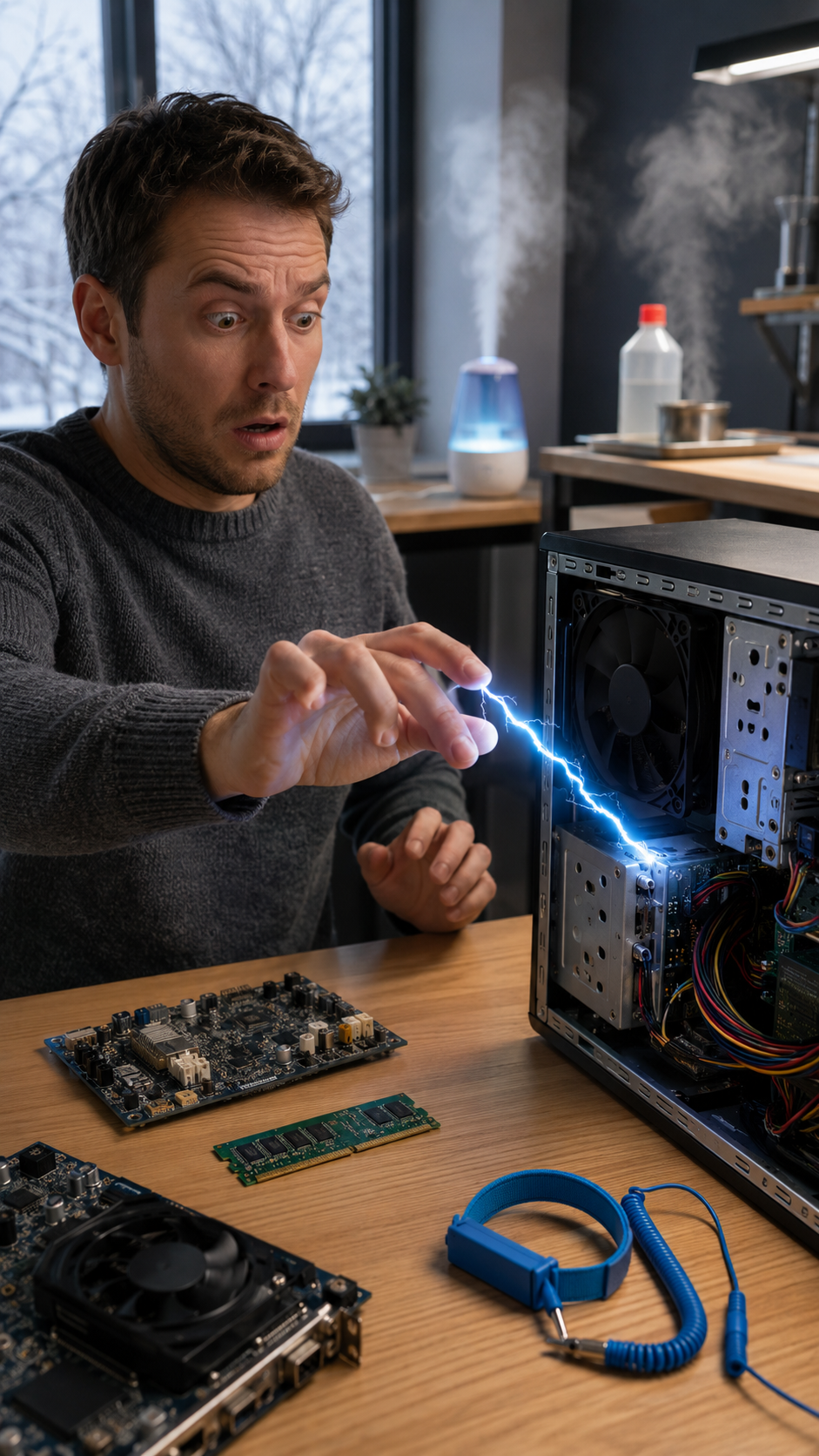
A discharge too small for a person to feel can still damage an electronic component. Microchips, circuit boards, memory modules, graphics cards, and sensors contain extremely small conductive paths that may be disrupted by ESD.
Damage is not always immediate. A component may continue working but become less reliable or fail later.
When installing or repairing electronics:
Follow the manufacturer’s ESD instructions.
Work on a clean, hard surface rather than carpet.
Avoid fleece, wool, and highly static-generating synthetic clothing.
Leave components in antistatic packaging until needed.
Hold circuit boards by their edges.
Do not touch exposed contacts or chips unnecessarily.
Use an approved ESD mat and correctly grounded wrist strap when appropriate.
Keep ordinary plastic bags and foam away from exposed components.
Power down equipment according to the manufacturer’s procedure.
The EOS/ESD Association identifies grounding, ionization, and conductive or static-dissipative materials as core methods for reducing charge and protecting sensitive devices.
An antistatic wrist strap is designed for appropriate electronics work. It does not make it safe to work on energized electrical equipment and should never be connected to an unknown conductor or live circuit.
Reducing Static Electricity at Home
Household static cannot always be eliminated, but it can usually be reduced.
Increase indoor humidity carefully
Very dry indoor air encourages charge to remain on surfaces. A properly maintained humidifier can help, especially during winter.
Use a hygrometer to monitor humidity and avoid creating condensation on windows or walls. Excessive humidity can encourage mold and dust mites. Clean the humidifier according to its instructions so it does not spread microorganisms or mineral residue.
Avoid over-drying laundry
Clothes rubbing together in a dryer can create significant static charge. Remove laundry when it is dry rather than running an unnecessarily long cycle. Dryer balls, fabric softener, or an appropriate antistatic laundry product may reduce static cling when used according to label instructions.
Consider clothing and furnishing materials
Synthetic fabrics, plastic surfaces, and certain carpets often contribute to static buildup. Natural fibers may generate less noticeable static in some combinations, although any two materials can exchange charge.
When static is persistent, consider antistatic carpet treatments or products intended for that specific surface. Test products in a hidden area and follow their safety instructions.
Moisturize dry skin
Very dry skin can make static shocks feel more frequent or uncomfortable. Applying a suitable moisturizer may help reduce dryness, although it is not a substitute for ignition-control procedures in a hazardous environment.
Touch metal more deliberately
In an ordinary room with no flammable material nearby, touching a large metal object with a key or knuckle first may make a discharge less painful. However, never intentionally discharge static near gasoline, solvents, gas cylinders, aerosols, or combustible dust.
Preventing Startle-Related Accidents
A static shock may not seriously injure the body, but the reflexive reaction can cause an accident. This matters when someone is:
If repeated static shocks occur in these situations, treat them as a workplace or environmental warning rather than a joke. Report the problem, review grounding and flooring conditions, and use approved static-control measures.
What to Do If a Static Spark Starts a Fire
If gasoline vapor, solvent fumes, or combustible material ignites, do not attempt to solve the problem by touching or grounding the source.
Move away, warn others, and activate the emergency alarm or call 911. Use a fire extinguisher only if the fire is small, you have been trained, the extinguisher is suitable for that type of fire, and you have a clear escape route behind you.
At a fuel pump, do not pull a burning nozzle out of the vehicle because this can spread burning fuel. Back away and alert the station attendant or use the emergency shutoff if it can be reached safely.
If clothing catches fire, stop, drop, and roll. Call emergency services for burns or smoke exposure.
Common Static-Electricity Myths
“A high-voltage static shock must be deadly”
Voltage alone does not determine injury severity. Ordinary static discharges are brief and contain little total energy. They should not be confused with sustained contact with an electrical power source.
“If I cannot see a spark, there is no danger”
Some discharges capable of igniting a sensitive vapor or damaging electronics may be invisible or impossible to feel.
“Grounding is just touching any metal object”
An object is not necessarily connected to a safe earth ground simply because it is made of metal. Industrial grounding requires an approved, verified path.
“Static is only a winter problem”
Dry winter air makes household shocks common, but static can be generated year-round by flowing liquids, moving powders, conveyor belts, synthetic materials, and industrial processes.
A Small Spark Deserves Respect in the Right Environment
Most static shocks at home are harmless inconveniences. The risk changes dramatically, however, when a spark occurs around flammable vapor, combustible dust, fuel transfer, sensitive electronics, machinery, or work at height.
The safest approach is situational awareness. Control dry indoor air, handle electronics with appropriate ESD precautions, remain outside your vehicle while refueling, fill portable gas cans only on the ground, and never improvise bonding or grounding systems at work. Static electricity may be invisible, but its risks are manageable when you know where a spark matters most.
Where do you notice static electricity most often—in your home, car, workplace, or around electronics? Have you found a safe and effective way to reduce it? Share your experience or questions in the comments so other readers can learn from them too.
Hi, I’m the creator and editor behind ZestyHabit. I research everyday safety, first aid, and practical wellness topics using official guidance and reliable public sources, then turn that information into clear, realistic steps for daily life.
My goal is to help readers make safer, better-informed choices at home and beyond.