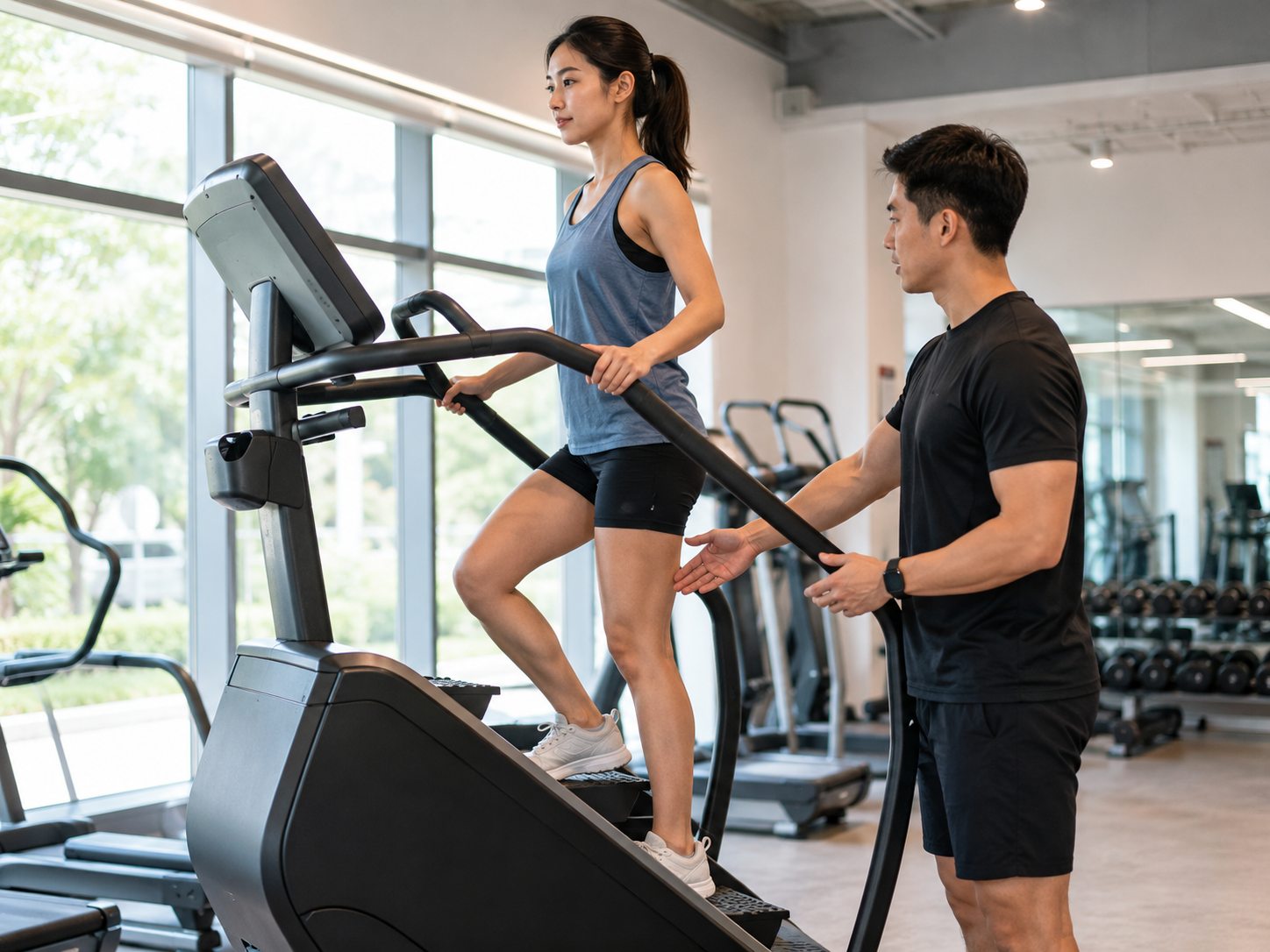
Stair Climber Precautions: How to Protect Your Knees and Calves
Minjin Park
·
The stair climber looks simple: step, step, step, repeat. It does not require complicated choreography, heavy weights, or a lot of space. You get on the machine, choose a speed, and let your legs do the work.
But anyone who has stayed on a stair climber for more than a few minutes knows it can become intense quickly. Your heart rate rises, your calves start burning, your thighs feel heavy, and suddenly those “simple” steps feel much harder than expected.
That is why the stair climber deserves more attention than many people give it. It can be a great cardio and lower-body workout, but it can also irritate your knees, overload your calves, or strain your lower back if your posture, step depth, pace, or foot placement is off.
The goal is not to fear the machine. The goal is to use it in a way that builds strength and endurance without making your joints feel beaten up. Here is what to watch out for before your next stair climber session.
Why the Stair Climber Can Feel Hard on the Knees and Calves
The stair climber combines repeated stepping with constant bodyweight resistance. Unlike walking on flat ground, every step asks your hips, knees, ankles, calves, glutes, and quads to work against gravity.
That repeated movement can be useful, especially if you want a low-impact cardio option compared with running. But “low impact” does not mean “no stress.” Your knees still bend over and over. Your calves still push and stabilize. Your ankles still work through each step.
Problems usually appear when the pace is too fast, the steps are too shallow, the heels stay lifted, the body leans too heavily on the handles, or the workout lasts longer than your muscles can control.
Good stair climber form should feel strong and steady. It should not feel like your knees are being jammed forward or your calves are cramping with every step.
Start With a Warm-Up Pace
One of the easiest mistakes is starting too fast.
The stair climber can feel manageable for the first minute, so people often choose a speed that is too aggressive. Then, a few minutes later, their form changes. They start leaning on the handles, stepping only with the toes, rushing the steps, or letting the knees cave inward.
Start slower than you think you need to. Give your calves, knees, hips, and breathing a few minutes to adjust. A warm-up pace should let you stand tall and step smoothly without gripping the machine for survival.
After three to five minutes, you can increase the speed gradually. This gives your joints and muscles time to prepare instead of suddenly forcing them into a hard climb.
A better stair climber workout usually starts controlled, not dramatic.
Keep Your Posture Tall
Posture matters more than people realize on the stair climber.
A common mistake is leaning forward heavily, rounding the back, and resting body weight on the handles. This may make the workout feel easier, but it also changes the exercise. Instead of your legs supporting your body, your arms and the machine start doing some of the work.
Try to keep your chest lifted, shoulders relaxed, and gaze forward or slightly downward. Your ribs should stay stacked over your pelvis. Your core should feel lightly engaged, not completely relaxed.
You do not need to stand stiff like a statue. A slight forward lean from the ankles or hips can be natural. But avoid folding over the console or hanging from the handles.
If you cannot keep an upright posture at your chosen speed, slow down. The machine should match your form, not force you into a hunched position.
Use the Handles Lightly
The handles are there for balance, not for carrying your body.
Lightly touching the handles can help you feel stable, especially when you are getting used to the machine. But gripping hard or pushing down through your arms reduces the work your legs are supposed to do. It can also hide the fact that the pace is too fast.
A good test is to ask yourself: could I briefly remove my hands without losing control? You do not have to train hands-free, but you should not feel completely dependent on the handles.
If you are holding on tightly because you feel unstable, lower the speed. If you are leaning on the handles because your legs are tired, take a break or reduce the intensity.
Using the handles lightly helps your knees, calves, hips, and core work more naturally.
Place Your Whole Foot on the Step
Foot placement is one of the biggest stair climber precautions for protecting the calves and knees.
Many people step only on the balls of their feet, especially when the pace is fast. This keeps the heels lifted and forces the calves to work constantly. A little calf work is expected, but staying on your toes the entire time can lead to tightness, burning, or strain.
Try to place as much of your foot on the step as the machine allows. Your heel does not always need to press heavily into the step, but it should not be floating high the whole time.
Think about stepping through the whole foot: heel, midfoot, and forefoot. This helps distribute the work through the glutes, quads, hamstrings, and calves instead of overloading one area.
If your calves are burning within the first few minutes, check whether you are climbing on your toes.
Avoid Tiny, Rushed Steps
When the speed gets too high, many people start taking tiny steps. They barely press down before the next step arrives. This can make the workout feel frantic and may increase stress on the knees and calves.
Shallow stepping often keeps the ankles and calves under constant tension. It may also prevent the glutes from contributing fully because you are not stepping deeply enough to use the hip.
Instead, use a pace that allows a full, controlled step. Let your foot land securely. Press through the step. Keep your knees tracking in a comfortable line.
You do not need to exaggerate each step or sink too low. But each step should feel intentional, not like you are running away from the machine.
If you cannot complete a clean step, the speed is too high.
Watch Your Knee Tracking
Your knees should generally move in the same direction as your toes.
On the stair climber, knee collapse can happen when you are tired, moving too fast, or not paying attention to foot placement. If your knees drift inward with each step, the joints may feel irritated over time.
Look down briefly and check your alignment. Your knees should not be knocking inward or twisting. Your feet should not be turning dramatically outward or inward unless that is your natural comfortable stance.
A helpful cue is to press through the step while keeping the knee softly lined up over the middle of the foot.
This does not need to be perfect, but it should be controlled. If your knees wobble, slow down and reset.
Do Not Let Your Heels Stay Lifted the Whole Time
The stair climber naturally works the calves, but it should not feel like a never-ending calf raise.
If your heels stay high during the entire workout, your calves may fatigue quickly. This can lead to tightness, cramping, or strain, especially if you are new to the machine or already have tight calves from running, walking hills, or wearing heeled shoes.
Try allowing the heel to lower slightly as the foot settles onto the step. You do not need to force a deep stretch. Just avoid staying perched on your toes.
If the machine’s steps are too small for your full foot, focus on lowering the heel as much as comfortably possible. Reduce the speed so you have time to place your foot better.
Your calves should work, but they should not be the only muscles working.
Choose a Pace You Can Maintain
A fast stair climber pace may look impressive, but it is not always better.
When pace is too high, posture usually gets worse. People lean forward, grip the handles, step on their toes, shorten their range, and breathe harder than they can control.
A good pace should challenge your heart and legs while still allowing clean steps. You should be able to maintain your posture, keep your foot placement steady, and avoid slamming or skipping steps.
For beginners, a moderate pace for a shorter time is better than an intense pace that destroys form after two minutes.
You can always make the workout harder later by increasing time, resistance, or intervals. First, build a clean rhythm.
Be Careful With Long Sessions
The stair climber can feel efficient because it gets hard quickly. That also means long sessions may be more demanding than expected.
If you are new to it, you do not need to start with 30 or 45 minutes. Even 5 to 10 minutes can be enough at first, especially if your calves are not used to repeated stepping.
Build gradually. Add a few minutes over time rather than jumping into long sessions right away.
Overdoing it too soon can leave your calves extremely sore or make your knees feel irritated the next day. Soreness is not always a sign of a better workout. Sometimes it is just a sign that you asked too much too soon.
A sustainable routine is better than one brutal session that makes you avoid the machine for a week.
Do Not Skip Calf Mobility
Tight calves can change how you step.
If your calves and ankles are stiff, you may find it harder to place your foot fully on the step. You may stay on your toes without realizing it. This can increase calf fatigue and affect knee mechanics.
Before using the stair climber, do a short warm-up with ankle circles, calf raises, gentle calf stretches, or walking. After the workout, take a few minutes to stretch the calves lightly.
Do not force aggressive stretching when the muscle is already cramping or painful. Gentle, consistent mobility work is usually more helpful than pulling hard for a few seconds.
If your calves always feel overloaded on the stair climber, ankle and calf mobility may be part of the issue.
Engage Your Glutes
The stair climber should not only be a quad-and-calf workout. Your glutes can help power each step, especially when you use a controlled step depth and avoid leaning heavily on the handles.
Think about pressing through the foot and driving the step down with the hip, not just pushing from the toes. This can help distribute the work across the lower body.
If you want to feel your glutes more, slow the pace slightly and take cleaner, deeper steps. Keep your torso tall and avoid bouncing.
Do not exaggerate by leaning far forward or taking huge steps that strain your hips. Just allow the glutes to participate naturally.
When the glutes do more, the knees and calves often feel less overloaded.
Avoid Locking or Snapping the Knees
Each step should be smooth. Avoid forcefully snapping the knee straight or locking it hard at the bottom of the step.
Hard, choppy movement can make the knees feel irritated, especially during longer sessions. Keep a soft bend and controlled pressure through the leg.
The stair climber is repetitive, so small habits add up. A slightly rough step repeated hundreds of times can become uncomfortable.
Focus on quiet, smooth stepping. The machine should not sound like you are stomping through every rep.
Wear Supportive Shoes
Shoes affect how your feet, ankles, calves, and knees feel on the stair climber.
Very soft or unstable shoes can make your feet wobble. Shoes with poor grip may make you feel less secure on the steps. Shoes that are too tight can make your feet uncomfortable as your workout continues.
Choose shoes that feel stable, supportive, and comfortable. They do not need to be special stair climber shoes, but they should let you place your foot confidently.
Avoid using the machine in slides, sandals, loose shoes, or worn-out sneakers. Your feet need a secure base.
You do not have to stay at one difficult pace for the entire workout.
Intervals can be a smarter way to use the stair climber, especially if you are trying to build fitness without losing form. For example, you can do one minute at a moderate pace, then one minute slower. Or thirty seconds faster, followed by ninety seconds easy.
This lets your heart rate rise while giving your legs time to recover.
The key is that even your faster intervals should still be controlled. If the fast portion makes you lean on the handles or step only on your toes, it is too fast.
Intervals should challenge you, not turn your form into chaos.
Pay Attention to Warning Signs
Some effort is normal. Your breathing may get heavier. Your thighs and glutes may burn. Your calves may work. That is expected.
But sharp knee pain, sudden calf pain, Achilles discomfort, numbness, dizziness, or lower back pain should not be ignored.
If your knees hurt, reduce the speed and check your foot placement, knee tracking, and posture. If your calves feel like they are cramping or pulling, stop and rest. If your lower back hurts, check whether you are leaning too heavily or arching your back.
Do not push through pain just to finish a number on the screen.
The machine will always be there next time. Your joints need to last longer than one workout.
Step Off Carefully
Getting off the stair climber while tired can be awkward.
Always slow the machine down before stepping off. Use the handles for balance. Wait until the steps are moving slowly enough that you can exit safely.
Do not hop off while the machine is still moving quickly. Your legs may feel more fatigued than you realize, and your coordination may be slightly off after climbing.
Take a moment after stepping down. Walk around slowly, breathe, and let your legs adjust.
Before and during your workout, check these points:
Start with a slower warm-up pace. Keep your posture tall. Use the handles lightly, not as body support. Place as much of your foot on the step as possible. Avoid staying on your toes the whole time. Keep your knees tracking over your feet. Use controlled, complete steps. Choose a pace you can maintain with good form. Stop if you feel sharp knee, calf, or Achilles pain. Step off slowly and carefully.
These basics make the stair climber safer, cleaner, and more effective.
Final Thoughts
The stair climber can be an excellent cardio tool. It challenges your legs, raises your heart rate, and can fit into a short gym session when you want something efficient. But it is not a machine to rush through mindlessly.
Your posture, step depth, foot placement, calf control, and pace all matter. Leaning on the handles, stepping only on your toes, going too fast, or staying on too long before your body is ready can turn a useful workout into knee or calf discomfort.
Start slowly. Stand tall. Use your whole foot. Keep your knees aligned. Let your calves work, but do not make them do everything. Build your time and intensity gradually.
A good stair climber workout should leave you feeling challenged and strong, not limping away with tight calves and sore knees.
Hi, I’m the creator and editor behind ZestyHabit. I research everyday safety, first aid, and practical wellness topics using official guidance and reliable public sources, then turn that information into clear, realistic steps for daily life.
My goal is to help readers make safer, better-informed choices at home and beyond.