
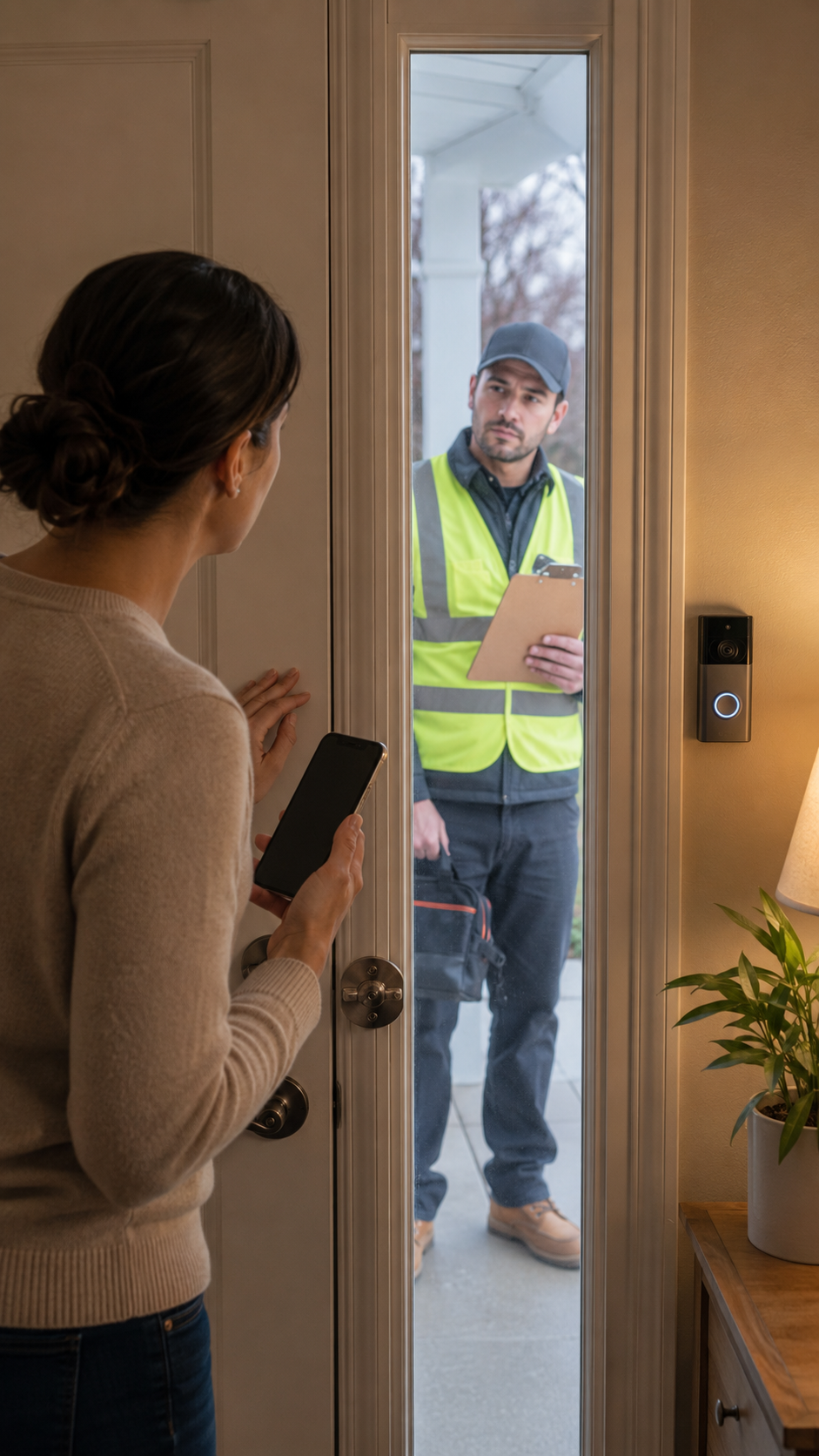

Learn how criminals may pose as delivery drivers, utility workers, contractors, or officials—and how to respond safely to suspicious visitors.
A knock at the front door usually feels ordinary. It could be a package, a neighbor, a utility worker, or someone offering a local service. Most visitors are harmless, but criminals sometimes rely on that sense of normality to persuade a resident to unlock the door.
These incidents are often called distraction burglaries or bogus-caller crimes. Someone creates a believable reason to speak with you or enter your home. While you are focused on that person, an accomplice may look for another entrance, enter behind you, or search another part of the house.
In other cases, the visitor may intend to pressure you into paying for unnecessary work, reveal personal information, or open the door far enough for a forced entry. If threats or violence are used, the incident may become a robbery rather than a burglary or scam.
Understanding the warning signs does not mean treating every stranger as a criminal. It means slowing the interaction down, verifying unexpected claims, and remembering that you never have to open your door simply because someone knocks.
What Is a Distraction Burglary?
A distraction burglary begins with deception. Instead of obviously breaking a window or forcing a lock, the offender tries to be invited inside or keeps the resident occupied while someone else enters.
The visitor may wear work clothes, carry a clipboard, hold a package, display an identification badge, or use the name of a real organization. These details can make the story feel convincing, but uniforms and badges alone do not prove anyone’s identity.
Police guidance warns that bogus callers often pretend to represent utility providers, local authorities, repair companies, charities, or other professional organizations. Some also claim to need urgent help. They may work in pairs even when the resident can see only one person. Staffordshire Police
The goal is usually to make the resident act before there is time to verify the story.
Why These Front-Door Deceptions Can Be Effective
Most people want to be polite. They do not want to ignore a delivery driver, delay an important repair, or refuse help to someone who appears distressed. Criminals can exploit that instinct by combining authority, urgency, confusion, and social pressure.
A suspicious visitor might imply that:
- A pipe, meter, or electrical system must be checked immediately
- A package cannot be delivered without personal information
- Damage has just been discovered on the roof or driveway
- They were sent by a landlord, utility company, or government office
- A neighbor needs help
- Refusing entry will cause a fine, service interruption, or safety problem
- The offer or inspection is available only at that moment
The details may vary, but the emotional pattern is often similar: “You must decide now.”
A legitimate visitor should normally be willing to remain outside while you independently verify their identity. Someone who becomes angry, intimidating, or increasingly urgent when you ask reasonable questions should not be allowed inside.
Common Disguises and Stories Used at the Door
The following examples are presented so residents can recognize suspicious behavior—not as a complete list of every possible approach.
1. The Unexpected Utility Worker
A visitor may claim to be from the water, gas, electric, cable, or telecommunications company. They might say there is a leak, meter problem, service interruption, or safety inspection requiring immediate access.
Real utility emergencies can happen, so do not automatically dismiss the warning. However, keep the door locked and call the utility company using the number printed on a recent bill or listed on its official website. Do not rely on a telephone number supplied by the visitor.
If you smell gas or believe there may be a genuine immediate hazard, leave the property without operating switches or creating a flame, move to a safe location, and contact the gas utility or emergency services yourself.
2. The Delivery Problem
Someone wearing delivery-style clothing may say that a package requires a signature, has been damaged, or needs to be brought inside because it is heavy. Another variation involves asking you to confirm personal or financial information before releasing a package.
You can usually communicate through a locked door, intercom, or video doorbell. Check the retailer’s app or the carrier’s official tracking page rather than scanning an unfamiliar code or calling a number provided at the door.
The U.S. Postal Inspection Service warns that postal impersonation scams may seek personally identifying information under the pretense of verifying a delivery. U.S. Postal Inspection Service
3. The Contractor Who “Noticed a Problem”
An unexpected contractor may claim to have spotted roof damage, unsafe trees, a cracked driveway, clogged gutters, or another urgent repair. Some may say they have materials left over from a nearby job and can offer a special price.
Even if the problem appears real, there is rarely a good reason to make an immediate decision at the door. Do not allow the visitor inside, pay a cash deposit, or follow them to a secluded part of the property.
Ask for written information, research the company independently, check licensing requirements, and obtain multiple estimates before agreeing to significant work.
4. The Government or Official Representative
A visitor might claim to represent a government agency, housing authority, health department, tax office, census operation, or law enforcement organization. A badge, official language, or knowledge of your name does not automatically make the claim genuine.
The Federal Trade Commission warns that impersonators may use real agency names, employee identification numbers, and personal details to appear credible. Government representatives should not demand immediate payment through cash, gift cards, cryptocurrency, or a payment app. Federal Trade Commission
Keep the door closed and verify the visit through the agency’s publicly listed telephone number. If someone claims to be a police officer and you are uncertain, call 911 or the local police department to confirm.
5. The Person Asking for Emergency Help
A stranger may say that their car broke down, their phone died, a child is missing, or someone nearby is injured. The story may be completely genuine, but helping does not require letting the person into your home.
Keep the door locked and offer to call emergency services, roadside assistance, or another appropriate service for them. A person facing a real emergency should generally welcome that solution. Be especially cautious if they reject outside help and insist on entering.
6. The Charity Worker, Surveyor, or Salesperson
Door-to-door fundraising and sales can be legitimate, but the interaction can also be used to collect information about the home. Questions about who lives there, when everyone is at work, whether an alarm is installed, or where valuables are kept should never be answered.
Do not provide identification numbers, banking details, card information, or cash simply because the person appears friendly. If you want to support a charity, contact the organization later through its official website.
7. The Landlord, Building Worker, or Service Appointment
In apartments and shared buildings, someone may claim to have been sent by management to inspect a detector, repair an appliance, or investigate a complaint.
Call the landlord, management office, or service provider using contact information you already have. Ask whether a visit was scheduled and request the worker’s name. Do not use a number displayed only on the visitor’s badge, vehicle, or paperwork.
Warning Signs of a Suspicious Doorstep Visitor
No single behavior proves criminal intent, but several warning signs together should make you cautious:
- The visit is unexpected and cannot be independently confirmed.
- The person insists that the situation is urgent.
- They ask to enter before explaining the problem clearly.
- They become irritated when asked to wait outside.
- Their identification is blurry, damaged, or shown too quickly.
- The name on the badge does not match the company or appointment.
- There is no clearly marked work vehicle when one would be expected.
- They request cash, gift cards, cryptocurrency, or immediate payment.
- They ask whether you live alone or when another resident will return.
- They repeatedly look past you into the home.
- A second person is waiting out of sight or moving around the property.
- They try to direct you into another room.
- They test the door, place a foot near it, or refuse to step back.
- Their story changes when you ask basic questions.
Trusting your instincts is reasonable. You do not need enough evidence to accuse someone of a crime before deciding not to open the door.
What to Do When an Unexpected Person Knocks
First, pause. You are not required to answer immediately—or at all.
Look through a peephole, window, security camera, or video doorbell without unlocking the door. If you choose to respond, speak through the closed door.
You can say:
- “I don’t open the door for unexpected visitors.”
- “Please leave your information outside.”
- “I’ll call the company and confirm the appointment.”
- “I can call emergency services for you.”
- “I’m not interested. Please leave the property.”
Avoid announcing that you are home alone. You do not need to invent a complicated explanation or debate the visitor. A short, firm statement is enough.
If the person claims to represent an organization, find its official number yourself. Close the conversation while you verify. Genuine workers should not object to this precaution, and police specifically recommend independent verification rather than using a number supplied by the caller. Police.uk
Check that other doors and accessible windows are locked before focusing on the front entrance. Distraction offenders may work with an accomplice who approaches another part of the home.
If you feel uncomfortable, call a trusted neighbor or family member. Let the visitor know that someone is coming over or that you are contacting the organization directly.
What If the Person Refuses to Leave?
Do not open the door to argue. Move away from the entrance and call 911 if the person:
- Tries to force the door open
- Makes a threat
- Displays a weapon
- Attempts to enter through another door or window
- Continues testing doors after being told to leave
- Appears to be coordinating with someone around the property
- Creates an immediate fear for your safety
Give the dispatcher your address first. Then describe what you can observe safely, including clothing, approximate age, direction of travel, vehicle description, and whether another person is present.
Do not step outside to photograph the person, confront them, or block their escape. Your safety matters more than obtaining evidence or protecting property.
If Someone Has Already Entered the Home
If you become suspicious after allowing someone inside, do not try to physically remove or restrain them.
Move toward a safe exit if possible and take children or vulnerable family members with you. Go to a neighbor’s home, locked room, or another secure location and call 911. Avoid moving deeper into the house or placing yourself between the person and the exit.
If valuables are taken, do not chase the offender. Once it is safe, avoid touching areas they may have handled. Save doorbell footage, security recordings, messages, paperwork, or vehicle information for police.
If you shared financial or identity information, contact your bank or card issuer immediately. Change affected passwords and report suspected fraud at ReportFraud.ftc.gov.
Simple Ways to Improve Front-Door Security
Technology cannot replace good judgment, but several layers of security can give you more time and information:
- Install and consistently use a quality deadbolt.
- Keep the door locked even while you are home.
- Use a wide-angle peephole, intercom, or video doorbell.
- Maintain bright lighting around the entrance.
- Repair weak frames, locks, and loose strike plates.
- Keep side and back entrances secured.
- Trim vegetation that blocks the view of the doorway.
- Set deliveries to a secure location when possible.
- Teach children never to open the door without an adult.
- Create a household rule for verifying all unexpected workers.
- Keep emergency and utility numbers easily available.
- Arrange a check-in system for older relatives living alone.
Cameras may record an incident and discourage some offenders, but they do not make it safe to open the door. The locked barrier remains your most important immediate protection.
Politeness Is Never More Important Than Safety
Disguised intruders succeed when an ordinary-looking visit creates enough urgency, sympathy, or authority to make someone unlock the door. The strongest response is simple: keep the door closed, slow the conversation down, verify every unexpected claim independently, and call for help if the visitor becomes threatening.
A legitimate worker, delivery driver, official, or person seeking help should understand reasonable safety boundaries. You are not being rude by protecting your household.
Have you ever received an unexpected doorstep visit that did not feel right, and how did you handle it? Share your experience or best front-door safety tip in the comments so other readers can learn from it.

Hi, I’m the creator and editor behind ZestyHabit. I research everyday safety, first aid, and practical wellness topics using official guidance and reliable public sources, then turn that information into clear, realistic steps for daily life.
My goal is to help readers make safer, better-informed choices at home and beyond.


