
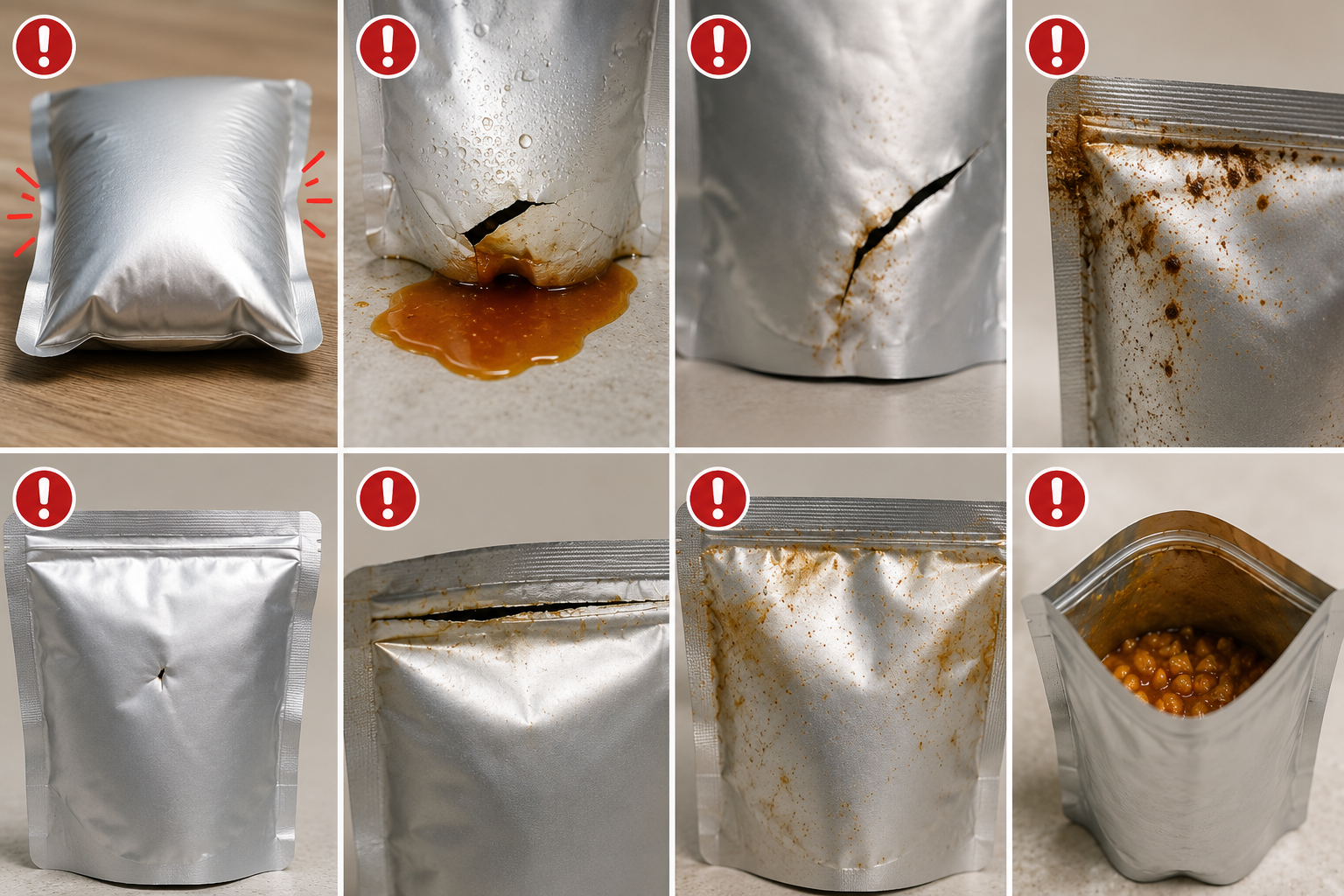

Is a dented, leaking, or swollen retort pouch safe to eat? Learn which packaging defects signal contamination, how to inspect shelf-stable pouches, and when to discard them.
Retort pouches are lightweight, convenient, and surprisingly durable. They are used for shelf-stable rice, curry, tuna, soup, baby food, military meals, sauces, beans, and ready-to-eat entrées. Because the food has been commercially heat-processed and sealed, an unopened pouch can often remain at room temperature for months or even years.
That long shelf life, however, depends on one crucial condition: the package must remain hermetically sealed.
A tiny puncture, separated seam, hidden channel in the seal, or damaged laminate may allow microorganisms or moisture to enter. A swollen pouch can also indicate gas production from spoilage. Although commercially produced retort foods are generally very safe, a compromised package should never be treated as a minor cosmetic issue.
The simplest rule is this: discard a retort pouch that is swollen, leaking, punctured, torn, opening at a seam, or otherwise abnormal. Do not taste the food to determine whether it is safe.
Here is how to inspect retort pouches, distinguish harmless surface wear from meaningful damage, and dispose of a suspicious package safely.
What Is a Retort Pouch?
A retort pouch is a flexible or semi-rigid package designed to withstand commercial heat sterilization. Food is placed inside the pouch, the edges are sealed, and the entire package is heated under carefully controlled conditions.
This process destroys microorganisms that could cause illness or spoilage. The package then prevents new contamination from entering.
Most retort pouches contain multiple bonded layers. Depending on the product, those layers may include:
- Heat-resistant plastic
- An oxygen and moisture barrier
- Aluminum foil
- A printable outer film
- A heat-sealable inner food-contact layer
Each layer performs a different job. The outer layer provides strength and printing, the barrier layer protects the food from oxygen and light, and the inner layer creates the sealed seam.
This construction explains why a pouch can look mostly normal even when one part of the barrier has been damaged. The package does not need to split completely open for its protective function to become questionable.
Why Package Integrity Matters
Shelf-stable retort food is different from dried pasta or crackers. Many pouch meals contain moist, low-acid foods such as meat, seafood, vegetables, beans, or rice. These foods require commercial sterilization and an intact seal to remain safe at room temperature.
If the pouch develops a hole or seal failure after processing, bacteria, mold, air, or moisture may enter. If processing was inadequate or the package becomes contaminated, microorganisms can grow inside without necessarily producing an obvious odor.
One rare but severe concern associated with improperly processed or compromised shelf-stable foods is botulism. The toxin that causes botulism cannot reliably be detected by sight, smell, or taste. The CDC warns that even a small taste of contaminated food can be deadly. CDC botulism prevention guidance
Not every damaged pouch contains dangerous bacteria, but consumers cannot evaluate its microbiological safety at home. When the barrier or seal is questionable, replacement is safer than experimentation.
Warning Sign No. 1: A Swollen or Bulging Pouch
A pouch that appears inflated, unusually tight, or balloon-like should be discarded.
Swelling may result from gas produced by microorganisms inside the package. It can also occur because the package was exposed to extreme temperatures or experienced another physical problem. Regardless of the cause, unexplained swelling is not something to test by opening the pouch.
A normal retort pouch may contain a small amount of headspace, and some products are naturally softer or puffier than others. To identify a meaningful change:
- Compare the package with identical products.
- Look for unusual tightness or outward pressure.
- Check whether the pouch used to lie flat but now rocks or balloons.
- Notice whether both sides are expanding.
- Examine the seals for stress or separation.
Do not squeeze an inflated pouch to see whether it bursts or leaks. Pressure may force contaminated food through a weak seam and spread it onto your hands, clothing, or kitchen surfaces.
The USDA advises discarding retort pouches that show swelling or leakage. USDA packaging guidance
Warning Sign No. 2: Leakage, Wetness, or Dried Residue
Any leaking shelf-stable pouch should be thrown away.
A leak may appear as:
- Drops of liquid
- A damp spot on the package
- Sticky residue along the seam
- Dried sauce or food around an edge
- Staining inside the shipping box
- An unusual odor coming from the unopened package
- Moisture collecting underneath it
Do not assume the mess came from another product without inspecting every pouch. A pinhole may release only a tiny amount of liquid, especially when the package is moved or squeezed.
If liquid can escape, microorganisms can potentially enter. Wiping the pouch clean does not restore the seal, and reheating the food does not make an unknown package failure safe.
Place a leaking pouch inside another bag without pressing on it. Keep it away from children and animals, then dispose of it according to local waste guidance.
Warning Sign No. 3: Punctures, Pinholes, Cuts, or Tears
Even a very small hole can defeat the purpose of retort packaging.
Punctures may be caused by:
- A box cutter used to open a shipping carton
- A sharp edge on another package
- Forks, knives, or pantry tools
- Pet teeth or rodent damage
- Rough handling during delivery
- A hard grain, bone, or shell fragment pressing from inside
- Repeated folding along the same line
Some holes are obvious. Others appear only as a dark dot, tiny wet area, or sharp crease. Do not hold a suspicious pouch up to bright light and repeatedly bend or squeeze it, since this could enlarge the damage.
If you cannot confidently confirm that the pouch is intact, contact the manufacturer or discard it.
Warning Sign No. 4: Damaged or Separating Seams
The sealed border around a retort pouch is one of its most important safety features. The seal should look continuous, firmly bonded, and free from openings.
Discard the package if you notice:
- A seam that is peeling apart
- A corner that has opened
- A split extending into the seal
- A channel running from the food area through the seam
- Food or liquid trapped across the sealing surface
- An area that looks incompletely bonded
- A deep wrinkle crossing the entire seal
- A seam repaired with tape, glue, or another material
FDA guidance for salvage-food shoppers specifically warns against purchasing sealed packages that are torn, have holes, leak, or are coming apart at the seams. FDA guidance on damaged packaged foods
A slightly uneven outer edge left beyond the sealed area may be harmless, but separation within the bonded seam is not. If you cannot tell which area is functional, compare it with another pouch or ask the manufacturer.
Warning Sign No. 5: Delamination or Peeling Layers
Delamination occurs when the bonded layers of a pouch begin to separate. It may look like:
- Bubbles trapped between layers
- Peeling film
- Blistered areas
- Silvery patches changing shape
- A cloudy region within the laminate
- A crackling layer that moves independently
- Separation near a corner or seam
Minor scuffing of the printed exterior does not always compromise the package. However, widespread bubbling, peeling near the seal, exposed foil, or separation that appears to reach the food-contact layer should be treated seriously.
Do not cover a damaged area with tape and return the pouch to the pantry. Tape cannot restore the original oxygen barrier or hermetic seal.
Warning Sign No. 6: Deep Creases and Sharp Folds
Retort pouches are flexible, so ordinary wrinkles are expected. A shallow bend from sitting in a box does not automatically mean the food is unsafe.
The concern is a severe crease that:
- Crosses a sealed edge
- Has turned white or cracked
- Exposes an inner layer
- Creates a sharp point
- Shows residue or moisture
- Has been folded repeatedly
- Feels significantly thinner than the surrounding material
A deep fold can stress the laminate and eventually create a pinhole. This is especially concerning when it occurs at a corner, where several sealed layers meet.
When storing retort pouches, avoid crushing them under heavy cans or folding them to fit into a small bin.
Warning Sign No. 7: Heat, Fire, or Chemical Damage
A pouch that has melted, scorched, shriveled, or become distorted from heat should be discarded.
Do not store retort food:
- Directly above a stove
- Beside an oven vent
- Near a furnace or water heater
- Inside a hot vehicle
- In direct sunlight for extended periods
- In an excessively hot attic or garage
Heat may damage seals, alter the packaging layers, and accelerate food deterioration. Exposure to fire introduces additional concerns from smoke, heat, and firefighting chemicals. The USDA advises discarding food that has been near a fire, even when the packaging appears closed. USDA emergency food-safety guidance
Similarly, discard a pouch contaminated with household chemicals, pesticides, fuel, or an unknown liquid. Washing the exterior may not be sufficient if the package has been damaged or the contaminant could penetrate the material.
Warning Sign No. 8: Signs of Tampering
Retort pouches should be sold in their original, intact packaging.
Possible tampering signs include:
- A cut that appears to have been resealed
- Tape or adhesive over an edge
- A missing outer package
- Mismatched or altered labels
- An obscured lot code or date
- Unusual puncture marks
- A package that weighs much less than expected
- A product that looks different from identical pouches
- Damage inconsistent with ordinary shipping
Do not eat the food if deliberate tampering is suspected. Preserve the package without opening it, notify the retailer and manufacturer, and follow instructions from the appropriate authorities.
What If the Pouch Makes a Hissing Sound?
Some products may release a slight sound when opened because of normal pressure differences. However, a pouch that is already swollen, leaks gas before opening, or spurts liquid or foam is abnormal.
If a suspicious container releases gas, liquid, or foam:
- Do not taste the food.
- Do not smell it closely.
- Keep your face and hands away from the opening.
- Stop handling the package unnecessarily.
- Keep children and pets away.
- Follow local health department or manufacturer guidance for disposal.
The FDA advises consumers not to use products that are discolored, moldy, have an off odor, or spurt liquid or foam when opened. FDA food-tampering safety guidance
Remember that a normal appearance does not prove safety. Dangerous botulinum toxin may be present without an unusual taste or smell.
Cosmetic Damage Versus Unsafe Damage
Because retort packaging is flexible, not every mark requires disposal. A pouch may still be usable when it has:
- A light surface scratch affecting only the printing
- A gentle curve from normal packing
- A loose paper label
- A superficial wrinkle away from the sealed border
- Minor discoloration on the outer ink with no heat damage
- A slightly uneven cut outside the sealed area
The pouch should still be flat or normally shaped, dry, fully sealed, and free from cracks, holes, peeling layers, or deep creases.
When uncertain, do not rely on pressing, submerging, or conducting a homemade leak test. Manufacturers use specialized equipment to evaluate seal strength and microscopic leaks. Home testing may enlarge a defect without proving that the package is safe.
Does the Best-By Date Change the Decision?
A best-by date usually relates to quality rather than an automatic safety deadline. However, an intact package is essential regardless of the printed date.
A pouch within its best-by period should still be discarded if it is swollen, leaking, torn, or otherwise compromised. A future date does not guarantee safety after physical damage.
For an undamaged shelf-stable pouch, follow the manufacturer’s storage and date guidance. USDA information indicates that properly stored retort packages can remain stable for extended periods, but packages showing swelling or leakage should be discarded.
Once opened, the product is no longer shelf-stable. Refrigerate leftovers promptly in a clean container and use them within the period stated on the label. Do not store leftover food in a torn or opened pouch unless the manufacturer specifically designed it to be resealable.
Can Heating Make Food From a Damaged Pouch Safe?
No. Do not attempt to rescue food from a compromised pouch by boiling, microwaving, pressure-cooking, or reheating it.
The problem is not simply that live bacteria might be present. Some organisms can produce toxins, and home heating cannot reliably compensate for an unknown seal failure or improper processing.
Similarly, freezing a damaged pouch does not restore safety. Freezing slows microbial growth but does not repair the package or reliably destroy pathogens and toxins.
If the pouch is questionable, discard it unopened.
How to Dispose of a Suspicious Retort Pouch
For a swollen, leaking, or badly damaged shelf-stable pouch:
- Do not open or taste it.
- Avoid squeezing or puncturing it.
- Place it inside a sturdy plastic bag.
- Seal that bag and place it inside a second bag.
- Close the second bag securely.
- Put it in non-recyclable outdoor trash.
- Keep it out of reach of children, pets, and wildlife.
- Wash your hands after handling it.
USDA botulism guidance recommends double-bagging swollen, gassy, or spoiled shelf-stable containers before placing them in outside trash. USDA botulism guidance
Do not recycle a suspicious pouch or empty its contents into a sink, garbage disposal, compost bin, or pet-food bowl.
If several packages from the same case are swollen or leaking, retain the outer carton, receipt, lot codes, and photographs. Contact the manufacturer and retailer because the problem may involve a larger production or transportation issue.
What to Do If You Already Ate the Food
Most package damage does not result in botulism, and botulism remains rare. Nevertheless, it is a medical emergency when symptoms occur.
Possible foodborne botulism symptoms include:
- Blurred or double vision
- Drooping eyelids
- Slurred speech
- Difficulty swallowing
- Dry mouth
- Muscle weakness
- Difficulty breathing
- Nausea, vomiting, or abdominal symptoms
Seek emergency medical attention immediately if these neurological or breathing symptoms occur after eating shelf-stable food. Do not wait for symptoms to improve, and tell medical professionals what you ate and when.
Save the remaining unopened product, packaging, lot number, and receipt only if authorities instruct you to do so. Keep them isolated so nobody else consumes the food.
For more common food-poisoning symptoms such as persistent vomiting, severe diarrhea, bloody stool, dehydration, or high fever, contact a healthcare professional.
How to Prevent Retort-Pouch Damage at Home
Good pantry organization protects both food quality and packaging integrity.
Use these practical habits:
- Store pouches in a cool, clean, dry cabinet.
- Keep them away from sharp utensils and box cutters.
- Do not pile heavy cans on top of them.
- Avoid tightly folding pouches.
- Place older products in front and use them first.
- Inspect packages after delivery.
- Check for leaks before placing them beside other foods.
- Keep rodent and pet food areas separate.
- Follow any “Keep Refrigerated” instructions.
- Inspect the pouch again immediately before opening.
Not every food sold in a flexible pouch is shelf-stable. Refrigerated meals, vacuum-packed meats, and some seafood products require continuous refrigeration even when unopened. The label—not the appearance of the pouch—determines whether it belongs in the pantry.
Frequently Asked Questions
Is a slightly puffy retort pouch always unsafe?
Not necessarily. Some products contain normal headspace and may not lie completely flat. However, a pouch that has become noticeably swollen, feels unusually tight, or differs from identical packages should be discarded or reported to the manufacturer.
Can I eat food from a pouch with a small tear outside the seal?
If the tear affects only excess material beyond the sealed border and the bonded seal remains completely intact, the food may still be protected. If the tear reaches the seam or you are uncertain, discard the pouch.
Is it safe to eat a pouch meal after dropping it?
Inspect the entire package, especially the corners and seams. If it remains dry, normally shaped, and free from punctures, cracks, delamination, and seal damage, it may still be usable. Discard it if the drop created a sharp crease, leak, or opened seam.
Can I wash a dirty retort pouch?
An undamaged commercial retort pouch can generally be cleaned on the outside. However, washing cannot repair punctures, tears, or seal damage. Food exposed to chemicals, fire, or contaminated floodwater requires separate emergency guidance.
Should I open a swollen pouch to confirm that it is spoiled?
No. Opening it may spray contaminated food or liquid. Place it in two sealed bags and discard it unopened.
Final Thoughts
A retort pouch protects food only while its multilayer barrier and heat-sealed seams remain intact. Swelling, leaks, punctures, deep creases, separating seams, delamination, heat distortion, and signs of tampering are all reasons to stop and discard the product. Never taste food from a suspicious package, and do not assume that reheating can correct an unknown seal failure. When the difference between a harmless wrinkle and genuine damage is unclear, contact the manufacturer—or choose the safer option and throw it away.
Have you ever found a swollen, leaking, or strangely creased retort pouch in your pantry or grocery delivery? What warning sign made you decide to keep it or discard it? Share your experience in the comments to help other readers recognize damaged food packaging before opening it.

Hi, I’m the creator and editor behind ZestyHabit. I research everyday safety, first aid, and practical wellness topics using official guidance and reliable public sources, then turn that information into clear, realistic steps for daily life.
My goal is to help readers make safer, better-informed choices at home and beyond.


