How to Deal With Upstairs Neighbor Noise: A Practical Apartment Noise Guide
Minjin Park
·
A heavy thud wakes you just as you are falling asleep. A chair scrapes across the floor. Footsteps travel from one side of the ceiling to the other, followed by what sounds like something rolling, bouncing, or dropping.
Living below a noisy neighbor can be exhausting, especially when the disturbance happens late at night or continues for weeks. It can also be surprisingly difficult to solve. The person upstairs may not realize how clearly the sound travels, while the person downstairs may experience every impact as if it happened inside the room.
The best response usually involves several steps: identifying the type of noise, keeping an accurate record, communicating calmly, requesting practical changes, involving the landlord or property manager, and using mediation or official complaint procedures when necessary.
The goal is not to “win” a battle with your neighbor. It is to restore a reasonable living environment without turning a noise problem into a dangerous personal conflict.
Apartment noise generally falls into two categories.
Airborne noise travels through the air and includes conversations, televisions, music, barking, and shouting. It may pass through floors, walls, ventilation ducts, doors, and small gaps around pipes or electrical outlets.
Impact noise occurs when an object strikes or moves across a building surface. Common examples include footsteps, jumping, dropped objects, dragging furniture, exercise equipment, and children playing on a hard floor.
Impact noise can be especially frustrating because the vibration travels through the building’s structure. A footstep on the floor above may move through joists, concrete, pipes, walls, and the ceiling. The sound may therefore seem to come from a different location than its actual source.
This is why acoustic foam attached to your ceiling often provides disappointing results. Foam can reduce echo within your own room, but it does not necessarily stop structural vibration entering from the floor above.
Start by Confirming the Source
Before contacting anyone, make sure the sound is actually coming from the apartment you suspect.
Noise can travel sideways, downward, or through shared building systems. Plumbing sounds, elevators, heating equipment, loose pipes, and doors in common areas may resemble neighbor activity. A washing machine several units away can sometimes create vibration in an unexpected part of the building.
Walk quietly through your apartment when the noise occurs and note where it is strongest. If possible, ask another trusted resident whether they hear the same disturbance. Do not enter restricted areas or stand outside someone’s door trying to listen.
If the noise follows a mechanical pattern—such as regular knocking, humming, or vibration—the building may have a maintenance problem rather than a careless resident. Report that possibility to management.
Keep a Detailed Noise Log
A single complaint saying “My upstairs neighbor is always loud” gives a property manager very little useful information. A written noise log is far more persuasive.
For each disturbance, record:
The date
The start and end time
The type of noise
Where it was heard
Whether it interrupted sleep, work, or another activity
Any action you took
Whether another person also heard it
Use neutral descriptions. Write “repeated heavy impacts and furniture dragging from 11:40 p.m. to 12:15 a.m.” instead of “the neighbor was being inconsiderate again.”
A smartphone recording may provide supporting context, but it has limitations. Phone microphones may change sound levels automatically, and an audio clip may not show how vibration felt inside the room. Consumer decibel apps are also not equivalent to calibrated professional equipment.
Do not secretly record private conversations or point cameras into another person’s home. Audio-recording and privacy laws vary by location. A time-stamped written log is often safer and more useful than intrusive surveillance.
Check Your Lease and Building Rules
Review your lease, resident handbook, condominium rules, and posted building policies. Look for sections covering:
Quiet hours
Excessive noise
Floor-covering requirements
Musical instruments
Parties and guests
Exercise equipment
Pets
Renovations
Tenant complaint procedures
Some buildings require residents with hard flooring to cover a certain portion of it with rugs or carpet. Others restrict construction, laundry, vacuuming, or moving furniture during specified hours.
Do not assume that every sound violates a rule. Ordinary walking, showering, a baby crying, and occasional dropped objects may be considered normal residential activity. The strongest complaints generally involve excessive volume, unreasonable timing, long duration, or repeated preventable behavior.
Local noise ordinances also differ. A rule that applies in one city may not exist in another, so verify the regulations through your city or county’s official website.
Speak to the Neighbor Calmly
If you feel safe doing so, a polite conversation is often the fastest solution.
Choose a neutral time—not the middle of the disturbance and not when you are visibly angry. The neighbor may genuinely have no idea that the building transmits sound so easily.
You might say:
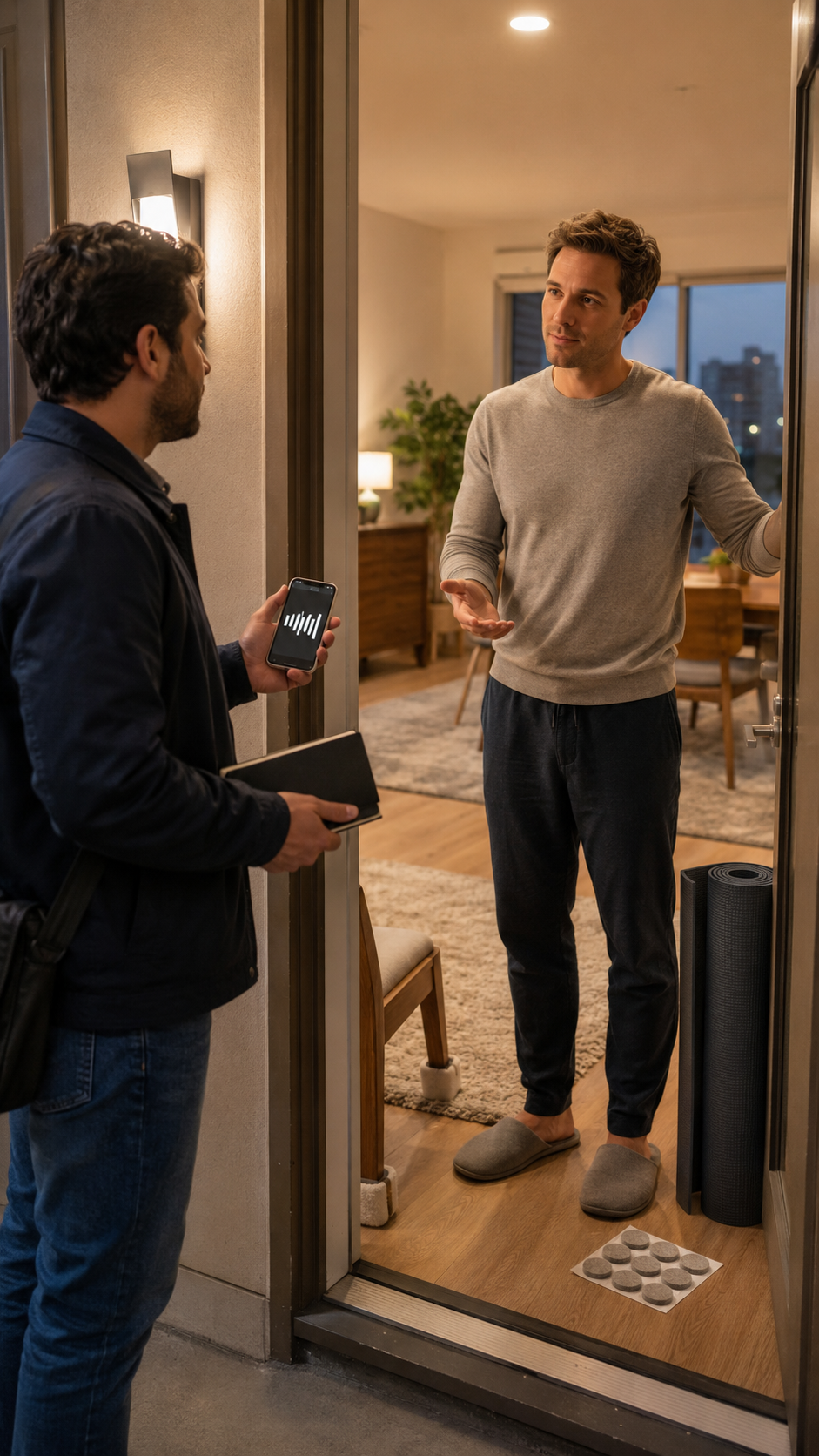
“Hi, I live in the apartment below you. I wanted to let you know that footsteps and furniture movement have been coming through the ceiling quite clearly, especially after 11 p.m. I’m not asking for complete silence, but would it be possible to keep the heavier activity down during nighttime hours?”
This approach describes the effect without accusing the person of being deliberately disrespectful.
Avoid statements such as “You are constantly stomping,” “You have no consideration,” or “If it happens again, you’ll regret it.” Accusations and threats tend to create defensiveness rather than cooperation.
If face-to-face contact feels uncomfortable, send a short, friendly note. Do not post an angry anonymous message in a hallway or public resident group.
Suggest Specific, Realistic Solutions
“Stop making noise” is vague. A specific request gives the neighbor something practical to change.
Possible solutions for the upstairs apartment include:
Adding area rugs with thick rug pads
Placing felt pads under chairs and tables
Wearing soft indoor slippers
Avoiding hard-soled shoes indoors
Using padded mats beneath exercise equipment
Moving speakers away from shared walls and floors
Keeping subwoofers off the floor
Lifting furniture instead of dragging it
Scheduling workouts, vacuuming, or furniture movement earlier
Adding foam play mats in children’s activity areas
Checking whether a washing machine is level
Using rubber anti-vibration pads under appliances
If the problem happens at a predictable time, compromise may be easier. For example, the neighbor might agree to finish treadmill workouts before 9 p.m., while you accept ordinary movement during daytime hours.
The most effective solution for impact noise is usually applied at the source. A rug and dense underlay on the upstairs floor generally have a better chance of reducing footsteps than a thin decorative panel on the ceiling below.
Reduce the Noise Inside Your Apartment
You may not be able to eliminate the noise completely, but several changes can make it less intrusive.
Move your bed, desk, or reading chair away from the part of the room where the sound is strongest. A fan, air purifier, or white- or pink-noise machine can mask intermittent sounds such as voices and light footsteps. Keep masking sound at a comfortable level rather than turning it up high enough to create another noise hazard.
Soft furnishings—including curtains, upholstered furniture, rugs, and full bookshelves—can reduce echo inside your apartment. They are more effective against airborne sound than structural impacts, but a less reflective room may still feel quieter.
Earplugs can help during sleep, but make sure you can still detect smoke alarms, carbon monoxide alarms, a child calling, or other important warning sounds. People with ear conditions should seek professional advice before regularly using in-ear products.
Major modifications such as suspended ceilings, resilient channels, additional drywall, acoustic insulation, or vibration-isolation systems require the owner’s permission and professional planning. Poorly installed materials may violate fire, electrical, or building codes.
Submit a Written Complaint to Management
If direct communication does not work—or if contacting the neighbor feels unsafe—notify the landlord, property manager, homeowners’ association, or condominium board in writing.
Include:
Your apartment number
The suspected source, if reasonably known
A concise description of the noise
Dates and times from your log
How long the problem has continued
Any previous communication
The relevant building rule, if known
A reasonable request for investigation
For example:
“I am reporting repeated impact noise that appears to come from the apartment above mine. The disturbances include heavy impacts, furniture dragging, and exercise-related vibration, usually between 11 p.m. and 1 a.m. I have attached a two-week log. Could management investigate the source, review applicable quiet-hour or flooring rules, and advise what steps can be taken?”
Ask for confirmation that the complaint was received. Keep copies of emails, letters, maintenance requests, and management responses.
A property manager may be able to inspect flooring, enforce rug requirements, check appliances, contact the resident, or determine whether a building defect is contributing to the problem.
Consider Mediation
Mediation can be useful when neighbors disagree about what is happening or how much noise is reasonable. A neutral mediator helps both sides explain the problem and develop a voluntary agreement.
Possible agreements might establish quiet hours, relocate exercise equipment, require rug pads, limit music volume, or create a direct method for reporting future disturbances.
New York City provides a concrete example of this approach. Its official 311 service accepts complaints involving neighbor noise such as loud music, parties, television, talking, and furniture movement. The city also offers free, confidential mediation for certain ongoing disputes. Details are available through NYC311’s neighbor noise guidance.
Your city may use a different system, but searching official local resources for “community mediation,” “neighbor dispute resolution,” or “noise complaint” may reveal similar programs.
File an Official Noise Complaint When Necessary
If the disturbance is persistent, excessive, and unresolved, contact the appropriate local agency. Depending on the location and type of property, this might be:
A municipal 311 service
Code enforcement
A housing department
A local environmental or health agency
A non-emergency police line
A condominium or homeowners’ association
Before filing, check which agency handles residential neighbor noise and what evidence it requests. Some ordinances rely on quiet hours, while others use duration, audibility, or measured sound levels.
Avoid calling an emergency number for an ordinary noise dispute. Emergency services should be used when there is an immediate threat, violence, suspected abuse, a dangerous crowd, or another urgent safety issue.
An official complaint does not guarantee immediate silence. Ordinary household movement may fall outside enforceable noise rules, and an officer may need to witness the disturbance. Your documentation can still establish that the problem is repeated rather than isolated.
Know When to Seek Legal or Housing Advice
If management repeatedly ignores a serious problem, consult a local tenant organization, housing counselor, condominium attorney, or landlord-tenant lawyer. Laws governing leases, habitability, nuisance, soundproofing, and a resident’s right to reasonable use of a home vary significantly.
Bring your lease, noise log, written complaints, responses, recordings, and any witness information. A local professional can explain which remedies actually apply in your jurisdiction.
Do not withhold rent, break a lease, install permanent soundproofing, or take legal action based solely on general information found online. These choices can have financial or legal consequences.
Protect Your Health While the Problem Is Being Resolved
Chronic noise is not merely annoying. It can interfere with rest, concentration, and emotional well-being. The World Health Organization reports that excessive environmental noise is associated with sleep disturbance, annoyance, cognitive effects, hypertension, and increased cardiovascular risk. The exact risk depends on the type, intensity, timing, and duration of exposure. See the WHO’s guidance on environmental noise.
Try to maintain a consistent bedtime routine and create a quieter temporary sleeping area if possible. Spend time away from the apartment when you need uninterrupted work or recovery. Talk with a healthcare professional if the situation is causing persistent insomnia, headaches, anxiety, or significant emotional distress.
If the conflict makes you fear for your physical safety, stop direct communication. Use management, mediation, local authorities, or legal representatives instead.
What Not to Do
Even when frustration is understandable, retaliation usually makes the situation worse.
Do not:
Bang repeatedly on the ceiling
Blast music or speakers upward
Leave threatening messages
Confront someone while angry or intoxicated
Damage property
Publish the neighbor’s personal information online
Encourage other residents to harass them
Make knowingly false complaints
Enter the neighbor’s apartment without permission
Retaliatory noise can lead to complaints against you and may weaken your credibility with management. More importantly, personal confrontations can escalate unpredictably.
If You Are the Upstairs Neighbor
Sometimes you may discover that your normal routine sounds much louder below than it does in your own apartment. This does not necessarily mean you have behaved irresponsibly; it may indicate poor sound insulation.
Ask where and when the noise is strongest. Add rugs and pads, secure loose furniture, move exercise equipment, avoid hard shoes, and check vibrating appliances. Small adjustments can make a substantial difference without requiring you to stop living normally.
A cooperative response can prevent months of hostility between neighbors.
Frequently Asked Questions
What time should upstairs neighbors be quiet?
There is no universal quiet period. Many buildings establish nighttime hours, but the exact schedule depends on the lease, building rules, and local ordinance. Confirm the applicable rules before making a formal claim.
Can I call the police about upstairs noise?
Use a local non-emergency line if residential noise falls under police enforcement in your area. Call emergency services only when the situation involves immediate danger, violence, threats, or another urgent concern.
Do acoustic foam panels stop footsteps?
Usually not. Foam primarily absorbs reflected sound within a room. Footsteps are impact noise carried through the building structure and generally require treatment at the source or a properly designed structural system.
What if the noise comes from children?
Children inevitably create some ordinary living noise. A respectful request may still lead to practical changes, such as foam play mats, rugs, moving active play away from bedrooms, or establishing quieter nighttime routines. Focus on timing and preventable impact rather than demanding complete silence.
What if the neighbor denies making the noise?
Do not argue. Continue documenting the disturbance and ask management to investigate. The source may be another unit, plumbing, an appliance, or a structural problem.
Final Thoughts
Upstairs neighbor noise is most likely to improve when you respond methodically: confirm the source, document the pattern, communicate without hostility, propose specific solutions, and escalate through management, mediation, or local complaint channels when necessary. You deserve reasonable peace in your home, but lasting solutions usually come from evidence and cooperation rather than retaliation. Have you dealt with persistent apartment noise, and which approach—speaking directly, contacting management, soundproofing, or mediation—worked best for you? Share your experience in the comments so other readers can learn from it too.
Hi, I’m the creator and editor behind ZestyHabit. I research everyday safety, first aid, and practical wellness topics using official guidance and reliable public sources, then turn that information into clear, realistic steps for daily life.
My goal is to help readers make safer, better-informed choices at home and beyond.