Low-Frequency Noise: Health Effects, Hidden Sources, and How to Stop the Hum
Minjin Park
·
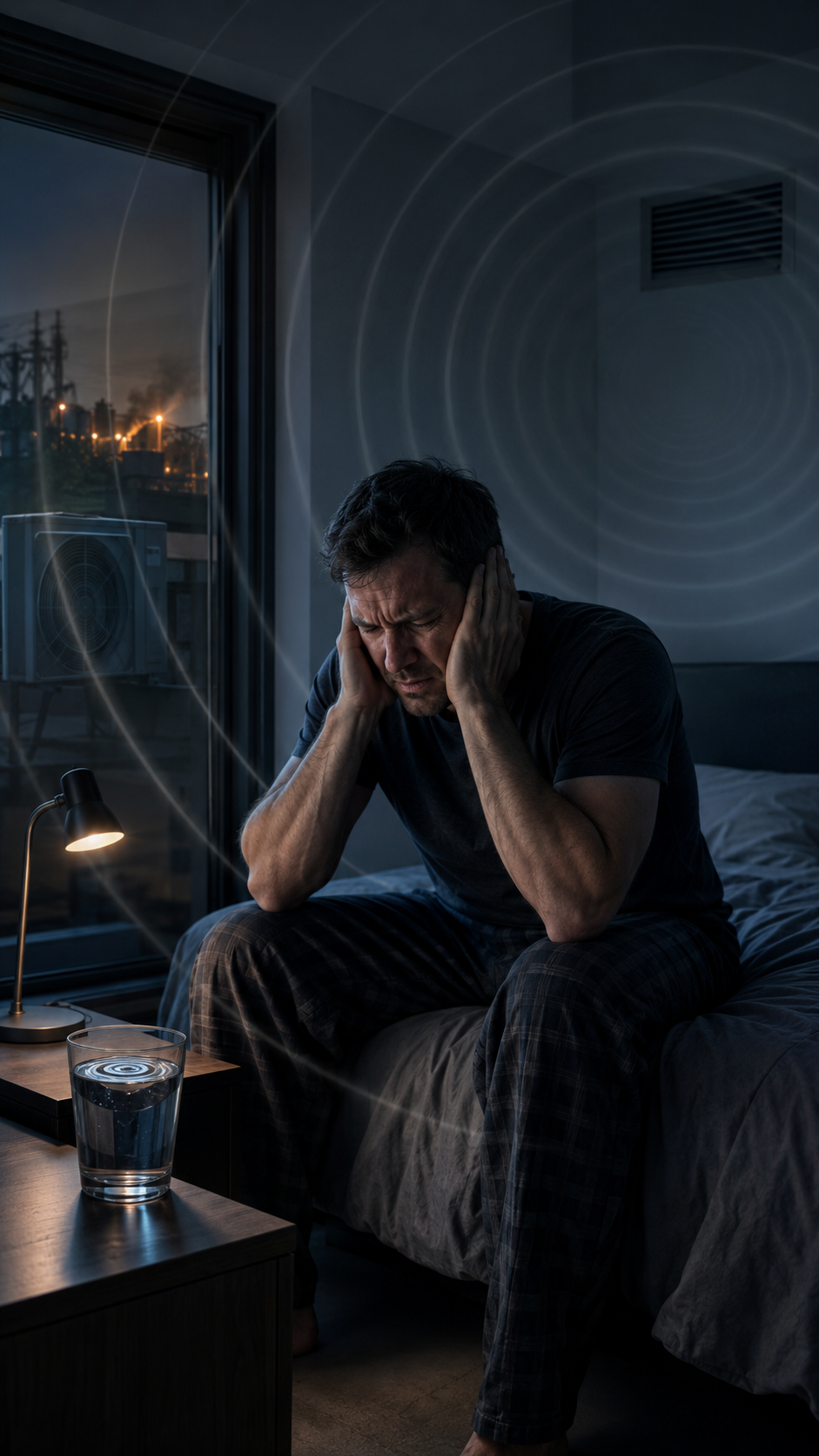
It is after midnight, and the neighborhood seems quiet. Yet somewhere in your bedroom, you can hear—or perhaps feel—a steady hum. It may resemble a distant truck idling, a washing machine running several floors away, or a bass note that never quite ends.
You check the refrigerator, heating system, and electrical panel. Nothing obvious explains it. Other family members may barely notice the sound, which makes the experience even more frustrating.
This type of disturbance may be low-frequency noise. It can come from ventilation equipment, pumps, transformers, generators, traffic, industrial facilities, heat pumps, or sound systems. Because low frequencies behave differently from ordinary speech and household noise, they can travel through structures, create vibrations, and become more noticeable inside certain rooms.
Low-frequency noise does not automatically cause physical injury, and many frightening claims about inaudible sound are not supported by strong evidence. However, a persistent hum can cause genuine annoyance, disrupt sleep, interfere with concentration, and contribute to stress. At sufficiently high sound levels, it can also become an occupational hearing hazard.
The challenge is finding out whether an external sound actually exists, identifying its source, and separating well-established health concerns from speculation.
Sound frequency is measured in hertz, or Hz. Frequency determines pitch: a low frequency sounds like a rumble or bass note, while a high frequency sounds sharper.
The boundaries are not universally fixed, but the UK Institute of Acoustics describes low-frequency noise as approximately 10 to 200 Hz. By comparison, the conventional range of human hearing is commonly given as 20 to 20,000 Hz.
Sound below about 20 Hz is called infrasound. That does not necessarily mean it is completely undetectable. Very low-frequency sound may be heard or felt if its sound pressure is sufficiently high. It may be perceived as pulsing, pressure, vibration, or movement rather than a clear musical tone.
Low-frequency noise and infrasound overlap, but the terms are not interchangeable. Many residential “hum” complaints involve audible frequencies between roughly 30 and 100 Hz rather than truly inaudible infrasound.
Common Sources of Low-Frequency Noise
A mysterious hum does not always come from a distant factory. The source may be inside the same building.
Machinery mounted directly to a wall, roof, or floor
Rotating equipment can produce a steady tone, while an unbalanced fan or motor may create periodic vibration. Ducts, pipes, floors, and wall cavities can then transmit or amplify it.
A source may also switch on automatically during the night. Refrigeration systems, water pumps, building ventilation, and industrial equipment often operate in cycles, which can make the noise seem unpredictable.
Why Low-Frequency Noise Is Difficult to Escape
High-frequency sound is comparatively easy to block with ordinary walls, curtains, carpeting, and acoustic foam. Low-frequency sound has a much longer wavelength and can be harder to absorb.
Several physical effects make it especially troublesome:
It can travel through structures
Vibration from a motor, pump, or compressor may enter a wall or floor through a rigid mounting point. The building itself then carries the vibration to another room. This is known as structure-borne noise.
The machine may not seem loud at its source, yet a wall, pipe, or ceiling elsewhere can act like a speaker.
It can create different “hot spots” in one room
Low-frequency sound waves can reflect between walls and form standing waves. The hum may be strong beside the bed but nearly disappear when you move a few feet away.
This helps explain why one person in a house may report a powerful sound while another, standing elsewhere, struggles to hear it.
It is not always represented well by dBA measurements
Many noise limits rely on A-weighted decibels, written as dBA. A-weighting reduces the contribution of very low frequencies because human hearing is generally less sensitive to them.
This works reasonably well for many ordinary noise assessments, but a single dBA value may not describe a prominent low-frequency tone accurately. The UK Environment Agency consequently notes that a common industrial noise assessment method, BS 4142, may not be appropriate by itself when evaluating low-frequency noise.
A proper investigation may require C-weighted, unweighted, and one-third-octave-band measurements instead of one overall number.
The Most Established Effect: Annoyance
The word “annoyance” can sound medically unimportant, but in noise research it means more than mild irritation. Persistent noise annoyance may involve anger, helplessness, disturbed rest, reduced enjoyment of the home, and difficulty relaxing.
A low hum is often especially distressing when it is:
Tonal or pulsing
More noticeable at night
Unpredictable
Outside the listener’s control
Present in a bedroom
Difficult for others to hear
Impossible to identify or stop
The Institute of Acoustics notes that low-frequency noise may be perceived as a throb, rumble, or hum and can disturb sleep or make people uncomfortable in their homes.
Individual sensitivity varies. Differences in hearing thresholds, age, previous exposure, room position, expectations, and emotional associations with the source can all influence the response. One person’s strong reaction does not prove that the sound is dangerously loud, but it should not automatically be dismissed as imaginary.
Sleep Disturbance and Daytime Fatigue
Nighttime noise does not need to wake someone completely to be disruptive. It may delay sleep, cause repeated brief awakenings, or keep the brain in a lighter stage of sleep.
The following day, the person may experience:
Fatigue
Irritability
Poor concentration
Reduced work performance
Headache
Low mood
Increased sensitivity to sound
Low-frequency noise can be particularly noticeable at night because traffic and other higher-frequency background sounds decrease. A hum that was masked during the day may suddenly dominate a quiet bedroom.
The World Health Organization identifies sleep disturbance and annoyance among the established public-health effects of excessive environmental noise. However, WHO’s broader findings should not be interpreted as proof that every quiet residential hum causes disease.
The sound’s level, duration, frequency spectrum, timing, and effect on sleep all matter.
Headaches, Pressure, Dizziness, and Concentration Problems
People exposed to persistent low-frequency noise sometimes report headaches, ear pressure, dizziness, nausea, difficulty concentrating, or a sensation of vibration.
These symptoms deserve attention, but they are nonspecific. They can also be caused by sleep deprivation, migraine, anxiety, medication, dehydration, vestibular disorders, infection, carbon monoxide exposure, or other medical conditions.
This makes it difficult to prove that a particular sound caused a particular symptom, especially when the noise was not measured at the time symptoms occurred.
A careful investigation should therefore examine both possibilities:
There may be an environmental sound or vibration that needs to be controlled.
The symptoms may have another medical cause that should not be overlooked.
If headaches, dizziness, chest pressure, balance problems, hearing changes, or nausea are persistent or severe, seek medical evaluation rather than assuming that low-frequency noise is the only explanation.
Sudden headache, fainting, weakness, confusion, breathing difficulty, or multiple people becoming ill in the same building requires urgent assessment, including consideration of carbon monoxide.
Can Low-Frequency Noise Damage Hearing?
Frequency alone does not determine whether a sound is dangerous. Sound pressure and exposure duration are critical.
Very loud industrial noise with strong low-frequency components can contribute to hearing damage. The National Institute for Occupational Safety and Health recommends limiting occupational exposure to 85 dBA averaged over eight hours, with permitted exposure time decreasing as the level increases.
A quiet residential hum is not automatically a hearing-loss hazard. If the overall level is well below occupational limits, annoyance and sleep disturbance may be more realistic concerns than direct damage to the inner ear.
Conversely, low-pitched industrial noise should not be considered safe simply because it does not sound sharp or painful. Workers around engines, compressors, generators, presses, and heavy machinery still need a professional noise assessment and appropriate hearing protection.
What About Heart Disease and Other Long-Term Effects?
Long-term environmental noise exposure has been associated with hypertension and ischemic heart disease, likely through pathways involving stress and disrupted sleep. WHO treats environmental noise as an important public-health issue.
However, much of the strongest evidence involves transportation noise across large populations. It should not be used to claim that a barely audible household hum will inevitably cause heart disease.
Evidence specifically linking low-level residential infrasound to organ damage, brain injury, or a unique multisystem disease remains limited. Claims that any inaudible sound is inherently toxic are misleading because infrasound occurs naturally and is produced by many ordinary activities.
The responsible conclusion is more measured: persistent low-frequency noise can meaningfully affect quality of life, particularly through annoyance and sleep disruption, while broader claims require reliable exposure measurements and stronger evidence.
A Documented NIOSH Investigation
A real workplace investigation shows why these complaints require both technical measurements and medical caution.
After two loud noise and vibration incidents involving methane flares at a neighboring landfill, an administrative building and men’s shelter in Ohio were evacuated. Employees reported unusual sounds, vibrations, and health symptoms.
NIOSH investigators interviewed workers, reviewed available medical information, and measured the acoustic environment. Their investigation found that low-frequency levels increased when the flares were operating, particularly from 16 to 25 Hz. The sound spectrum was also unbalanced, meaning low frequencies were relatively prominent compared with higher frequencies.
However, the measured levels were below those known to cause direct adverse health effects. The investigators noted that reported symptoms were common and nonspecific, while the unusual frequency balance could still have contributed to annoyance. The peer-reviewed NIOSH case study concluded that sound characteristics, symptoms, perceptions, and workplace communication all needed to be considered.
The lesson is not that employees imagined the problem. It is that identifying a real low-frequency component does not automatically prove every reported symptom was caused by toxic exposure.
Could the Hum Be Tinnitus?
Tinnitus is the perception of sound without an external acoustic source. It is often described as ringing, but some people hear humming, buzzing, throbbing, or an engine-like sound.
Clues that tinnitus may be involved include:
The sound follows you to different buildings.
It remains unchanged outdoors or during a power outage.
It began after loud-noise exposure, illness, or medication changes.
These clues are not diagnostic. External low-frequency sound can also be difficult for others to detect, and room acoustics can cause the noise to disappear when you move.
An audiologist or ear, nose, and throat specialist can evaluate hearing loss, tinnitus, ear pressure, and other possible causes. Pulsing that matches your heartbeat should receive medical attention, particularly if it is new or only on one side.
How to Investigate a Mysterious Hum
Start with a factual noise diary. Record:
The date and exact time
How long the sound lasts
The rooms where it is strongest
Whether it is audible outdoors
Weather and wind conditions
Nearby traffic or industrial activity
Which household equipment is operating
Whether vibration can be felt
Sleep disruption or other symptoms
Avoid writing only “terrible noise all night.” Specific information about cycles and locations is more useful to a landlord, technician, or environmental-health officer.
If it is safe, switch household appliances off one at a time. Check refrigerators, fans, heating systems, pumps, air conditioners, chargers, and audio equipment. Do not open electrical equipment or disable essential safety systems.
A smartphone recording may help document timing, but phone microphones often perform poorly at very low frequencies. Failure to capture the hum does not prove it is absent.
For a persistent problem, hire a qualified acoustical consultant. A proper investigation may require a calibrated Class 1 sound-level meter, one-third-octave analysis, and measurements taken inside the affected room while the noise is occurring.
How to Reduce Low-Frequency Noise
The best solution is controlling the source rather than trying to cover it up.
Depending on the equipment, effective measures may include:
Repairing worn bearings or unbalanced fans
Installing vibration-isolation mounts
Adding flexible connectors to pipes and ducts
Moving equipment away from shared walls
Reducing fan or motor speed
Installing an appropriately designed enclosure
Adding duct silencers
Decoupling machinery from floors or roofs
Increasing the mass of walls or ceilings
Relocating a bed away from a vibrating wall
Thin foam panels are usually ineffective against deep bass. Meaningful low-frequency soundproofing often requires mass, airtight construction, structural isolation, or changes to the machinery itself.
Temporary masking with a fan or gentle neutral sound may help with sleep, but keep the volume comfortable. Do not replace one noise problem with prolonged loud headphone exposure.
If the source belongs to a neighbor or business, begin with a calm, specific conversation when it feels safe. The owner may not know that a pump or fan is transmitting vibration. When informal communication fails, contact the landlord, building manager, local noise-control office, or relevant environmental authority.
The Bottom Line
Low-frequency noise can be far more disruptive than its measured volume suggests. Its long wavelengths, structural transmission, tonal character, and nighttime prominence can make a quiet hum difficult to escape. The most credible concerns at typical residential levels are annoyance, sleep disturbance, fatigue, and reduced concentration. Direct hearing damage requires sufficiently high exposure, while claims of widespread organ damage from barely detectable infrasound remain unproven. Careful documentation, medical evaluation when symptoms persist, and frequency-specific professional measurements offer the best path toward a real solution.
Have you ever heard a mysterious low-frequency hum in your home or workplace, and were you able to identify where it came from? Share your experience and any solution that worked for you in the comments so other readers dealing with the same frustrating problem can benefit.
Hi, I’m the creator and editor behind ZestyHabit. I research everyday safety, first aid, and practical wellness topics using official guidance and reliable public sources, then turn that information into clear, realistic steps for daily life.
My goal is to help readers make safer, better-informed choices at home and beyond.