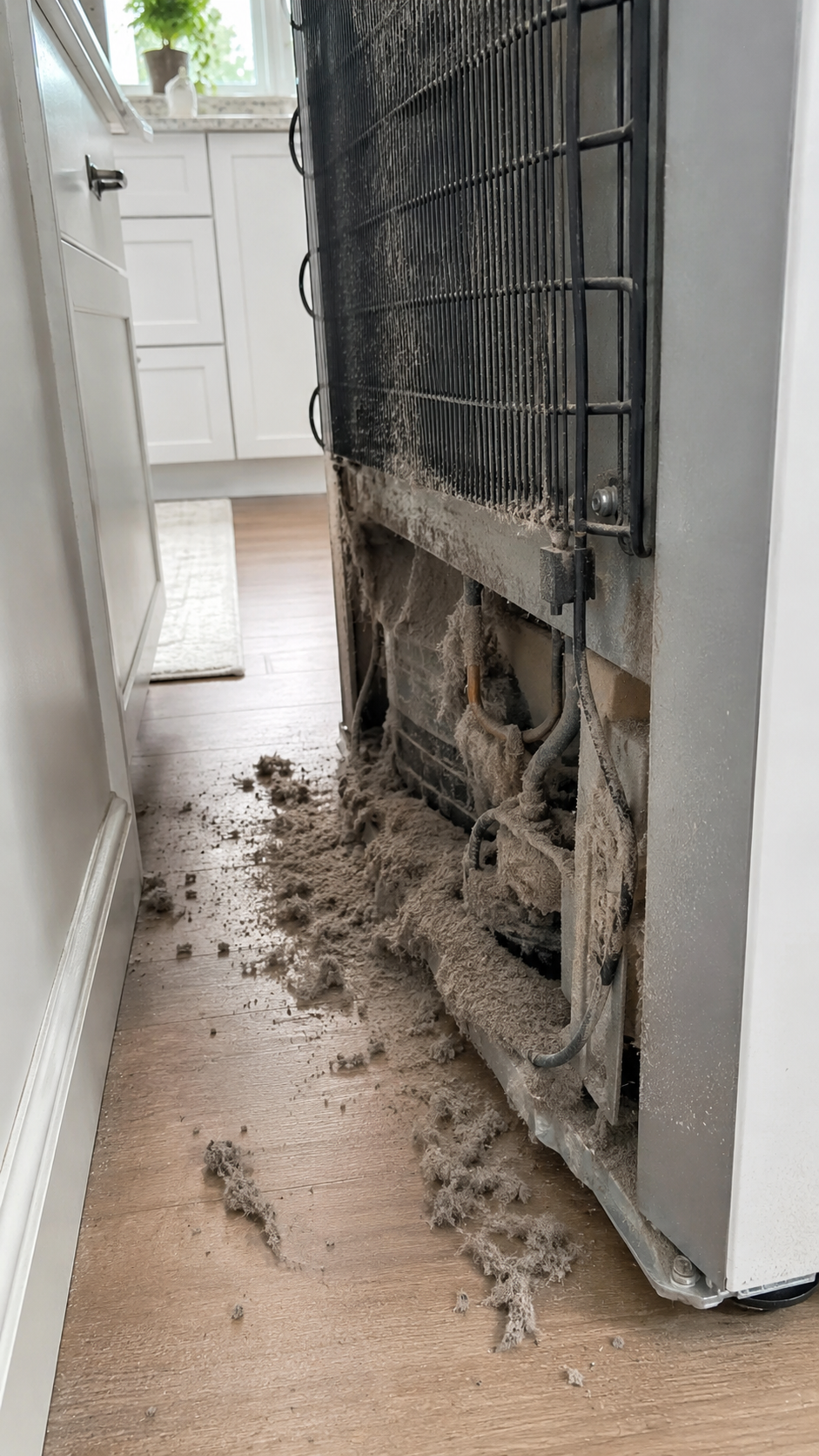
Why You Should Clean the Dust Behind Your Refrigerator
Minjin Park
·
Dust behind your refrigerator can affect cooling, energy use, and safety. Learn why it matters and how to clean it safely at home.
Most people clean the inside of their refrigerator much more often than the back of it.
That makes sense. You see the shelves, drawers, spills, leftovers, and expired condiments every day. The space behind the refrigerator, on the other hand, is easy to forget. It is hidden, awkward to reach, and not exactly the most exciting place to clean.
But behind your refrigerator, dust can build up slowly for months or even years.
At first, it may not seem like a big deal. It is just dust, right? But that dusty area can affect how well your refrigerator runs, how much energy it uses, and how much strain is placed on the appliance. In some situations, heavy dust buildup can also become a general household safety concern, especially when it collects around electrical parts, vents, coils, or the compressor area.
The good news is that this is one of those home maintenance tasks that does not need to be complicated. You do not have to deep-clean it every week. You just need to remember it once in a while and know what to look for.
Unlike a microwave, toaster, or washing machine, it never really gets a full break. It quietly cycles on and off to keep your food cold. To do that, it needs airflow around certain parts, especially the condenser coils and the area where heat is released.
When dust gathers behind or underneath the refrigerator, that airflow can become restricted.
Your Refrigerator Needs to Release Heat
A refrigerator does not simply “make cold air.” It removes heat from inside the fridge and releases that heat outside the unit. That is why the back, bottom, or sides of a refrigerator may feel warm during normal operation.
This is part of how the appliance works.
The problem starts when dust, pet hair, crumbs, lint, and kitchen debris collect around the coils or vents. If heat cannot escape easily, the refrigerator may have to work harder to maintain the right temperature.
That extra effort can lead to higher energy use and more wear on the appliance over time.
Dust Can Make the Appliance Work Harder
Imagine trying to breathe through a dusty filter.
That is not exactly what your refrigerator is doing, but the idea is similar. When dust blocks airflow, the system has to push through more resistance. The refrigerator may run longer, cycle more often, or sound louder than usual.
You may not notice it right away. The fridge may still feel cold. The freezer may still make ice. Everything may seem normal.
But behind the scenes, the appliance may be under more strain than necessary.
Common Places Dust Builds Up
Dust behind a refrigerator does not usually appear all at once. It gathers slowly.
Most kitchens naturally create the perfect mix of dust, grease, crumbs, pet hair, and lint. Add in limited airflow behind a large appliance, and it becomes a spot that collects debris easily.
Behind the Refrigerator
The wall behind the refrigerator often becomes dusty because it is rarely exposed. Air moves through the area, but people do not sweep or vacuum there often.
If your refrigerator sits in a tight space, dust may collect along the wall, floor, power cord, and back panel.
Sometimes you will find more than dust back there: dropped cereal, pet food, twist ties, old receipts, bottle caps, or small toys. Anything small enough to roll under the fridge can end up there.
Under the Refrigerator
Many refrigerators pull air from the front bottom area or release heat near the lower back. The exact design depends on the model.
The bottom area can become packed with dust bunnies, pet hair, and kitchen debris. This is especially common if you have pets, live near a busy road, keep windows open often, or cook frequently.
Grease from cooking can also make dust stickier. That sticky dust is harder to remove and can build up in layers.
Around the Coils
Older refrigerators often have visible coils on the back. Many newer models have coils underneath or behind a lower panel.
These coils are important because they help release heat. When they are covered in dust, the refrigerator may lose efficiency.
If you have never looked at the coils before, do not worry. You are not alone. Many homeowners and renters do not think about them until the fridge starts making noise, running too often, or struggling to stay cool.
Warning Signs Your Refrigerator Needs Cleaning
You do not need to wait for a problem before cleaning behind your refrigerator. But certain signs can tell you the appliance may already be struggling.
The Refrigerator Runs More Often Than Usual
A refrigerator naturally turns on and off throughout the day.
But if it seems to be running almost constantly, dust buildup could be one possible reason. It may be working harder because heat is not escaping efficiently.
This is not the only possible cause, of course. Door seals, temperature settings, room temperature, food placement, and appliance age can also matter. But dust behind or under the fridge is one of the simplest things to check.
The Back or Side Feels Very Warm
Some warmth is normal.
However, if the area around the refrigerator feels unusually hot, or the appliance seems warmer than it used to, it may be time to inspect the back and bottom. Heavy dust can trap heat and reduce airflow.
You should not ignore extreme heat, burning smells, or signs of electrical damage. For everyday maintenance, though, a dusty coil area is a common and fixable issue.
You Notice More Noise
A refrigerator that is working harder may sound louder.
You might hear more humming, clicking, buzzing, or longer running cycles. A little noise is normal, especially with modern refrigerators that have fans, ice makers, and compressors. But a noticeable change in sound is worth paying attention to.
Cleaning dust may not solve every noise problem, but it is a practical first step.
Your Energy Bill Creeps Up
Many things can affect your electric bill, from weather to heating and cooling habits. But an inefficient refrigerator can contribute.
If your fridge is older, dusty, or running more often than needed, it may use more electricity than it should. Cleaning the coils and improving airflow can help the appliance operate more efficiently.
It is not a magic fix for every energy bill, but it is a smart maintenance habit.
Common Mistakes People Make
Cleaning behind the fridge sounds simple, but there are a few mistakes that can make the job less effective or even create avoidable problems.
Waiting Until There Is a Problem
A lot of people only check behind the refrigerator when something goes wrong.
Maybe the fridge stops cooling. Maybe there is a strange smell. Maybe they are moving out and finally pull the appliance away from the wall.
By then, the dust buildup may be thick.
It is much better to treat this as light maintenance. A quick cleaning once or twice a year is usually easier than dealing with years of dust at once.
Forgetting About Pet Hair
If you have cats, dogs, or other furry pets, refrigerator dust can build up faster.
Pet hair travels across the floor and gets pulled into hidden spaces. It can collect around coils, vents, and the lower front grille. Even homes that look very clean can have surprising amounts of pet hair behind appliances.
If the appliance is pushed tightly against the wall, airflow may be reduced. The power cord can also become bent or pinched.
Always follow the clearance recommendations in your refrigerator’s manual when possible. If you do not have the manual, you can usually look it up online using the model number.
Even a small amount of breathing room can help.
Using Too Much Water
The area behind a refrigerator may include electrical parts, cords, and mechanical components.
This is not the place to splash water around. A slightly damp cloth may be useful for the floor or wall after vacuuming, but avoid spraying water directly onto the refrigerator’s back, coils, vents, plug, or electrical areas.
Dry cleaning methods, like a vacuum brush and microfiber cloth, are usually better.
How Often Should You Clean Behind the Refrigerator?
For many homes, cleaning behind and under the refrigerator once or twice a year is a reasonable habit.
But some homes may need it more often.
You may want to check every three to four months if:
You have pets that shed
Your kitchen gets dusty quickly
You cook often with oil
The refrigerator is in a tight space
You live in an older home
The appliance already seems to run loudly
You notice dust collecting around the lower grille
You do not need to turn this into a major project every time. Sometimes a quick vacuum around the front bottom grille and floor area is enough between deeper cleanings.
Simple Steps to Clean Behind Your Refrigerator
Before you start, take your time. Refrigerators are heavy, and kitchen floors can scratch.
The goal is to clean safely and gently, not rush.
Step 1: Clear the Area
Move anything stored on top of or beside the refrigerator.
If you have a small trash can, broom, pet bowl, or storage basket nearby, move it out of the way. Give yourself enough room to work.
It also helps to have a flashlight ready. The space behind a refrigerator can be darker than expected.
Step 2: Check the Manual If You Can
If you still have the manual, look for cleaning instructions.
Different refrigerator models have different coil locations. Some coils are on the back. Some are underneath. Some are behind a front grille or lower rear panel.
The manual may also tell you how much space the refrigerator needs from the wall.
Step 3: Unplug If Appropriate
For a deeper cleaning, many people unplug the refrigerator before working around the back or coils.
This can be a sensible safety step, especially if you are going to remove a lower panel or clean near electrical parts. Keep the doors closed while it is unplugged so the cold air stays inside as much as possible.
If you are uncomfortable moving or unplugging the fridge, keep the cleaning limited to easy-to-reach areas, or ask someone experienced to help.
Step 4: Gently Pull the Refrigerator Forward
If your refrigerator has wheels, it may slide forward more easily. If it does not, be careful. Do not yank it by the door handles.
Pull slowly and evenly. Watch the power cord and water line if your fridge has an ice maker or water dispenser.
Do not pull it so far that you strain or disconnect anything.
Step 5: Vacuum Loose Dust
Use a vacuum with a hose attachment or brush attachment.
Start with the floor, wall, and back area. Then carefully clean around the coils or vents if they are accessible. A soft brush can help loosen dust without being too rough.
Avoid forcing the vacuum into delicate parts.
If the dust is thick, go slowly. You may need to empty the vacuum canister afterward, especially if there is pet hair.
Step 6: Use a Coil Brush If Needed
A refrigerator coil brush is a long, flexible brush made for reaching narrow areas.
It can be useful if the coils are underneath the fridge or behind a grille. You can loosen dust with the brush, then vacuum it up.
Do not bend or damage the coils. Gentle cleaning is enough.
Step 7: Wipe the Floor and Wall
After vacuuming, you can wipe the floor and wall behind the refrigerator.
Use a slightly damp cloth for sticky dust or grime. Dry the area afterward if needed.
Avoid getting moisture near the plug, outlet, or refrigerator components.
Step 8: Push the Refrigerator Back Carefully
When you move the fridge back, make sure the cord is not trapped or sharply bent.
Leave enough space for airflow according to the manufacturer’s recommendation. Check that the refrigerator is level and the doors still close properly.
Then plug it back in if you unplugged it.
What Not to Do
A few habits are worth avoiding.
Do Not Use Sharp Tools
Do not scrape dust off coils with a knife, screwdriver, or metal object.
You could damage the coils, puncture something, or create a safety risk. Use a soft brush, vacuum attachment, or coil brush instead.
Do Not Ignore the Power Cord
While you are back there, look at the cord.
If it is frayed, cracked, crushed, or damaged, do not simply push the fridge back and forget about it. A damaged appliance cord should be handled seriously.
For general awareness, the cord should be intact, not pinched under the fridge, and not pressed tightly against sharp edges.
Do Not Block the Vent Area Again
After cleaning, avoid storing bags, boxes, paper towels, or cleaning supplies around the refrigerator vents.
It can be tempting to use every inch of kitchen space, especially in small apartments. But blocking airflow can make the refrigerator work harder.
Extra Tips for Everyday Refrigerator Safety
Cleaning behind the fridge is only one piece of good appliance care.
A few small habits can help your refrigerator run better and last longer.
Keep the Door Seals Clean
Dirty or sticky door seals can prevent the fridge from closing tightly.
Wipe the rubber gasket with mild soap and water when it looks dirty. If cold air leaks out, the refrigerator has to work harder.
A simple test is to close the door on a dollar bill. If the bill slips out very easily, the seal may not be tight in that spot.
Do Not Overpack the Refrigerator
A packed fridge can block airflow inside the appliance.
Cold air needs room to circulate. If every shelf is crammed full, some areas may not stay as evenly cold.
Try to leave small gaps between items when possible.
Let Hot Food Cool Slightly Before Storing
Putting very hot food directly into the refrigerator can raise the temperature inside and make the appliance work harder.
You do not need to leave food out for a long time, but letting it cool a bit before refrigerating can help. Use common food safety sense and avoid leaving perishable food sitting out too long.
Pay Attention to Strange Smells
A musty smell behind the refrigerator may come from old spills, spoiled food that rolled underneath, or dust mixed with moisture.
A hot plastic or burning smell is different and should not be ignored.
If something smells unusual and cleaning does not explain it, stop and look more carefully before continuing normal use.
A Practical Cleaning Schedule
The easiest way to remember this task is to connect it to something you already do.
You do not need a perfect schedule. Even doing it once a year is better than ignoring it for five years.
If you rent your home, this still matters. You may not own the appliance, but you still rely on it every day. Keeping the area clean can help prevent odors, pests, dust buildup, and unnecessary strain.
Conclusion: A Small Chore That Helps Your Kitchen Run Better
Cleaning the dust behind your refrigerator is not glamorous, but it is one of those small home habits that makes sense.
Your refrigerator works nonstop to keep food cold. When dust and pet hair build up around the coils, vents, cord, and floor behind it, the appliance may have to work harder than necessary. Over time, that can mean more noise, more energy use, extra wear, and a messier kitchen environment.
You do not need to worry about it every day. Just check the area once in a while, especially if you have pets or cannot remember the last time the fridge was moved.
Pull it out carefully, vacuum the dust, clean the floor, check the cord, and make sure there is enough space for airflow.
It is a simple task, but it is a useful one. And once it is done, you get the quiet satisfaction of knowing one more hidden corner of your home is cleaner, safer, and better cared for.
Hi, I’m the creator and editor behind ZestyHabit. I research everyday safety, first aid, and practical wellness topics using official guidance and reliable public sources, then turn that information into clear, realistic steps for daily life.
My goal is to help readers make safer, better-informed choices at home and beyond.