
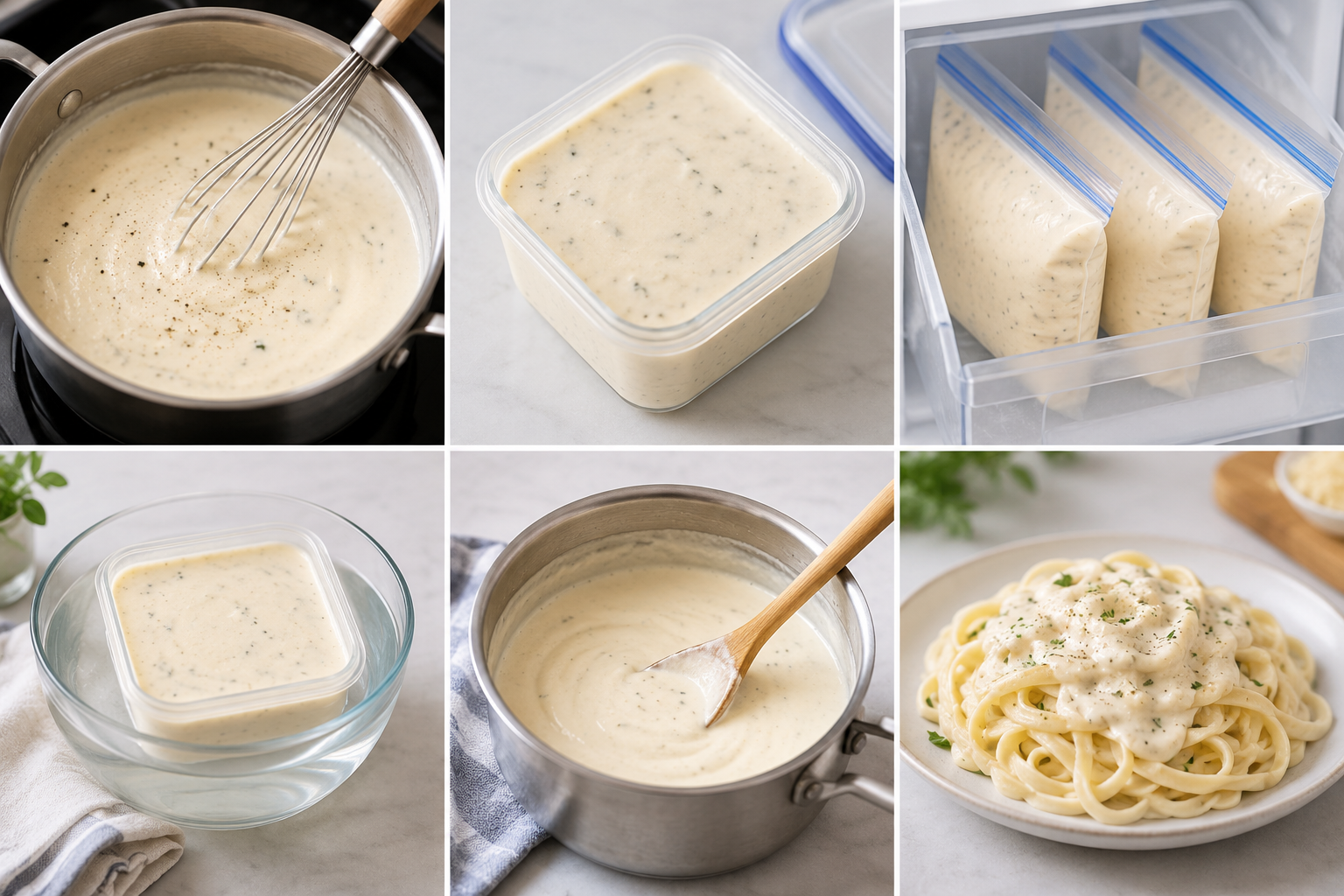

Learn how to freeze cream sauce safely, prevent separation, thaw it correctly, and restore its smooth, creamy texture when reheating.
Suggested URL slug: how-to-freeze-cream-sauce
A good cream sauce can transform a simple bowl of pasta, chicken, seafood, or vegetables into a rich and satisfying meal. Unfortunately, dairy-based sauces can also be difficult to store. If you have leftovers or want to prepare meals in advance, you may wonder whether cream sauce can be frozen without becoming grainy or separating.
The short answer is yes—you can freeze most cream sauces. However, they do not always return to exactly the same consistency after thawing. The fat, water, and milk proteins in the sauce may separate during freezing, leaving it thinner, grainier, or slightly curdled. Fortunately, slow reheating and vigorous whisking can often bring the sauce back together.
Some cream sauces freeze better than others. Sauces thickened with flour or cornstarch tend to remain more stable, while delicate sauces made primarily from heavy cream, butter, or cheese are more likely to separate. Understanding these differences will help you choose the best freezing, thawing, and reheating method.
What Happens to Cream Sauce When It Freezes?
Cream sauce is an emulsion—a mixture of fat and water held together with the help of milk proteins, starches, and other ingredients. When the sauce freezes, its water content forms ice crystals. These crystals can disturb the emulsion and push the fat, water, and proteins apart.
After thawing, you may notice:
- A watery layer on top or around the edges
- Small clumps of milk protein
- An oily surface
- A grainy or curdled appearance
- A thicker or thinner consistency
- Reduced smoothness and gloss
This does not necessarily mean the sauce has spoiled. Separation is often a quality problem rather than a safety issue. If the sauce was handled safely, frozen promptly, and kept continuously frozen, it may still be usable after whisking and reheating.
The USDA lists cream sauce among foods that may not freeze particularly well because freezing can affect quality. That does not mean cream sauce cannot be frozen; it means you should expect some change in texture. (USDA freezing and food-safety guidance)
Which Cream Sauces Freeze Best?
Not every sauce responds to freezing in the same way. The recipe’s balance of dairy, fat, starch, cheese, and other ingredients influences how well it holds together.
Flour-thickened cream sauces
Béchamel, white sauce, sausage gravy, and similar sauces made with a butter-and-flour roux generally freeze better than plain cream reductions. The starch helps stabilize the water and fat, reducing severe separation.
The sauce may become slightly thicker after thawing, but this is usually easy to correct with a splash of milk, cream, stock, or water.
Cornstarch-thickened sauces
Cornstarch can help stabilize a sauce, although the texture may occasionally become spongy or uneven after freezing. Whisking the sauce over low heat usually improves it.
If you are preparing a sauce specifically for freezing, a small amount of flour may produce a more dependable texture than relying entirely on cream reduction.
Heavy cream sauces
Sauces made mainly from heavy cream can be frozen, but some separation is likely. Heavy cream’s relatively high fat content may help it perform better than low-fat milk, yet the emulsion can still break during freezing and thawing.
Cheese-based cream sauces
Alfredo sauce, cheese sauce, and other dairy sauces containing Parmesan, cheddar, cream cheese, or similar ingredients are more likely to become grainy. Cheese proteins tighten when overheated, and freezing can make this effect more noticeable.
These sauces need particularly gentle reheating. Avoid bringing them to a rolling boil.
Tomato cream sauces
Tomato cream sauce, such as a pink sauce or creamy marinara, often freezes reasonably well. The tomato base provides additional body, although the dairy may still separate slightly.
Mushroom or vegetable cream sauces
These sauces can be frozen, but vegetables may release water during thawing. Mushrooms, spinach, zucchini, and onions can make the sauce thinner than it was originally.
Cream sauces containing seafood
The sauce itself may freeze, but seafood can become rubbery or dry when reheated. For the best result, freeze the sauce separately and add freshly cooked seafood after reheating.
How to Prepare Cream Sauce for Freezing
Proper preparation can reduce separation, freezer burn, and food-safety risks.
Do not overcook the sauce
If you know that the sauce will be frozen and reheated later, stop cooking it as soon as it has reached the desired thickness. Excessive cooking can destabilize the dairy before the sauce even enters the freezer.
For a cheese sauce, remove the pan from the heat before gradually stirring in the cheese. This helps prevent the proteins from becoming tight and grainy.
Consider freezing before adding delicate ingredients
Fresh herbs, seafood, sour cream, extra cheese, and delicate vegetables may be better added after thawing. A simple cream base is usually easier to restore than a fully finished sauce containing many ingredients.
Cool the sauce promptly
Do not leave cream sauce sitting on the counter for several hours. Transfer it to shallow containers so that it cools more quickly and evenly.
Perishable food should generally be refrigerated or frozen within two hours, or within one hour if the surrounding temperature is above 90°F (32°C). Freezing does not kill all harmful microorganisms, so it is important to handle the sauce safely before it reaches the freezer.
How to Freeze Cream Sauce Step by Step
Step 1: Allow the sauce to cool safely
Remove the sauce from the heat and divide a large batch among several shallow containers. This releases heat faster than leaving it in a deep pot.
Avoid putting an extremely large, steaming pot directly into the refrigerator. Smaller portions cool more efficiently and are easier to freeze.
Step 2: Portion the sauce
Divide the sauce according to how you expect to use it. One-cup portions may be convenient for individual meals, while larger portions can be used for family-size pasta dishes or casseroles.
Small portions also freeze and thaw more evenly.
Step 3: Choose freezer-safe packaging
Use airtight containers, heavy-duty freezer bags, or silicone freezer trays. Ordinary sandwich bags are usually too thin to protect the sauce from air and freezer odors.
If using a rigid container, leave approximately ½ inch of headspace because the sauce will expand as it freezes.
If using a freezer bag, press out as much air as possible before sealing it. Lay the bag flat in the freezer until solid. Flat packages save space and thaw more quickly than thick blocks.
Step 4: Label the package
Write the name of the sauce, the freezing date, and any important ingredients on the container. If the sauce contains chicken, seafood, mushrooms, or cheese, noting that on the label makes meal planning easier.
Step 5: Freeze promptly
Store the sauce in a freezer maintained at 0°F (-18°C) or colder. Place the packages in the coldest part of the freezer rather than in the door, where temperatures fluctuate more often.
Once flat freezer bags are solid, you can stand them upright to save space.
Can You Freeze Cream Sauce With Pasta?
You can freeze pasta already mixed with cream sauce, but the quality may not be as good as freezing the two separately. Pasta continues to absorb moisture while stored, which can leave it soft, swollen, or dry after reheating.
For meal preparation, consider slightly undercooking the pasta so that it still has a firm bite. Mix it with a little more sauce than you would normally use because some of the liquid will be absorbed.
For the best texture, freeze the cream sauce separately and cook fresh pasta when you are ready to eat. The thawed sauce can then be reheated and combined with the freshly cooked pasta.
Filled pasta, baked pasta, and casseroles often tolerate freezing better than delicate fresh noodles because their texture is expected to be softer.
How Long Can Cream Sauce Be Frozen?
For the best texture and flavor, try to use homemade frozen cream sauce within one to two months. It may remain acceptable for up to approximately three months if packaged well and kept continuously at 0°F.
This is primarily a quality recommendation. Frozen food maintained continuously at 0°F can remain safe for a long time, but cream sauce gradually becomes more vulnerable to freezer burn, flavor loss, and separation.
FoodSafety.gov recommends refrigerating most leftovers for no more than three to four days and gives a freezer-quality range of roughly two to six months for many cooked leftovers. Cream sauces are more delicate than many other foods, so using them toward the earlier end of that range generally produces better results. (FoodSafety.gov cold-storage guidance)
If you are not going to eat refrigerated cream sauce within three to four days, freeze it before that period ends. Freezing sauce that has already been stored too long does not make it fresh or safe again.
How to Thaw Cream Sauce Safely
Refrigerator thawing
Thawing cream sauce in the refrigerator is the safest and most reliable method. Move the container from the freezer to the refrigerator and allow it to thaw overnight.
Large containers may need a full day, while flat freezer bags or small portions may thaw within several hours.
Place the package on a plate or in a bowl to catch any leaks. Keep the refrigerator at 40°F (4°C) or colder.
Cold-water thawing
For faster thawing, place the tightly sealed package in cold water. Change the water approximately every 30 minutes so that it stays cold.
Once thawed, reheat and use the sauce promptly. Do not use warm or hot water because the outer part of the sauce may enter an unsafe temperature range while the center remains frozen.
Microwave thawing
Cream sauce can be thawed in the microwave, but this method can encourage separation. Use the defrost setting or low power, heat in short intervals, and stir frequently.
Reheat and use the sauce immediately after microwave thawing.
Can you thaw cream sauce on the counter?
Do not leave frozen cream sauce on the counter for hours. The outside can become warm enough for bacteria to multiply before the center has fully thawed.
The USDA identifies the refrigerator, cold water, and microwave as safe methods for thawing frozen leftovers. (USDA leftovers guidance)
How to Reheat Cream Sauce Without Curdling
The most important rule is to use gentle heat. High heat can tighten dairy proteins and cause the sauce to separate further.
Stovetop method
- Transfer the thawed sauce to a small saucepan.
- Heat it over low or medium-low heat.
- Whisk continuously as it warms.
- Add milk, cream, stock, or water one tablespoon at a time if it is too thick.
- If it appears watery, continue heating gently while whisking.
- Remove it from the heat before it reaches a vigorous boil.
If the sauce contains cheese, add a small amount of freshly grated cheese after removing the pan from the heat. This can improve both flavor and consistency.
Microwave method
Place the sauce in a microwave-safe container and cover it loosely. Heat at 50 percent power in short intervals, stirring thoroughly after each interval.
Full microwave power can create extremely hot areas that cause curdling while other parts remain cold.
Immersion-blender method
If whisking does not restore the sauce, an immersion blender may help re-emulsify the fat and liquid. Blend only after the sauce has warmed slightly, taking care to avoid splashing hot liquid.
For a badly broken sauce, whisking in a spoonful of warm cream, milk, or a small amount of cornstarch slurry may help. Add liquid gradually so that the sauce does not become too thin.
When reheating a cream sauce that contains meat, poultry, seafood, or other leftovers, heat the complete dish thoroughly. USDA guidance recommends reheating leftovers to 165°F (74°C).
How to Tell if Cream Sauce Has Gone Bad
Freezing and separation can change a sauce’s appearance, so visual texture alone is not always a reliable sign of spoilage. A separated sauce may still be safe if it was stored correctly.
Discard the sauce if it has:
- A sour, rancid, or strongly unpleasant odor
- Visible mold
- Pink, green, blue, or unusual dark discoloration
- A swollen or leaking container
- A slimy texture unrelated to ordinary separation
- An unknown storage history
- Been left at room temperature for more than two hours
Do not taste suspicious sauce to decide whether it is safe. Harmful bacteria do not always produce an obvious smell, flavor, or appearance.
Can You Refreeze Thawed Cream Sauce?
Cream sauce thawed in the refrigerator can generally be refrozen if it remained at 40°F or below. However, another freeze-and-thaw cycle will probably worsen its texture.
Sauce thawed with cold water or in the microwave should be reheated before it is frozen again. Do not refreeze sauce that has remained at room temperature for more than two hours.
For better quality, freeze the sauce in small portions so you only thaw what you can use at one time.
Tips for Better Frozen Cream Sauce
- Use heavy cream rather than very low-fat milk when the recipe allows.
- Include a flour-based roux for added stability.
- Freeze the sauce separately from pasta, seafood, and fresh vegetables.
- Avoid boiling the sauce before freezing or during reheating.
- Package it in small, airtight portions.
- Remove as much air as possible to reduce freezer burn.
- Thaw it slowly in the refrigerator.
- Whisk continuously while reheating.
- Add fresh herbs, cheese, or cooked seafood after the sauce is restored.
- Use the sauce within one or two months for the best texture.
Frequently Asked Questions
Why did my cream sauce turn grainy after freezing?
Ice crystals can disrupt the sauce’s emulsion, while dairy proteins and cheese may clump together during thawing. Low heat, whisking, and a small amount of fresh milk or cream can often improve it.
Can Alfredo sauce be frozen?
Yes, but Alfredo sauce is particularly likely to separate because it contains butter, cream, and cheese. Freeze it in airtight portions and reheat it very gently without boiling.
Can I freeze sauce made with sour cream?
Sour cream may become grainy or watery after freezing. The sauce may still work in a cooked dish, but it is unlikely to retain the same smooth consistency. When possible, add sour cream after thawing.
Can I freeze cream sauce in a glass jar?
Only use glass containers specifically labeled as freezer-safe. Leave enough headspace for expansion, and avoid sudden temperature changes that could cause the glass to crack.
Is separated thawed sauce unsafe?
Not necessarily. Separation is a common physical change in frozen dairy sauces. Safety depends on how long the sauce was left out, how quickly it was chilled, its storage temperature, and whether it shows signs of spoilage.
Final Thoughts
Cream sauce may not emerge from the freezer quite as silky as it was on the day it was made, but careful storage and gentle reheating can produce surprisingly good results. Cool it promptly, freeze it in airtight portions, thaw it in the refrigerator, and whisk it over low heat with a splash of milk or cream if needed. Have you successfully frozen Alfredo, béchamel, cheese sauce, or another creamy favorite? Share your method—and your best trick for restoring the texture—in the comments below.

Hi, I’m the creator and editor behind ZestyHabit. I research everyday safety, first aid, and practical wellness topics using official guidance and reliable public sources, then turn that information into clear, realistic steps for daily life.
My goal is to help readers make safer, better-informed choices at home and beyond.


