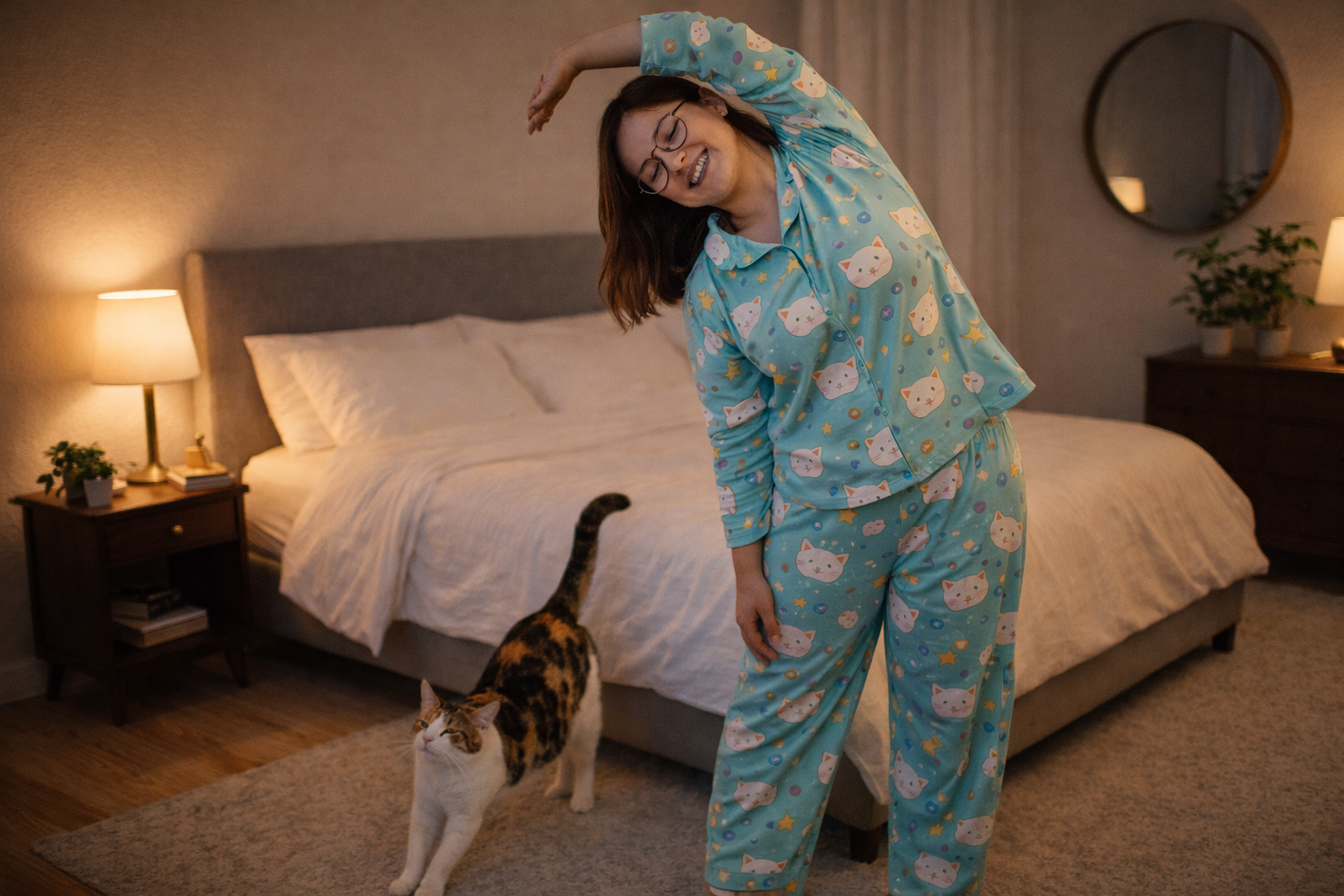
The Easiest Way to Start light stretching before bed
A lot of bedtime habits sound good until you are actually living your normal life.
You picture a calm evening. Soft lighting. Phone put away. Maybe a neat little yoga mat rolled out in a spotless bedroom. Then real life shows up instead. The dishes are still there, your shoulders feel tight from sitting all day, and somehow you are standing in the kitchen at 10:47 p.m. wondering where the evening went.
That is usually why light stretching before bed never starts.
Not because it is a bad idea. Mostly because people imagine it as a whole routine instead of a very small one. They think it has to be long enough to count, structured enough to be “done right,” or relaxing enough to look like something from a wellness ad. But most habits stick for a much less glamorous reason: they are easy to begin on an ordinary night.
That is the real trick with bedtime stretching. It should feel almost too simple.
You are not trying to become a different person by tomorrow. You are just trying to make the last part of the day feel a little looser, a little quieter, and maybe a bit less creaky when you get into bed. If that happens in five minutes next to your bed, in old pajama pants, while your hair is half-dry, that still counts.
This kind of stretching is not about pushing flexibility or doing dramatic poses. It is more like giving your body a small signal that the day is winding down.
And for a lot of people, that works better than aiming for a perfect nighttime routine that never quite happens.
Why bedtime stretching feels harder than it should
On paper, stretching before bed sounds easy. In practice, bedtime is when people have the least extra energy.
By that point, you may already feel mentally done. Even pleasant tasks can feel like one more thing. That is why people skip habits they technically want to do. Not because they do not care, but because the setup feels bigger than the habit itself.
Stretching also has a branding problem. People tend to picture formal exercise. A class. A mat. Matching activewear. A sequence you are supposed to remember. If you are tired, stiff, or not naturally drawn to fitness routines, that picture can make stretching feel weirdly high-effort.
Then there is the other issue: some people assume they need to be flexible first.
They do not.
Light stretching before bed is actually a pretty forgiving habit. It can be messy. You can do the same three moves every night. You can forget the names of things. You can yawn halfway through. None of that ruins it.
What usually helps is lowering the bar enough that your brain stops resisting it.
The easiest way to start: make it a “two-minute landing,” not a workout
If you only take one idea from this article, let it be this: bedtime stretching works better when you treat it like a landing, not a performance.
A landing is short. Familiar. Low pressure. Something that helps you settle a little before sleep.
That means your first version does not need to be 20 minutes. Honestly, for most people, that would be the wrong place to start. It is much easier to build a habit around two to five minutes than around a long routine you already resent by day three.
Think of it this way. If you can stand beside the bed and do a few gentle movements before lying down, you already have a real bedtime stretching habit. It does not need extra decoration.
A good starting question is not, “What is the best full stretching routine for sleep?”
It is, “What feels simple enough that I might actually do it tonight?”
That question tends to lead to better answers.
What “light stretching” should actually feel like
This matters, because a lot of people accidentally make bedtime stretching too intense.
At night, stretching should feel easy and mild. Not ambitious. Not painful. Not like you are trying to force your body into cooperation after a long day.
A light stretch usually feels like:
gentle pulling, not sharp discomfort
steady breathing, not strain
positions you can enter without a lot of setup
enough movement to reduce stiffness, not enough to feel wound up
If a stretch makes you clench your jaw, hold your breath, or feel like you are auditioning for an acrobat role you never wanted, it is probably too much for bedtime.
This is especially true if you already feel tired. The last thing most people need before bed is a mini fitness challenge disguised as relaxation.
The body areas that usually need the most help at night
You do not need to stretch every muscle in a perfect order. It is much more useful to focus on the spots that tend to feel tight from regular daily life.
For a lot of people, those are pretty predictable.
Neck and shoulders
These take a beating from laptop use, phone use, driving, stress, and just existing in a slightly tense way all day. A simple shoulder roll or gentle neck stretch often feels immediately useful.
Upper back and chest
If you spend hours leaning forward, your chest and upper back often feel stiff in that dull, familiar way that is hard to ignore once you lie down.
Hips
Long sitting tends to show up here. Even people who do not think of themselves as “tight” often notice their hips feel less cooperative by evening.
Lower back
Not everyone should stretch the lower back aggressively, but gentle movement here can feel good, especially when paired with hips and hamstrings.
Calves and legs
If you stand a lot, walk a lot, or just end the day with that heavy-leg feeling, a quick calf or hamstring stretch can help you feel less wound up.
That is already enough. You do not need a head-to-toe flexibility plan.
A very simple bedtime stretching routine that feels doable
Here is a beginner-friendly routine that works well for ordinary nights. It is short, requires no equipment, and does not ask you to become a yoga person by surprise.
Hold each stretch gently for about 20 to 30 seconds, or just a few slow breaths if you prefer that better.
1. Shoulder rolls and neck release
Start standing or sitting on the edge of the bed.
Roll your shoulders up, back, and down a few times. Then gently tilt your head toward one shoulder, pause, and switch sides. No pulling hard with your hand. Just enough to soften some of the tension.
This is a good opening move because it feels accessible even if your energy is low.
2. Chest opener
Stand and lightly clasp your hands behind your back, or simply place your hands on your hips and open the chest a little. Lift through the front of the body without turning it into a dramatic backbend.
If you have been hunched over screens all day, this one tends to feel especially nice.
3. Side stretch
Reach one arm overhead and lean slightly to the opposite side. Then switch.
This is one of those stretches that looks basic but often feels better than expected, especially if your torso feels compressed from sitting.
4. Gentle forward fold or seated fold
You can do this standing with bent knees or sitting on the bed with your legs comfortably placed in front of you. The point is not to touch your toes. The point is to let your back and legs lengthen a little without straining.
Bent knees are completely fine here. More than fine, actually. They often make the stretch feel much kinder.
5. Figure-four hip stretch
Sit on the bed or lie down and cross one ankle over the opposite knee. Stay there, or gently draw the legs in if that feels comfortable.
A lot of people do not realize how much their hips need this until they try it.
6. Knees-to-chest or gentle spinal twist
Lie on your back and pull one or both knees in gently. Or let your knees fall to one side for a soft twist.
This is a nice closing move because it feels restful without asking much from you.
That is it. That is already a complete routine.
Not flashy. Not advanced. Very usable.
How to make it easier to actually do every night
This is where habits either settle in or disappear.
A bedtime stretching habit usually sticks when it is connected to something that already happens. It usually fails when it relies on vague good intentions.
So instead of saying, “I should stretch more before bed,” attach it to a specific moment.
It also helps to remove any setup that makes the habit feel formal. If getting out a mat is a barrier, skip the mat. If changing clothes feels annoying, stretch in what you are already wearing. If the bedroom floor is cold and unappealing, do part of the routine on the bed.
You are not trying to impress anyone. You are trying to make the habit friction-free.
Why doing less works better at first
People are often weirdly suspicious of small habits.
They think five minutes is not enough to matter, so they either aim for 20 minutes or skip it entirely. But a short bedtime routine has one huge advantage: it fits into real life.
A two-minute stretch on a busy Tuesday still happens. A 25-minute ideal routine often does not.
And once a short routine becomes normal, it is easy to add to it if you want. The reverse is much harder. It is difficult to stay consistent with a long routine you never had the energy for in the first place.
This is true for people who are tired parents, office workers with late dinners, students, night shower people, and anyone whose evenings tend to unravel a little. Small habits survive messy schedules better.
Sometimes the best version of bedtime stretching is not the most complete one. It is the one you still do when the day was annoying.
Common mistakes that make bedtime stretching harder
A few things tend to trip people up.
Starting with stretches that are too intense
If you jump straight into deep hamstring stretches, long holds, or anything that feels athletic, your body may tense up instead of settling down.
Bedtime is usually a better time for gentle, familiar movements.
Treating it like a pass-or-fail habit
If you miss one night, nothing is ruined. If you only do two stretches, that still counts. People often quit habits because they imagine the “real” version has to be complete every time.
That kind of thinking is not very useful at 11 p.m.
Waiting for the perfect mood
You may not feel inspired to stretch at night. That is normal. Most habits are not powered by inspiration anyway. They happen because the version is easy enough to start without a speech.
Doing it too late when you are already half asleep
This sounds minor, but it matters. If you wait until the exact second your body shuts down, even two minutes can feel annoying.
It often works better to stretch a little earlier in the wind-down process, while you still have a sliver of energy left.
What bedtime stretching can realistically help with
It is helpful to keep expectations normal.
Light stretching before bed may help you feel less stiff. It can ease some tension from sitting or screen time. It can also create a smoother transition between “still doing stuff” and “trying to sleep.” For some people, that shift is half the value.
It may also make lying down feel more comfortable, especially if your hips, shoulders, or lower back usually complain once the day slows down.
What it probably will not do is solve every sleep issue or undo a whole day of stress in four minutes. It does not need to.
A lot of useful habits are valuable because they improve the edges of the day, not because they perform miracles.
Realistic versions for different kinds of nights
Not every evening feels the same, so it helps to have flexible options.
On a very tired night
Do just three things:
shoulder rolls
figure-four stretch
knees-to-chest
That is plenty.
On a stiff “I sat too much” night
Try:
chest opener
side stretch
forward fold
hip stretch
On a restless night
Keep the movements slow and stay on the bed:
neck release
seated fold
knees-to-chest
gentle twist
You do not have to force the same routine every time. Having a few versions makes the habit feel more human and less rigid.
A simple checklist for getting started this week
If you want this to become real, keep the starting plan almost boring.
Tonight
Pick three stretches only.
Tomorrow
Do them again in the same order.
For the rest of the week
Attach them to one bedtime cue, like brushing your teeth or putting your phone on charge.
That is enough to establish the shape of the habit.
You can always add a couple more stretches later. But keeping it simple at the beginning gives the routine a much better chance of surviving actual weekdays.
When to ease up or get advice
Light stretching should feel gentle. If something causes pain, numbness, dizziness, or sharp pulling, back off. If you have an injury, ongoing back pain, joint problems, or anything that makes movement complicated, it is smart to be more cautious and get guidance from a qualified professional.
There is no prize for forcing a stretch that your body clearly hates.
The best bedtime stretching routine is the one that feels easy to return to
That is really what matters in the long run.
Not the most impressive routine. Not the longest one. Not the one with the best name or the prettiest sequence. Just the one that fits into your real evening without making you negotiate with yourself every night.
Maybe it is four stretches beside the bed. Maybe it is a short routine done half on the rug and half sitting on the mattress. Maybe it becomes one of those habits that quietly makes evenings feel a little better without demanding much attention.
That is usually how the good routines work.
They do not take over your life. They just make the end of the day feel a bit softer, and a bit easier to settle into.
Hi, I’m the creator and editor behind ZestyHabit. I research everyday safety, first aid, and practical wellness topics using official guidance and reliable public sources, then turn that information into clear, realistic steps for daily life.
My goal is to help readers make safer, better-informed choices at home and beyond.