
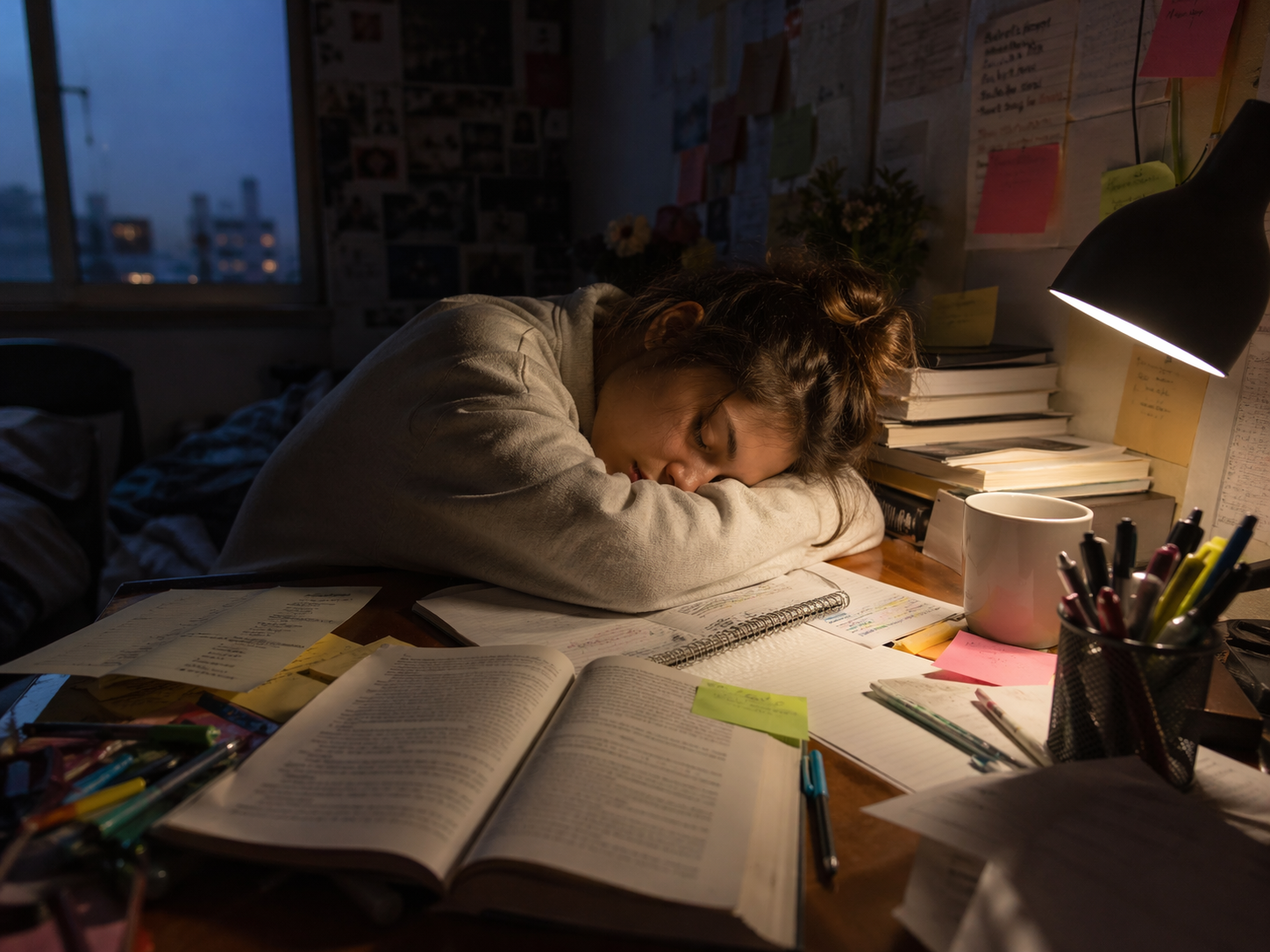

Exam season can wreck your sleep before you even notice it. This practical guide explains how to protect your rest with simple habits that actually fit real student life.
There is something about exam season that makes people start negotiating with sleep like it is an optional hobby.
You stay up “just for tonight.” Then the next night stretches too. Then suddenly you are eating a late snack over your notes at 1:20 a.m., telling yourself this is temporary, while your brain quietly turns into mashed potatoes.
Most students already know sleep matters. That is not really the problem. The problem is that during exams, sleep starts to feel like the easiest thing to borrow from. You cannot magically create more hours in the day, so people shave time off the night and hope adrenaline will cover the gap.
Sometimes it sort of works for a day or two. That is what makes the habit dangerous.
The hard part is that exam-period sleep advice is often either too strict or too unrealistic. It sounds nice in theory to keep a perfect bedtime, drink herbal tea, stop screens two hours early, and become the kind of person who is peacefully asleep by 10. But that is not how most people live when deadlines, review sessions, anxiety, and group chats are all happening at once.
What actually helps is something simpler. You do not need a flawless routine. You need a way to protect the core of your sleep, even when life gets messy for a couple of weeks.
That difference matters.
Why exam season wrecks sleep so easily
Sleep usually does not fall apart because of one dramatic decision. It slips.
You study a little later because you started late. Then you scroll because your brain is wired. Then you worry because you are still awake. Then you sleep badly because you are worried. Then the next day you drink more caffeine to stay functional. By evening you are exhausted but restless, which is a very annoying combination, and the cycle keeps going.
Exams also mess with your sense of time. A normal week has edges to it. Meals happen at roughly the same times. You go places. Other people are awake. There is a bit of structure built into the day whether you are disciplined or not.
Exam weeks blur. You might study in your room, snack at weird hours, skip daylight, and convince yourself that 11 p.m. is basically afternoon because you still have three chapters left.
That is why “just try to sleep more” is not very useful advice. People need something more specific than that.
The real goal is not perfect sleep. It is protected sleep.
This is the part that makes the whole thing more doable.
Trying to create an ideal sleep routine during exams can backfire because it feels too far away from your real life. The more perfect the routine sounds, the easier it is to give up by day two.
A better target is protected sleep.
That means you pick the part of sleep that matters most and defend it first. Not every detail. Just the base.
For most people, the easiest place to start is this: keep your wake-up time as steady as possible, and protect a minimum sleep window before exams.
That one shift is much more realistic than trying to become a completely different person overnight.
A stable wake-up time keeps your days from drifting into chaos. A minimum sleep window keeps you from sliding into those “I’ll just sleep four hours and power through” decisions that feel brave at midnight and awful the next morning.
Start with the easiest rule: do not let sleep become the emergency fund
People treat sleep like spare cash. Whenever something goes wrong, they pull from it.
Started studying late? Borrow from sleep.
Need one more hour? Borrow from sleep.
Feeling behind? Borrow from sleep again.
The problem is that sleep is not a harmless backup account. You do not just lose rest. You lose focus, patience, memory, and emotional stability at the exact time you need those things.
So the first practical rule is simple: stop using sleep as the first sacrifice.
That may sound obvious, but in real life it helps to make the rule very plain. When your study plan is off track, the automatic fix should not be “sleep less.” It should be one of these:
- cut lower-priority material
- do a shorter review session
- study earlier the next day
- accept that today’s plan was too ambitious
- go in better rested rather than squeezing in panicked late-night reading
That last one is hard for people to accept, especially high achievers. But a tired hour of studying is often much weaker than people admit. You can stare at the same paragraph six times and call it discipline when it is really just fatigue in a hoodie.
The easiest habit that helps most: keep the same morning anchor
If there is one habit that does the most work with the least drama, it is having a consistent get-up time.
Not a fantasy one. A real one.
If you usually wake up at 7:00, do not suddenly decide exam season is your chance to reinvent yourself as a 5:00 a.m. person. That kind of plan sounds noble for about eight minutes.
Pick a wake-up time you can keep even when you are stressed. Then keep coming back to it.
Why morning and not bedtime? Because bedtime gets pushed around more easily. Finishing a chapter, taking a late shower, texting a classmate, doom-scrolling because you are too tired to think clearly, all of that can delay sleep. Wake-up time is usually easier to pin down.
A morning anchor also stops the classic exam-season drift where one late night becomes two, then three, and soon you are sleeping from 3:30 a.m. to 10:45 a.m. and wondering why your whole body feels off.
Even if the night before was not great, getting up around the same time helps reset the next day. It is not magic, but it keeps one bad night from becoming a weird week.
Build a “minimum sleep line” before you get desperate
This helps more than people expect.
Do not wait until 1 a.m. to decide how little sleep is acceptable. That decision gets worse the later it gets. Tired brains are terrible negotiators.
Set a minimum sleep line ahead of time.
Maybe for you that means, “During exam week, I do not go below six and a half hours unless something truly unusual happens.” Maybe it is seven. Maybe it is a little more. The exact number is less important than the fact that you chose it in advance, while thinking clearly.
Once you have that line, use it as a hard stop. If you need to get up at 7:00 and your minimum is six and a half hours, then 12:30 becomes the latest reasonable bedtime. Not ideal. Just protected.
This works because it removes some of the emotional bargaining. You do not keep reopening the case every half hour.
Without that line, students tend to say things like, “I’ll sleep in ten minutes,” four times in a row.
Why late-night studying feels productive even when it often is not
Part of the trap is emotional. Studying late can feel serious.
The house is quiet. Your lamp is on. Your notes are everywhere. You are suffering a little, which makes it seem meaningful. There is a certain exam-season theater to it.
Sometimes late-night studying is genuinely necessary. But a lot of it is just inefficient studying wrapped in urgency.
At night, people are more likely to reread passively, highlight random lines, panic-search topics, or bounce between tasks without retaining much. You may spend two hours “studying” and end up with very little that actually sticks.
That does not mean you should never study at night. It just means you should be honest about what kind of study works at that hour.
If it is already late, lighter tasks are often better:
- reviewing flashcards
- organizing tomorrow’s topics
- skimming summaries
- writing a short checklist for the morning
- doing low-stress recap instead of brand-new hard material
This gives your brain an off-ramp. It is much easier to stop after a manageable review block than after telling yourself you are about to fully relearn an entire unit at midnight.
The bedtime routine does not need to be pretty. It needs to be short and repeatable.
People hear “bedtime routine” and imagine a whole wellness performance.
It does not have to be that.
During exams, a useful wind-down routine can be embarrassingly plain. In fact, plain is good. Fancy routines tend to disappear the minute you get busy.
A very workable version might be:
30 to 45 minutes before bed
Stop doing the most mentally intense studying.
20 minutes before bed
Set out what you need for tomorrow: notes, pens, charger, clothes, bag, whatever reduces morning friction.
10 minutes before bed
Wash up, dim the lights a bit, and stay off anything likely to pull you into a spiral.
That is enough.
You are not trying to become serene. You are trying to signal to your brain that the day is ending and there is nothing urgent left to solve tonight.
That last part matters. A lot of bedtime stress during exams is not about the exam itself. It is about the feeling that you are forgetting something.
What to do when your brain refuses to shut up
This is probably the most common problem. You lie down, and suddenly your mind becomes a very active little raccoon.
You remember three topics you still do not know. You think about the exam schedule. You wonder whether you have wasted the semester. You replay something your professor said two weeks ago. Very relaxing.
Trying to force yourself not to think usually makes it worse.
A better move is to give the thoughts a place to go before bed. Keep paper nearby and do a quick brain dump. Nothing fancy. Just write:
- what I need to review tomorrow
- what I am worried about
- what time I need to get up
- one or two concrete next steps for the morning
That helps because your brain stops trying so hard to hold everything in active memory. It no longer has to keep shouting, “Do not forget this.”
Some people also do well with a short reset phrase, something ordinary like: “I have a plan for tomorrow. I do not need to solve it tonight.”
A little corny? Maybe. Still useful.
Caffeine gets weird during exams
Exam season turns a lot of people into amateur chemists.
Morning coffee becomes morning coffee plus afternoon coffee plus a convenience-store drink plus whatever somebody handed you in the library. Then you wonder why you are tired and jittery at the same time.
Caffeine is not the enemy. Wild caffeine timing is the problem.
If you are trying to protect sleep, the simplest practical move is to cut off caffeine earlier than your stressed self wants to. Not because you are weak. Because the half-life does not care about your good intentions.
For a lot of people, having caffeine later in the afternoon starts causing trouble at night, even if they insist they are “used to it.” Maybe they do fall asleep, but the sleep feels lighter, more broken, or less refreshing.
A decent exam-week rule is to use caffeine early and on purpose instead of constantly and randomly. Drink it when it will actually help. Do not sip it all day like a personality trait.
Naps can help, but they can also quietly sabotage the night
A short nap after terrible sleep can be useful. The issue is when naps turn into accidental second sleeps.
You lie down at 5 p.m. “for twenty minutes,” wake up at 7:10, feel groggy, eat something strange, and now your real bedtime is floating out to 2 a.m.
If you are going to nap during exams, keep it short and avoid doing it too late in the day if you can. A brief nap can take the edge off. A long late one can steal from the upcoming night.
This is especially true if your sleep has already become fragile.
Protect the night before the exam more than the others
If you cannot do everything well, prioritize this.
Students often treat the night before the exam like their final chance to save themselves. That mindset leads to marathon studying, panic, and terrible sleep at exactly the wrong time.
The night before should be lighter than the days before it, not heavier.
At that point, your job is not to conquer the entire subject. It is to keep your brain usable. Review summaries. Look over high-yield material. Check logistics. Pack what you need. Then stop.
It is very hard to walk away when you feel unprepared. I get that. But there is a point where extra late-night effort stops helping and starts stealing from the version of you that actually has to take the exam.
That version needs sleep more than it needs one more frantic reread.
A simple exam-week sleep plan that real people can follow
If you want a low-drama version, try this:
Pick one wake-up time
Keep it roughly the same all week.
Set a minimum sleep line
Choose your absolute latest bedtime based on how much sleep you need to stay functional.
Stop heavy studying before bed
Use the last stretch of the night for lighter review or setup.
Do a two-minute brain dump
Write tomorrow’s priorities down so your mind does not keep carrying them.
Use caffeine earlier
Do not keep topping it up deep into the day.
Treat the night before the exam as protected
That night is for staying steady, not heroic.
This is not a perfect plan. It is a survivable one. And survivable plans are usually the ones people actually follow.
If your sleep is already a mess, do not try to fix everything in one night
This is another common mistake. People realize their schedule has drifted, panic, and try to snap it back all at once.
They go from sleeping at 2:30 a.m. to forcing themselves into bed at 10:00 p.m., which mostly leads to lying there frustrated and feeling broken.
Usually it works better to steady the morning first, get some daylight early if you can, reduce caffeine chaos, and pull bedtime earlier gradually. Even a modest correction helps.
Also, if one night goes badly, try not to turn it into a story about how everything is ruined. That kind of thinking creates a second layer of stress that makes the next night worse too.
Bad nights happen during stressful weeks. The goal is recovery, not perfection.
Sleep is part of studying, even if it does not look like studying
This is the part students resist until they have lived through enough awful exam mornings.
Sleep feels passive, so people undervalue it. Notes, flashcards, practice problems, those all look like effort. Sleep just looks like lying there. But being rested affects how well you remember, how long you can focus, how patient you are with hard questions, and how likely you are to spiral when something on the exam looks unfamiliar.
That is not extra credit. That is the foundation.
You do not have to become a sleep expert during exam season. You really do not. You just need to stop treating rest like wasted time and start treating it like part of the preparation.
That shift alone changes a lot.
A calmer way to think about it
Exam weeks are never going to feel perfectly balanced. Some nights will be shorter. Some days will feel off. That does not mean you have failed at taking care of yourself.
The easiest way to start protecting sleep during exams is not by building a beautiful routine from scratch. It is by keeping one steady morning anchor, setting a minimum sleep line, and refusing to let late-night panic make every decision for you.
That is enough to make a real difference.
Not glamorous. Not dramatic. Just the kind of practical habit that helps you feel a little more like yourself when you need your brain most.
.

Hi, I’m the creator and editor behind ZestyHabit. I research everyday safety, first aid, and practical wellness topics using official guidance and reliable public sources, then turn that information into clear, realistic steps for daily life.
My goal is to help readers make safer, better-informed choices at home and beyond.


